
Positioning Cheat Sheet: The Right Position for 30 Situations
Most positioning questions come down to four rules: upright helps breathing, so anyone short of breath sits up; flat protects blood pressure, so anyone hypotensive or fainting lies flat, sometimes with legs raised; side-lying protects the airway, so anyone unconscious, seizing, or vomiting goes on their side; and you position toward pressure you want to apply or away from an area you want to protect. Learn the reasons and the handful of exceptions (compartment syndrome (keep at heart level, do not elevate) and autonomic dysreflexia (sit the client up)) rather than memorizing a list of unconnected facts.

Positioning and immobility: every position the exam asks about, why it is used, and the complications it prevents.
From the Intensive NCLEX Course. See the course; the full video library is part of Pro and Ultimate.
Positioning questions are free points if you learn the list. Most have one correct answer and a clear reason.
The general rules
Upright helps breathing. Anyone short of breath sits up.
Flat protects blood pressure. Anyone with low blood pressure or fainting lies flat, sometimes with legs raised.
Side-lying protects the airway. Anyone unconscious, seizing, or vomiting goes on their side.
Position toward the pressure you want to apply, or away from the area you want to protect.
If you forget a specific one, reason from these four.
The full list
| Situation | Position | Why |
|---|---|---|
| Trouble breathing (any cause) | High Fowler’s (sitting up) | Lets the lungs expand |
| Heart failure / pulmonary edema | High Fowler’s, legs dependent | Reduces fluid returning to the heart |
| COPD | Sitting up, leaning forward on a table (tripod) | Helps accessory muscles work |
| Asthma attack | Sitting upright | Eases breathing |
| Unconscious client | Side-lying (recovery) | Protects the airway |
| During a seizure | Side-lying if possible | Lets secretions drain |
| Vomiting | Side-lying or upright | Prevents aspiration |
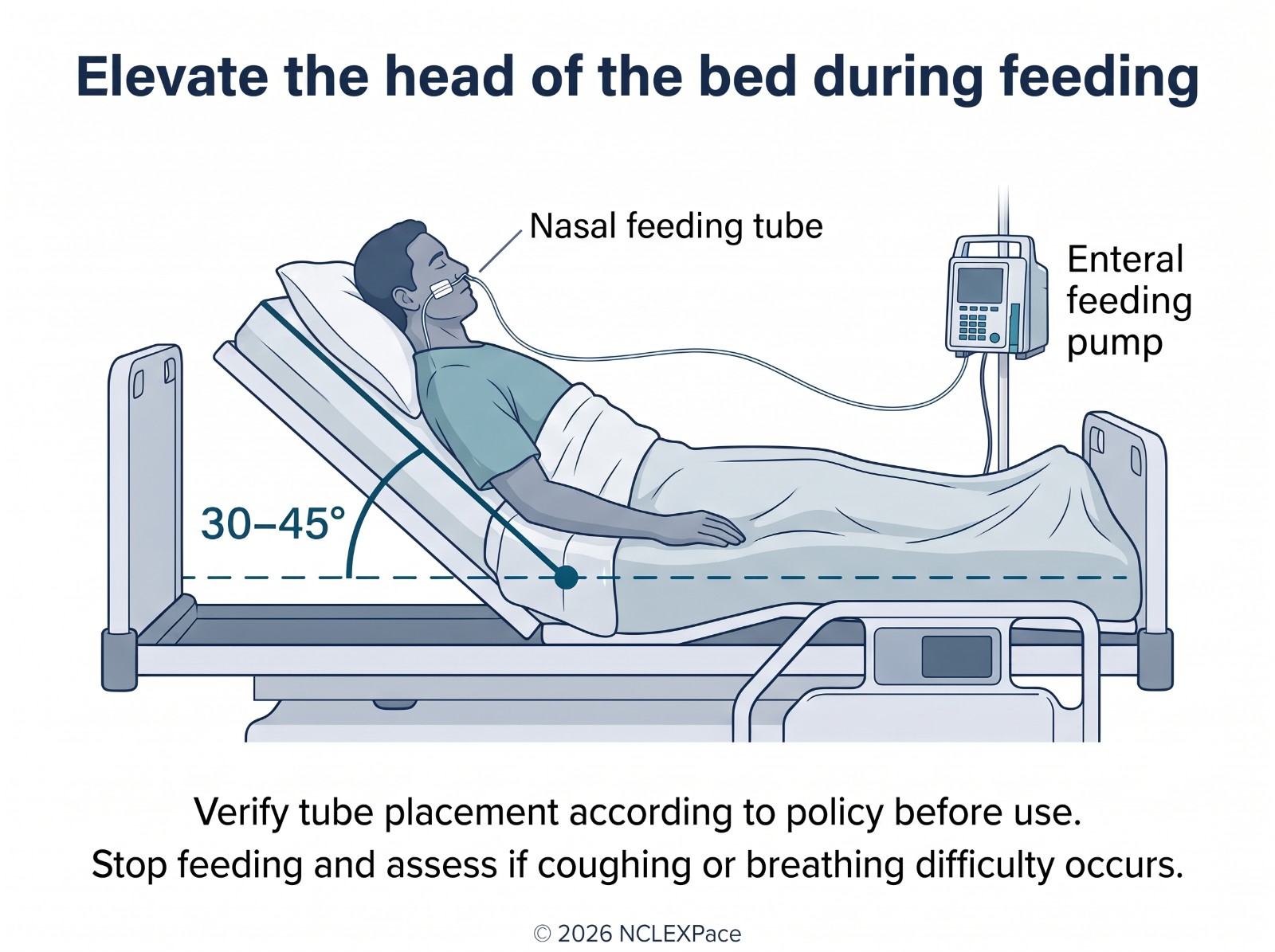
| Tube feeding | Head of bed elevated at least 30 degrees, and for a period after | Prevents aspiration |
| After a stroke, before a swallow check | Upright, nothing by mouth | Aspiration risk |
| Increased brain pressure | Head of bed about 30 degrees, head midline | Helps drainage from the brain |
| After a lumbar puncture | Flat, several hours | Reduces headache |
| After a liver biopsy | Right side-lying | Applies pressure to the site |
| After a bronchoscopy | Upright, NPO until gag reflex returns | Aspiration risk |
| After a cardiac catheter (groin) | Flat, leg straight | Prevents bleeding |
| Thoracentesis (during) | Sitting, leaning forward over a table | Opens the space between ribs |
| Chest tube in place | Semi-Fowler’s to Fowler’s | Aids drainage and breathing |
| After a lung removal (pneumonectomy) | Often on the operative side or back, as ordered | Protects the remaining lung |
| After a lobectomy | Usually not on the operative side, as ordered | Allows the remaining lung to expand |
| Shock / low blood pressure | Flat, legs elevated if appropriate | Sends blood to the core |
| Fainting | Flat with legs raised | Restores blood flow to the brain |
| Air embolism suspected | Left side-lying, head down | Traps air in the right side of the heart |
| After a total hip replacement | Abduction pillow, do not cross legs, do not bend past 90 degrees | Prevents dislocation |
| After a knee replacement | No pillow under the knee | Prevents a permanent bend |
| After an amputation | Elevate first 24 hours only, then flat; prone periods as ordered | Prevents contracture |
| Compartment syndrome | Keep at heart level — do NOT elevate | Elevation reduces blood flow further |
| Autonomic dysreflexia | Sit the client UP | Lowers blood pressure immediately |
| After thyroid surgery | Semi-Fowler’s, neck supported, avoid bending the neck | Protects the suture line and airway |
| After a cataract or eye surgery | Semi-Fowler’s, avoid lying on the operative side, avoid bending or straining | Protects the eye |
| After a mastectomy | Affected arm elevated on a pillow | Reduces swelling |
| Pancreatitis | Side-lying with knees drawn up, or leaning forward | Eases pain |
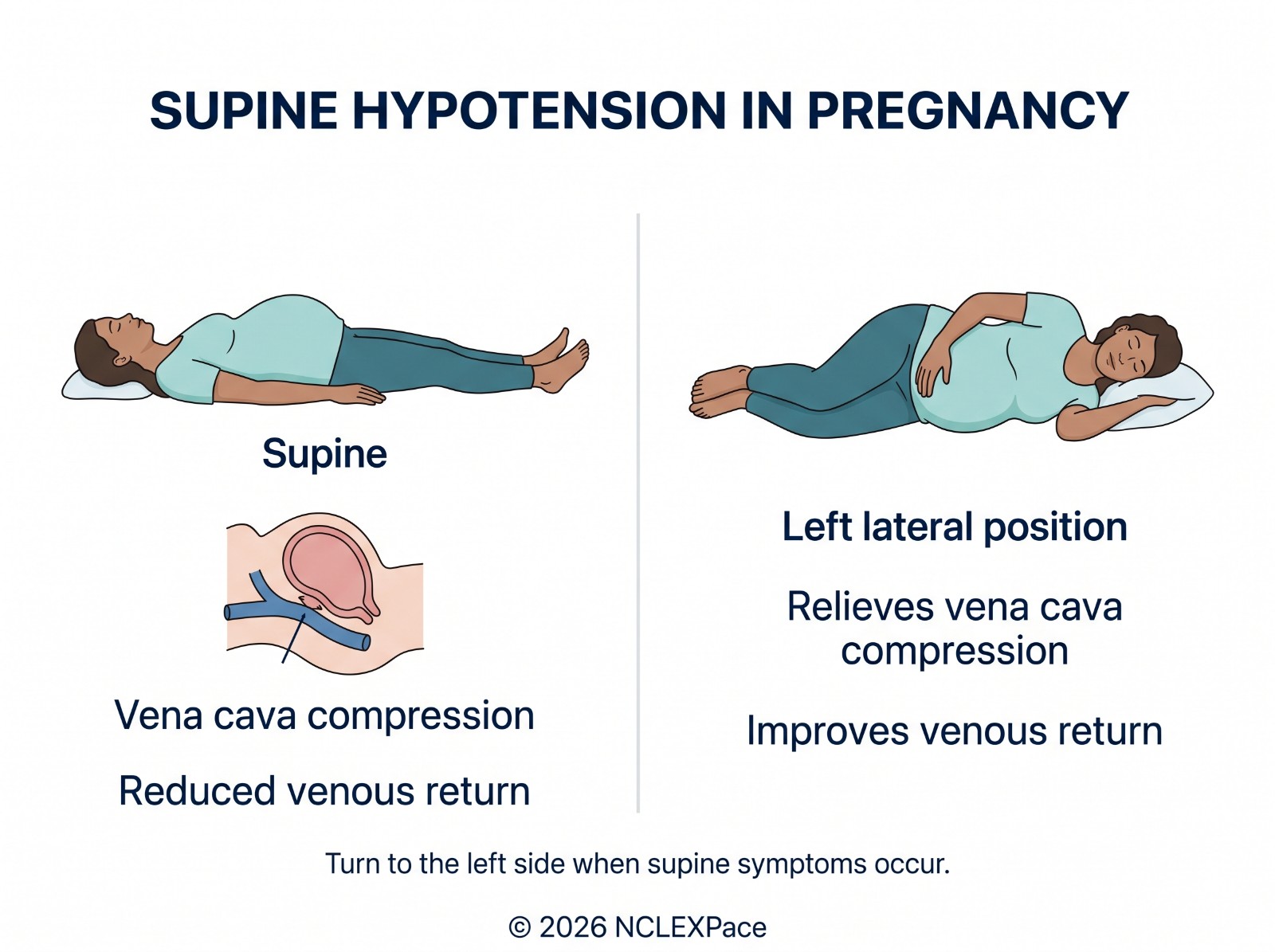
| Late pregnancy | Left side-lying | Improves blood flow to the placenta |
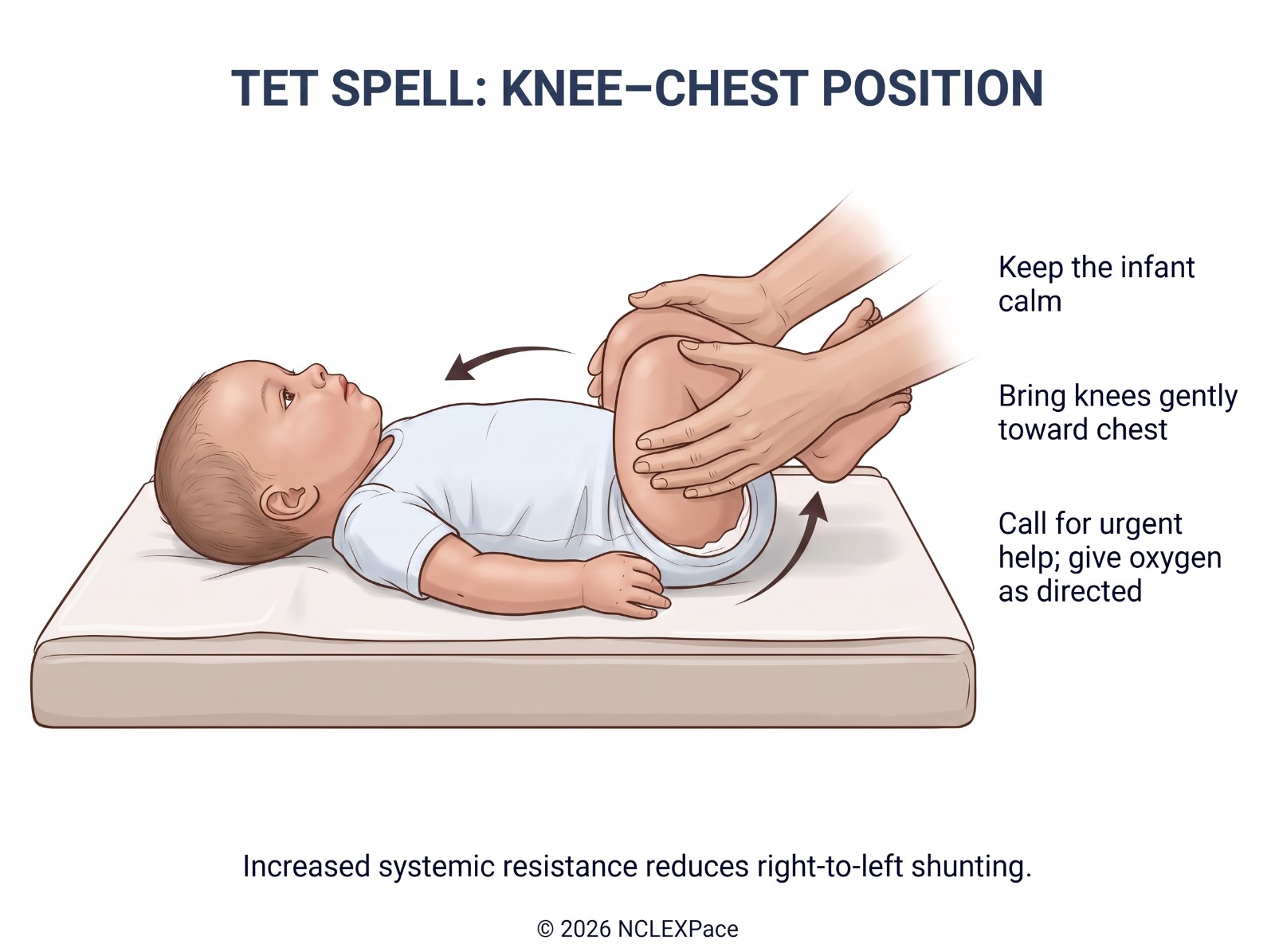
| Umbilical cord prolapse | Knee-chest or Trendelenburg | Takes pressure off the cord |
| After a rectal or perineal procedure | Side-lying or prone as ordered | Comfort and reduces pressure |
| Enema or rectal medication | Left side-lying | Follows the shape of the colon |
| Nasogastric tube insertion | Sitting up, chin to chest when swallowing | Directs the tube into the esophagus |
| Postural drainage | Varies by lung segment; head lower for lower lobes | Uses gravity to move secretions |
| Client with one weak side | Approach and place items on the strong side (unless retraining) | Safety and function |
The ones tested most
If you learn only ten, learn these:
- Trouble breathing → sit up
- Unconscious → side-lying
- Shock → flat, legs up
- Increased brain pressure → head of bed 30 degrees, head midline
- After lumbar puncture → flat
- After liver biopsy → right side
- Air embolism → left side, head down
- Autonomic dysreflexia → sit up
- Compartment syndrome → heart level, do not elevate
- Cord prolapse → knee-chest
The two that surprise people
Compartment syndrome: do NOT elevate. Elevation is right for ordinary swelling and wrong here, because it reduces blood flow to a limb that is already starved.
Autonomic dysreflexia: sit UP. Most emergencies with high blood pressure get positioned flat. This one is the opposite — sitting up lowers the blood pressure immediately, and that is the point.
How to study this
Do not memorize a list of 30 unconnected facts.
Group them by the reason:
- Airway protection → side-lying
- Breathing → upright
- Blood pressure → flat with legs up
- Pressure on a site → lie on that side
- Protect a repair → avoid that side, avoid bending
Then learn the handful of exceptions that do not fit the pattern.
Positioning orders vary by surgeon, procedure, and facility. Follow the specific order given.
5 NCLEX practice questions on this topic
The same questions, player and partial-credit scoring students use inside NCLEXPace: answer, submit, read the full rationale, then Next. Your score is waiting at the end. No account needed for these.
A free account opens 20 more questions, a case study, a video and a cheat sheet. The full bank has 3,200+ questions with rationales, by topic.
Practice more, free →Ready for the full bank? See NCLEXPace plans and prices: one payment for 1, 2, 3 or 6 months.
Frequently asked questions
Common follow-up questions on Body Systems & Clinical Content.
What are the general positioning rules?
Upright helps breathing, so anyone short of breath sits up. Flat protects blood pressure, so anyone with low blood pressure or fainting lies flat, sometimes with legs raised. Side-lying protects the airway, so anyone unconscious, seizing, or vomiting goes on their side. And you position toward the pressure you want to apply, or away from the area you want to protect. If you forget a specific one, reason from these four.
How should I position a client after a liver biopsy or lumbar puncture?
After a liver biopsy, place the client on the right side, which applies pressure to the site to stop bleeding. After a lumbar puncture, keep the client flat for several hours to reduce the headache from a spinal fluid leak. These are among the most commonly tested positioning points.
Which position is used for a suspected air embolism?
Left side-lying with the head down. This traps air in the right side of the heart, keeping it out of the circulation. It is one of the ten positions the article recommends learning even if you learn no others.
Why is compartment syndrome an exception to elevating a limb?
You keep the limb at heart level and do NOT elevate it. Elevation is right for ordinary swelling but wrong here, because it reduces blood flow to a limb that is already starved. This is one of the two positions that surprise people.
How is autonomic dysreflexia positioned differently from other high-blood-pressure emergencies?
You sit the client UP, which is the opposite of most high-blood-pressure emergencies that get positioned flat. Sitting up lowers the blood pressure immediately, and that is the point. It is a tested exception worth memorizing.
Sources and references
- Potter PA, Perry AG, Stockert PA, Hall AM. Fundamentals of Nursing. 10th ed. Elsevier; 2021; Chapter: Immobility.
- Potter PA, Perry AG, Stockert PA, Hall AM. Fundamentals of Nursing. 10th ed. Elsevier; 2021; Chapter: Patient Safety and Quality.
Reviewed by the NCLEXPace team, October 2026.
Keep reading


3,200+ NCLEX questions with think-like-a-nurse rationales, unfolding case studies and adaptive readiness exams. Start with free practice questions, then choose a plan when you are ready.
Create Free Account →