Neuro Map: Stroke, Increased ICP, Seizures, and Spinal Cord Injury
Neuro emergencies turn on a few decisive rules: a stroke gets a CT scan before any clot-dissolving treatment because that medication saves an ischemic stroke and kills a hemorrhagic one; the earliest sign of increased intracranial pressure is a change in level of consciousness, with Cushing's triad being a late and dangerous finding; and in autonomic dysreflexia you sit the client up first, then find the cause, usually a full bladder. During a seizure you protect the client, turn them side-lying, and time it, but never restrain them or put anything in the mouth.

Increased intracranial pressure and head injury: the signs in order, Cushing triad, positioning and the actions that lower the pressure.
From the Intensive NCLEX Course. See the course; the full video library is part of Pro and Ultimate.
Stroke
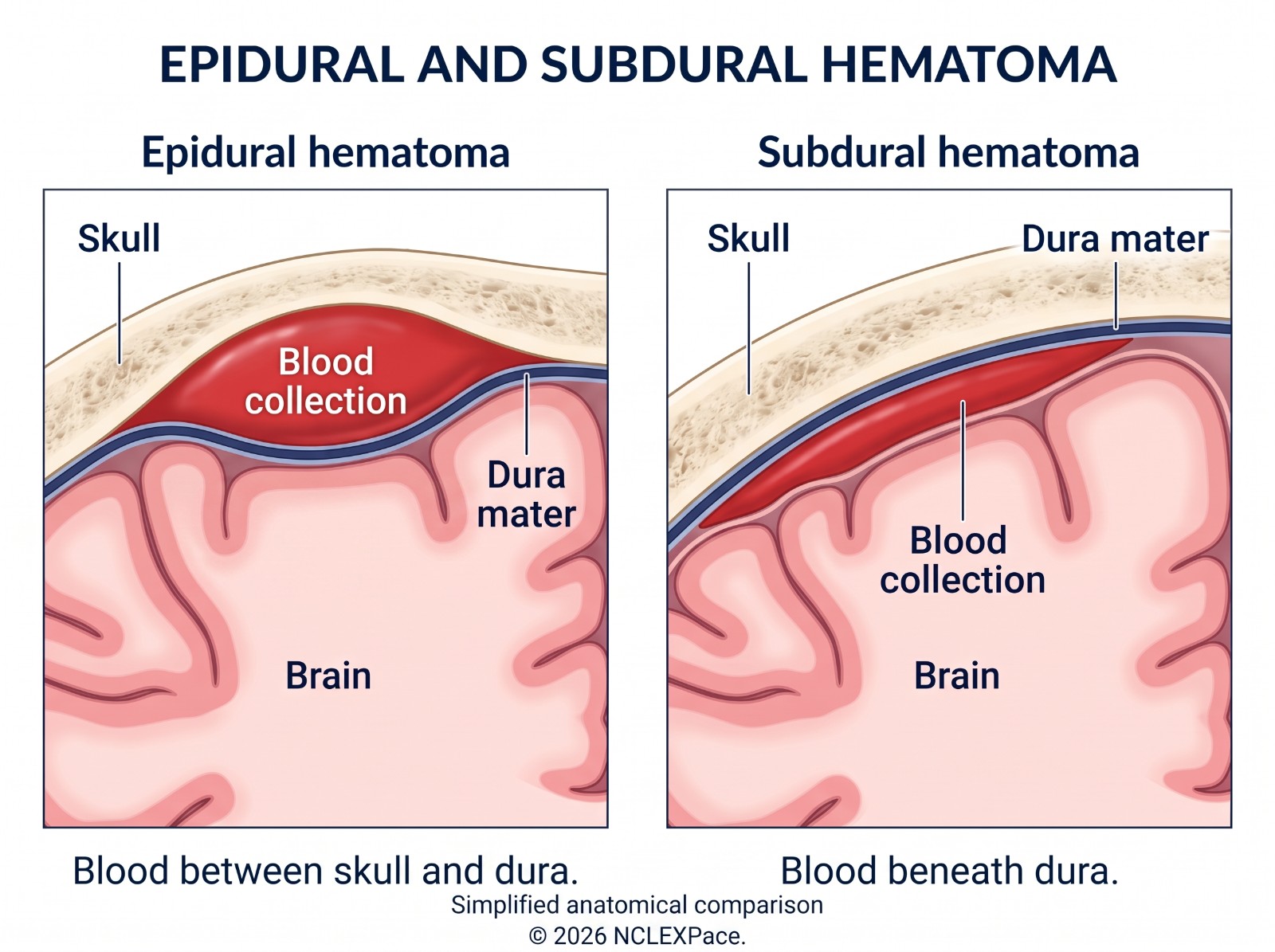
Two types, and telling them apart changes everything.
Ischemic — a clot blocks blood flow. Most strokes. Hemorrhagic — a vessel bleeds into the brain.
Why it matters: clot-dissolving medication saves the ischemic stroke and kills the hemorrhagic one.
So a CT scan comes before any clot-dissolving treatment. Always. This is heavily tested.
Recognizing a stroke — FAST:
- Face drooping
- Arm weakness
- Speech difficulty
- Time — note the time symptoms started
Time of onset is critical, because clot-dissolving treatment has a limited time window. “When was the client last seen normal?” is the key question.
Which side?
| LEFT brain stroke | RIGHT brain stroke |
|---|---|
| Right side weakness | Left side weakness |
| Speech problems (aphasia) | Speech usually intact |
| Slow, cautious behavior | Impulsive, poor judgment |
| Aware of deficits, often frustrated | Ignores the affected side (neglect) |
Memory aid: the brain controls the opposite side. Left brain = language.
Safety point: right brain stroke clients are often impulsive and unaware of their weakness, which makes them a high fall risk. They may try to get up alone.
Swallowing: check the swallow before giving anything by mouth. Aspiration is a major risk.
Increased intracranial pressure
What it is: pressure builds inside the skull. The skull cannot expand, so the brain is squeezed.
The earliest sign: a change in level of consciousness.
Restlessness, confusion, difficulty waking. This comes before everything else. Any change in consciousness in a head-injured client must be reported.
Later signs: headache, vomiting, pupil changes (one pupil larger or slow to react), weakness on one side, seizures.
Cushing’s triad — a LATE and dangerous sign:
- High blood pressure with a widening gap between the top and bottom numbers
- Slow heart rate
- Irregular breathing
This means the brain is being severely compressed. It is an emergency.
Nursing care:
- Head of bed elevated about 30 degrees
- Head and neck in a straight, midline position — turning or bending the neck blocks drainage
- Avoid anything that raises pressure: straining, coughing, vomiting, hip flexion
- Do not cluster care activities — space them out so pressure has time to recover
- Keep the room quiet and calm
- Prevent constipation
- Monitor neurological status closely
Seizures
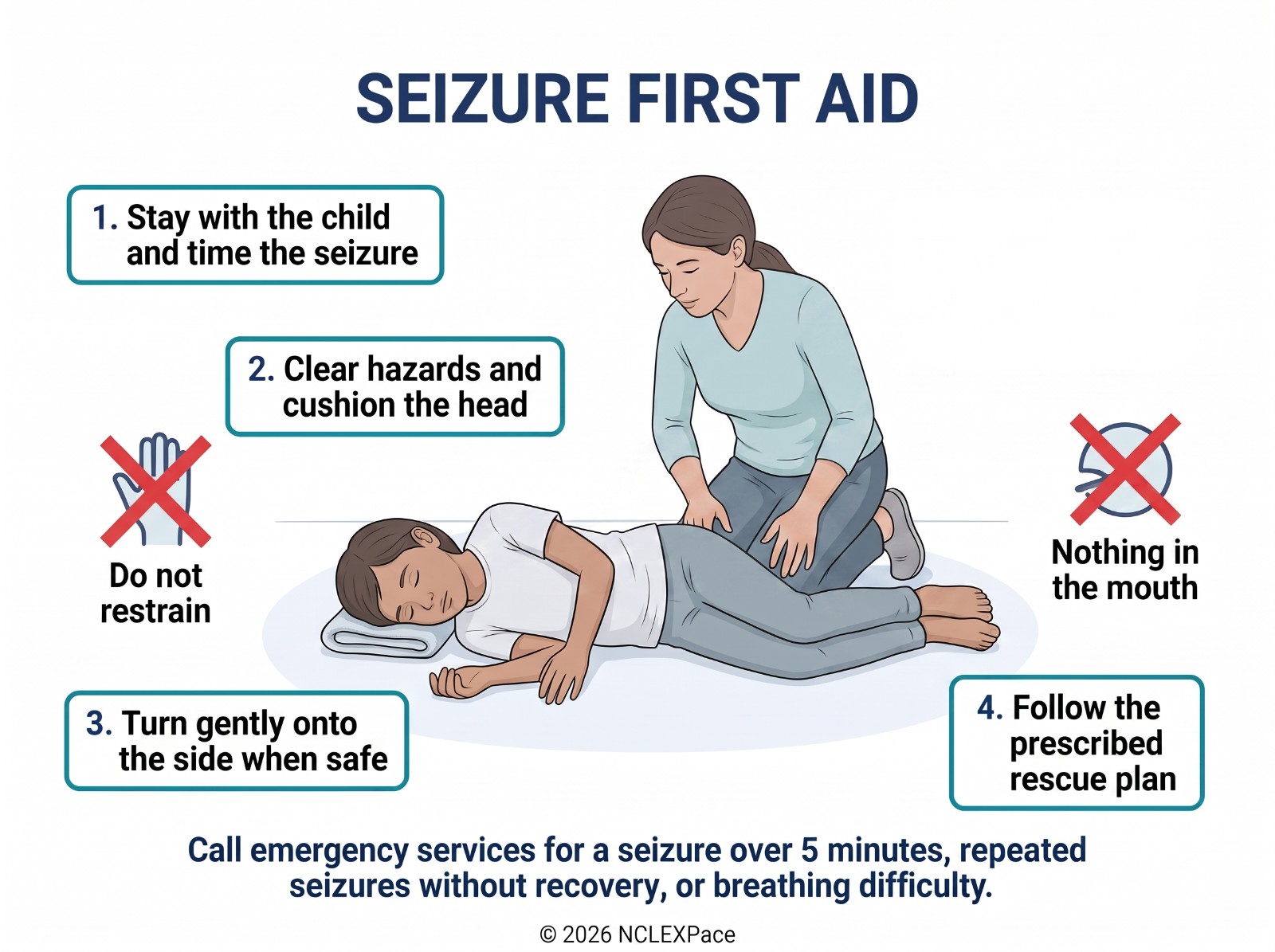
What you do during a seizure:
- Stay with the client
- Protect the head and clear the area
- Turn them on their side if possible, to keep the airway clear
- Loosen tight clothing
- Time the seizure
- Note what you see
What you never do:
- Never restrain the client
- Never put anything in the mouth
- Never move them unless they are in danger
After: stay with them, keep them on their side, allow rest, reorient gently, check for injuries, document.
Seizure precautions for at-risk clients: bed in the lowest position, side rails padded and up, suction and oxygen available, nothing in the mouth.
Status epilepticus — a seizure that will not stop or seizures without recovery between them. This is a medical emergency. Airway support and emergency medications.
Spinal cord injury
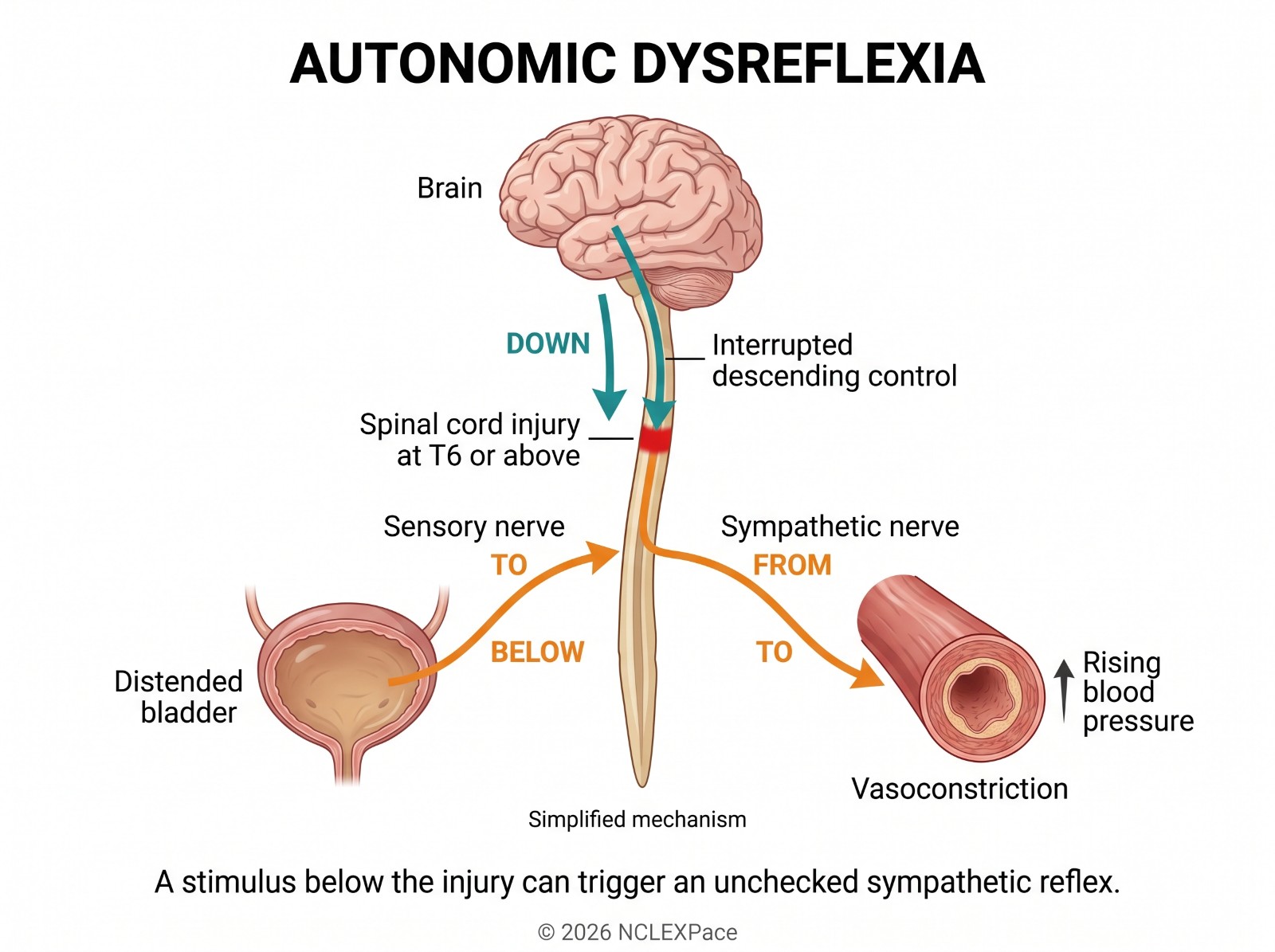
The emergency you must know: autonomic dysreflexia.
Who is at risk: clients with a spinal cord injury at about the level of the sixth thoracic vertebra or higher.
What you see:
- Sudden, severe high blood pressure
- Pounding headache
- Flushing and sweating above the level of injury
- Cool, pale skin below the injury
- Slow heart rate
- Nasal congestion, blurred vision, anxiety
What causes it: something irritating the body below the injury that the client cannot feel. The most common cause is a full bladder. Also constipation or impacted stool, a kinked catheter, tight clothing, a pressure injury, or skin irritation.
What you do — in this order:
- Sit the client upright — this lowers blood pressure right away
- Find and remove the cause — check the catheter for kinks first, then check for bladder distension, then bowel
- Loosen tight clothing
- Notify the provider
- Monitor blood pressure
Sitting up comes first. It is a nursing action that works immediately, and it is the tested answer.
This can cause a stroke or seizure if untreated. It is a true emergency.
The short version
- Stroke: CT before clot-dissolving treatment. Left brain = right weakness + speech problems. Right brain = left weakness + neglect + impulsive.
- Increased ICP: a change in consciousness is the earliest sign. Head of bed 30 degrees, head midline.
- Cushing’s triad = high BP with widening gap, slow pulse, irregular breathing = late and dangerous
- Seizures: protect, side-lying, time it. Never restrain, never put anything in the mouth.
- Autonomic dysreflexia: sit them UP first, then find the cause — usually the bladder
Stroke treatment windows and protocols follow current national guidelines and change periodically.
5 NCLEX practice questions on this topic
The same questions, player and partial-credit scoring students use inside NCLEXPace: answer, submit, read the full rationale, then Next. Your score is waiting at the end. No account needed for these.
A free account opens 20 more questions, a case study, a video and a cheat sheet. The full bank has 3,200+ questions with rationales, by topic.
Practice more, free →Ready for the full bank? See NCLEXPace plans and prices: one payment for 1, 2, 3 or 6 months.
Frequently asked questions
Common follow-up questions on Body Systems & Clinical Content.
Why must a stroke client have a CT scan before treatment?
Because clot-dissolving medication saves an ischemic stroke, where a clot blocks blood flow, but kills a hemorrhagic stroke, where a vessel bleeds into the brain. A CT scan tells the two apart, so it always comes before any clot-dissolving treatment. Time of onset also matters, because the treatment has a limited time window.
How do left-brain and right-brain strokes differ?
The brain controls the opposite side, so a left-brain stroke causes right-sided weakness plus speech problems (aphasia) and slow, cautious behavior, while a right-brain stroke causes left-sided weakness, impulsive behavior with poor judgment, and neglect of the affected side. Right-brain stroke clients are often impulsive and unaware of their weakness, which makes them a high fall risk. Check swallowing before giving anything by mouth because aspiration is a major risk.
What is the earliest sign of increased intracranial pressure?
A change in level of consciousness (restlessness, confusion, or difficulty waking) comes before everything else. Any change in consciousness in a head-injured client must be reported. Later signs include headache, vomiting, pupil changes, one-sided weakness, and seizures.
What is Cushing's triad and why does it matter?
Cushing's triad is high blood pressure with a widening gap between the top and bottom numbers, a slow heart rate, and irregular breathing. It is a late and dangerous sign that the brain is being severely compressed, and it is an emergency.
What do I do first for autonomic dysreflexia?
Sit the client upright first, because this lowers the dangerously high blood pressure right away. Then find and remove the cause (check the catheter for kinks first, then for bladder distension, then bowel) loosen tight clothing, and notify the provider. A full bladder is the most common cause, and untreated it can lead to a stroke or seizure.
Sources and references
- Harding MM, Kwong J, Hagler D, Reinisch C. Lewis's Medical-Surgical Nursing: Assessment and Management of Clinical Problems. 12th ed. Elsevier; 2023; Chapter: Stroke.
- Harding MM, Kwong J, Hagler D, Reinisch C. Lewis's Medical-Surgical Nursing: Assessment and Management of Clinical Problems. 12th ed. Elsevier; 2023; Chapter: Spinal Cord and Peripheral Nerve Problems.
- Powers WJ, et al. Guidelines for the Early Management of Patients With Acute Ischemic Stroke: 2019 Update. Stroke. 2019;50(12):e344-e418.
Reviewed by the NCLEXPace team, October 2026.
Keep reading



3,200+ NCLEX questions with think-like-a-nurse rationales, unfolding case studies and adaptive readiness exams. Start with free practice questions, then choose a plan when you are ready.
Create Free Account →