Bones and Muscles Map: Fractures, Casts, Traction, and Joint Replacement
The emergency to learn first in musculoskeletal care is compartment syndrome, where swelling inside a closed limb space cuts off blood flow; its earliest and most reliable sign is pain out of proportion that is not relieved by opioids, and you must not elevate above heart level or apply ice. Beyond that, know fat embolism after long-bone fractures, cast and traction rules, and hip replacement precautions.

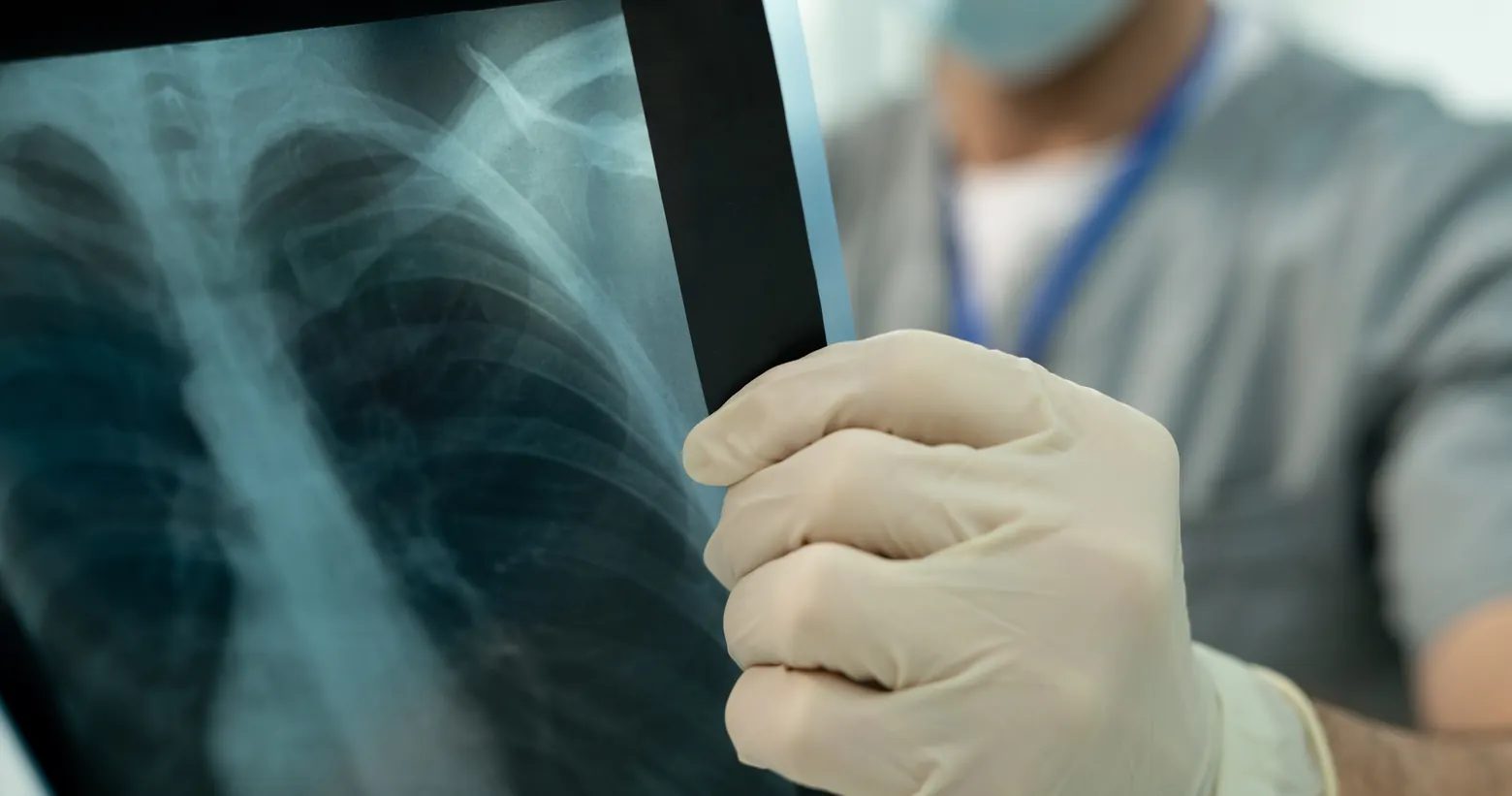
Fractures and cast care: neurovascular checks, compartment syndrome, fat embolism, and what the client is taught about the cast.
From the Intensive NCLEX Course. See the course; the full video library is part of Pro and Ultimate.
Compartment syndrome — learn this first
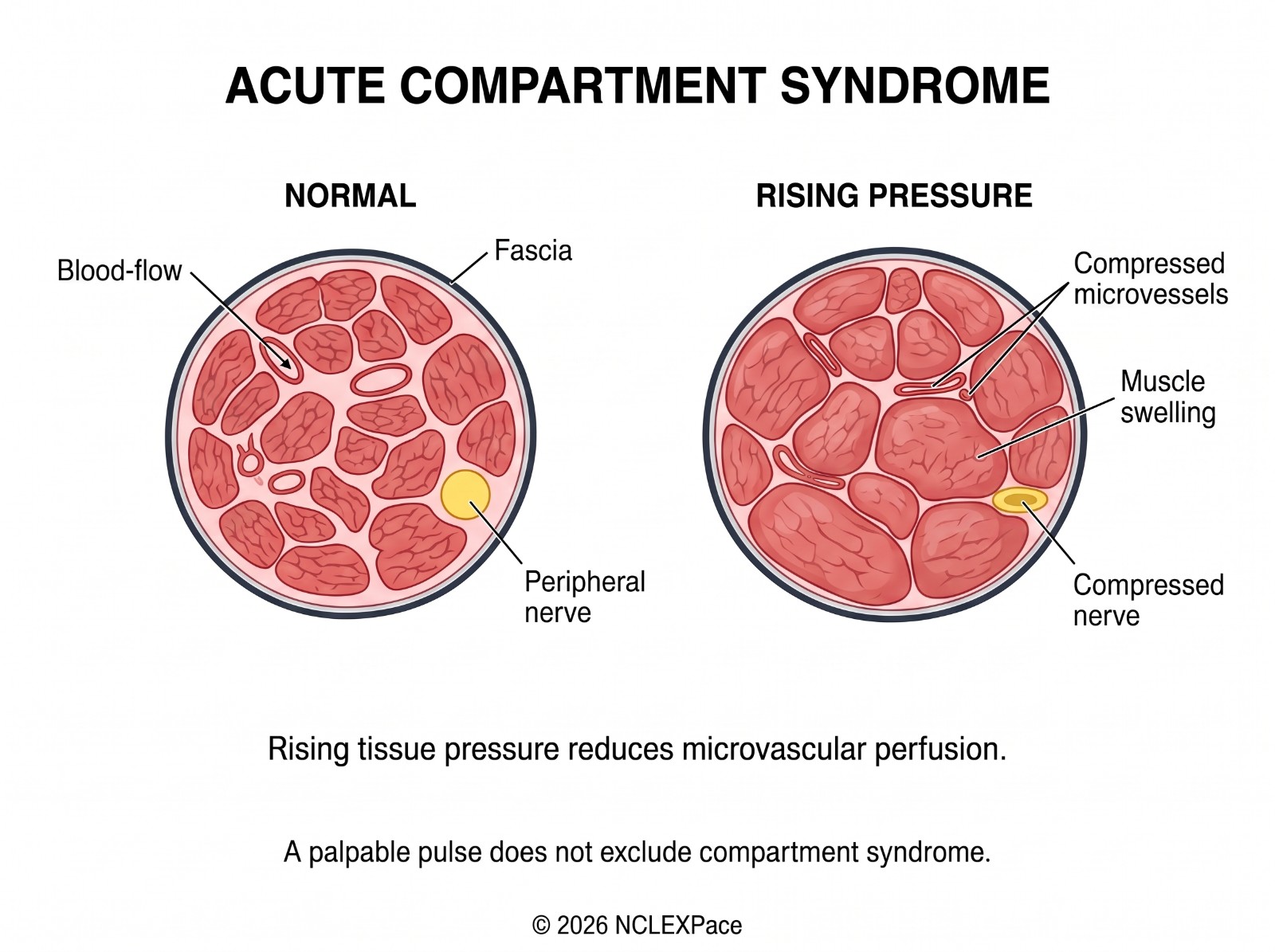
This is the emergency in this whole category.
What it is: swelling inside a closed space in the limb. Pressure builds, blood flow stops, tissue starts to die.
Where: after a fracture, a cast, a crush injury, or severe swelling.
The signs — the classic six:
- Pain out of proportion — much worse than expected, and not relieved by opioids
- Pain with passive stretching of the fingers or toes
- Pressure — the limb feels tight and hard
- Paresthesia — numbness and tingling
- Pallor — pale, cool skin
- Pulselessness — a very late sign
The earliest and most reliable sign is pain that is far worse than expected and does not respond to pain medication.
Do not wait for a missing pulse. By then the damage is done.
What you do:
- Notify the provider immediately
- Loosen or remove any tight dressing. A cast may need to be split or removed.
- Do NOT elevate the limb above heart level — this reduces blood flow further. Keep it at heart level.
- Do NOT apply ice — it narrows blood vessels
- Prepare for surgery to release the pressure
The “do not elevate, do not ice” point is heavily tested, because elevation and ice are correct for ordinary swelling and wrong here.
Fat embolism
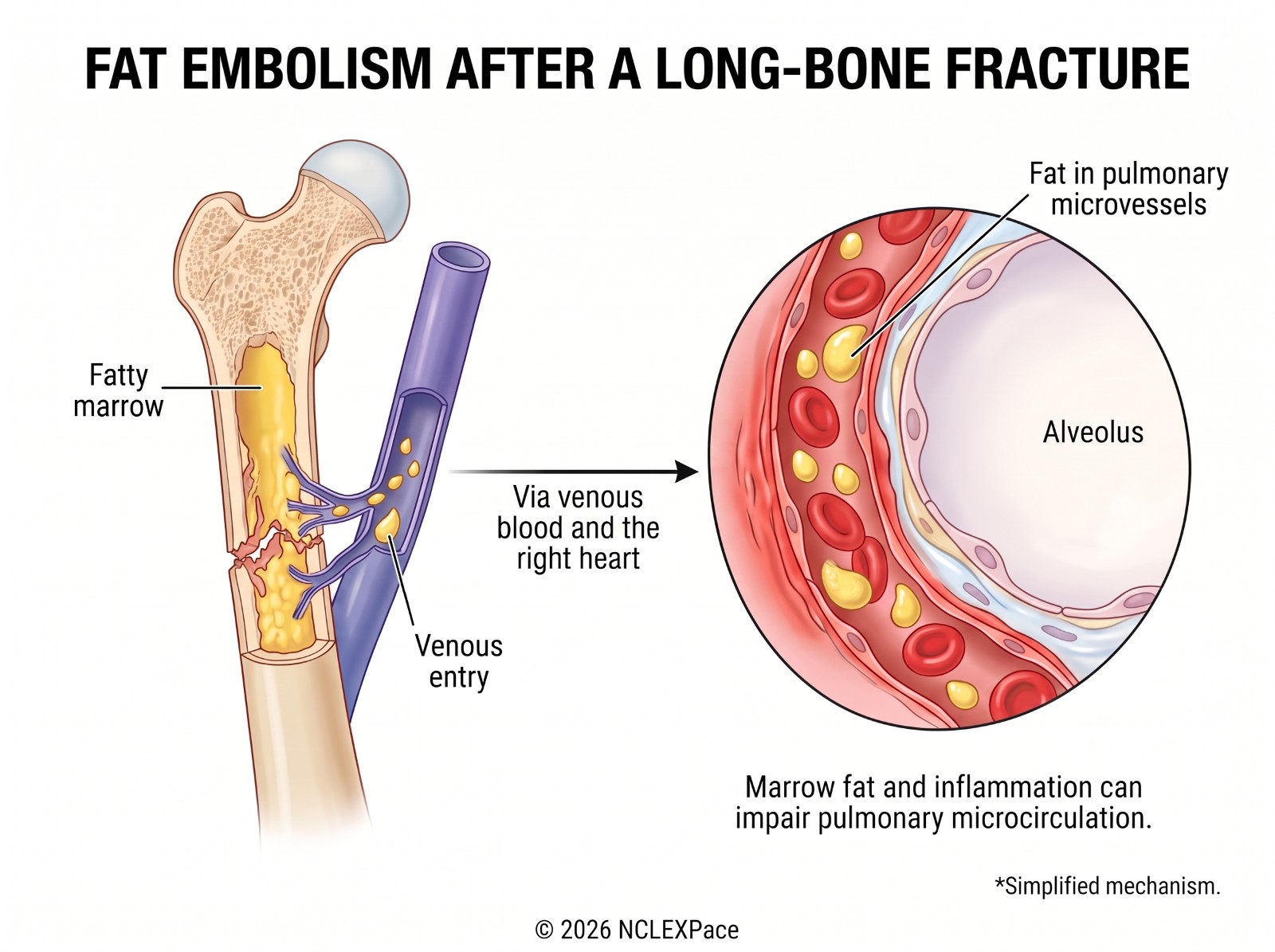
What it is: fat from the bone marrow enters the bloodstream after a fracture, usually of a long bone like the femur or pelvis.
When: usually within the first one to three days after injury.
What you see: sudden shortness of breath, confusion or restlessness, low oxygen, fast heart rate, and sometimes a rash of tiny red spots on the chest, neck, or armpits.
The combination of breathing trouble plus confusion after a long bone fracture is the clue.
What you do: oxygen, notify the provider immediately, support breathing.
Prevention: stabilize the fracture early, careful handling.
Casts
Nursing care:
- Let a plaster cast dry before covering it. Handle with the palms, not fingertips, to avoid dents.
- Check circulation, movement, and sensation below the cast regularly
- Elevate for ordinary swelling in the first day or two — but not if compartment syndrome is suspected
- Never put anything inside the cast to scratch — teach this clearly. Use cool air instead.
- Keep it dry
- Report: increasing pain, numbness, tingling, pale or blue skin, coolness, a bad smell, drainage, or a hot spot
A bad smell or drainage suggests infection under the cast.
Traction
The rules:
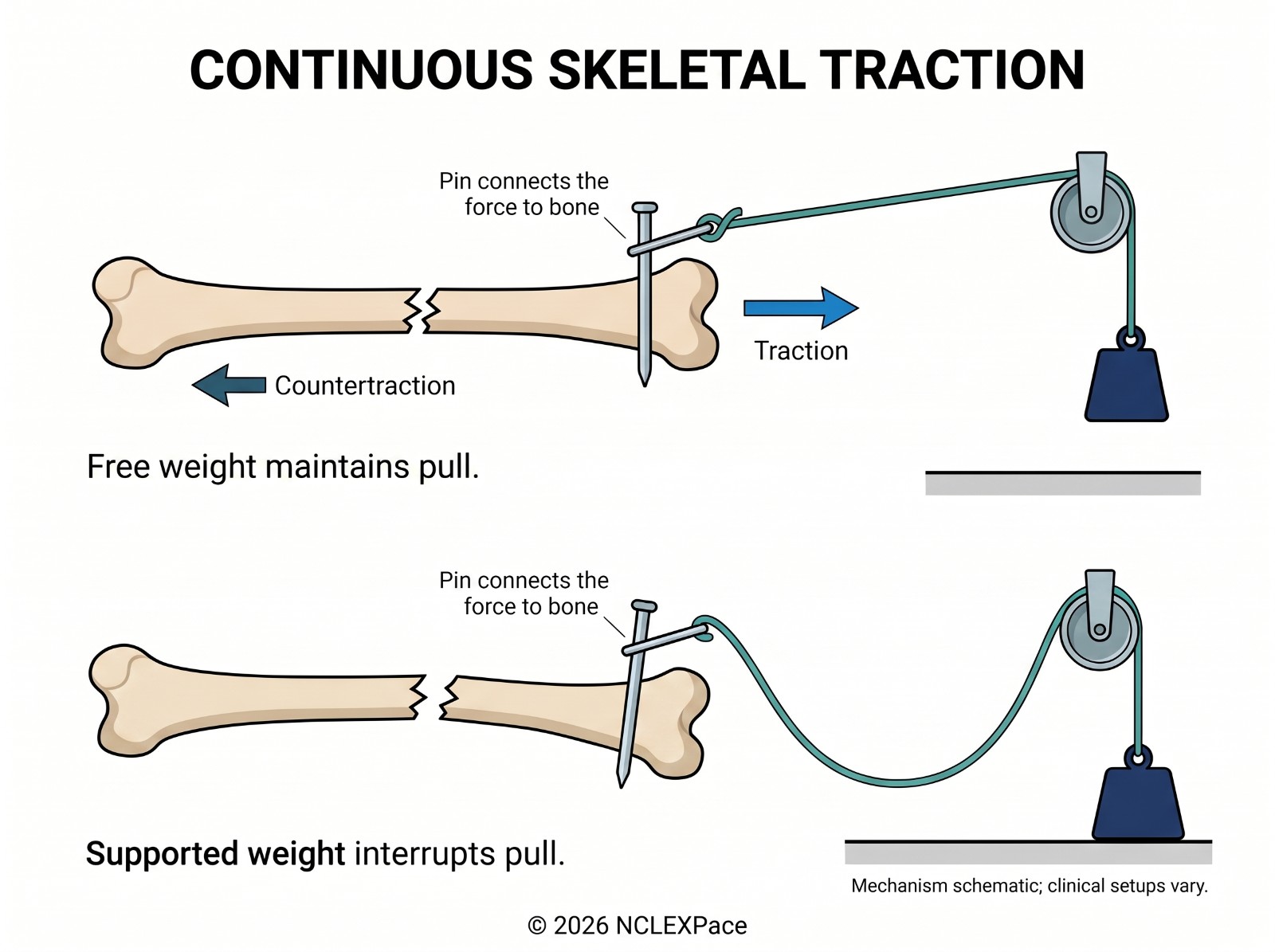
- Weights hang freely. They must never rest on the floor or the bed.
- Never lift or remove the weights unless specifically ordered
- Keep the ropes in the pulleys and free of knots
- Maintain alignment
- Check the pin sites for infection if skeletal traction is used
- Assess circulation and sensation regularly
- Prevent complications of bed rest — skin, lungs, clots
“The weights are resting on the floor” is always a problem that needs correcting.
Hip replacement
The precautions depend on the surgical approach. For the common posterior approach:
- Do not cross the legs
- Do not bend the hip more than 90 degrees
- Do not turn the leg inward
- Use an abduction pillow between the legs
- Use a raised toilet seat and a chair with arms
- Do not bend down to pick things up — use a reaching device
- Sleep on the back or as directed
Signs of dislocation: sudden severe pain, the leg looks shorter, the leg turns outward or inward abnormally, and the client cannot move it. Report immediately.
Other post-op care: blood clot prevention (compression devices, blood thinners, early walking), pain control, watch for infection, and early mobility as ordered.
Knee replacement
- Continuous passive motion machine may be ordered
- Do not place a pillow under the knee — this can cause a permanent bend
- Early walking with physical therapy
- Blood clot prevention
Amputation
- Monitor for bleeding — keep a tourniquet nearby in the early period
- Elevate the residual limb for the first 24 hours only, then keep it flat to prevent a permanent bend
- Position prone periodically as ordered to prevent hip contracture
- Phantom limb pain is real — do not dismiss it. It is treated.
- Support the client emotionally with body image change
The short version
- Compartment syndrome: pain out of proportion, not relieved by opioids. Do NOT elevate. Do NOT ice.
- Fat embolism: breathing trouble plus confusion after a long bone fracture
- Casts: nothing inside to scratch; report a smell, drainage, or new numbness
- Traction: weights hang free, never lift them
- Hip replacement: no crossing legs, no bending past 90 degrees, abduction pillow
- Knee replacement: no pillow under the knee
Hip precautions depend on the surgical approach used. Follow the surgeon’s specific orders.
5 NCLEX practice questions on this topic
The same questions, player and partial-credit scoring students use inside NCLEXPace: answer, submit, read the full rationale, then Next. Your score is waiting at the end. No account needed for these.
A free account opens 20 more questions, a case study, a video and a cheat sheet. The full bank has 3,200+ questions with rationales, by topic.
Practice more, free →Ready for the full bank? See NCLEXPace plans and prices: one payment for 1, 2, 3 or 6 months.
Frequently asked questions
Common follow-up questions on Body Systems & Clinical Content.
What are the signs of compartment syndrome and what should the nurse do?
The classic six signs are pain out of proportion not relieved by opioids, pain with passive stretching, pressure with a tight hard limb, paresthesia, pallor, and pulselessness, which is a very late sign. The earliest and most reliable sign is pain far worse than expected that does not respond to pain medication. Notify the provider immediately, loosen or remove tight dressings or split the cast, keep the limb at heart level rather than elevated, and do not apply ice.
Why should the limb not be elevated or iced in compartment syndrome?
Elevating the limb above heart level reduces blood flow further, and ice narrows blood vessels, both of which worsen the ischemia. This is heavily tested precisely because elevation and ice are correct for ordinary swelling but wrong here. Keep the limb at heart level instead.
What is fat embolism and when does it occur?
Fat embolism is fat from the bone marrow entering the bloodstream after a fracture, usually of a long bone like the femur or pelvis, typically within the first one to three days after injury. You see sudden shortness of breath, confusion or restlessness, low oxygen, fast heart rate, and sometimes a rash of tiny red spots on the chest, neck, or armpits. The combination of breathing trouble plus confusion after a long-bone fracture is the clue; give oxygen and notify the provider immediately.
What are the key rules for traction?
Weights hang freely and must never rest on the floor or the bed, and "the weights are resting on the floor" is always a problem that needs correcting. Never lift or remove the weights unless specifically ordered, keep the ropes in the pulleys and free of knots, maintain alignment, check pin sites for infection with skeletal traction, and assess circulation and sensation regularly.
What precautions follow a posterior hip replacement?
For the common posterior approach: do not cross the legs, do not bend the hip more than 90 degrees, and do not turn the leg inward. Use an abduction pillow between the legs, a raised toilet seat and a chair with arms, and a reaching device rather than bending down. Signs of dislocation are sudden severe pain, a leg that looks shorter, a leg turned outward or inward abnormally, and inability to move it, and these are reported immediately.
Sources and references
- Harding MM, Kwong J, Hagler D, Reinisch C. Lewis's Medical-Surgical Nursing: Assessment and Management of Clinical Problems. 12th ed. Elsevier; 2023; Chapter: Musculoskeletal Trauma and Orthopedic Surgery.
Reviewed by the NCLEXPace team, October 2026.
Keep reading

3,200+ NCLEX questions with think-like-a-nurse rationales, unfolding case studies and adaptive readiness exams. Start with free practice questions, then choose a plan when you are ready.
Create Free Account →