
Chest Tubes: Drainage, Air Leaks and What You Never Clamp
Continuous bubbling in the water-seal chamber means an air leak; gentle rise and fall with breathing (tidaling) is normal. You do not routinely clamp a chest tube, because trapped air has nowhere to go and a tension pneumothorax can follow within minutes. If the tube disconnects, put the end in sterile water; if it pulls out of the chest, cover the site with a dressing taped on three sides.

Chest tubes from setup to removal: the three chambers, tidaling and bubbling, the emergencies, and why the tube is never clamped routinely.
From the Intensive NCLEX Course. See the course; the full video library is part of Pro and Ultimate.
Chest-tube questions turn on three distinctions: which chamber is bubbling, whether the water level is tidaling, and what to do when the system fails. Miss the chamber and you lose the question; match it and the answer is obvious.
What a chest tube is doing
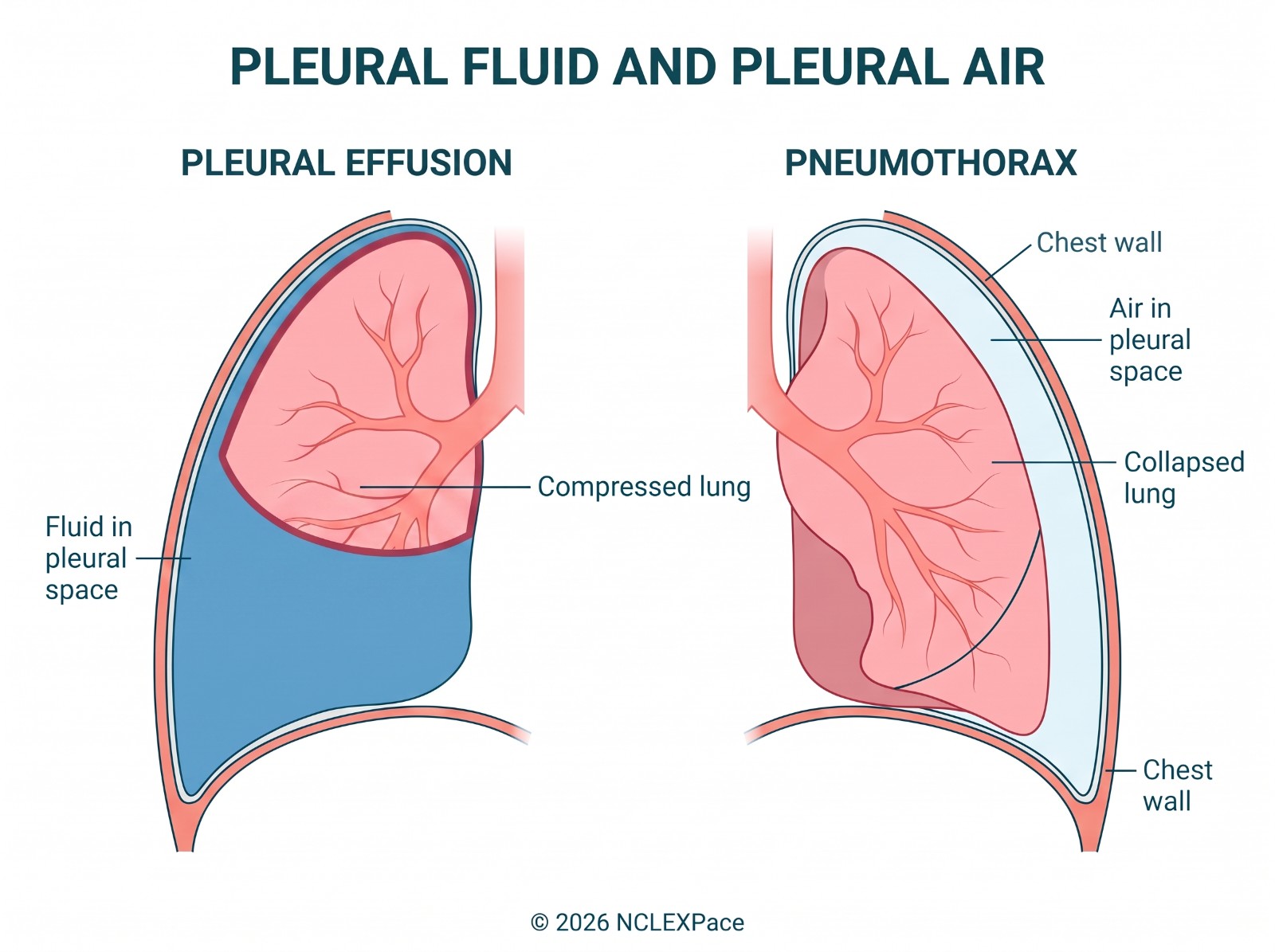
The pleural space normally holds a thin film of fluid and negative pressure, which keeps the lung expanded. Air (pneumothorax), blood (haemothorax) or fluid (effusion) in that space collapses the lung. The chest tube removes what is there and restores the negative pressure — and the drainage system's whole job is to let things out without letting air back in.
The three chambers
| Chamber | Job | What normal looks like |
|---|---|---|
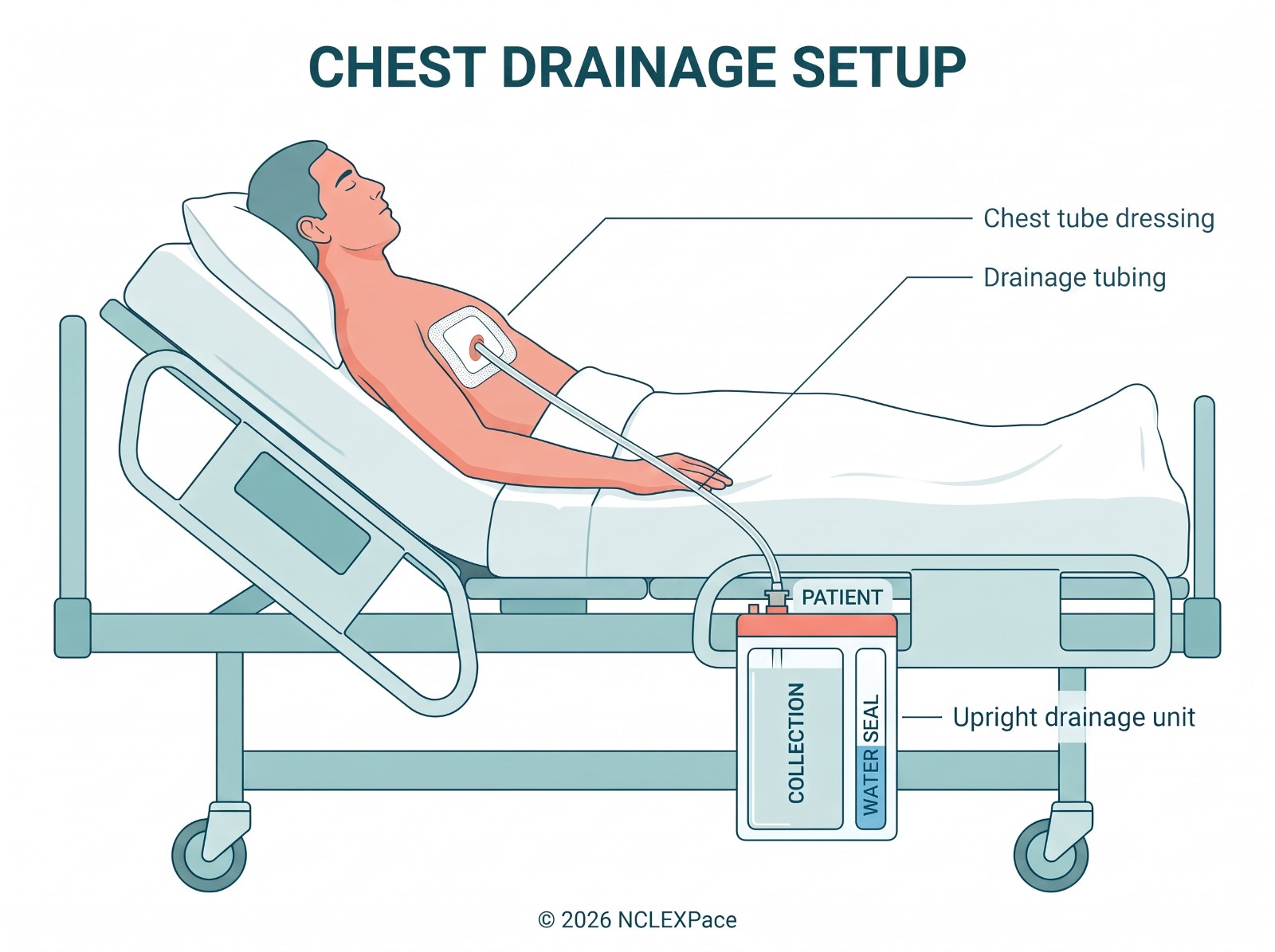
| 1. Collection | Collects drainage from the chest | Marked hourly; character and volume documented |
| 2. Water seal | A one-way valve — air escapes, none returns | Tidaling: the water level rises and falls with respiration. Intermittent bubbling when the client coughs or exhales is expected early on |
| 3. Suction control | Regulates how much negative pressure is applied | Gentle continuous bubbling here is normal — it is the suction working |
The distinction students lose marks on: bubbling in the suction chamber is normal; continuous bubbling in the water-seal chamber is not.
Reading the system
| What you see | What it means | What you do |
|---|---|---|
| Tidaling with respiration | Normal — the tube is patent and the lung has not fully re-expanded | Document |
| Tidaling stops | Either the lung has re-expanded (good) or the tube is obstructed or kinked (not good) | Check for kinks and dependent loops, assess the client, correlate with breath sounds and the chest film |
| Continuous bubbling in the water seal | Air leak | Work from the client outward: insertion-site dressing, then connections, then tubing |
| Sudden bright red drainage, or over ~100 mL/hour | Active bleeding | Notify the provider immediately |
| Subcutaneous emphysema — crackling under the skin | Air tracking into the tissues | Mark the border, assess extent, notify — around the neck it threatens the airway |
The emergencies, and the exact action
| Situation | Action |
|---|---|
| Tubing disconnects from the drainage unit | Place the end of the tube in a container of sterile water to re-establish a water seal, then get a new system. Do not clamp |
| Tube pulls out of the chest | Cover the site immediately with a sterile dressing taped on three sides — air out but not in. Stay with the client and call for help |
| Drainage unit tips over | Set it upright, check the water levels, reassess the client |
| Unit is raised above chest level | Lower it — drainage can siphon back into the pleural space |
Why you do not clamp
Clamping a chest tube blocks the only escape route for air leaving the pleural space. If air continues to enter, pressure builds and the result is a tension pneumothorax: tracheal deviation away from the affected side, absent breath sounds, distended neck veins, hypotension — a rapid killer.
Momentary clamping is used only in narrow circumstances — changing the drainage unit, or briefly to locate a leak — and only where policy allows. On the exam, “clamp the tube” is the wrong answer unless the stem is explicitly about changing the system.
Routine care
- Keep the unit upright and below chest level at all times, including during transfer.
- Keep tubing free of kinks and dependent loops; coil it flat on the bed.
- Do not routinely strip or milk the tubing — it generates high negative pressure and damages tissue.
- Assess the site dressing, breath sounds and respiratory status each shift and after any change.
- Encourage deep breathing, coughing and incentive spirometry — re-expanding the lung is the goal.
- Have a sterile occlusive dressing and a container of sterile water at the bedside.
NCLEX tip: Match the chamber to the finding before you choose. Bubbling in the suction chamber is the system working; continuous bubbling in the water seal is a leak; no tidaling is either success or obstruction — and you decide which by assessing the client, not the box.
Educational use only: this article supports nursing review and does not replace clinical judgment, facility protocols, or instructions from an authorised prescriber.
5 NCLEX practice questions on this topic
The same questions, player and partial-credit scoring students use inside NCLEXPace: answer, submit, read the full rationale, then Next. Your score is waiting at the end. No account needed for these.
A free account opens 20 more questions, a case study, a video and a cheat sheet. The full bank has 3,200+ questions with rationales, by topic.
Practice more, free →Ready for the full bank? See NCLEXPace plans and prices: one payment for 1, 2, 3 or 6 months.
Frequently asked questions
Common follow-up questions on Body Systems & Clinical Content.
What does continuous bubbling in the water-seal chamber mean?
An air leak somewhere between the pleural space and the drainage unit. Assess systematically from the client outward (insertion site dressing first, then each connection, then the tubing) and notify the provider if no external cause is found.
Is tidaling in a chest tube normal?
Yes. The water level rising and falling with respiration shows the tube is patent and communicating with the pleural space. Tidaling stopping means either the lung has fully re-expanded or the tube is obstructed, and assessing the client distinguishes the two.
Why should a chest tube never be clamped?
Clamping traps air in the pleural space with no route out. If air continues to accumulate, pressure rises and a tension pneumothorax can develop within minutes, producing tracheal deviation, absent breath sounds and cardiovascular collapse.
What should the nurse do if a chest tube becomes disconnected?
Immediately place the end of the chest tube into a container of sterile water to re-establish a water seal, then obtain a new drainage system. Do not clamp the tube and do not leave the client.
What should the nurse do if a chest tube is pulled out?
Cover the insertion site at once with a sterile occlusive dressing taped on three sides, which allows air to escape but not to enter, then stay with the client, call for help and monitor for respiratory distress.
How much chest tube drainage is too much?
Drainage exceeding roughly 100 mL per hour, or a sudden change to bright red blood, suggests active bleeding and requires immediate provider notification. Volume, colour and consistency are documented and the chamber marked hourly.
Sources and references
- Harding MM, Kwong J, Hagler D, Reinisch C. Lewis's Medical-Surgical Nursing: Assessment and Management of Clinical Problems. 12th ed. Elsevier; 2023; Chapter: Lower Respiratory Problems.
Reviewed by the NCLEXPace team, October 2026.
Keep reading


3,200+ NCLEX questions with think-like-a-nurse rationales, unfolding case studies and adaptive readiness exams. Start with free practice questions, then choose a plan when you are ready.
Create Free Account →