
Enteral Feeding and TPN: Placement, Residuals and Complications
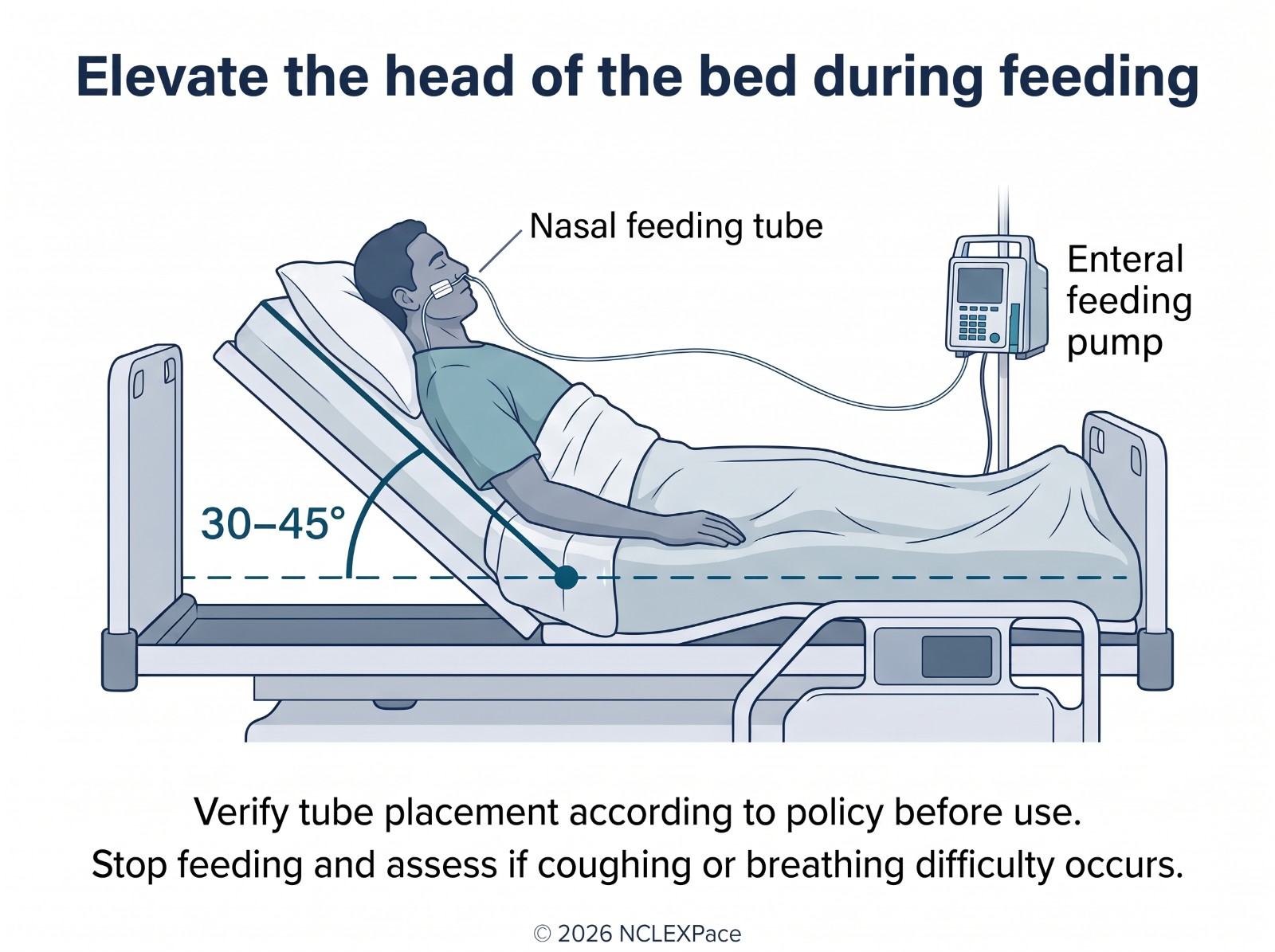
Radiographic confirmation is the only acceptable way to verify initial placement of a new feeding tube. Auscultating an air bolus is unreliable and is not used. Keep the head of the bed at 30 to 45 degrees during feeding and for at least 30 to 60 minutes after, and flush before and after feeds and medications. Parenteral nutrition runs through a central line, is never stopped abruptly because of rebound hypoglycaemia, and never has medication added to the bag.

Enteral and parenteral nutrition: verifying the tube, running the feed safely, residuals, aspiration, and the TPN rules.
From the Intensive NCLEX Course. See the course; the full video library is part of Pro and Ultimate.
Feeding questions reward three reflexes: a new tube is confirmed by X-ray, never auscultation; aspiration risk is managed by sitting the client up; and TPN is never stopped abruptly. Everything else hangs off those.
Enteral feeding — verifying the tube
| Method | Verdict |
|---|---|
| X-ray | The standard for initial placement. Nothing goes down the tube until it is read |
| Aspirate pH | Useful for ongoing checks. Gastric aspirate is typically acidic (~5 or below); a higher pH may mean intestinal or respiratory placement, and acid suppression raises it too |
| Marked external length | Checked every time. A change from the documented mark means the tube has moved |
| Auscultating an air bolus | Not reliable — sound transmits from a tube in the lung. If an option offers this as verification, it is wrong |
Placement is rechecked before every feed, every medication and every 4 hours during continuous feeding — a tube confirmed yesterday is not confirmed now.
Running the feed safely
- Head of bed 30–45 degrees throughout and for 30–60 minutes after an intermittent feed. If it must be lowered for care, hold the feed first.
- Flush with water before and after feeds and between medications — this is also how free-water needs are met.
- Give medications separately, each flushed in between. Use liquid forms where possible; never crush enteric-coated or extended-release tablets.
- Hang-time limits: opened formula per policy, commonly 4–8 hours for an open system, with bag and tubing changed every 24 hours.
- Formula at room temperature — cold formula causes cramping and diarrhoea.
- Daily weights, intake and output, glucose monitoring, and mouth care even though nothing goes through the mouth.
Residual volumes
Practice varies by facility, and the exam tests the reasoning rather than a single number. A high residual suggests delayed gastric emptying and raises aspiration risk. The usual approach is to hold the feed, reassess in an hour, and notify the provider if it remains high — while assessing the abdomen for distension, absent bowel sounds, nausea and discomfort. Aspirate is generally returned rather than discarded to avoid losing electrolytes, unless policy directs otherwise.
Complications of enteral feeding
| Problem | What to do |
|---|---|
| Aspiration — coughing, dyspnoea, falling saturation, new crackles | Stop the feed immediately, suction, sit upright, oxygen, notify. This is the complication the topic exists to prevent |
| Diarrhoea | Consider rate, formula osmolality, temperature, sorbitol-containing medications, antibiotics and C. difficile. Slowing the rate is usually tried before changing the formula |
| Clogged tube | Flush with warm water using a gentle push-pause. Not carbonated drinks or juice. Prevent it by flushing properly around medications |
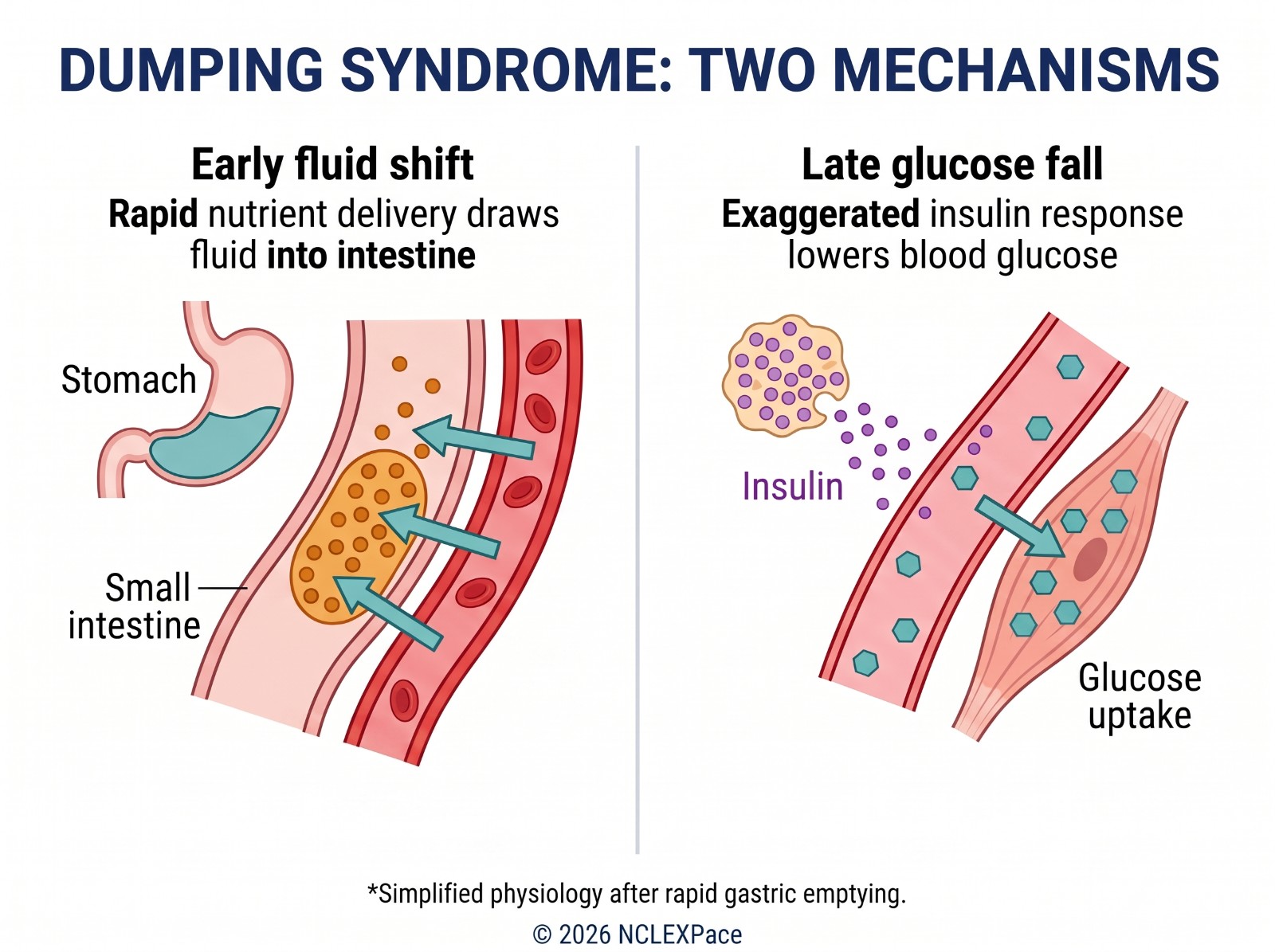
| Dumping syndrome — cramping, diarrhoea, dizziness, sweating after a bolus | Slow the rate; use continuous rather than bolus feeding |
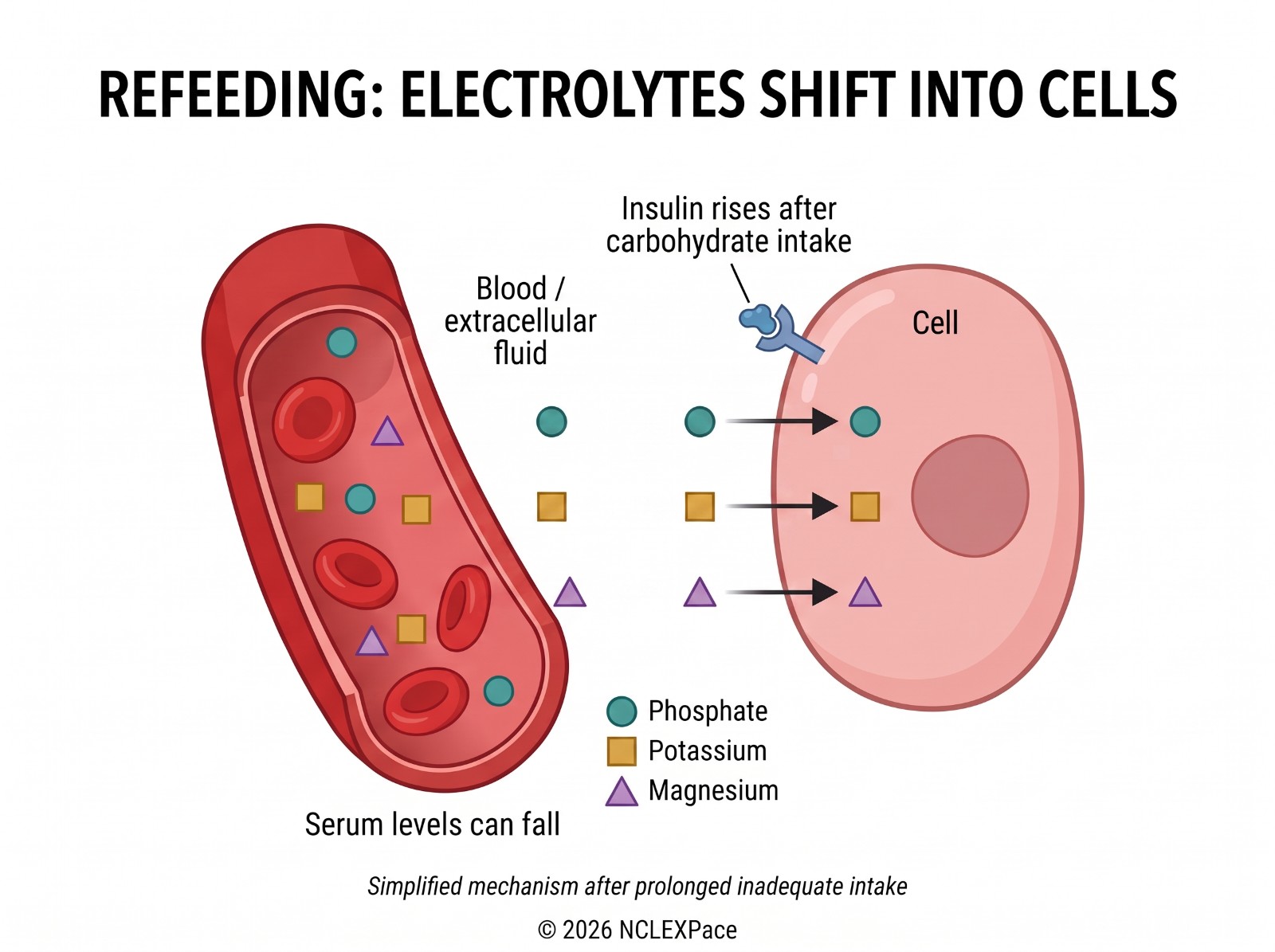
| Refeeding syndrome in severe malnutrition | Start low and advance slowly; monitor phosphate, potassium and magnesium, which fall sharply as feeding begins |
Parenteral nutrition
TPN delivers nutrition directly into the bloodstream when the gut cannot be used. Because the solution is highly concentrated, it needs a central line — peripheral parenteral nutrition exists but is dilute, short-term and hard on veins.
- Confirm central line placement by X-ray before starting.
- Nothing else in that lumen. No medications added to the bag, no piggybacks, no blood products, no blood draws where a dedicated lumen is required.
- Use a filter and an infusion pump, and follow the rate exactly.
- Never speed up or slow down to catch up. Speeding causes hyperglycaemia and fluid overload; slowing causes hypoglycaemia.
- Never stop abruptly. TPN is tapered, because the pancreas is still producing insulin for a high glucose load — abrupt discontinuation causes rebound hypoglycaemia. If a bag runs out and none is available, hang 10% dextrose per policy.
- Monitor glucose frequently; sliding-scale insulin is common even without diabetes.
- Daily weights, strict intake and output, electrolytes; watch phosphate, potassium and magnesium.
- Bag and tubing changed every 24 hours; a spiking fever in a client on TPN is a line infection until proven otherwise.
NCLEX tip: Three answers recur. Verification of a new tube is an X-ray, never auscultation. Aspiration risk is managed by sitting the client up before anything else. And TPN is never stopped suddenly — if the options include hanging dextrose while the next bag is obtained, that is usually the one.
Educational use only: this article supports nursing review and does not replace clinical judgment, facility protocols, or instructions from an authorised prescriber.
5 NCLEX practice questions on this topic
The same questions, player and partial-credit scoring students use inside NCLEXPace: answer, submit, read the full rationale, then Next. Your score is waiting at the end. No account needed for these.
A free account opens 20 more questions, a case study, a video and a cheat sheet. The full bank has 3,200+ questions with rationales, by topic.
Practice more, free →Ready for the full bank? See NCLEXPace plans and prices: one payment for 1, 2, 3 or 6 months.
Frequently asked questions
Common follow-up questions on Body Systems & Clinical Content.
How is feeding tube placement confirmed?
Radiographic confirmation is required before a newly inserted tube is used. Ongoing checks combine aspirate pH with the marked external length of the tube; auscultating an injected air bolus is unreliable and is not an acceptable method.
What is the correct position during tube feeding?
Head of bed elevated 30 to 45 degrees during the feed and for at least 30 to 60 minutes afterwards. If the client must lie flat for a procedure, the feed is held first.
What should the nurse do about a high gastric residual?
Hold the feed, assess the abdomen for distension, absent bowel sounds, nausea or discomfort, recheck in about an hour, and notify the provider if it remains high. Aspirate is generally returned rather than discarded so electrolytes are not lost, unless policy directs otherwise.
Why must TPN never be stopped abruptly?
The pancreas is producing insulin to match a high continuous glucose load. Stopping suddenly leaves that insulin unopposed and causes rebound hypoglycaemia, so the infusion is tapered and 10% dextrose is hung per policy if a bag is unavailable.
Can medications be added to a TPN bag?
No. Nothing is added to the bag and nothing else is infused through that lumen: no piggybacks, no blood products, and no blood sampling where a dedicated lumen is required. Incompatibility and infection risk are both unacceptable.
What is refeeding syndrome?
A sharp fall in phosphate, potassium and magnesium when nutrition is reintroduced to a severely malnourished client, which can cause arrhythmias, respiratory failure and death. Feeding is started at a low rate and advanced slowly with close electrolyte monitoring.
Sources and references
- Harding MM, Kwong J, Hagler D, Reinisch C. Lewis's Medical-Surgical Nursing: Assessment and Management of Clinical Problems. 12th ed. Elsevier; 2023; Chapter: Nutrition Problems.
- Boullata JI, et al. ASPEN Safe Practices for Enteral Nutrition Therapy. JPEN J Parenter Enteral Nutr. 2017;41(1):15-103.
Reviewed by the NCLEXPace team, October 2026.
Keep reading



3,200+ NCLEX questions with think-like-a-nurse rationales, unfolding case studies and adaptive readiness exams. Start with free practice questions, then choose a plan when you are ready.
Create Free Account →