Increased Intracranial Pressure: Early Signs, Late Signs, Positioning
A change in level of consciousness (restlessness, confusion, difficulty rousing) is the earliest sign of rising intracranial pressure. Cushing triad (rising blood pressure with a widening pulse pressure, bradycardia and irregular respirations) is a late sign that means herniation is near. Keep the head of the bed at about 30 degrees with the head and neck midline, and space nursing activities apart rather than clustering them.

The lesson behind this guide: why the rigid skull matters, the early and late signs, and what raises or lowers the pressure.
From the Intensive NCLEX Course. See the course; the full video library is part of Pro and Ultimate.
Raised-ICP questions turn on one idea: the earliest sign is a change in level of consciousness, and the dramatic late sign — Cushing triad — means you already missed the window. Recognise the restless, newly confused client and you have the question.
Why the skull is the problem
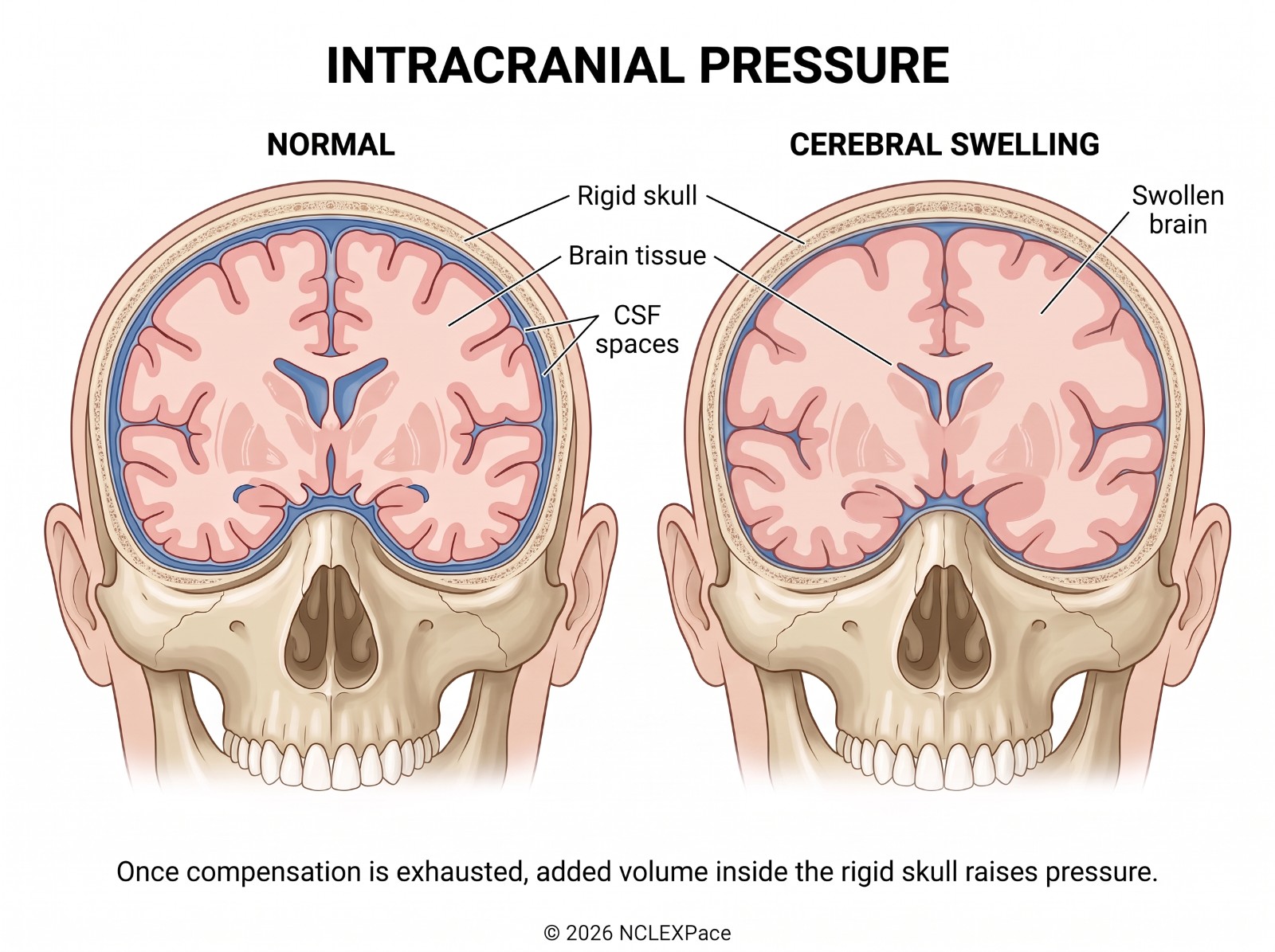
The cranium is a closed box of fixed volume holding three things: brain tissue, blood and cerebrospinal fluid. If any one increases, another must decrease or the pressure rises. Compensation works for a while — CSF is displaced, venous blood shunted out — and then it does not. This is why deterioration looks gradual and then suddenly is not.
Signs, in the order they appear
| Stage | What you see |
|---|---|
| Earliest | Change in level of consciousness — restlessness, irritability, confusion, increasing difficulty to rouse. This precedes everything else |
| Progressive | Headache, projectile vomiting without nausea, pupil changes (sluggish, then unequal, then fixed and dilated on the affected side), unilateral weakness, seizures, papilloedema |
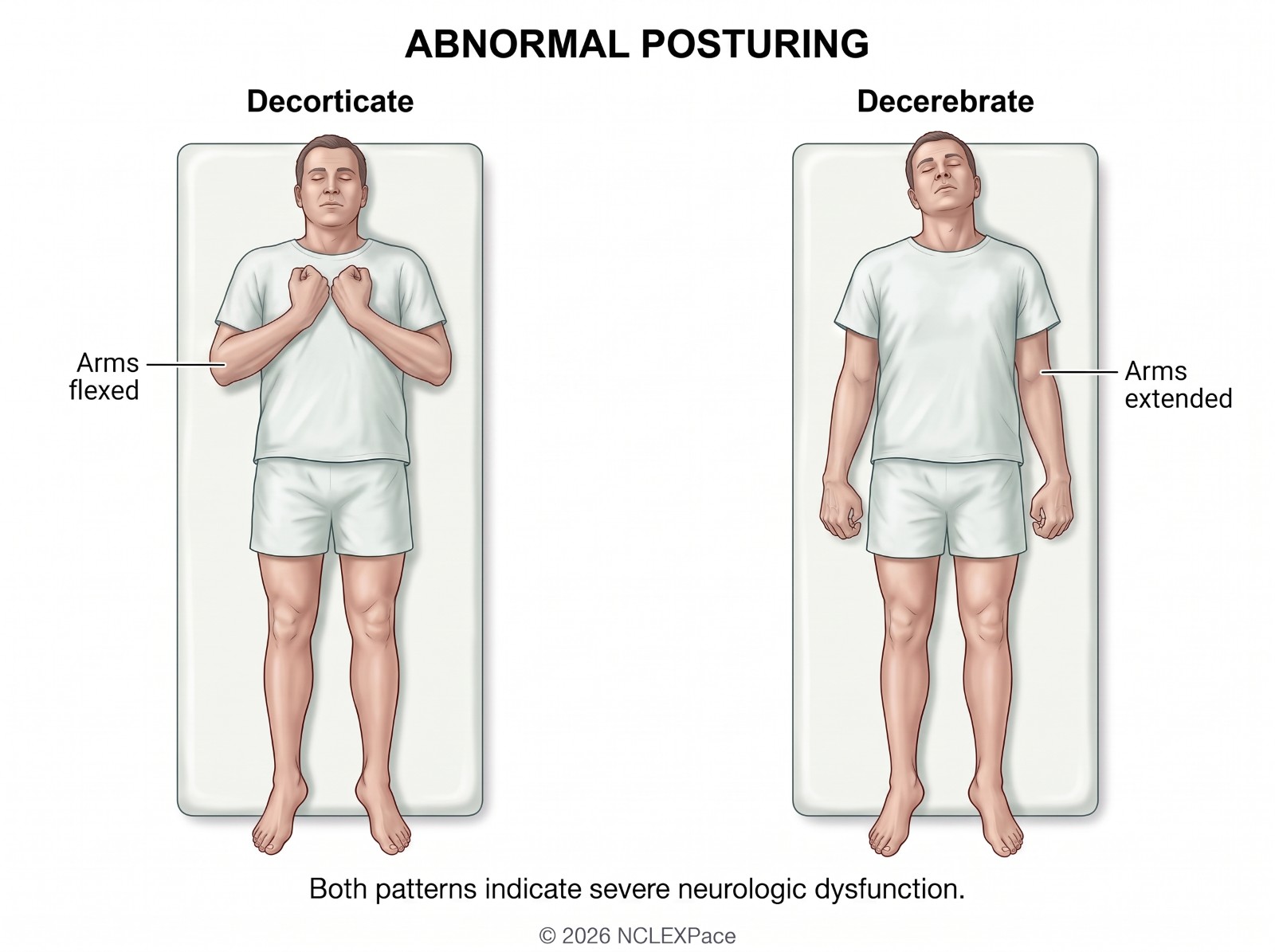
| Late — emergency | Cushing triad: rising systolic pressure with a widening pulse pressure, bradycardia, and irregular respirations. Also decorticate then decerebrate posturing |
Two details the exam leans on. First, in raised ICP the blood pressure goes up while the heart rate goes down — the opposite of shock, and mixing them up costs the question. Second, Cushing triad is not the finding to act on; it is the finding that means you acted too late. The one to act on is the restless client who was alert an hour ago. In infants, a bulging fontanel and increasing head circumference are the equivalent early findings.
What raises the pressure, and what lowers it
| Raises ICP — avoid | Lowers or protects — do |
|---|---|
| Neck flexion, rotation or anything tight around the neck | Head and neck midline, head of bed about 30 degrees |
| Hip flexion, Trendelenburg, lying flat | Avoid extreme hip flexion; log-roll rather than bend |
| Straining — coughing, vomiting, Valsalva, constipation | Stool softeners, antiemetics, cough suppression as ordered |
| Clustering care — suctioning, turning, bathing back to back | Space activities apart to let pressure recover between them |
| Prolonged suctioning; keep passes under ~10 seconds | Hyperoxygenate first, keep passes brief and few |
| Noise, bright light, painful stimuli, agitation | Quiet, dim environment; treat pain and agitation |
| Hypercapnia — a rising CO₂ dilates cerebral vessels | Maintain oxygenation and normal ventilation |
Medical management typically includes osmotic diuresis with mannitol (watch urine output, serum osmolality and for fluid depletion), hypertonic saline, sometimes controlled ventilation, and a ventriculostomy to drain CSF and measure pressure directly. Fluids are restricted, not pushed — an option offering a fluid bolus to a client with raised ICP is wrong unless they are frankly hypotensive.
Where it comes from
Head injury, haemorrhagic stroke, brain tumour, meningitis or encephalitis, hydrocephalus, and cerebral oedema after any significant insult. On the exam it most often follows trauma or a haemorrhagic stroke.
NCLEX tip: When a stem gives you a neurologically injured client and a list of findings, look first for a described change from a stated baseline — “was oriented on admission, now confused” outranks every number in the stem. And if the options include repositioning, choose the one that puts the head midline with the bed at 30 degrees; anything flat, twisted or Trendelenburg is the distractor.
Educational use only: this article supports nursing review and does not replace clinical judgment, facility protocols, or instructions from an authorised prescriber.
5 NCLEX practice questions on this topic
The same questions, player and partial-credit scoring students use inside NCLEXPace: answer, submit, read the full rationale, then Next. Your score is waiting at the end. No account needed for these.
A free account opens 20 more questions, a case study, a video and a cheat sheet. The full bank has 3,200+ questions with rationales, by topic.
Practice more, free →Ready for the full bank? See NCLEXPace plans and prices: one payment for 1, 2, 3 or 6 months.
Frequently asked questions
Common follow-up questions on Body Systems & Clinical Content.
What is the earliest sign of increased intracranial pressure?
A change in level of consciousness: restlessness, irritability, confusion or increasing difficulty rousing the client. It appears before pupil changes, before vomiting and long before Cushing triad, which is why serial neurological assessment is the monitoring that matters.
What is Cushing triad?
Rising systolic blood pressure with a widening pulse pressure, bradycardia, and irregular respirations. It is a late sign of severely raised intracranial pressure indicating impending herniation, and it requires immediate emergency intervention rather than continued monitoring.
How should a client with increased intracranial pressure be positioned?
Head of the bed elevated to approximately 30 degrees with the head and neck in neutral midline alignment, avoiding neck flexion or rotation and extreme hip flexion. This promotes venous drainage from the head without compromising cerebral perfusion.
Why should nursing activities be spaced apart?
Suctioning, turning, bathing and painful procedures each transiently raise intracranial pressure. Performing them back to back stacks those rises without allowing recovery between them, so care is deliberately spread out in a client with limited compensatory reserve.
Why is the blood pressure high and the pulse low in raised ICP?
The body raises systemic pressure to force blood into a skull whose pressure is climbing, and the resulting baroreceptor response slows the heart. It is the mirror image of shock, where pressure falls and heart rate rises: confusing the two is a common exam trap.
Sources and references
- Harding MM, Kwong J, Hagler D, Reinisch C. Lewis's Medical-Surgical Nursing: Assessment and Management of Clinical Problems. 12th ed. Elsevier; 2023; Chapter: Acute Intracranial Problems.
- Carney N, et al. Guidelines for the Management of Severe Traumatic Brain Injury, Fourth Edition. Neurosurgery. 2017;80(1):6-15.
Reviewed by the NCLEXPace team, October 2026.
Keep reading

3,200+ NCLEX questions with think-like-a-nurse rationales, unfolding case studies and adaptive readiness exams. Start with free practice questions, then choose a plan when you are ready.
Create Free Account →