
Cord Prolapse, Abruption, Previa and Postpartum Hemorrhage: First Actions
The obstetric emergencies the NCLEX tests most are cord prolapse, placental abruption, placenta previa, uterine rupture and postpartum haemorrhage, and each has one signature first action. For cord prolapse, lift the presenting part off the cord and position the mother knee-chest or Trendelenburg; for postpartum haemorrhage, massage the fundus first.

Obstetric emergencies: cord prolapse, abruption, previa, postpartum hemorrhage and uterine rupture, first action each.
From the Intensive NCLEX Course. See the course; the full video library is part of Pro and Ultimate.
These items are rarely about diagnosis. They give you the picture and ask what the nurse does first — so the useful thing to hold is one opening move per emergency.
The first action, one line each
| Emergency | The picture | First action |
|---|---|---|
| Cord prolapse | Cord visible or palpable; variable decelerations | Gloved hand lifts the presenting part off the cord — and stays there |
| Placental abruption | Painful bleeding, rigid board-like uterus | Assess for shock; prepare for emergency delivery |
| Placenta previa | Painless bright red bleeding, soft uterus | No vaginal examination; monitor and notify |
| Uterine rupture | Sudden tearing pain, contractions stop, fetal heart changes | Prepare for immediate caesarean |
| Postpartum haemorrhage | Heavy bleeding, boggy uterus | Massage the fundus |
Cord prolapse
The cord slips ahead of the presenting part and is compressed with every contraction. The fetus loses its blood supply within minutes, so this is one of the few situations where the nurse acts with their hands before anything else.
- Insert a gloved hand and hold the presenting part off the cord. Do not remove it until the surgical team takes over.
- Position knee-chest or Trendelenburg to let gravity move the fetus off the cord.
- Call for help without leaving the bedside.
- Give oxygen, stop oxytocin, prepare for immediate caesarean.
- Never attempt to push the cord back in. If it is exposed, cover it with a sterile saline-moistened dressing.
Variable decelerations are cord compression until proven otherwise.
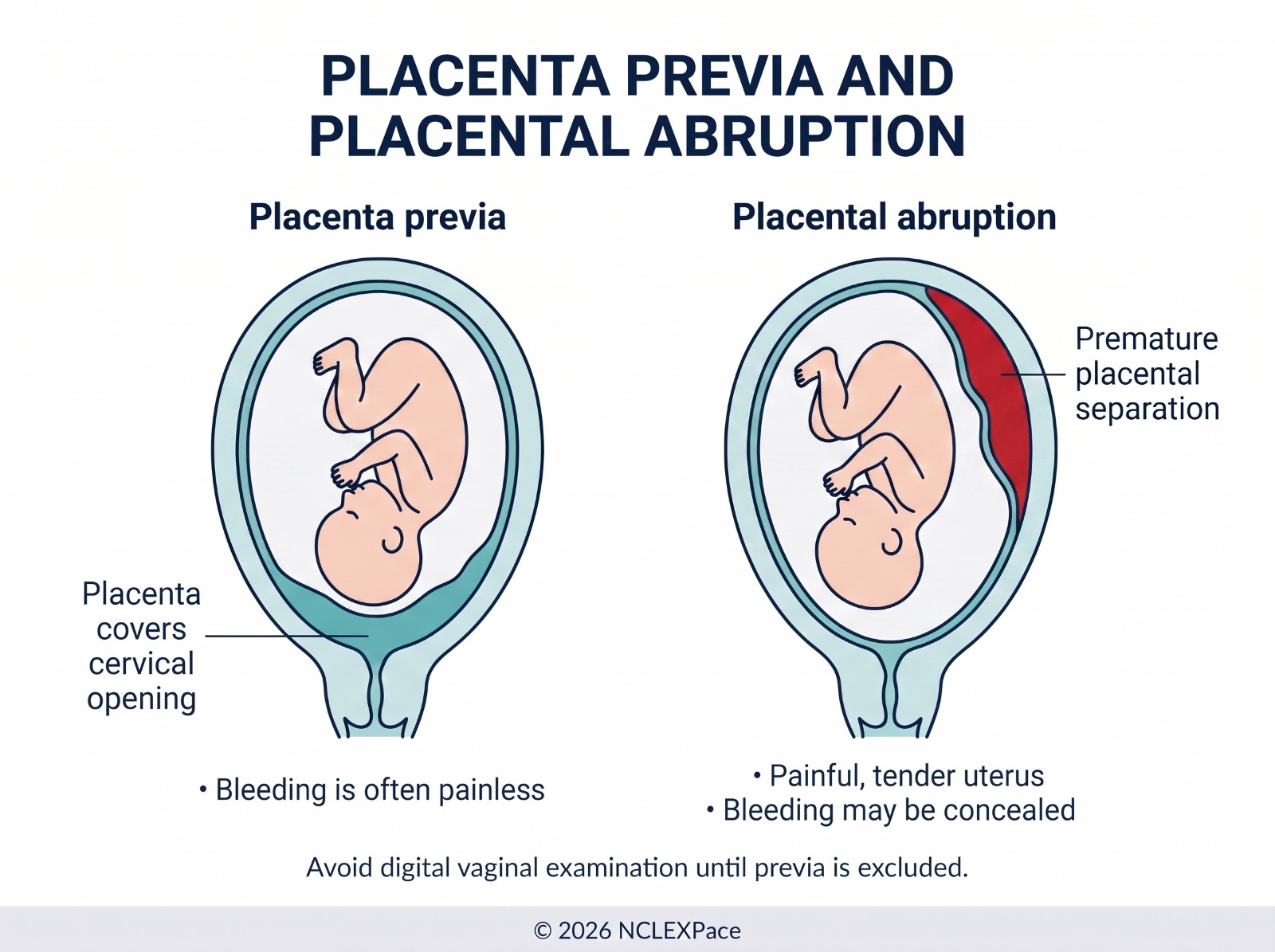
Bleeding in late pregnancy — previa vs abruption
| Placenta previa | Placental abruption | |
|---|---|---|
| What it is | The placenta covers the cervix | The placenta separates from the uterus early |
| Bleeding | Bright red | Dark red, or may be hidden |
| Pain | Painless | Painful |
| Uterus | Soft, normal | Rigid, board-like, tender |
| Key rule | No vaginal exam | Monitor for shock |
Memory aid: previa is Painless, abruption is Painful. The critical safety rule for previa: never perform a vaginal examination — it can cause massive bleeding. And in abruption the bleeding may be concealed behind the placenta, so watch vital signs, not just the pad count.
Postpartum haemorrhage
The most common cause is a uterus that will not contract — uterine atony. After delivery the uterus must contract to close the vessels where the placenta was attached.
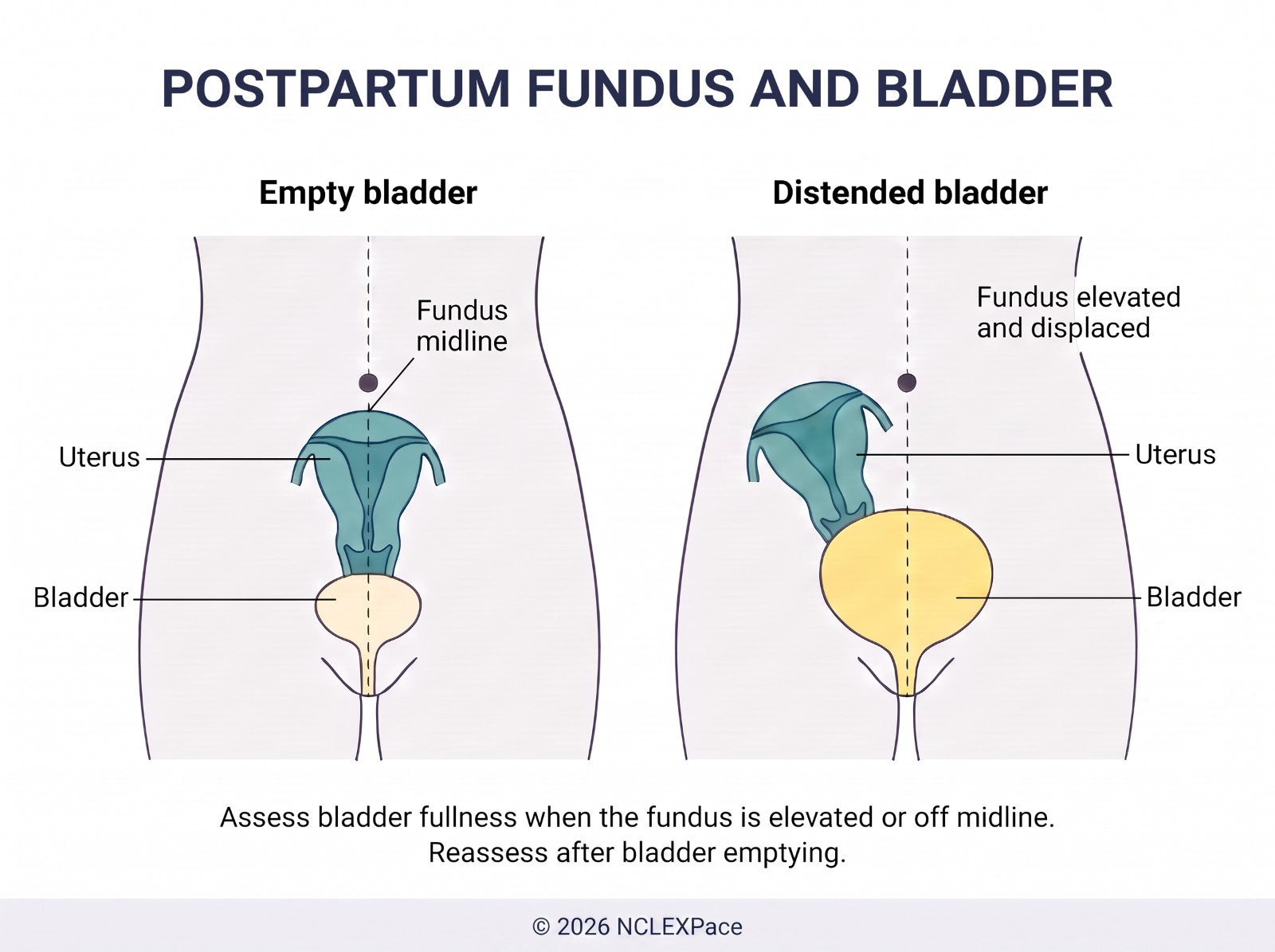
What you see: heavy bleeding, a soft or “boggy” uterus, a uterus higher than expected or pushed to one side, rising heart rate, falling blood pressure, pale clammy skin.
What you do — the order matters:
- Massage the fundus. The first action. A firm uterus stops bleeding.
- Empty the bladder. A full bladder pushes the uterus up and to the side and stops it contracting. Have the client void, or catheterise.
- Give medications as ordered — oxytocin and others.
- Monitor vital signs, start IV fluids, notify the provider.
Massage first, then bladder, then medications — this sequence is the answer to most postpartum-haemorrhage questions. A boggy uterus displaced to the side almost always means a full bladder.
Uterine rupture and the rest
| Emergency | What you see | What the nurse does |
|---|---|---|
| Uterine rupture | Sudden severe tearing abdominal pain, contractions stop, loss of fetal station, abnormal or absent fetal heart tones, signs of shock | Emergency caesarean — surgical emergency |
| Amniotic fluid embolism | Sudden severe shortness of breath, hypotension and collapse during or just after labour. Rare and life-threatening | Emergency resuscitation and support |
| Shoulder dystocia | The head delivers but the shoulders do not | Call for help; assist with the manoeuvres (McRoberts, suprapubic pressure) |
NCLEX tip: Hold one opening move per emergency and the diagnosis barely matters. Cord prolapse — hand lifts the presenting part off the cord. Previa — no vaginal exam. Postpartum haemorrhage — massage the fundus first.
Educational use only: this article supports nursing review and does not replace clinical judgment, facility protocols, or instructions from an authorised prescriber.
5 NCLEX practice questions on this topic
The same questions, player and partial-credit scoring students use inside NCLEXPace: answer, submit, read the full rationale, then Next. Your score is waiting at the end. No account needed for these.
A free account opens 20 more questions, a case study, a video and a cheat sheet. The full bank has 3,200+ questions with rationales, by topic.
Practice more, free →Ready for the full bank? See NCLEXPace plans and prices: one payment for 1, 2, 3 or 6 months.
Frequently asked questions
Common follow-up questions on Maternity, Newborn & Pediatrics.
What is the first action for umbilical cord prolapse?
Use a gloved hand to lift the presenting part off the cord and keep it there, place the mother in knee-chest or Trendelenburg position, call for help, and prepare for immediate caesarean delivery. Never attempt to push the cord back in.
How do I tell placental abruption from placenta previa?
Abruption presents with painful, often dark bleeding and a rigid board-like uterus; previa presents with painless, bright red bleeding and a soft uterus. Vaginal examination is contraindicated in suspected previa because it can provoke catastrophic haemorrhage.
What is the first action for postpartum haemorrhage?
Massage the fundus. A boggy uterus is the most common cause, and firm massage restores tone; if bleeding continues, empty the bladder, give uterotonics such as oxytocin as prescribed, establish large-bore intravenous access and notify the provider.
What are the signs of uterine rupture?
Sudden sharp abdominal pain often described as tearing, loss of fetal station, abnormal or absent fetal heart tones, cessation of contractions, and signs of maternal shock. It is a surgical emergency requiring immediate caesarean delivery.
Why is a full bladder a problem after delivery?
A full bladder pushes the uterus up and to the side and prevents it from contracting, which can cause or worsen postpartum bleeding. A boggy uterus displaced from the midline almost always means the bladder needs emptying.
Sources and references
- Lowdermilk DL, Perry SE, Cashion K, Alden KR, Olshansky EF. Maternity & Women's Health Care. 12th ed. Elsevier; 2020; Chapter: Hemorrhagic Disorders.
- American College of Obstetricians and Gynecologists. Postpartum Hemorrhage: ACOG Practice Bulletin No. 183. Obstetrics & Gynecology. 2017;130(4):e168-e186.
Reviewed by the NCLEXPace team, October 2026.
Keep reading



3,200+ NCLEX questions with think-like-a-nurse rationales, unfolding case studies and adaptive readiness exams. Start with free practice questions, then choose a plan when you are ready.
Create Free Account →