
Central Lines, PICCs and Ports: What the Nurse Owns
A newly inserted central line is not used until placement is confirmed on chest X-ray. Every dressing change and every access is a sterile procedure, and the hub is scrubbed before each entry. If air enters the line, clamp it, lie the client flat on their left side with the head down, give oxygen and call for help: that position traps air in the right atrium instead of letting it reach the lungs.

Central line care and CLABSI prevention: the bundle, the dressing, the flush and the complications.
From the Intensive NCLEX Course. See the course; the full video library is part of Pro and Ultimate.
Central-line questions reward two reflexes above all: a new line is not used until the X-ray confirms it, and air embolism is left side, head down. Around those sit a device table and a prevention bundle the exam draws from constantly.
The line types, and what differs
| Device | Where it goes | Typical use | What the nurse should know |
|---|---|---|---|
| Non-tunnelled central catheter | Subclavian, internal jugular or femoral; tip in the SVC | Days to weeks; acute care | Highest infection risk of the group. Femoral highest of all |
| PICC | Inserted in the arm (basilic or brachial); tip advanced to the SVC | Weeks to months | No BP cuff, no venepuncture, no injections in that arm. Measure upper-arm circumference as a baseline for thrombosis |
| Tunnelled catheter (Hickman, Broviac) | Tunnelled under the skin with an anchoring cuff | Months to years | The tunnel and cuff reduce infection risk |
| Implanted port | Reservoir under the skin on the chest wall | Long term, intermittent — chemotherapy | Accessed only with a non-coring (Huber) needle. Lowest infection risk; best body image |
Central access allows what a peripheral line cannot: vesicants and chemotherapy, parenteral nutrition, high-concentration potassium, vasopressors, long courses of irritating antibiotics, and central venous pressure measurement. That is also why the complications are more serious.
Before first use, and at insertion
- Chest X-ray to confirm tip position before the line is used — for a PICC as well as a chest line. Using an unconfirmed line is a tested error.
- Insertion is done under maximal sterile barrier precautions: cap, mask, sterile gown and gloves, full drape, chlorhexidine prep allowed to dry.
- The client is positioned head-down (Trendelenburg) for subclavian or jugular insertion and asked to perform a Valsalva as the catheter is inserted and removed — both raise venous pressure and keep air out.
- Watch afterwards for pneumothorax: sudden dyspnoea, chest pain, decreased breath sounds on that side.
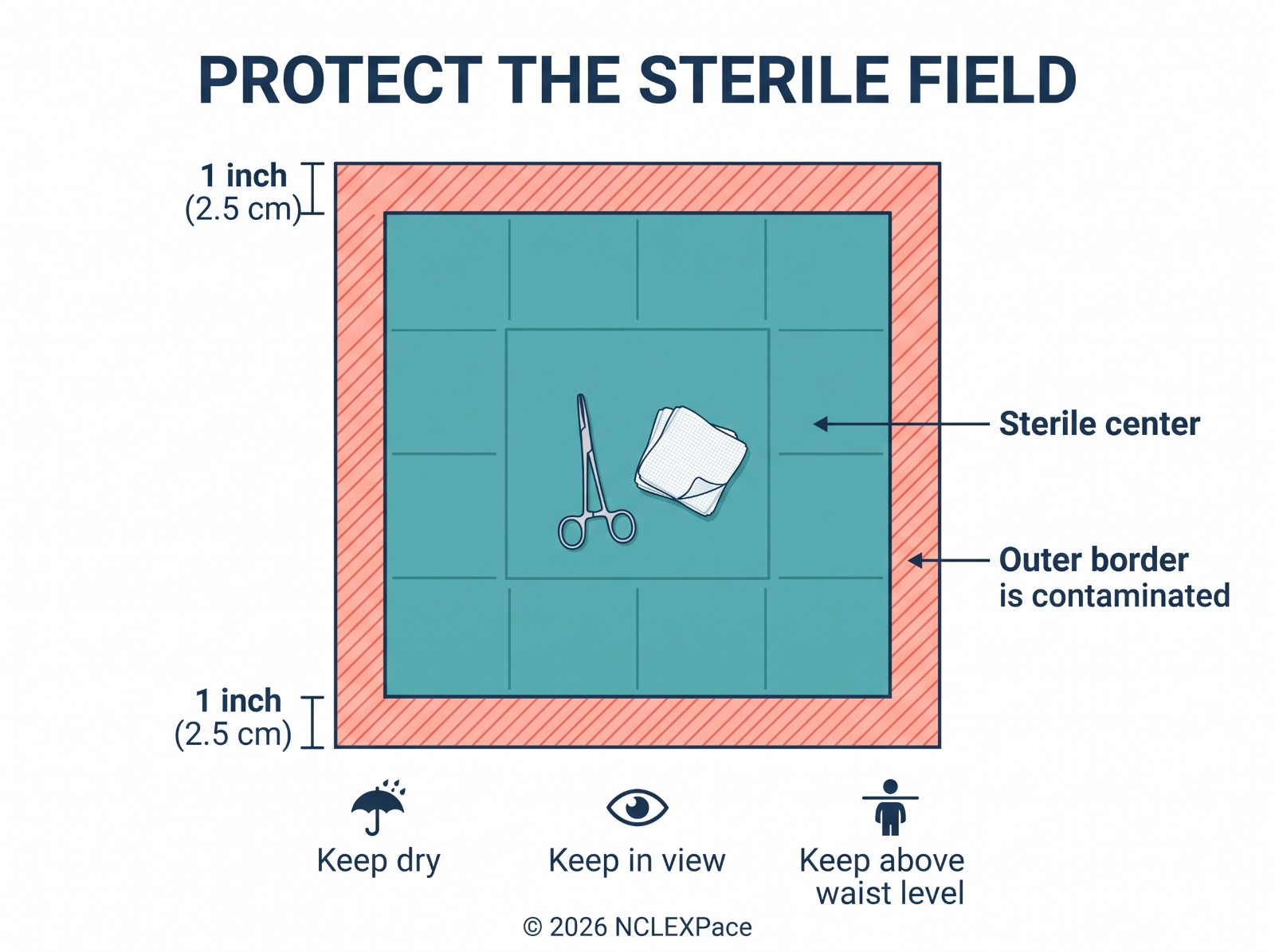
Preventing CLABSI — the bundle
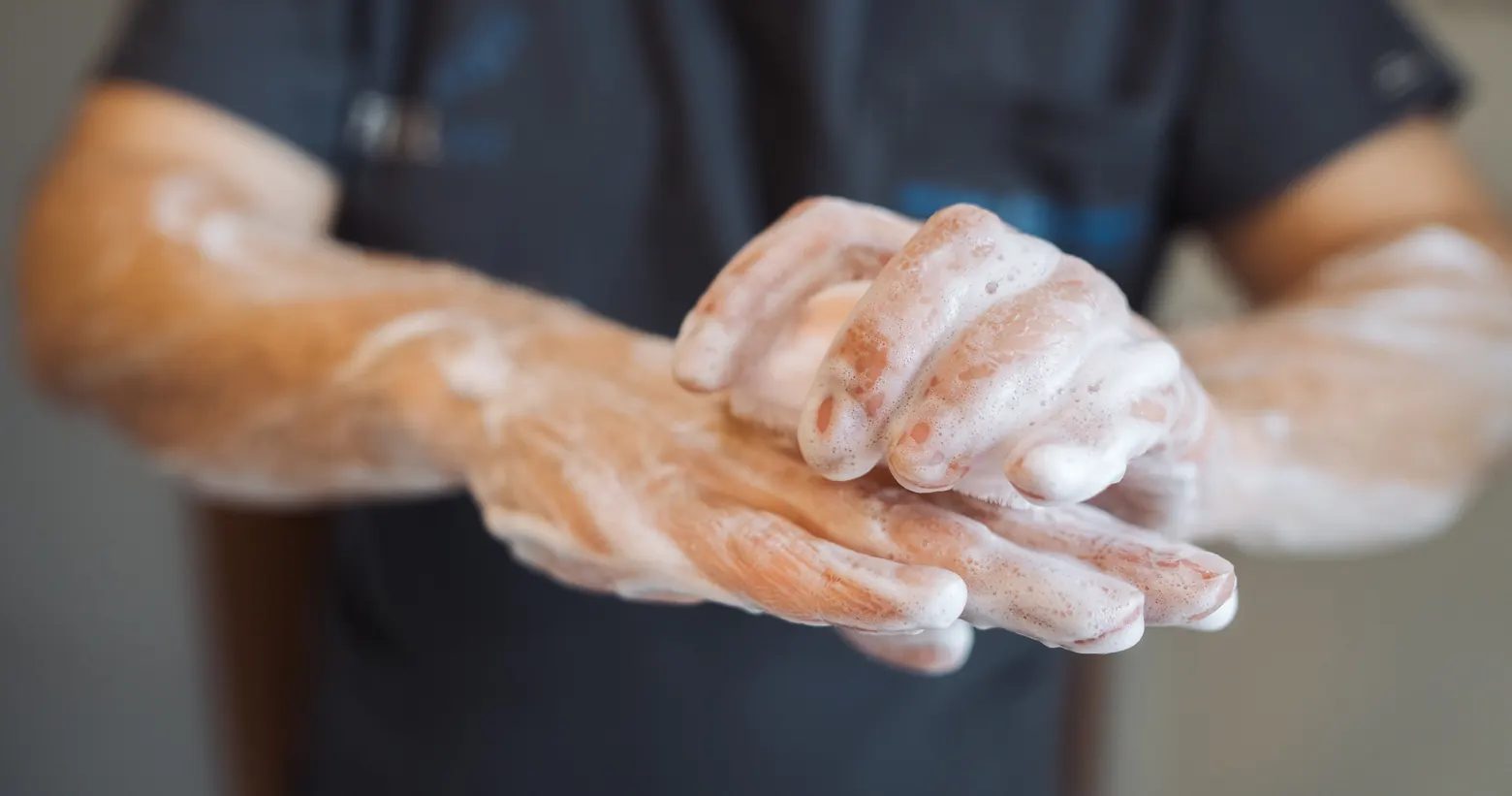
- Hand hygiene before and after any contact with the line.
- Scrub the hub with alcohol or chlorhexidine for the recommended time and let it dry — every access, every time. The single most quoted item in this topic.
- Chlorhexidine skin antisepsis at dressing changes.
- Sterile dressing changes — transparent dressings typically every 7 days, gauze every 2 days, and immediately whenever damp, loose or soiled.
- Change administration sets per policy — more frequently for blood, blood products and lipid emulsions.
- Review daily whether the line is still needed, and remove it as soon as it is not. Nothing prevents infection like not having a line.
- Avoid the femoral site where a subclavian or jugular route is possible.
The complications and what you do
| Problem | What you see | What you do |
|---|---|---|
| Air embolism | Sudden dyspnoea, chest pain, hypotension, tachycardia, anxiety, sometimes a churning murmur; often at connection, disconnection or removal | Clamp the line. Position flat, left side, head down. Oxygen. Call for help. Left-lateral Trendelenburg traps air in the right atrium |
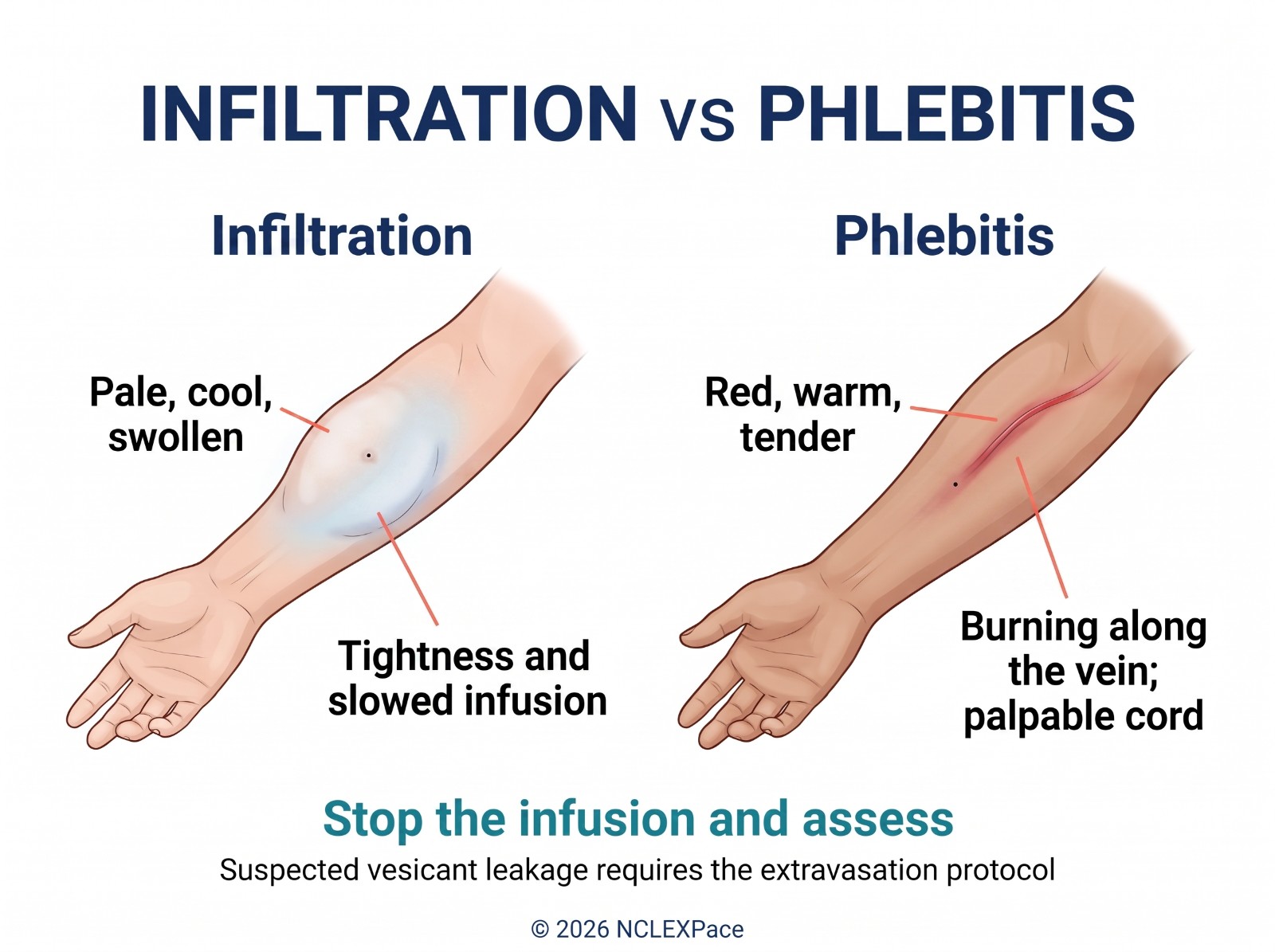
| Infection / CLABSI | Fever, chills — especially spiking when the line is flushed — redness, tenderness or drainage at the site | Assess, obtain cultures as ordered (often peripheral and line), notify. Do not simply keep using it |
| Occlusion | Sluggish or absent flow; unable to aspirate | Check for closed clamps and kinks, reposition, ask the client to raise the arm or turn the head. Never force a flush — a clot can be pushed into the circulation |
| Thrombosis | Arm, neck or facial swelling; visible distended veins on that side | Stop using the line, notify. The baseline arm measurement is what makes this obvious early |
| Migration / dislodgement | External length has changed; pain on infusion; swelling at the site | Stop the infusion, secure the line, notify — the tip may no longer be central |
Flushing: use a 10 mL or larger syringe barrel — smaller barrels generate high pressure and can rupture the catheter. Use a pulsatile push-pause technique and maintain positive pressure as you clamp so blood does not track back into the tip.
NCLEX tip: Two answers repeat almost verbatim. Any new central line that has not had its X-ray is not used, whatever the urgency in the stem. And air embolism is always left side, head down — an option offering right side, upright or high Fowler is the distractor.
Educational use only: this article supports nursing review and does not replace clinical judgment, facility protocols, or instructions from an authorised prescriber.
5 NCLEX practice questions on this topic
The same questions, player and partial-credit scoring students use inside NCLEXPace: answer, submit, read the full rationale, then Next. Your score is waiting at the end. No account needed for these.
A free account opens 20 more questions, a case study, a video and a cheat sheet. The full bank has 3,200+ questions with rationales, by topic.
Practice more, free →Ready for the full bank? See NCLEXPace plans and prices: one payment for 1, 2, 3 or 6 months.
Frequently asked questions
Common follow-up questions on Infection Control, Safety & Risk Reduction.
Why must a chest X-ray be done before using a new central line?
To confirm the catheter tip sits in the correct position, usually the lower superior vena cava, and to rule out pneumothorax from the insertion. Infusing through a malpositioned catheter can deliver vesicants or concentrated solutions into the wrong vessel or the pleural space.
What is the position for a suspected air embolism?
Clamp the catheter, then place the client flat on the left side with the head lowered (left-lateral Trendelenburg) so air is trapped in the right atrium rather than travelling to the pulmonary circulation. Give oxygen and call for help immediately.
What restrictions apply to the arm with a PICC line?
No blood pressure measurement, no venepuncture and no injections in that arm. Upper-arm circumference is measured at baseline so that swelling from thrombosis is recognised early.
Why is a 10 mL syringe used to flush a central line?
Smaller syringe barrels generate much higher pressure at the catheter tip and can rupture it. A 10 mL or larger barrel keeps pressure within a safe range, and a resistant line is never force-flushed because a clot can be dislodged into the circulation.
How is a port accessed?
With a non-coring Huber needle using sterile technique, after palpating the septum and preparing the skin with chlorhexidine. A standard hypodermic needle cores the septum and destroys the port.
What is the most effective way to prevent a central line infection?
Removing the line as soon as it is no longer needed. Beyond that, hand hygiene, scrubbing the hub before every access, chlorhexidine skin antisepsis, sterile dressing changes and daily review of necessity form the prevention bundle.
Sources and references
- Harding MM, Kwong J, Hagler D, Reinisch C. Lewis's Medical-Surgical Nursing: Assessment and Management of Clinical Problems. 12th ed. Elsevier; 2023; Chapter: Fluid, Electrolyte, and Acid-Base Imbalances.
- Buetti N, et al. Strategies to Prevent Central Line-Associated Bloodstream Infections in Acute-Care Hospitals: 2022 Update. Infection Control & Hospital Epidemiology. 2022;43(5):553-569.
Reviewed by the NCLEXPace team, October 2026.
Keep reading


3,200+ NCLEX questions with think-like-a-nurse rationales, unfolding case studies and adaptive readiness exams. Start with free practice questions, then choose a plan when you are ready.
Create Free Account →