
Shock Types Compared: Hypovolemic, Cardiogenic, Septic, Neurogenic
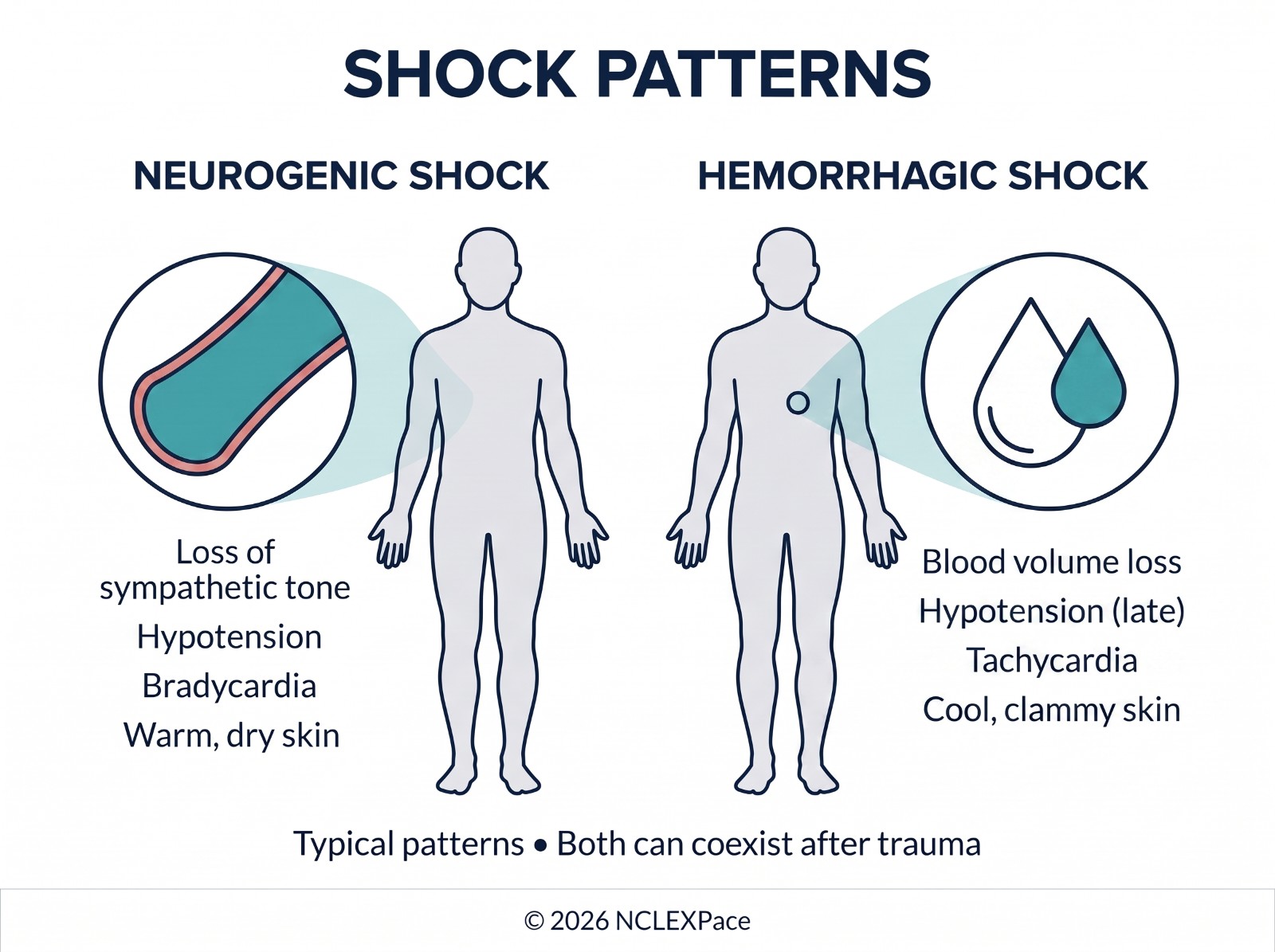
All shock states share hypotension, tachycardia and poor perfusion, but the cause separates them: hypovolaemic shock loses volume, cardiogenic shock fails as a pump, septic shock vasodilates from infection, and neurogenic shock loses sympathetic tone, which is why neurogenic shock is the one type that presents with bradycardia and warm dry skin rather than tachycardia and cold clammy skin.

Every shock type compared: the differentiator, the distinguishing features and the treatment traps, with sepsis in the same lesson.
From the Intensive NCLEX Course. This lesson is a free sample: watch it with a free account.
Shock questions all open the same way: a client with a low blood pressure and a fast heart rate. What separates them is never the blood pressure — it is the cause, and the cause changes the treatment completely. Give fluids to the wrong kind of shock and you make it worse.
Step 1 — Know all the shock types
| Feature | Hypovolemic | Cardiogenic | Septic (distributive) | Anaphylactic (distributive) | Neurogenic (distributive) |
|---|---|---|---|---|---|
| Cause | Blood or fluid loss | The heart cannot pump — MI, failure | Infection → vasodilation | Allergen → histamine release | Spinal cord injury → loss of sympathetic tone |
| Skin | Cold, pale, clammy | Cold, clammy | Warm, flushed (early) | Flushed, urticaria, swelling | Warm, dry, flushed |
| Heart rate | ↑ Tachycardia | ↑ Tachycardia | ↑ Tachycardia | ↑ Tachycardia | ↓ Bradycardia |
| Blood pressure | ↓ | ↓ | ↓ | ↓ | ↓ |
| Cardiac output | ↓ | ↓ | ↑ early, then ↓ | ↓ | ↓ |
| Lungs | Clear | Crackles, pulmonary congestion | May be clear | Wheeze, stridor | Clear |
| First treatment | IV fluids, then blood | NOT fluid loading — support the pump, inotropes | Fluids, cultures, antibiotics, vasopressors | Epinephrine | Fluids and vasopressors; immobilise the spine |
Step 2 — The differentiator that does most of the work
Feel the skin. It splits the whole table in two:
- Cold skin — the blood is missing or not moving. The body clamps down the periphery to protect the core. Hypovolemic and cardiogenic.
- Warm skin — the vessels are dilated. The blood is there, it is just in the wrong place. Septic, anaphylactic, neurogenic.
Then one more question separates the warm group: what is the heart rate doing? Everything tachycardic except neurogenic, where the loss of sympathetic tone means the heart cannot speed up. Warm skin plus bradycardia is neurogenic shock and nothing else.
Step 3 — Eliminate by distinguishing feature
Work through a typical four-option item this way:
| The clue in the stem | What it points to |
|---|---|
| Warm skin + bradycardia after a fall from height | Neurogenic — spinal cord injury |
| Urticaria and bronchospasm minutes after a drug or food | Anaphylactic |
| Ruptured spleen, pale and cool, tachycardic | Hypovolemic |
| Fever with bounding pulses and warm flushed skin | Early septic — the hyperdynamic phase |
| Recent MI, crackles, cool and clammy | Cardiogenic |
Step 4 — The treatment traps
| Trap | Why it is wrong |
|---|---|
| Fluid bolus for cardiogenic shock | The pump is already failing. More volume floods the lungs |
| Antihistamine first for anaphylaxis | Epinephrine is first, always. Antihistamines and steroids come after |
| Trendelenburg for shock | No longer recommended — it worsens breathing without helping perfusion |
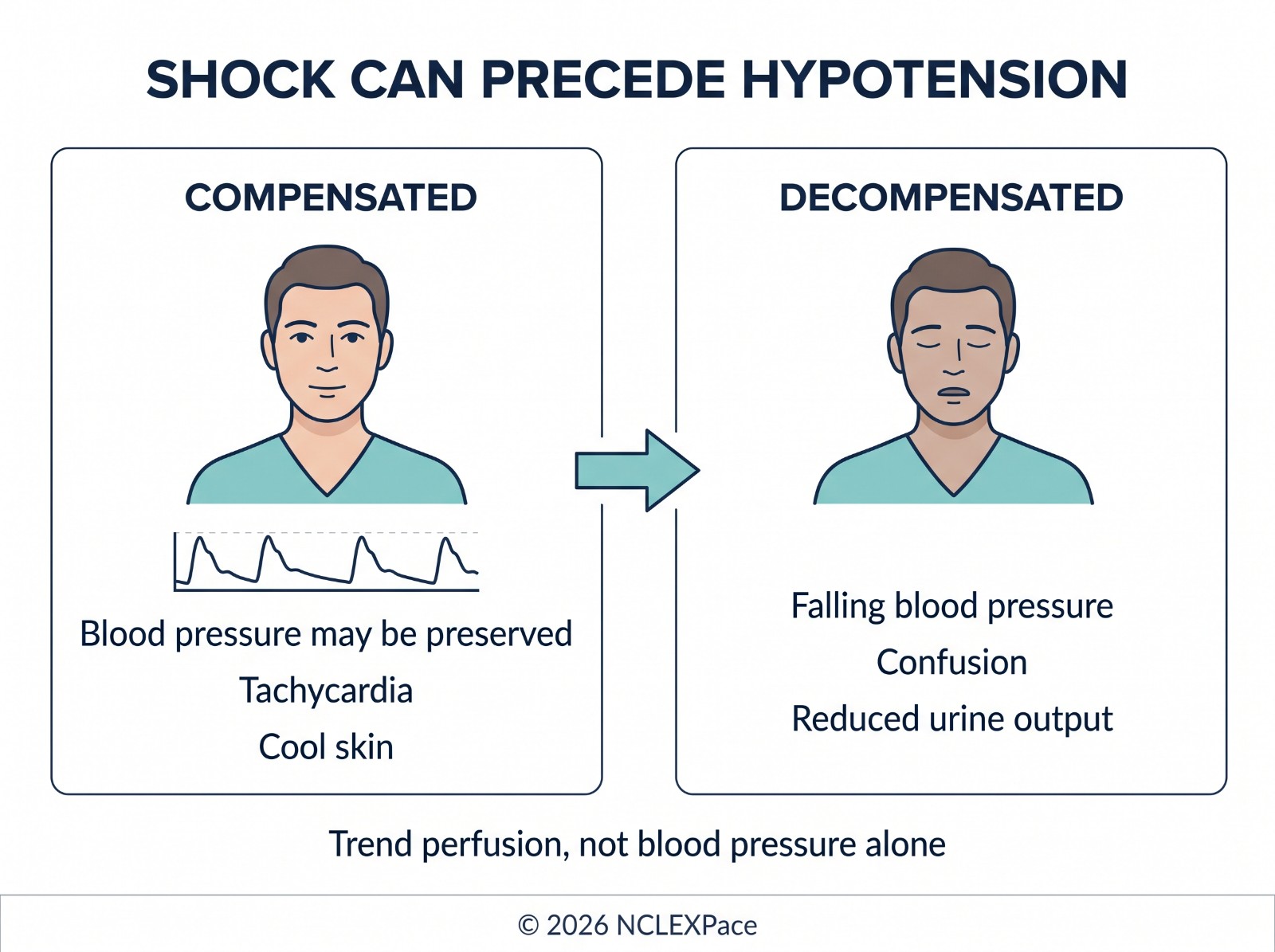
| Waiting for the blood pressure to fall to diagnose it | Hypotension is late. Tachycardia, narrowing pulse pressure, restlessness and falling urine output come first |
The earliest sign, in any type
Restlessness and anxiety. A dropping urine output below 30 mL/hr and a client who suddenly cannot settle are earlier and more reliable than a blood pressure reading. By the time the pressure drops, compensation has already failed.
NCLEX tip: In hypovolemic shock the blood is missing from the vessels, so the skin goes cold as the body shunts what is left to the core. In septic and neurogenic shock the vessels are dilated, so the skin goes warm. Skin temperature is your differentiator — reach for it before you reach for the numbers.
5 NCLEX practice questions on this topic
The same questions, player and partial-credit scoring students use inside NCLEXPace: answer, submit, read the full rationale, then Next. Your score is waiting at the end. No account needed for these.
A free account opens 20 more questions, a case study, a video and a cheat sheet. The full bank has 3,200+ questions with rationales, by topic.
Practice more, free →Ready for the full bank? See NCLEXPace plans and prices: one payment for 1, 2, 3 or 6 months.
Frequently asked questions
Common follow-up questions on Body Systems & Clinical Content.
Which type of shock causes bradycardia instead of tachycardia?
Neurogenic shock. Loss of sympathetic tone after a spinal cord injury leaves the parasympathetic system unopposed, producing hypotension with bradycardia and warm, dry, flushed skin: the opposite of every other shock presentation.
What is the first sign of shock?
Restlessness, anxiety and altered mental status from reduced cerebral perfusion, which appear before blood pressure falls. Tachycardia and narrowing pulse pressure follow; hypotension is a late sign.
What is the priority treatment for hypovolaemic shock?
Restore volume: two large-bore intravenous lines with isotonic crystalloid such as normal saline or lactated Ringer's, control any ongoing bleeding, and give blood products as prescribed. Fluid replacement takes precedence over vasopressors.
How does septic shock present differently in its early stage?
Early or warm septic shock produces vasodilation with warm flushed skin, bounding pulses, fever and a high cardiac output. As it progresses to the cold stage the client becomes cool, clammy and hypotensive, and mortality rises sharply: early recognition and antibiotics within the first hour are the priority.
Sources and references
- Harding MM, Kwong J, Hagler D, Reinisch C. Lewis's Medical-Surgical Nursing: Assessment and Management of Clinical Problems. 12th ed. Elsevier; 2023; Chapter: Shock, Sepsis, and Multiple Organ Dysfunction Syndrome.
- Evans L, et al. Surviving Sepsis Campaign: International Guidelines for Management of Sepsis and Septic Shock 2021. Critical Care Medicine. 2021;49(11):e1063-e1143.
Reviewed by the NCLEXPace team, October 2026.
Keep reading


3,200+ NCLEX questions with think-like-a-nurse rationales, unfolding case studies and adaptive readiness exams. Start with free practice questions, then choose a plan when you are ready.
Create Free Account →