
Heart Failure Left vs Right: The Table That Settles Every Question
Left-sided heart failure backs blood into the lungs, so it presents with dyspnoea, orthopnoea, crackles and a frothy cough; right-sided failure backs blood into the body, so it presents with peripheral oedema, jugular venous distension, hepatomegaly and weight gain. Remember left equals lungs and right equals rest of the body.

Left-sided and right-sided heart failure: the findings side by side, the causes, and the nursing priorities.
From the Intensive NCLEX Course. This lesson is a free sample: watch it with a free account.
Almost every heart failure question on the NCLEX resolves to one decision: which side failed? Get that right and the findings, the priorities and the teaching all follow. There is one sentence that gets you there.
Step 1 — The one sentence to remember
Left side backs up into the Lungs. Right side backs up into the Rest of the body. Left and Lungs both start with L. That is the whole model — everything below is a consequence of it.
Step 2 — The findings, side by side
| Feature | Left-sided failure | Right-sided failure |
|---|---|---|
| Blood backs up into | Pulmonary circulation | Systemic circulation |
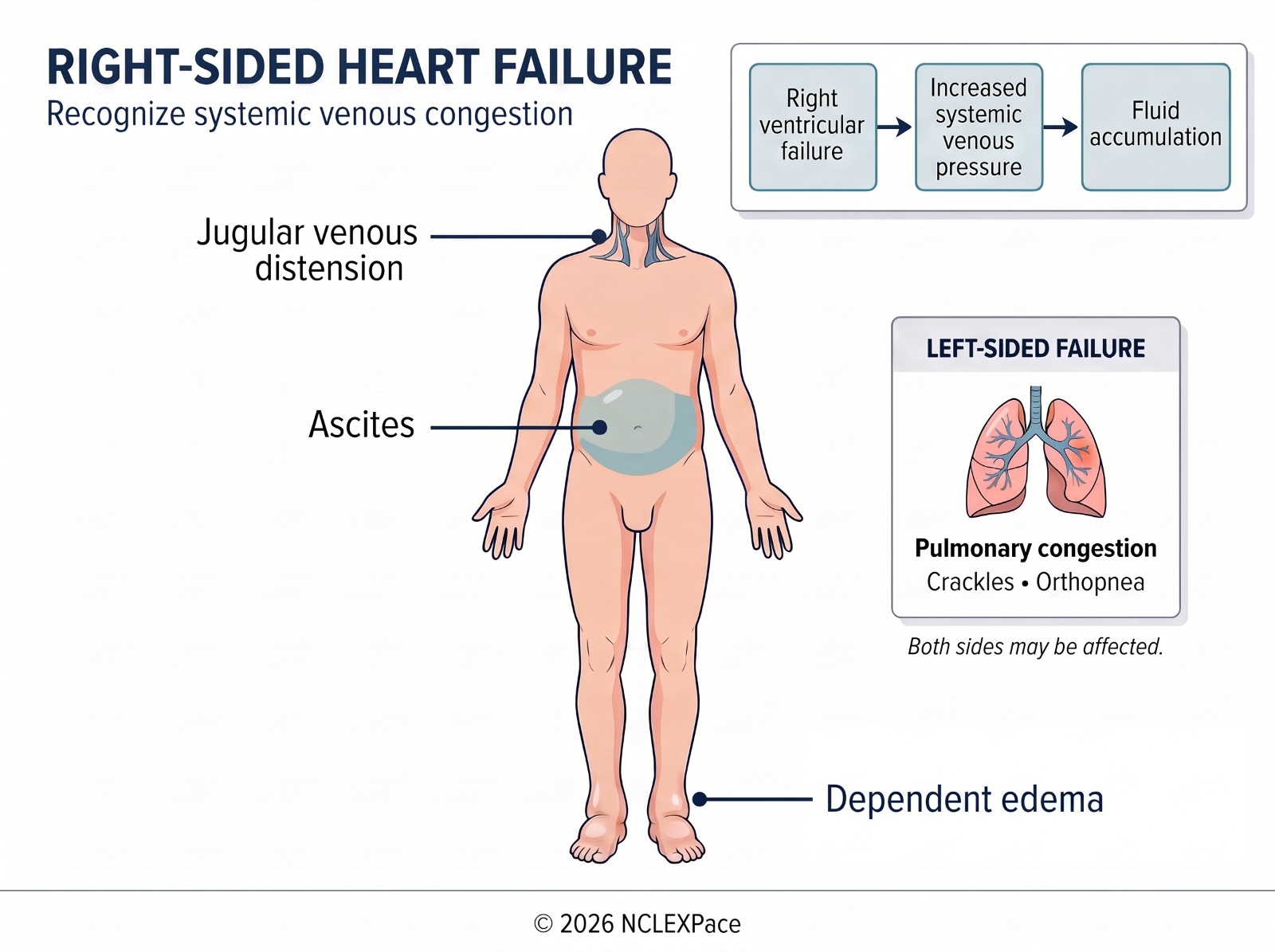
| Hallmark findings | Dyspnea, crackles, orthopnea, paroxysmal nocturnal dyspnea, frothy pink sputum | Peripheral edema, JVD, hepatomegaly, ascites, weight gain |
| Cough | Yes — worse lying flat | Not typical |
| What you hear | Crackles in the lung bases; S3 gallop | Lungs often clear |
| What you see | A client who cannot lie flat | Swollen ankles, distended neck veins |
| Most common cause | Hypertension, MI | Left-sided failure; also COPD (cor pulmonale) |
Step 3 — Why the causes matter
The most common cause of right-sided failure is left-sided failure. Pressure that backs up into the lungs eventually strains the right ventricle. That is why advanced clients show both — crackles and ankle edema. A question describing both is not a contradiction; it is describing later disease.
The other route to right-sided failure is chronic lung disease. Long-standing COPD raises pulmonary pressures until the right ventricle fails — cor pulmonale. A COPD client with new leg swelling and JVD is that question.
Step 4 — Nursing priorities
| Priority | What to do | Why |
|---|---|---|
| Positioning | High Fowler's, legs dependent | Drops preload and lets the diaphragm move — first action in acute pulmonary congestion |
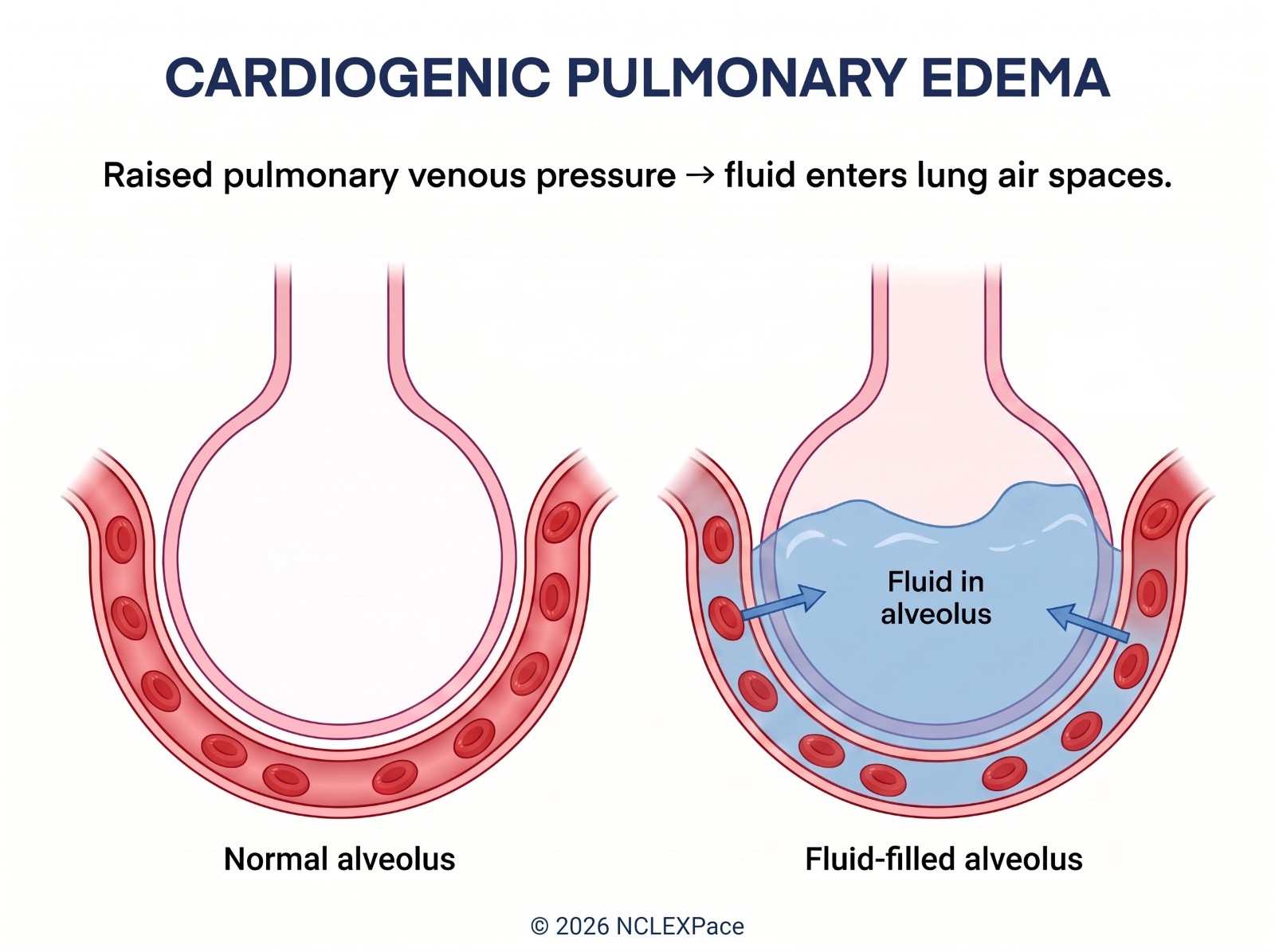
| Oxygenation | Oxygen, monitor SpO₂ and work of breathing | Fluid in alveoli is a gas-exchange problem |
| Fluid status | Daily weight, same time, same scale, same clothing | The single most reliable measure — more reliable than intake and output |
| Medication | Diuretics; monitor potassium with loop diuretics | Furosemide wastes K⁺, and low K⁺ plus digoxin causes toxicity |
| Diet | Sodium restriction; fluid restriction if ordered | Sodium holds water in the vessels |
The weight rule the exam expects you to report
2–3 lb in a day, or 5 lb in a week — that is the teaching point and the reportable finding. A client who gained three pounds overnight has retained roughly a litre and a half of fluid, and that is worth a phone call before it becomes an admission.
The emergency version
Acute pulmonary edema is left-sided failure at its worst: severe dyspnea, anxiety, and pink frothy sputum. Sit the client upright with legs dependent, give oxygen, and notify the provider immediately. Frothy pink sputum in any stem is an emergency finding, not a symptom to monitor.
NCLEX tip: When a heart failure question asks for the best indicator of fluid status, the answer is daily weight — not intake and output, not edema, not lung sounds. Scales do not forget to chart, and a kilogram of weight is a litre of fluid.
5 NCLEX practice questions on this topic
The same questions, player and partial-credit scoring students use inside NCLEXPace: answer, submit, read the full rationale, then Next. Your score is waiting at the end. No account needed for these.
A free account opens 20 more questions, a case study, a video and a cheat sheet. The full bank has 3,200+ questions with rationales, by topic.
Practice more, free →Ready for the full bank? See NCLEXPace plans and prices: one payment for 1, 2, 3 or 6 months.
Frequently asked questions
Common follow-up questions on Body Systems & Clinical Content.
What are the signs of left-sided heart failure?
Dyspnoea, orthopnoea, paroxysmal nocturnal dyspnoea, crackles on auscultation, a cough that may produce pink frothy sputum, fatigue and restlessness from poor oxygenation.
What are the signs of right-sided heart failure?
Dependent peripheral oedema, jugular venous distension, hepatomegaly and ascites, weight gain, and nausea or anorexia from congestion of the gastrointestinal tract.
Which assessment finding is the earliest sign of fluid overload?
Daily weight. A gain of 2–3 pounds in a day or 5 pounds in a week signals fluid retention before oedema or crackles appear, which is why daily weights at the same time on the same scale are the priority teaching point.
How should a client with heart failure be positioned?
High Fowler's position, which lowers the diaphragm and eases the work of breathing. Combine it with oxygen as prescribed and rest periods between activities.
Sources and references
- Harding MM, Kwong J, Hagler D, Reinisch C. Lewis's Medical-Surgical Nursing: Assessment and Management of Clinical Problems. 12th ed. Elsevier; 2023; Chapter: Heart Failure.
- Heidenreich PA, et al. 2022 AHA/ACC/HFSA Guideline for the Management of Heart Failure. Circulation. 2022;145(18):e895-e1032.
Reviewed by the NCLEXPace team, October 2026.
Keep reading


3,200+ NCLEX questions with think-like-a-nurse rationales, unfolding case studies and adaptive readiness exams. Start with free practice questions, then choose a plan when you are ready.
Create Free Account →