Seizure Precautions and Status Epilepticus: What Never to Do
During a seizure you stay with the client, protect their head, clear the area and turn them side-lying when you can: and you never restrain them, never force anything into their mouth, and never move them unless they are in danger. Status epilepticus is continuous seizing or repeated seizures without recovery between them, and it is a medical emergency treated with airway support and urgent intravenous medication.

Seizures and status epilepticus: what to do during a seizure, what never to do, the precautions at the bedside and the medications.
From the Intensive NCLEX Course. See the course; the full video library is part of Pro and Ultimate.
Seizure questions are mostly about what you never do. Stay with the client, protect the head, clear the area and turn them side-lying — and never restrain them, never force anything into the mouth, and never move them unless they are in danger.
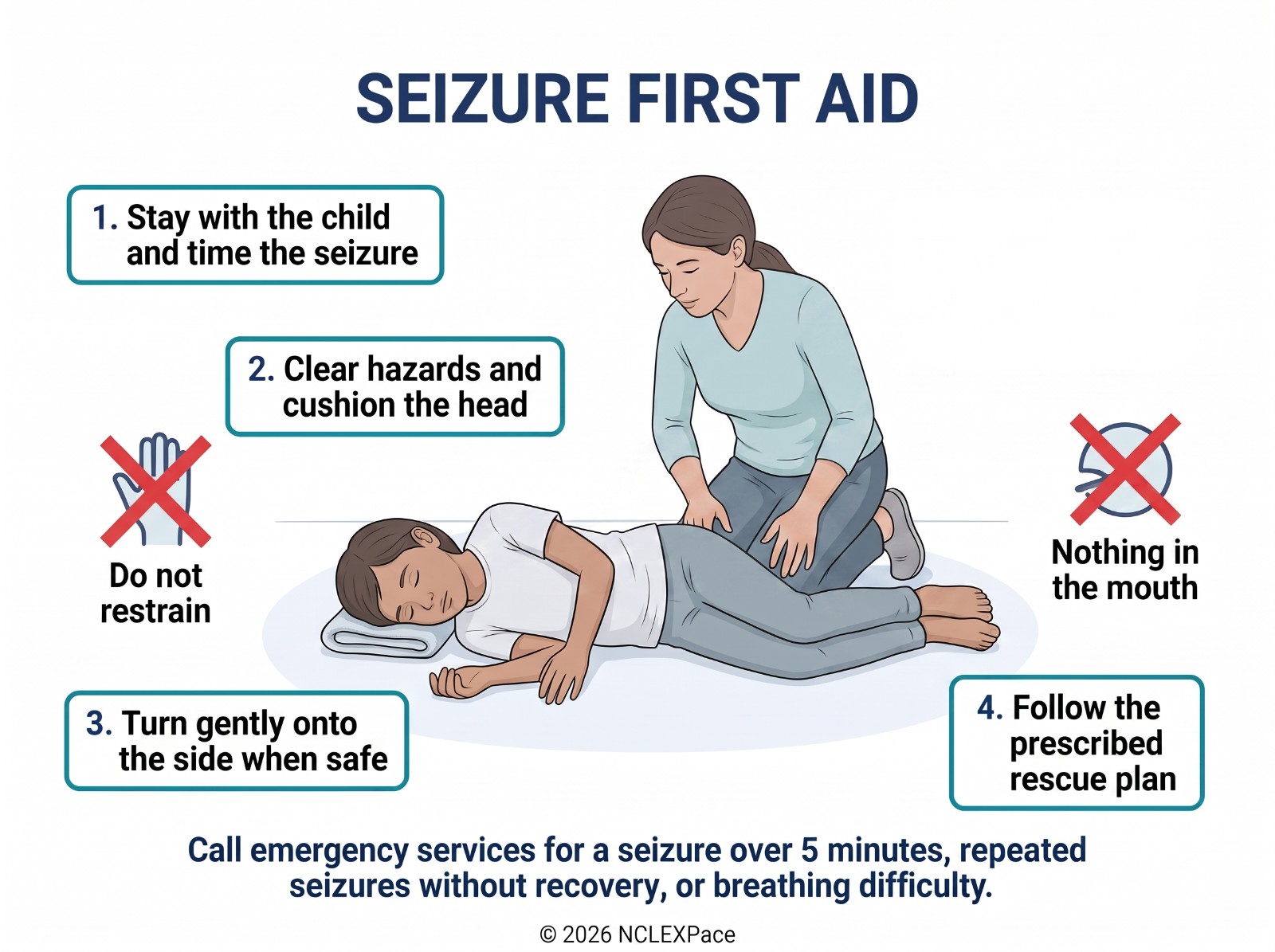
What you do during a seizure
- Stay with the client. Do not leave to get help — use the call system.
- Protect the head — a pillow, a folded blanket, your hands.
- Clear the surroundings of furniture and hard objects.
- Turn side-lying when it can be done safely, so secretions drain and the tongue falls forward.
- Loosen restrictive clothing, particularly around the neck.
- Time it — duration decides whether this becomes status epilepticus.
- Observe and document — what the client was doing beforehand, where it started, which limbs, whether the eyes deviated, incontinence, duration, and the state afterwards.
What you never do
| Never | Why |
|---|---|
| Restrain the limbs | Holding a convulsing limb causes fractures and dislocations. The movement cannot be stopped by force |
| Insert anything into the mouth | No airway, no padded tongue blade, no fingers. It breaks teeth, causes aspiration, and can be bitten through. A client cannot swallow their tongue — the old advice is wrong |
| Move the client | Unless they are in immediate danger — at the top of stairs, near a heat source |
| Leave them alone | Observation is the intervention |
These four “nevers” are the single most reliably tested part of this topic. If an option contains one of them, it is wrong before you read the rest of it.
Seizure precautions — what belongs at the bedside beforehand
- Bed in the lowest position with side rails up and padded.
- Suction and oxygen set up and working at the bedside.
- IV access maintained in a client at risk.
- Nothing hard, sharp or hot within reach; no oral thermometers.
- Supervision during showering; consider a shower rather than a bath.
Precautions are anticipatory — the exam asks about them for clients with a known seizure disorder, alcohol or benzodiazepine withdrawal, eclampsia, head injury, severe hyponatraemia, and high fever in young children.
Post-ictal care
After the seizure the client is typically drowsy, confused and may be briefly incontinent or have bitten their tongue.
- Keep them side-lying and maintain the airway; suction secretions if needed.
- Allow them to sleep — do not force them awake.
- Reorient gently and repeatedly as they surface; expect no memory of the event.
- Assess for injury — head, tongue, shoulders, and posterior shoulder dislocation.
- Provide privacy and dignity, especially after incontinence, and document fully.
Status epilepticus
Continuous seizure activity, or repeated seizures without regaining consciousness between them. The brain's oxygen demand outstrips supply, and the risk is permanent neurological injury or death — so it is treated as an airway and circulation emergency, not a neurological curiosity.
| Priority | What happens |
|---|---|
| 1 | Airway and oxygen — position, suction, high-flow oxygen; prepare for intubation |
| 2 | IV access and glucose check — hypoglycaemia is a reversible cause |
| 3 | Intravenous benzodiazepines (lorazepam or diazepam) as first-line, per orders |
| 4 | Longer-acting anticonvulsant loading, continuous monitoring, treat the underlying cause |
Teaching a client with a seizure disorder
- Never stop anticonvulsants abruptly — withdrawal can precipitate status epilepticus.
- Take medication at the same time daily; report rash, unusual bruising or bleeding gums.
- Phenytoin causes gingival hyperplasia — meticulous oral care and regular dental review.
- Avoid alcohol, sleep deprivation and, where relevant, flashing lights.
- Carry identification; know local driving restrictions after a seizure.
- Teach family what to do — and what never to do.
NCLEX tip: Two questions recur. During an active seizure, the correct answer protects and observes — anything that restrains, inserts or relocates is wrong. In status epilepticus, the correct answer is airway first; the drug comes after the airway is secured, however urgent the drug feels.
Educational use only: this article supports nursing review and does not replace clinical judgment, facility protocols, or instructions from an authorised prescriber.
5 NCLEX practice questions on this topic
The same questions, player and partial-credit scoring students use inside NCLEXPace: answer, submit, read the full rationale, then Next. Your score is waiting at the end. No account needed for these.
A free account opens 20 more questions, a case study, a video and a cheat sheet. The full bank has 3,200+ questions with rationales, by topic.
Practice more, free →Ready for the full bank? See NCLEXPace plans and prices: one payment for 1, 2, 3 or 6 months.
Frequently asked questions
Common follow-up questions on Body Systems & Clinical Content.
What should the nurse do during a seizure?
Stay with the client, protect the head, clear the area of hazards, turn them side-lying if it can be done safely, loosen tight clothing, time the seizure and observe the details for documentation. Call for help using the call system rather than leaving the bedside.
Why should nothing be put in the mouth during a seizure?
Inserting an airway, tongue blade or fingers breaks teeth, causes soft-tissue injury and aspiration, and risks injuring the person doing it. A client cannot swallow their tongue, so the practice protects against a danger that does not exist while creating several that do.
What is status epilepticus?
Continuous seizure activity, or repeated seizures without regaining consciousness in between. Cerebral oxygen demand exceeds supply, so it is a medical emergency requiring airway management, oxygen, intravenous access, a glucose check and urgent intravenous benzodiazepines.
What are seizure precautions?
Bed in the lowest position with padded side rails raised, suction and oxygen set up at the bedside, intravenous access maintained, and no hard, sharp or hot items within reach. They are put in place before any seizure occurs, for clients known to be at risk.
What is post-ictal care?
Keep the client side-lying to protect the airway, allow them to sleep, reorient gently as they wake, assess for injuries including tongue trauma and shoulder dislocation, provide privacy after incontinence, and document the event fully. Confusion and amnesia for the seizure are expected.
Sources and references
- Harding MM, Kwong J, Hagler D, Reinisch C. Lewis's Medical-Surgical Nursing: Assessment and Management of Clinical Problems. 12th ed. Elsevier; 2023; Chapter: Chronic Neurologic Problems.
- Glauser T, et al. Evidence-Based Guideline: Treatment of Convulsive Status Epilepticus in Children and Adults: Report of the Guideline Committee of the American Epilepsy Society. Epilepsy Currents. 2016;16(1):48-61.
Reviewed by the NCLEXPace team, October 2026.
Keep reading

3,200+ NCLEX questions with think-like-a-nurse rationales, unfolding case studies and adaptive readiness exams. Start with free practice questions, then choose a plan when you are ready.
Create Free Account →