
Pressure Injury Staging and the Prevention That Works
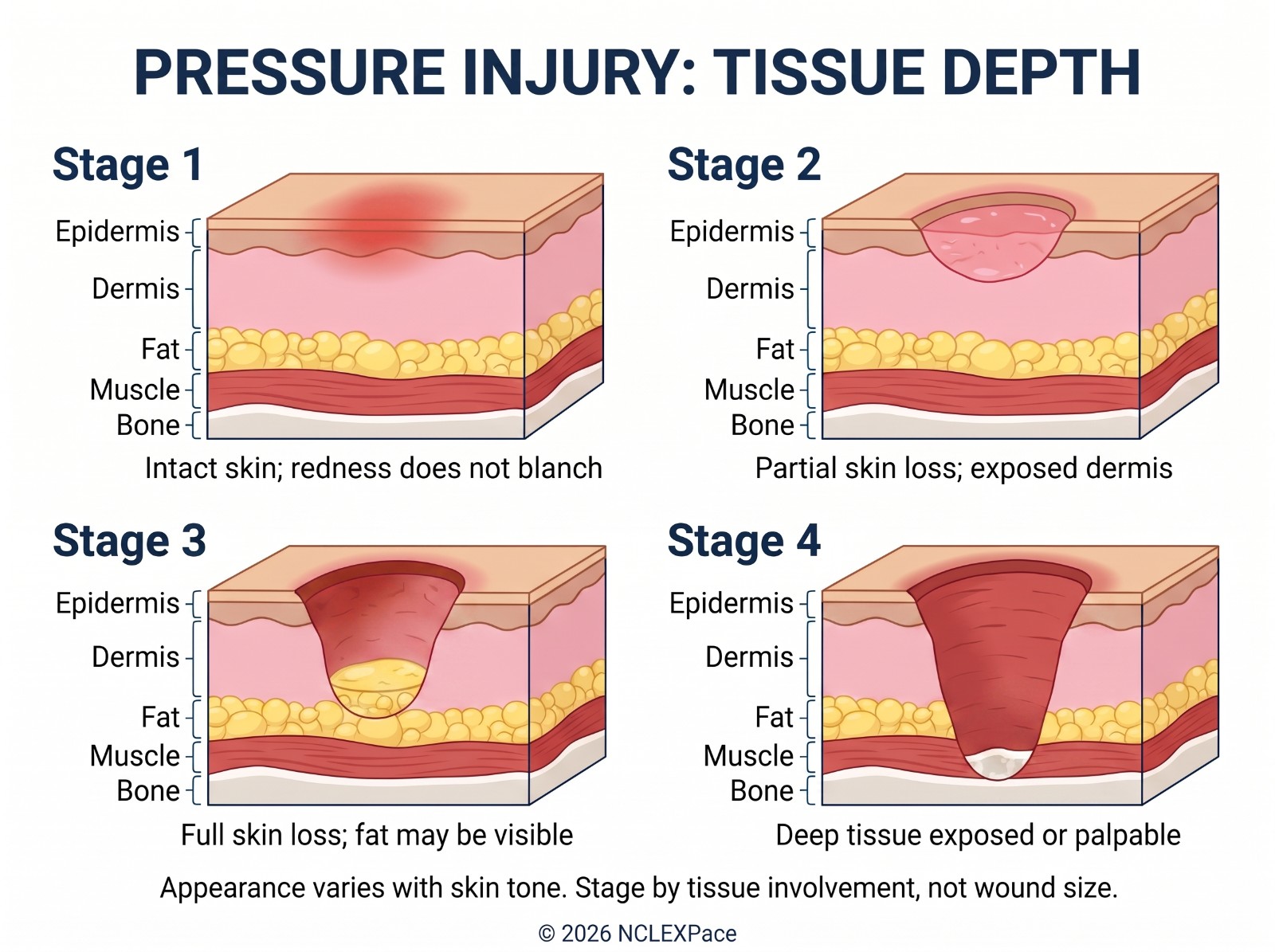
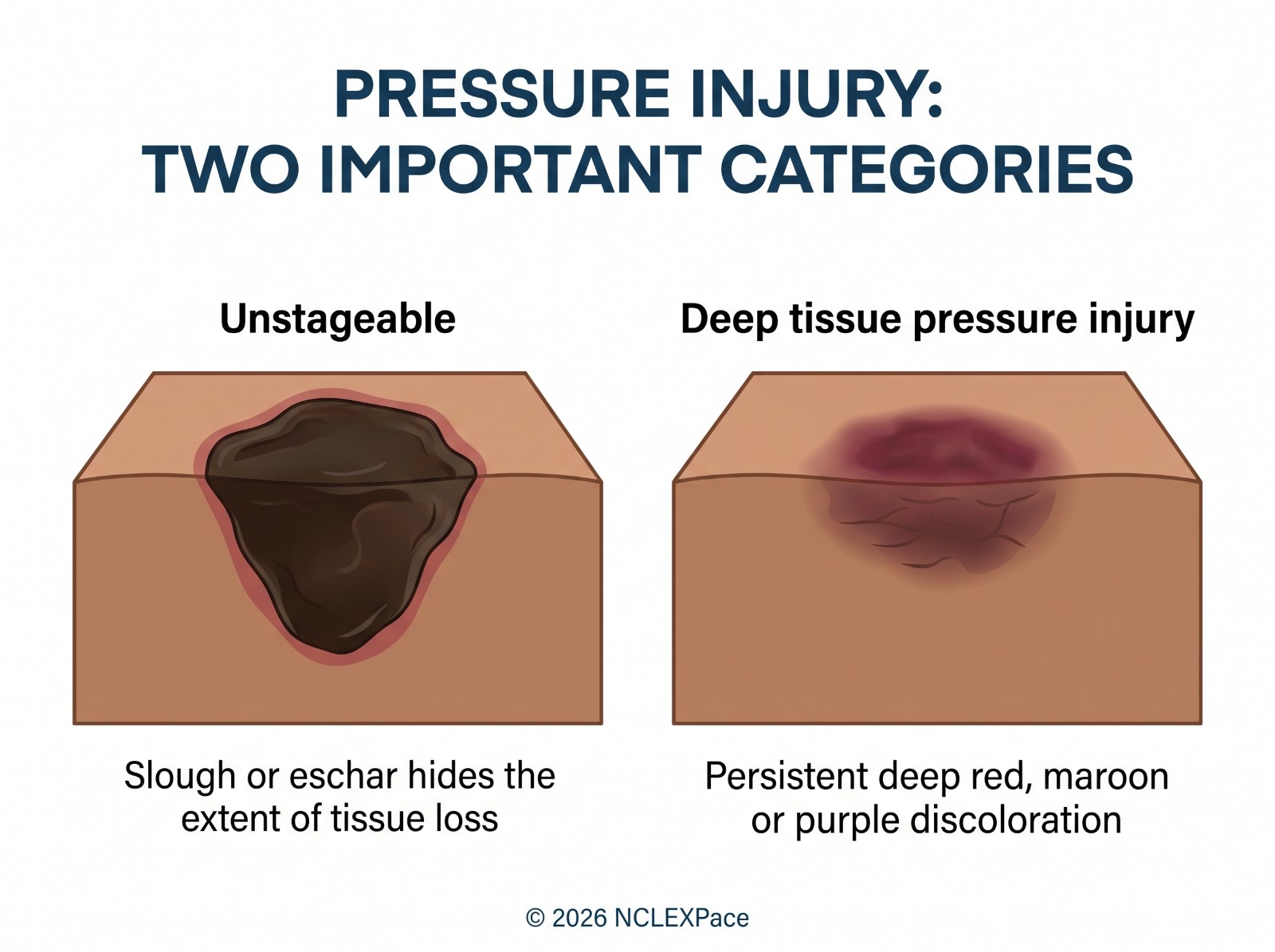
Pressure injuries are staged by the deepest tissue you can see. Stage 1 is intact skin with non-blanchable redness; stage 2 is partial thickness with the epidermis broken; stage 3 reaches subcutaneous fat; stage 4 exposes muscle, tendon or bone. If slough or eschar covers the base, it is unstageable until that is removed: and a purple, boggy area under intact skin is a deep tissue injury.

Pressure injuries: every stage with what you see and feel, where they form, and the prevention that actually works.
From the Intensive NCLEX Course. See the course; the full video library is part of Pro and Ultimate.
Pressure injuries are staged by the deepest tissue you can see. Get the staging logic and two rules — stages never reverse, and stable heel eschar is left intact — and the questions become mechanical.
The stages
| Stage | What you see | The distinguishing feature |
|---|---|---|
| Stage 1 | Intact skin with localised redness that does not blanch when pressed; may feel warmer, cooler, firmer, boggier or more painful | The skin is not broken. In darker skin tones colour change is subtle — temperature, firmness and pain matter more than colour |
| Stage 2 | Partial-thickness loss of dermis — a shallow open ulcer with a pink-red base, or an intact or ruptured serum-filled blister | The surface is broken but you cannot see fat. No slough, no bruising |
| Stage 3 | Full-thickness loss. Subcutaneous fat visible; may have slough, undermining or tunnelling | Fat visible, but no muscle, tendon or bone |
| Stage 4 | Full-thickness with exposed muscle, tendon, cartilage or bone | Structure visible. High risk of osteomyelitis |
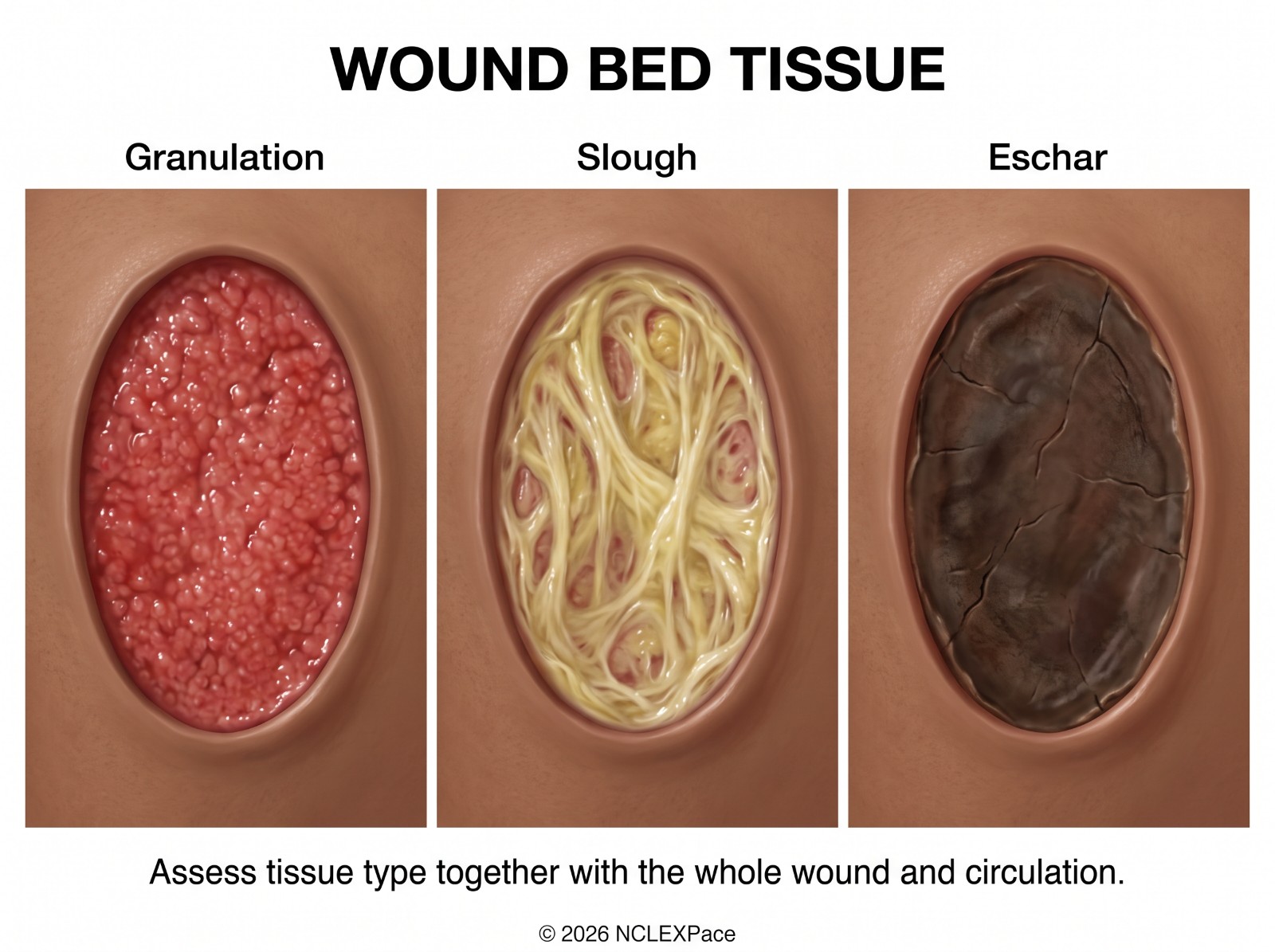
| Unstageable | Base obscured by slough or eschar | You cannot stage what you cannot see. At least stage 3 once debrided |
| Deep tissue injury | Persistent non-blanchable deep red, maroon or purple under intact skin, or a blood-filled blister | Damage began at the bone–muscle interface and works outward. Can deteriorate rapidly |
Two rules the exam leans on. Stages are never reversed — a healing stage 4 is a “healing stage 4”, not a stage 2, because lost tissue does not regenerate as it was. And stable, dry, adherent eschar on a heel is not debrided — it is left intact as a biological cover and monitored.
Where they form
| Position | Sites at risk |
|---|---|
| Supine | Sacrum, heels, occiput, scapulae, elbows |
| Side-lying | Greater trochanter, lateral malleolus, ear, shoulder, knees where they touch |
| Sitting | Ischial tuberosities — pressure here is higher than lying, so sitting time is limited |
| Prone | Cheek, ear, chest, iliac crest, knees, toes |
| Device-related | Under oxygen tubing behind the ears, nasal cannulae, catheters, casts, cervical collars, compression devices |
The sacrum and heels account for most of them. Device-related injuries are the most often missed — checking under every device is part of routine skin assessment.
Prevention that actually works
- Reposition — commonly every 2 hours in bed and every hour when sitting, adjusted to the individual. Use the 30-degree lateral tilt rather than full 90-degree side-lying, which loads the trochanter directly.
- Lift, do not drag. Use a slide sheet and two staff. Dragging causes shear, which does more damage than pressure alone.
- Head of bed at or below 30 degrees where the condition allows — sitting them up slides them down and shears the sacrum.
- Float the heels off the mattress entirely with a pillow under the calves. Heel protectors do not offload; elevation does.
- Pressure-redistributing surfaces for at-risk clients. A doughnut ring is never used — it concentrates pressure in a circle.
- Keep skin clean and dry; use a barrier product. Do not massage reddened bony prominences.
- Nutrition and hydration — adequate protein, calories, vitamin C, zinc and fluid. Malnutrition is one of the strongest predictors of both development and non-healing.
- Assess on admission and every shift with a validated tool such as Braden, and act on the score rather than filing it.
NCLEX tip: If the skin is intact and red, it is stage 1 — and the correct answer is prevention, not a dressing. If you cannot see the base, do not guess a number; it is unstageable. And any option offering to massage a red bony prominence or apply a doughnut cushion is wrong.
Educational use only: this article supports nursing review and does not replace clinical judgment, facility protocols, or instructions from an authorised prescriber.
5 NCLEX practice questions on this topic
The same questions, player and partial-credit scoring students use inside NCLEXPace: answer, submit, read the full rationale, then Next. Your score is waiting at the end. No account needed for these.
A free account opens 20 more questions, a case study, a video and a cheat sheet. The full bank has 3,200+ questions with rationales, by topic.
Practice more, free →Ready for the full bank? See NCLEXPace plans and prices: one payment for 1, 2, 3 or 6 months.
Frequently asked questions
Common follow-up questions on Body Systems & Clinical Content.
How are pressure injuries staged?
By the deepest visible tissue. Stage 1 is intact skin with non-blanchable redness, stage 2 is partial-thickness loss with a broken surface, stage 3 exposes subcutaneous fat, and stage 4 exposes muscle, tendon or bone.
What does unstageable mean?
The wound base is obscured by slough or eschar, so the depth cannot be determined. Once the non-viable tissue is removed the injury will prove to be at least stage 3.
What is a deep tissue pressure injury?
Persistent non-blanchable deep red, maroon or purple discolouration under intact skin, or a blood-filled blister, caused by damage that began at the bone–muscle interface. It can deteriorate rapidly despite the surface looking closed.
Should eschar on a heel be removed?
Not when it is stable, dry and adherent with no signs of infection. Intact heel eschar acts as a biological cover and is left in place and monitored; softening, drainage, redness or odour changes that decision.
How often should an at-risk client be repositioned?
Commonly every 2 hours in bed and every hour when seated, adjusted to the individual and how their skin responds. A 30-degree lateral tilt is used rather than full side-lying, because 90 degrees loads the greater trochanter directly.
Why should reddened bony prominences not be massaged?
Massage over compromised tissue causes further mechanical damage to already ischaemic capillaries and can deepen the injury. Pressure relief, not rubbing, is the intervention.
Sources and references
- Potter PA, Perry AG, Stockert PA, Hall AM. Fundamentals of Nursing. 10th ed. Elsevier; 2021; Chapter: Skin Integrity and Wound Care.
- EPUAP, NPIAP, PPPIA. Prevention and Treatment of Pressure Ulcers/Injuries: Clinical Practice Guideline. 3rd ed. European Pressure Ulcer Advisory Panel, National Pressure Injury Advisory Panel, Pan Pacific Pressure Injury Alliance; 2019.
- Edsberg LE, et al. Revised National Pressure Ulcer Advisory Panel Pressure Injury Staging System. J Wound Ostomy Continence Nurs. 2016;43(6):585-597.
Reviewed by the NCLEXPace team, October 2026.
Keep reading


3,200+ NCLEX questions with think-like-a-nurse rationales, unfolding case studies and adaptive readiness exams. Start with free practice questions, then choose a plan when you are ready.
Create Free Account →