Stroke: Ischemic vs Hemorrhagic, tPA Windows and Nursing Priorities
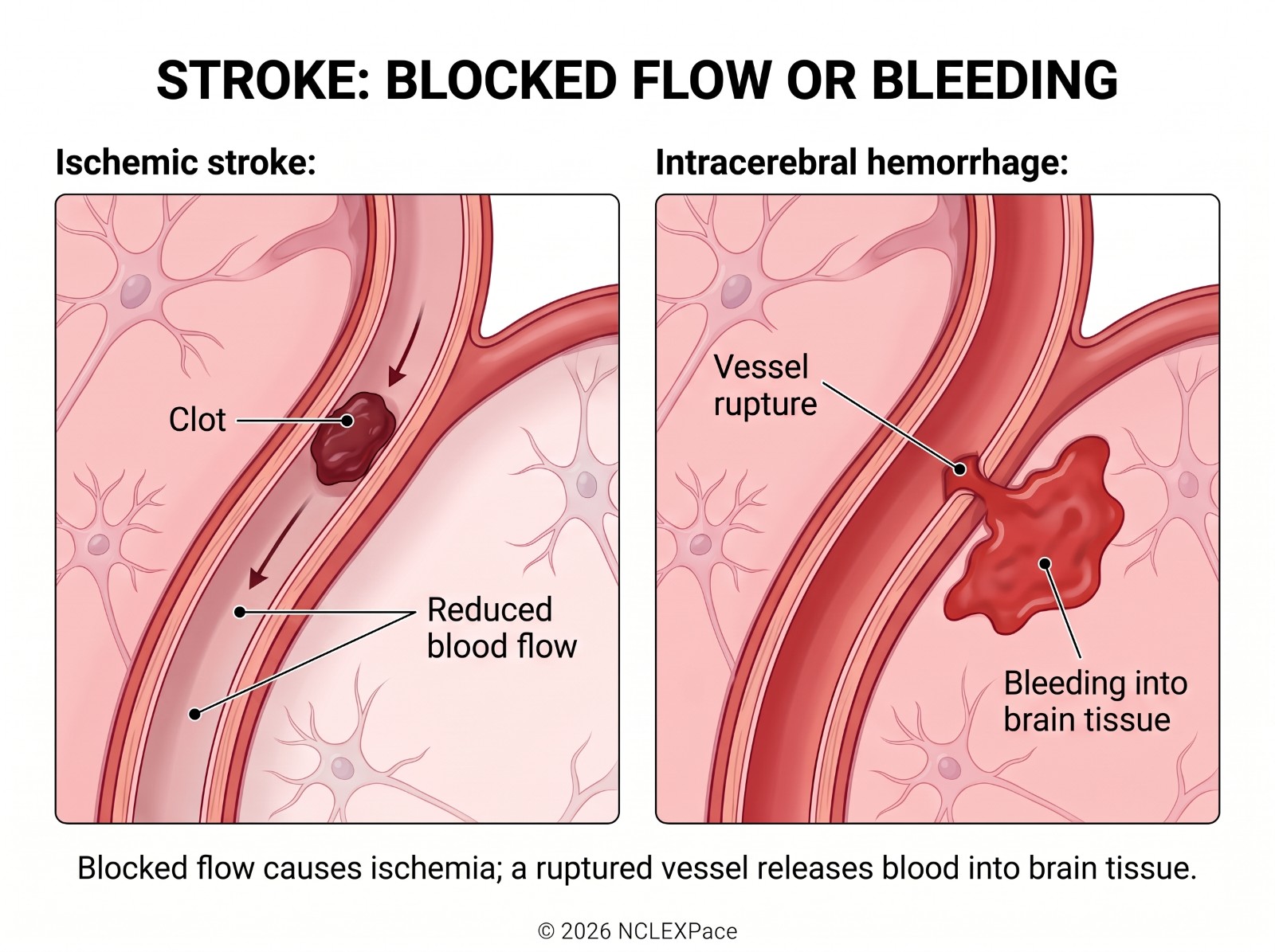
An ischemic stroke is a clot blocking blood flow (most strokes); a haemorrhagic stroke is a vessel bleeding into the brain. A non-contrast CT must come before any clot-dissolving drug, because thrombolytics rescue an ischemic stroke and make a haemorrhagic one catastrophically worse. Nothing goes in the mouth (food, fluid or tablets) until a swallow screen is passed.

Stroke recognition with BEFAST, last known well time, the CT before any treatment, alteplase criteria and the nursing priorities afterwards.
From the Intensive NCLEX Course. This lesson is a free sample: watch it with a free account.
Two very different emergencies share one name. Everything the nurse does next depends on which one it is — and the whole point of the priority intervention, the CT scan, is to tell them apart before a drug that saves one type makes the other catastrophically worse.
Step 1 — The two types, and why the difference decides everything
| Ischemic | Haemorrhagic | |
|---|---|---|
| Mechanism | A clot blocks a cerebral artery | A vessel ruptures and bleeds into brain tissue |
| Share of strokes | The majority | The minority, but higher mortality |
| Typical story | Sudden deficit, often on waking; atrial fibrillation, carotid disease | Sudden “worst headache of my life”, vomiting, rapid decline in consciousness |
| Thrombolytics | May be given within the window | Absolutely contraindicated |
| Blood pressure | Permissive hypertension — the pressure is perfusing the penumbra | Lowered actively to limit further bleeding |
This is the whole reason the CT scan is the priority intervention. Every item that asks “what must occur before administering alteplase” has the same answer: imaging to exclude haemorrhage.
Step 2 — Recognise it: FAST, and the time that matters
Face drooping · Arm weakness · Speech difficulty · Time — establish when the client was last known well.
“Time of onset” is not when the symptoms were noticed; it is the last moment the client was seen at their normal baseline. A client who wakes with a deficit has an onset time of the previous night, not the morning — and that single fact often removes them from the thrombolytic window.
Step 3 — Left brain vs right brain
| LEFT hemisphere stroke | RIGHT hemisphere stroke |
|---|---|
| Right-sided weakness | Left-sided weakness |
| Speech problems (aphasia) | Speech usually intact |
| Slow, cautious behaviour | Impulsive, poor judgment |
| Aware of deficits, often frustrated and depressed | Ignores the affected side (neglect) — unaware anything is wrong |
The safety consequence is the tested point: a right-hemisphere stroke produces an impulsive client who does not believe they are weak. That combination is the highest fall risk on the unit, and it is why the answer to “which client needs the closest supervision” is often the one who seems least distressed. For neglect, place objects and approach from the unaffected side at first, then gradually teach the client to scan toward the neglected side.
Step 4 — Thrombolytics: the window and the exclusions
Alteplase is given for ischemic stroke within 3 hours of last known well, extended to 4.5 hours in selected clients. Mechanical thrombectomy extends the treatable window considerably further in large-vessel occlusion, which is why rapid transfer to a stroke centre matters even outside the drug window.
| Before giving it | Why |
|---|---|
| Non-contrast CT | Excludes haemorrhage. Non-negotiable |
| Blood glucose | Hypoglycaemia mimics stroke exactly and is reversible in seconds |
| Time last known well | Determines eligibility |
| Blood pressure under roughly 185/110 | Above that, bleeding risk from the drug is unacceptable |
| Bleeding history, recent surgery, anticoagulant use | Standard exclusions |
After the infusion: no anticoagulants or antiplatelets for 24 hours, no invasive lines or injections where avoidable, neurological checks and blood pressure at frequent intervals, and immediate escalation for a sudden headache, vomiting, rising blood pressure or falling consciousness — these mean bleeding.
Step 5 — Nursing priorities on the unit
- Swallow screen before anything by mouth. No water, no food, no oral tablets until it is passed — aspiration pneumonia is the most common preventable complication after stroke.
- Positioning: head of bed elevated unless otherwise ordered; head and neck midline.
- Neurological checks at the ordered frequency — a change in level of consciousness is the earliest sign of deterioration.
- Communication: with aphasia, allow time, use short sentences, yes/no questions, pictures or a communication board. Do not raise your voice — the deficit is language, not hearing.
- Affected limb care: support the arm, reposition regularly, prevent shoulder subluxation and contractures.
If pressure inside the skull begins to rise — deteriorating consciousness, vomiting, pupil changes — the priorities change again toward managing increased intracranial pressure.
Educational use only: this article supports nursing review and does not replace clinical judgment, facility protocols, or instructions from an authorised prescriber.
NCLEX tip: If a stroke stem offers “check a blood glucose” among the first actions, it is rarely a distractor — hypoglycaemia produces an identical picture and is corrected immediately. And any option that gives fluids, food or oral medication before a documented swallow screen is wrong, however reasonable it sounds.
5 NCLEX practice questions on this topic
The same questions, player and partial-credit scoring students use inside NCLEXPace: answer, submit, read the full rationale, then Next. Your score is waiting at the end. No account needed for these.
A free account opens 20 more questions, a case study, a video and a cheat sheet. The full bank has 3,200+ questions with rationales, by topic.
Practice more, free →Ready for the full bank? See NCLEXPace plans and prices: one payment for 1, 2, 3 or 6 months.
Frequently asked questions
Common follow-up questions on Body Systems & Clinical Content.
What is the difference between ischemic and haemorrhagic stroke?
An ischemic stroke is caused by a clot obstructing a cerebral artery and makes up most strokes; a haemorrhagic stroke is caused by a ruptured vessel bleeding into brain tissue. Thrombolytic therapy treats the first and is absolutely contraindicated in the second, which is why a non-contrast CT scan precedes treatment.
What is the time window for tPA in stroke?
Alteplase is given within 3 hours of the time the client was last known well, extended to 4.5 hours in selected clients. Mechanical thrombectomy can treat large-vessel occlusion beyond that window, so rapid transfer still matters when the drug window has closed.
Why must a swallow screen be done before giving anything by mouth?
Stroke frequently impairs swallowing without any outward sign, and aspiration pneumonia is the most common preventable complication afterwards. Nothing (including water and oral medication) is given until a swallow screen has been passed and documented.
Which side of the brain causes speech problems?
The left hemisphere in most people. A left-sided stroke produces right-sided weakness with aphasia and a cautious, frustrated client, while a right-sided stroke produces left-sided weakness with neglect and impulsivity: the higher fall risk of the two.
What are the signs of bleeding after thrombolytic therapy?
A sudden severe headache, new nausea or vomiting, an abrupt rise in blood pressure, a falling level of consciousness, or any new neurological deficit. The infusion is stopped and the provider notified immediately.
Sources and references
- Harding MM, Kwong J, Hagler D, Reinisch C. Lewis's Medical-Surgical Nursing: Assessment and Management of Clinical Problems. 12th ed. Elsevier; 2023; Chapter: Stroke.
- Powers WJ, et al. Guidelines for the Early Management of Patients With Acute Ischemic Stroke: 2019 Update. Stroke. 2019;50(12):e344-e418.
Reviewed by the NCLEXPace team, October 2026.
Keep reading



3,200+ NCLEX questions with think-like-a-nurse rationales, unfolding case studies and adaptive readiness exams. Start with free practice questions, then choose a plan when you are ready.
Create Free Account →