
Cancer and Immunity Map: Neutropenia, Chemotherapy, and HIV
Chemotherapy destroys the bone marrow's ability to make white blood cells, leaving neutropenic clients unable to fight infection, with the lowest counts usually about 7 to 14 days after treatment. Because they cannot mount a normal immune response, they may show no redness, swelling, or pus, so a fever is an emergency and the single most important teaching point.

Neutropenia and infection precautions: the absolute neutrophil count, the protective environment, and why a fever is an emergency.
From the Intensive NCLEX Course. See the course; the full video library is part of Pro and Ultimate.
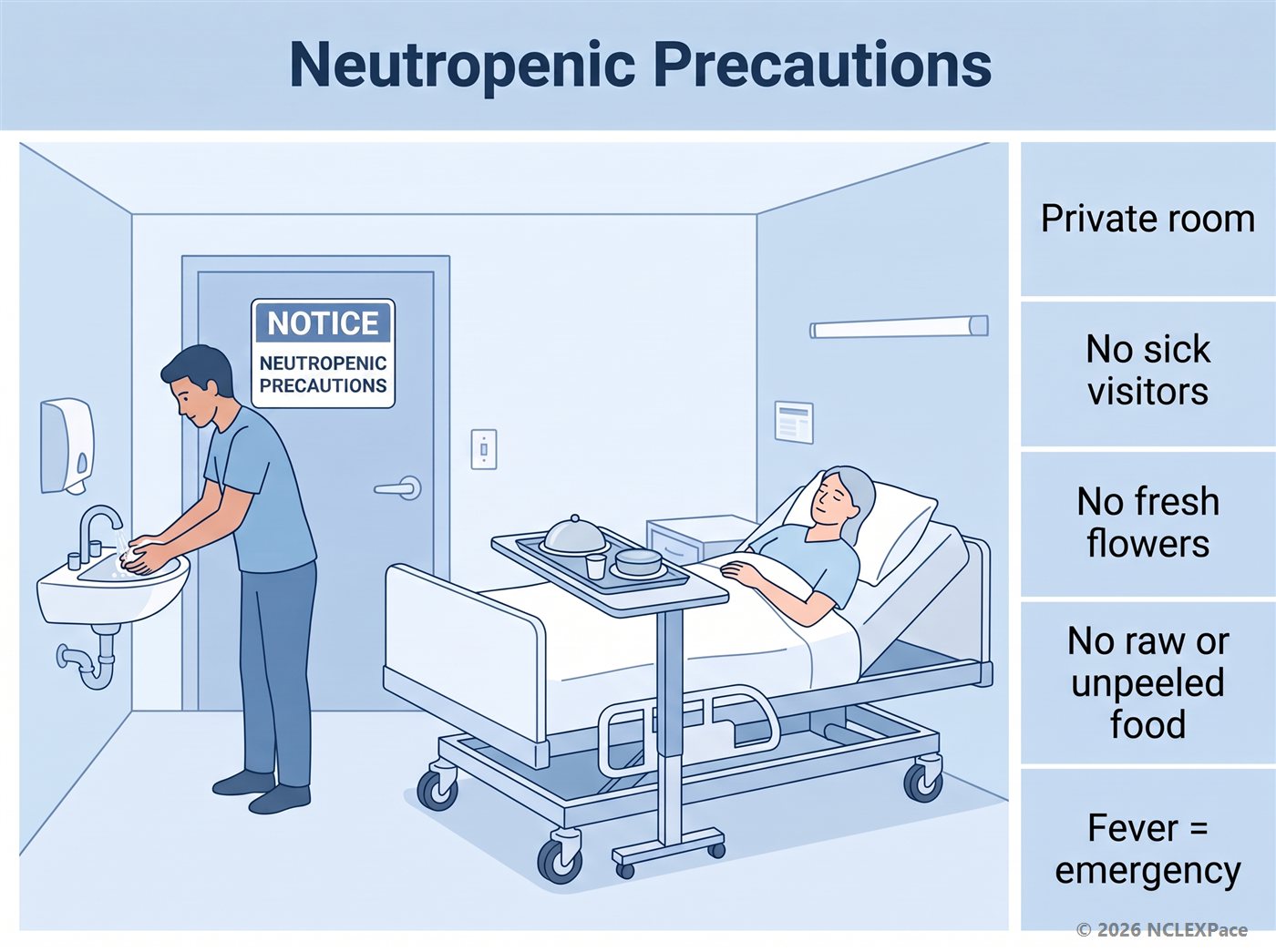
Neutropenic precautions
Why: chemotherapy destroys the bone marrow’s ability to make white blood cells. Without them, the client cannot fight infection.
The lowest point is usually about 7 to 14 days after chemotherapy. This is when infection risk is highest.
The precautions:
- Private room where indicated
- Strict hand hygiene by everyone
- No fresh flowers or standing water — they grow bacteria and fungus
- No raw fruits and vegetables in many protocols; cooked food only
- No visitors who are sick
- Avoid crowds
- No live vaccines
- Avoid rectal temperatures, suppositories, and enemas
- Monitor temperature closely
The critical teaching point: a fever is an emergency.
A neutropenic client cannot mount a normal immune response, so they may not show redness, swelling, or pus. A fever may be the only sign of a life-threatening infection.
Teach the client to report a fever immediately, day or night.
Chemotherapy side effects
Bone marrow suppression — the main danger.
| Cell type | Effect | What to do |
|---|---|---|
| White cells low | Infection risk | Neutropenic precautions |
| Platelets low | Bleeding risk | Bleeding precautions |
| Red cells low | Fatigue, shortness of breath | Rest, monitor |
Nausea and vomiting — give anti-nausea medication before chemotherapy, not after it starts. Prevention works better than treatment.
Mouth sores (mucositis) — painful sores in the mouth and throat.
Care: soft toothbrush, rinse with saline or a prescribed solution, avoid alcohol-based mouthwash, avoid spicy, acidic, hot, and rough foods, soft bland diet.
Hair loss — usually temporary. Prepare the client emotionally in advance.
Extravasation — chemotherapy leaking into tissue around the vein. Causes severe tissue damage.
Signs: pain, burning, swelling, redness at the IV site, no blood return, slowed infusion.
Action: stop the infusion immediately, leave the needle in place, follow the specific protocol, notify the provider.
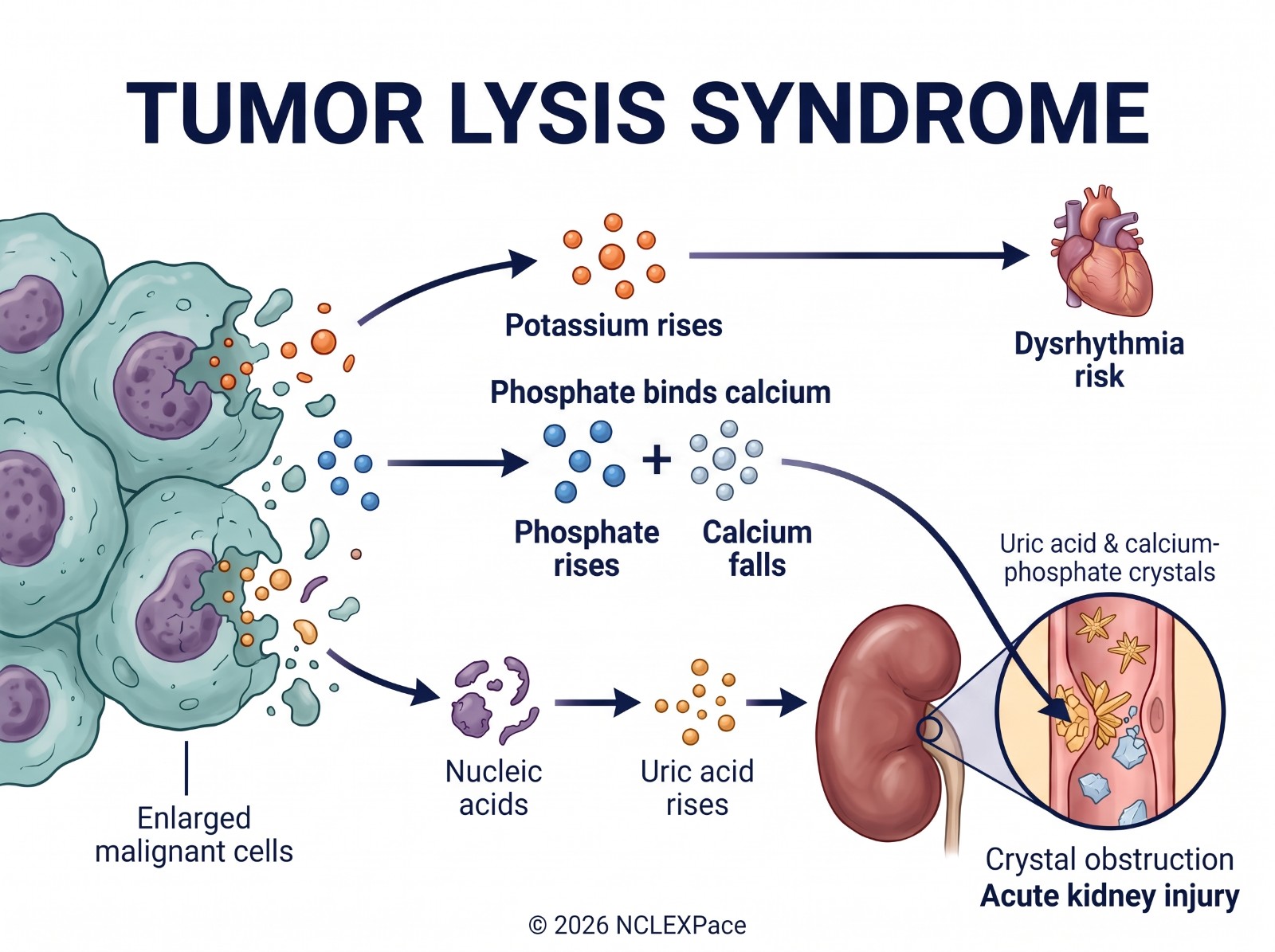
Tumor lysis syndrome — cancer cells break down fast and dump their contents into the blood.
The pattern: high potassium, high phosphorus, high uric acid, low calcium.
Risk: kidney failure and fatal heart rhythms. Prevention is hydration and medications to lower uric acid.
Radiation therapy
Skin care at the treatment site:
- Do not wash off the markings
- Wash gently with mild soap and water, pat dry
- No lotions, powders, or deodorants unless approved
- No heat or ice on the site
- Protect from sun
- Wear loose, soft cotton clothing
Internal radiation (implants) — safety rules:
- Time, distance, shielding
- Private room
- Limit time in the room
- Stand at a distance when possible
- No pregnant staff or visitors, no children
- Keep long-handled forceps and a lead container in the room in case the implant becomes dislodged
- Never touch a dislodged implant with your hands
HIV
What it does: attacks CD4 cells, which coordinate the immune response.
The key number: the CD4 count.
- Normal is roughly 500 to 1,500 cells/mm³
- A CD4 count below 200 defines AIDS, as does the presence of certain opportunistic infections
Viral load measures how much virus is in the blood. The treatment goal is an undetectable viral load.
Transmission: blood, sexual fluids, breast milk, and from mother to baby. Not spread by casual contact, sharing food, toilet seats, hugging, or insects.
Standard precautions are used for all clients, which is what protects staff.
Teaching:
- Take antiretroviral medication exactly as prescribed — missing doses causes resistance
- Do not stop without talking to the provider
- Practice safer sex
- Do not share needles
- Report signs of infection
- Regular monitoring of CD4 and viral load
Nursing focus: preventing infection, supporting adherence to medication, nutrition, and emotional support. Stigma and isolation are real problems for these clients.
The short version
- Neutropenic: no fresh flowers, no raw produce, fever is an emergency
- Chemotherapy: lowest blood counts around 7 to 14 days; anti-nausea medication before treatment; stop the infusion immediately for extravasation
- Tumor lysis: high potassium, high phosphorus, high uric acid, low calcium
- Radiation skin: do not wash off markings, no lotions, no heat or cold
- Implants: time, distance, shielding; long-handled forceps in the room; never touch with hands
- HIV: CD4 under 200 defines AIDS
Precaution protocols and treatment guidelines vary by facility and change over time.
5 NCLEX practice questions on this topic
The same questions, player and partial-credit scoring students use inside NCLEXPace: answer, submit, read the full rationale, then Next. Your score is waiting at the end. No account needed for these.
A free account opens 20 more questions, a case study, a video and a cheat sheet. The full bank has 3,200+ questions with rationales, by topic.
Practice more, free →Ready for the full bank? See NCLEXPace plans and prices: one payment for 1, 2, 3 or 6 months.
Frequently asked questions
Common follow-up questions on Body Systems & Clinical Content.
What are neutropenic precautions?
A private room where indicated, strict hand hygiene, no fresh flowers or standing water, cooked food only with no raw fruits and vegetables in many protocols, no sick visitors, avoiding crowds, no live vaccines, and avoiding rectal temperatures, suppositories, and enemas. Temperature is monitored closely. These reduce the client's exposure to bacteria and fungus while the white count is low.
Why is a fever an emergency in a neutropenic client?
A neutropenic client cannot mount a normal immune response, so the usual signs of infection such as redness, swelling, and pus may be absent. A fever may be the only sign of a life-threatening infection. Teach the client to report a fever immediately, day or night.
What is extravasation and what do you do about it?
Extravasation is chemotherapy leaking into the tissue around the vein, which causes severe tissue damage. Signs include pain, burning, swelling, redness at the IV site, no blood return, and a slowed infusion. Stop the infusion immediately, leave the needle in place, follow the specific protocol, and notify the provider.
What is tumor lysis syndrome?
Tumor lysis syndrome is when cancer cells break down fast and dump their contents into the blood, producing high potassium, high phosphorus, high uric acid, and low calcium. It risks kidney failure and fatal heart rhythms. Prevention is hydration and medications to lower uric acid.
What defines AIDS in a client with HIV?
HIV attacks CD4 cells, which coordinate the immune response, and a normal CD4 count is roughly 500 to 1,500 cells/mm3. A CD4 count below 200 defines AIDS, as does the presence of certain opportunistic infections. Viral load measures how much virus is in the blood, and the treatment goal is an undetectable viral load.
Sources and references
- Harding MM, Kwong J, Hagler D, Reinisch C. Lewis's Medical-Surgical Nursing: Assessment and Management of Clinical Problems. 12th ed. Elsevier; 2023; Chapter: Cancer.
- Harding MM, Kwong J, Hagler D, Reinisch C. Lewis's Medical-Surgical Nursing: Assessment and Management of Clinical Problems. 12th ed. Elsevier; 2023; Chapter: Infection.
- Olsen MM, LeFebvre KB, Brassil KJ, eds. Chemotherapy and Immunotherapy Guidelines and Recommendations for Practice. Oncology Nursing Society; 2019.
Reviewed by the NCLEXPace team, October 2026.
Keep reading



3,200+ NCLEX questions with think-like-a-nurse rationales, unfolding case studies and adaptive readiness exams. Start with free practice questions, then choose a plan when you are ready.
Create Free Account →