
Potassium on the NCLEX: Why K+ Is the Exam's Favourite Electrolyte
Potassium is the exam's favourite electrolyte because both extremes stop the heart: normal is 3.5–5.0 mEq/L, and any value outside that range needs cardiac monitoring. Potassium is never given by IV push under any circumstance. It must be diluted and infused slowly through a pump, and the client must be producing urine before it is given.

Fluids and electrolytes, with potassium front and centre: causes, ECG changes, treatment order and the IV rules.
From the Intensive NCLEX Course. See the course; the full video library is part of Pro and Ultimate.
No electrolyte appears on the NCLEX as often as potassium, and the reason is simple: it is the one where getting it wrong kills someone quickly. The normal range is narrow — 3.5–5.0 mEq/L — and both ends stop the heart.
Step 1 — The two directions, side by side
| Feature | Hypokalemia (< 3.5) | Hyperkalemia (> 5.0) |
|---|---|---|
| Common causes | Loop and thiazide diuretics, vomiting, diarrhea, NG suction, insulin, alkalosis | Renal failure, ACE inhibitors and ARBs, potassium-sparing diuretics, acidosis, crush injury, burns |
| Muscles | Weakness, cramps, decreased reflexes | Weakness, then flaccid paralysis |
| Gut | Hypoactive bowel sounds, constipation, ileus | Hyperactive bowel sounds, diarrhea, cramping |
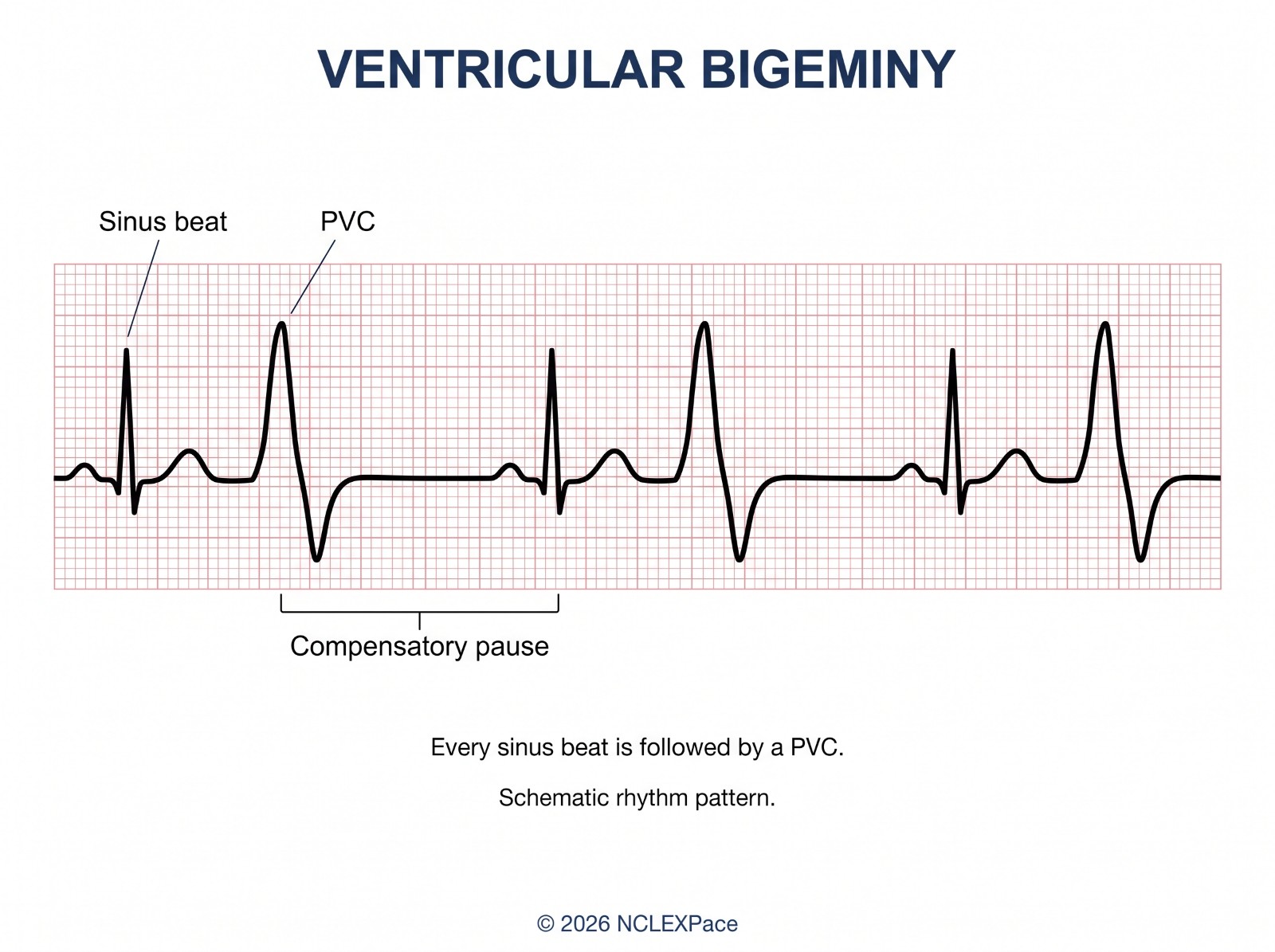
| ECG | Flat T waves, U waves, ST depression | Peaked T waves, widened QRS, then asystole |
| The danger | Dysrhythmias, and digoxin toxicity | Cardiac arrest, often with little warning |
The gut findings are the pair students mix up most, and they follow logically: low potassium slows smooth muscle, high potassium irritates it. Low = quiet, high = loud.
Step 2 — The digoxin connection
This is the highest-yield pairing on the whole topic. Low potassium increases digoxin toxicity. A client on both furosemide and digoxin whose potassium is 3.1 is a question waiting to happen, and the correct action is to hold the digoxin and report, not to give it and monitor.
Signs of digoxin toxicity worth recognising: nausea and anorexia first, then visual changes — yellow-green haloes — and bradycardia. Hold digoxin for an apical pulse under 60 in an adult, counted for a full minute.
Step 3 — Treating hypokalemia, and the IV rules
Oral replacement when the client can take it. When it must be IV, the safety rules are strict — and they are exam favourites because a mistake here is fatal.
| Rule | Detail |
|---|---|
| Never IV push | Potassium given as a bolus causes cardiac arrest. There is no exception |
| Always diluted | Never given undiluted, ever |
| Always on a pump | Rate control is the safety mechanism |
| Maximum rate | Usually 10 mEq/hr peripherally; higher only with continuous cardiac monitoring in critical care |
| Check urine output first | Potassium is excreted renally — at least 30 mL/hr before replacing |
| Watch the site | Potassium is irritating; burning or pain means stop and reassess |
If an answer option offers to "push potassium slowly", it is wrong no matter how the rest of it reads.
Step 4 — Treating hyperkalemia, in the right order
Three different jobs, and the exam wants to know which comes first.
| Job | Drug | What it actually does |
|---|---|---|
| 1. Protect the heart | Calcium gluconate | Stabilises the cardiac membrane. Does not lower potassium at all — it buys time. First when there are ECG changes |
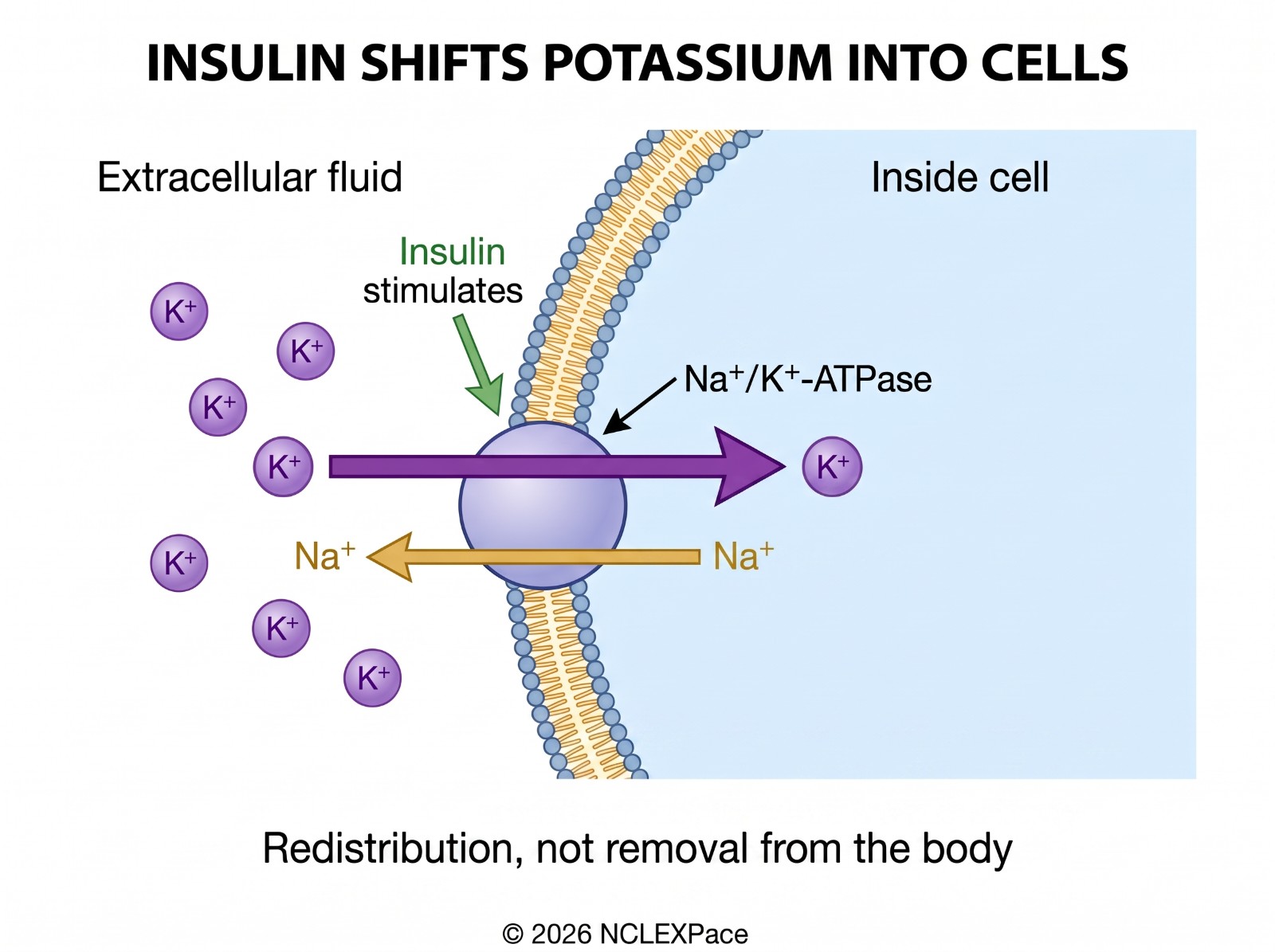
| 2. Move it into cells | Insulin with dextrose; albuterol; sodium bicarbonate if acidotic | Drops serum potassium fast, but it is still in the body — a temporary fix |
| 3. Remove it | Sodium polystyrene or patiromer; dialysis | The only steps that take potassium out of the body. Dialysis is definitive |
The trap: an option offering calcium gluconate looks wrong to students because it does not lower the number. It is correct precisely because the number is not what kills the client in the next five minutes — the rhythm is.
A false reading worth knowing
Pseudohyperkalemia — a high result caused by hemolysis during a difficult draw, a tight tourniquet or fist clenching. If a client with a potassium of 6.2 looks entirely well with a normal ECG, the appropriate action may be to redraw the specimen before treating.
Foods, for the teaching questions
High in potassium: bananas, oranges, potatoes, tomatoes, avocados, spinach, beans, salt substitutes. Teach a client on a potassium-sparing diuretic or an ACE inhibitor to avoid salt substitutes — they are potassium chloride, and clients do not know that.
NCLEX tip: When a potassium question shows ECG changes, the first action is always about the heart, never about the number. Calcium gluconate for hyperkalemia with peaked T waves; hold the digoxin for hypokalemia. Treat the rhythm, then treat the lab.
5 NCLEX practice questions on this topic
The same questions, player and partial-credit scoring students use inside NCLEXPace: answer, submit, read the full rationale, then Next. Your score is waiting at the end. No account needed for these.
A free account opens 20 more questions, a case study, a video and a cheat sheet. The full bank has 3,200+ questions with rationales, by topic.
Practice more, free →Ready for the full bank? See NCLEXPace plans and prices: one payment for 1, 2, 3 or 6 months.
Frequently asked questions
Common follow-up questions on Labs, Values & Diagnostics.
Why is potassium never given by IV push?
Rapid intravenous potassium causes fatal cardiac arrest. It must always be diluted and given as a slow controlled infusion through a pump, never as a bolus, and never exceeding the prescribed rate even if a dose is late.
What are the signs of hyperkalaemia?
Muscle weakness, nausea, diarrhoea, paraesthesia, and the cardiac changes that matter most: peaked T waves progressing to a widened QRS and ventricular dysrhythmias. Hyperkalaemia is a medical emergency above 6.0 mEq/L.
What are the signs of hypokalaemia?
Muscle weakness and cramps, fatigue, decreased bowel sounds and constipation or ileus, and ECG changes including a flattened T wave with a U wave. Hypokalaemia also potentiates digoxin toxicity, which is a frequent exam pairing.
Which medications affect potassium?
Loop and thiazide diuretics lower it; ACE inhibitors, ARBs, potassium-sparing diuretics such as spironolactone, and potassium supplements raise it. A client on both digoxin and a loop diuretic is the classic setup for a hypokalaemia-driven digoxin toxicity question.
Sources and references
- Harding MM, Kwong J, Hagler D, Reinisch C. Lewis's Medical-Surgical Nursing: Assessment and Management of Clinical Problems. 12th ed. Elsevier; 2023; Chapter: Fluid, Electrolyte, and Acid-Base Imbalances.
- Clase CM, et al. Potassium Homeostasis and Management of Dyskalemia in Kidney Diseases: Conclusions from a KDIGO Controversies Conference. Kidney International. 2020;97(1):42-61.
Reviewed by the NCLEXPace team, October 2026.
Keep reading

3,200+ NCLEX questions with think-like-a-nurse rationales, unfolding case studies and adaptive readiness exams. Start with free practice questions, then choose a plan when you are ready.
Create Free Account →