
Cardiac Map: Heart Failure, Heart Attack, and Angina
A myocardial infarction is blocked blood flow with dying heart muscle, marked by chest pain not relieved by rest or nitroglycerin, with troponin as the key marker and a fast EKG the priority. In heart failure, left-sided disease backs fluid into the lungs and right-sided into the body; daily weight is the single most important nursing action, and pink frothy sputum signals pulmonary edema, an emergency.

Coronary artery disease from stable angina to infarction: risk factors, recognition, and the nursing care that follows.
From the Intensive NCLEX Course. See the course; the full video library is part of Pro and Ultimate.
Heart attack (myocardial infarction)
What it is: blood flow to part of the heart muscle is blocked. Muscle starts dying.
What you see:
- Chest pain or pressure, often described as crushing or heavy
- Pain spreading to the jaw, neck, left arm, or back
- Not relieved by rest or nitroglycerin — this is what separates it from stable angina
- Sweating, nausea, shortness of breath
- Feeling of doom
Important: women, older adults, and people with diabetes often have atypical symptoms — fatigue, indigestion, shortness of breath, or no chest pain at all. This is heavily tested.
The lab: troponin is the key marker. It rises within a few hours, peaks around a day, and stays elevated for over a week.
What you do first: assess and get an EKG quickly, place the client on a monitor, give oxygen if oxygen levels are low, and follow the orders for aspirin and nitroglycerin.
Time matters. The goal is to restore blood flow fast, either with a catheter procedure or with clot-dissolving drugs.
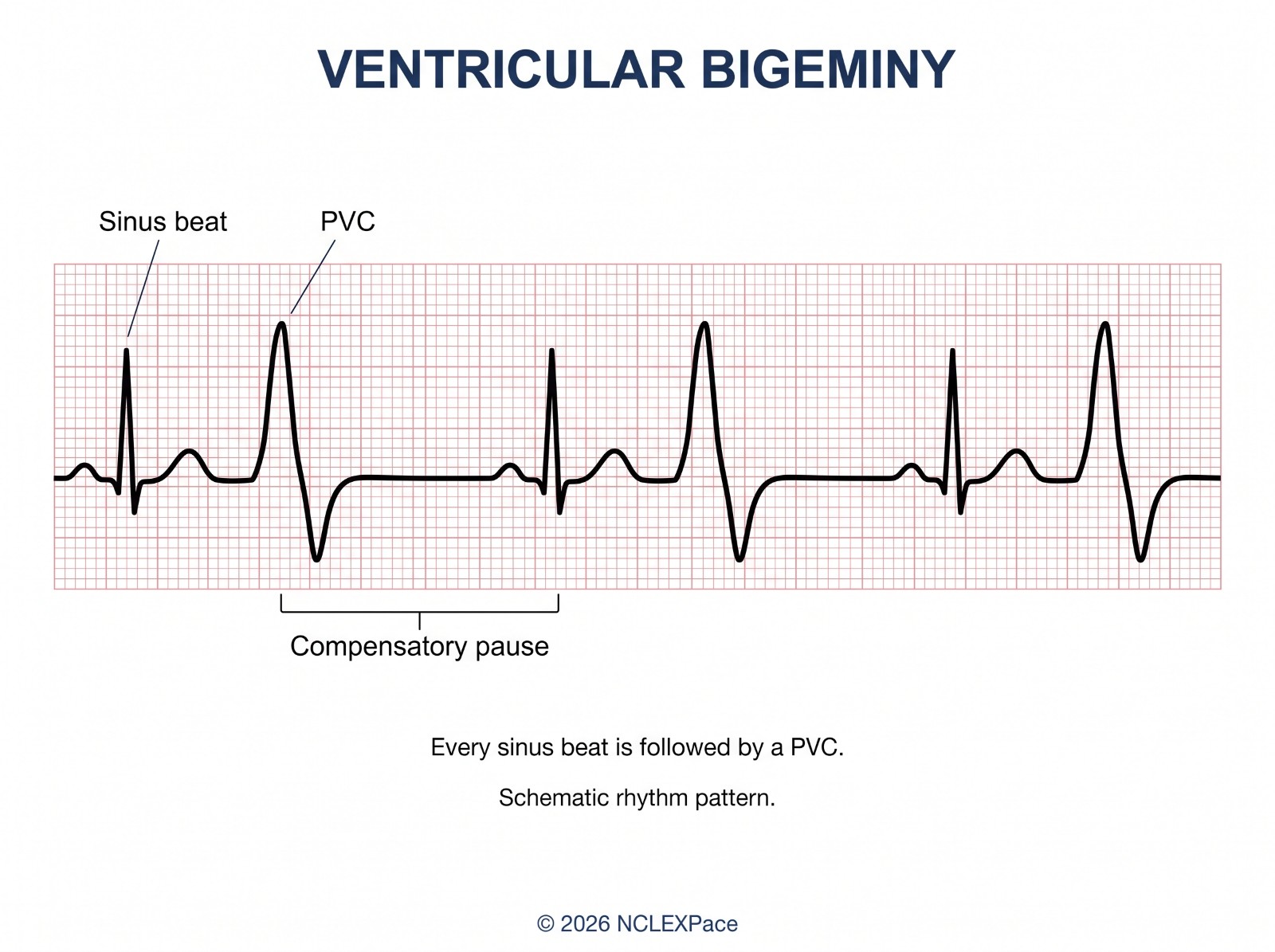
What kills: dangerous rhythms, especially in the first hours. Also heart failure and cardiogenic shock.
Angina
Stable angina — predictable. Comes with exertion or stress. Relieved by rest and nitroglycerin.
Unstable angina — new, worse, or happening at rest. Not reliably relieved. This is an emergency and is treated like a heart attack until proven otherwise.
The exam distinction: relieved by rest means stable. At rest or not relieved means emergency.
Heart failure
What it is: the heart cannot pump well enough to meet the body’s needs. Fluid backs up.
The two sides matter, and this is the most tested part.
| LEFT-sided failure | RIGHT-sided failure | |
|---|---|---|
| Fluid backs up into | The lungs | The body |
| Signs | Shortness of breath, crackles, cough, orthopnea (cannot lie flat), waking at night short of breath, pink frothy sputum | Swollen legs and feet, distended neck veins, enlarged liver, ascites, weight gain |
Memory aid: Left = Lungs. Right = Rest of the body.
The lab: BNP rises in heart failure.
The single most important nursing action: daily weight.
- Same time each day
- After urinating, before eating
- Same scale, same clothing
Teach the client to report a gain of 2 to 3 pounds in a day, or about 5 pounds in a week. Weight change shows fluid retention before symptoms appear.
Other nursing:
- Position upright to ease breathing
- Monitor intake and output
- Low sodium diet
- Fluid restriction if ordered
- Balance activity with rest
What kills: acute pulmonary edema — the lungs fill with fluid. Signs: severe shortness of breath, crackles throughout, pink frothy sputum, extreme anxiety. This is an emergency. Sit the client upright, give oxygen, notify the provider immediately.
The medications
See Article 62 for full detail. Quick version:
- Digoxin — apical pulse for a full minute, hold under 60, check potassium, watch for yellow-green halos
- Beta blockers — never stop suddenly
- ACE inhibitors — dry cough, high potassium, facial swelling is an emergency
- Diuretics — monitor potassium, daily weight
- Nitroglycerin — sit down first, never with erectile dysfunction drugs
The short version
- MI: pain not relieved by rest or nitro, atypical in women and diabetics, troponin, EKG fast
- Stable angina: relieved by rest. Unstable: emergency.
- Left heart failure = lungs. Right = rest of the body.
- Daily weight is the key nursing action
- Pink frothy sputum = pulmonary edema = emergency
Treatment protocols follow current cardiac guidelines and change periodically.
5 NCLEX practice questions on this topic
The same questions, player and partial-credit scoring students use inside NCLEXPace: answer, submit, read the full rationale, then Next. Your score is waiting at the end. No account needed for these.
A free account opens 20 more questions, a case study, a video and a cheat sheet. The full bank has 3,200+ questions with rationales, by topic.
Practice more, free →Ready for the full bank? See NCLEXPace plans and prices: one payment for 1, 2, 3 or 6 months.
Frequently asked questions
Common follow-up questions on Body Systems & Clinical Content.
How do you tell a heart attack from stable angina?
Stable angina is predictable, comes with exertion or stress, and is relieved by rest and nitroglycerin. A myocardial infarction's chest pain is not relieved by rest or nitroglycerin. Unstable angina, which is new, worse, or happening at rest and not reliably relieved, is an emergency treated like a heart attack until proven otherwise.
Why are heart attacks missed in women and diabetics?
Women, older adults, and people with diabetes often have atypical symptoms such as fatigue, indigestion, shortness of breath, or no chest pain at all. This is heavily tested. So a cardiac cause should stay on the list even without classic crushing chest pain.
What is the difference between left and right heart failure?
In left-sided failure fluid backs up into the lungs, causing shortness of breath, crackles, cough, orthopnea, waking at night short of breath, and pink frothy sputum. In right-sided failure fluid backs up into the body, causing swollen legs and feet, distended neck veins, an enlarged liver, ascites, and weight gain. The memory aid is Left equals Lungs, Right equals Rest of the body.
Why is daily weight the key nursing action in heart failure?
Weight change shows fluid retention before symptoms appear, which makes daily weight the single most important nursing action. Weigh at the same time each day, after urinating and before eating, on the same scale and in the same clothing. Teach the client to report a gain of 2 to 3 pounds in a day, or about 5 pounds in a week.
What signs mean acute pulmonary edema?
Severe shortness of breath, crackles throughout, pink frothy sputum, and extreme anxiety mean the lungs are filling with fluid. This is an emergency. Sit the client upright, give oxygen, and notify the provider immediately.
Sources and references
- Harding MM, Kwong J, Hagler D, Reinisch C. Lewis's Medical-Surgical Nursing: Assessment and Management of Clinical Problems. 12th ed. Elsevier; 2023; Chapter: Coronary Artery Disease and Acute Coronary Syndrome.
- Harding MM, Kwong J, Hagler D, Reinisch C. Lewis's Medical-Surgical Nursing: Assessment and Management of Clinical Problems. 12th ed. Elsevier; 2023; Chapter: Heart Failure.
- Rao SV, et al. 2025 ACC/AHA/ACEP/NAEMSP/SCAI Guideline for the Management of Patients With Acute Coronary Syndromes. Circulation. 2025;151(13):e771-e862.
Reviewed by the NCLEXPace team, October 2026.
Keep reading



3,200+ NCLEX questions with think-like-a-nurse rationales, unfolding case studies and adaptive readiness exams. Start with free practice questions, then choose a plan when you are ready.
Create Free Account →