Infection Precautions: Airborne vs Droplet vs Contact
The three transmission-based precautions are airborne, droplet, and contact, and the exam checks room type and mask hardest: airborne needs a private negative-pressure room with the door closed and an N95 respirator, droplet needs a surgical mask, and contact needs a gown and gloves every entry. Remember the nurse wears the N95 while the client wears a surgical mask during transport, and C. difficile requires soap and water because alcohol gel does not kill spores.

Free sample lesson: infection control and the precautions, disease by disease.
From the Intensive NCLEX Course. This lesson is a free sample: watch it with a free account.
Precaution questions are pure recall and entirely winnable. There are three categories, a short list of diseases in each, and one rule about room type that the exam checks constantly.
Step 1 — The three categories
| Airborne | Droplet | Contact | |
|---|---|---|---|
| Spreads by | Tiny particles that stay suspended and travel | Large droplets that fall within about 6 feet | Touching the person or their surroundings |
| Room | Private, negative pressure, door closed | Private preferred | Private preferred |
| Mask | N95 respirator (fit-tested) | Surgical mask | Not required for the route |
| Also wear | Per standard precautions | Per standard precautions | Gown and gloves every entry |
| Client leaves the room | Only if essential, client wears a surgical mask | Client wears a surgical mask | Cover the infected area, clean hands |
The mask detail worth getting right
The nurse wears the N95; the client wears a surgical mask when transported. Not the other way round, and not an N95 on the client. Exam items swap these deliberately.
Step 2 — Which disease, which precaution
| Precaution | Diseases | Memory hook |
|---|---|---|
| Airborne | Measles, Tuberculosis, Varicella (chickenpox), disseminated herpes zoster | My Chicken Hez TB — Measles, Chickenpox, Herpes zoster, TB |
| Droplet | Influenza, pertussis, meningitis (bacterial), mumps, rubella, group A strep, diphtheria | Things that spread by coughing and sneezing at close range |
| Contact | C. difficile, MRSA, VRE, scabies, RSV, impetigo, hepatitis A, norovirus | Things you carry on your hands |
Two combinations the exam likes: varicella and disseminated zoster need airborne AND contact — the lesions are infectious to touch as well. And C. difficile requires soap and water, not alcohol gel: alcohol does not kill spores. That is one of the most repeated items in the whole topic.
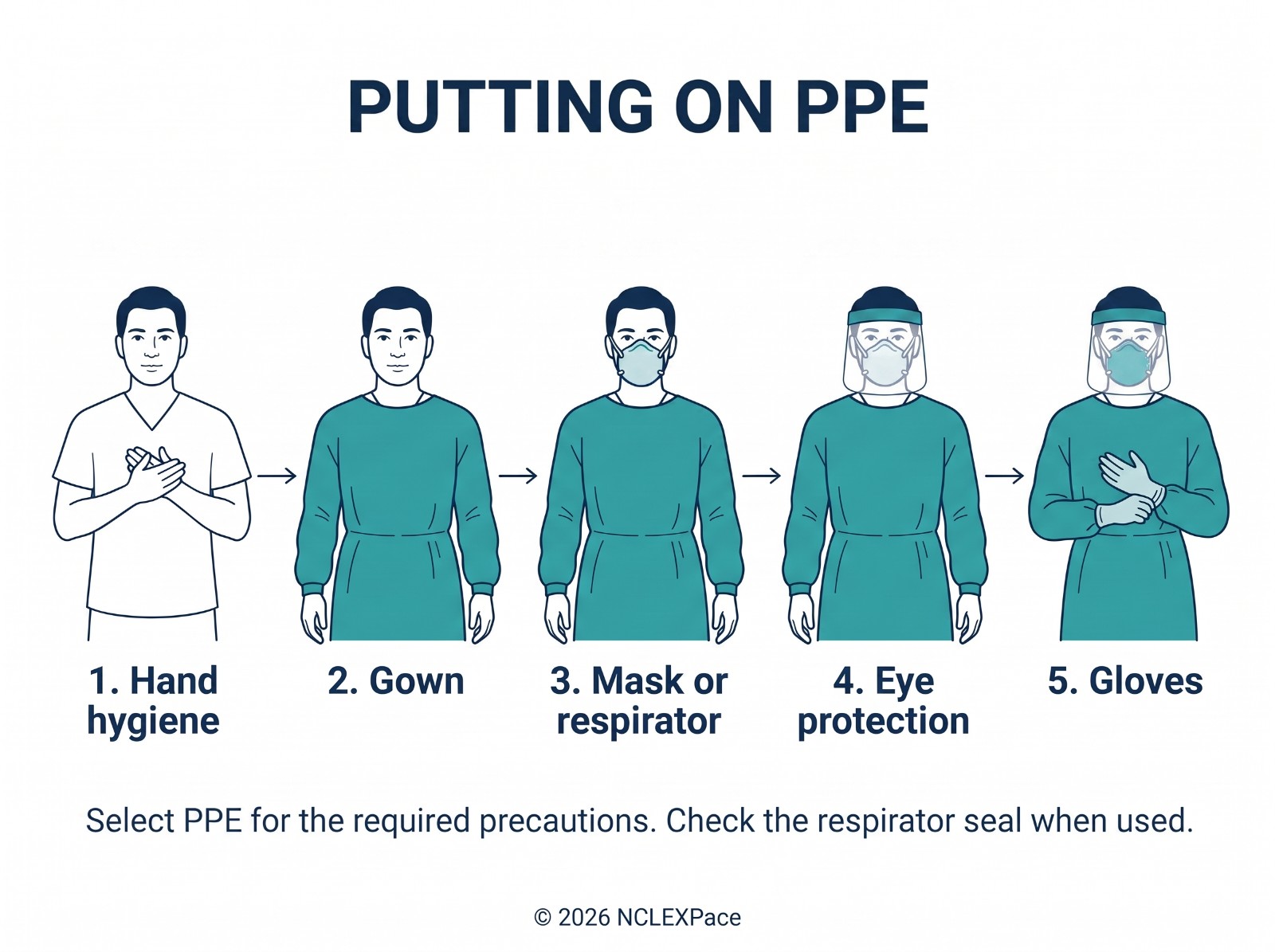
Step 3 — Order of PPE, both directions
| Putting on | Taking off |
|---|---|
| 1. Gown 2. Mask or respirator 3. Goggles or face shield 4. Gloves | 1. Gloves 2. Goggles or face shield 3. Gown 4. Mask last |
The logic: gloves are dirtiest so they come off first, and the mask comes off last because you are still in a contaminated space until you leave. Remove the mask outside the room for airborne precautions, after the door is closed.
Step 4 — Protective (neutropenic) precautions are the reverse
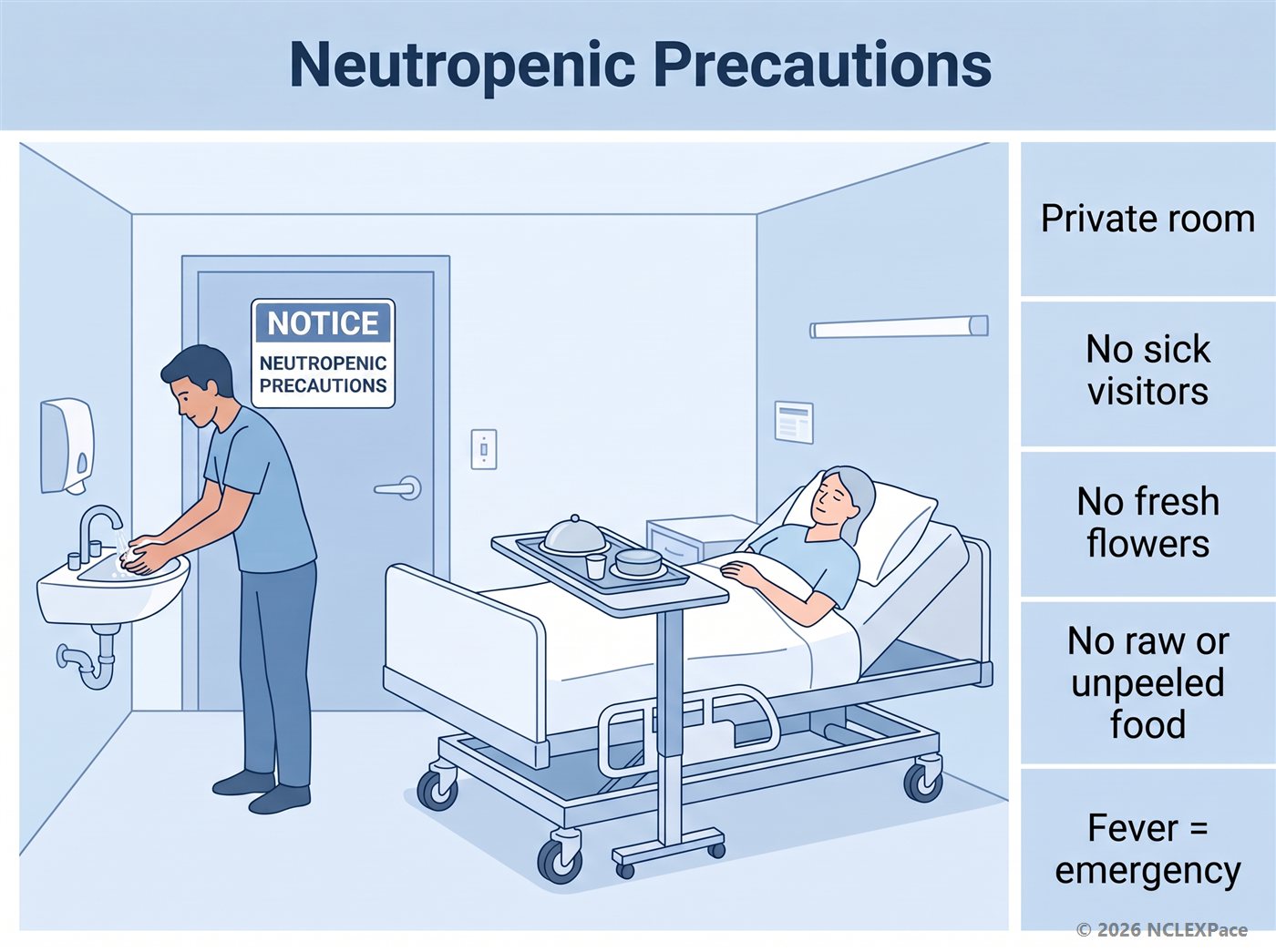
Everything above protects other people from the client. Protective isolation protects the client from everyone else — for a neutropenic client after chemotherapy or a transplant.
- Positive pressure room, not negative.
- No fresh flowers, no standing water, no raw or undercooked food.
- No visitors with any infection.
- The client wears a mask when leaving, and anyone with symptoms stays out.
Negative pressure keeps air in; positive pressure keeps air out. If a stem describes a client with a neutrophil count of 400 and asks about room assignment, positive pressure is the answer.
Standard precautions underneath everything
Every category sits on top of standard precautions, which apply to every client regardless of diagnosis: hand hygiene, gloves for anything wet, and treating all blood and body fluid as infectious. A question that offers "wash your hands" as an option is very often correct, and hand hygiene is the single most effective measure there is.
NCLEX tip: Two facts win a disproportionate number of these questions. C. difficile means soap and water — alcohol gel does not kill spores. And negative pressure keeps infection in, positive pressure keeps infection out — so a TB client gets negative and a neutropenic client gets positive.
5 NCLEX practice questions on this topic
The same questions, player and partial-credit scoring students use inside NCLEXPace: answer, submit, read the full rationale, then Next. Your score is waiting at the end. No account needed for these.
A free account opens 20 more questions, a case study, a video and a cheat sheet. The full bank has 3,200+ questions with rationales, by topic.
Practice more, free →Ready for the full bank? See NCLEXPace plans and prices: one payment for 1, 2, 3 or 6 months.
Frequently asked questions
Common follow-up questions on Infection Control, Safety & Risk Reduction.
Which diseases require airborne precautions?
Measles, tuberculosis, varicella (chickenpox), and disseminated herpes zoster, remembered by the hook 'My Chicken Hez TB'. Airborne precautions require a private negative-pressure room with the door closed and an N95 respirator for the nurse. Varicella and disseminated zoster need airborne AND contact precautions, because the lesions are infectious to touch as well.
Who wears the N95 and who wears the surgical mask?
The nurse wears the N95 respirator, and the client wears a surgical mask when transported out of the room. It is not the other way round, and the client is never put in an N95. Exam items swap these deliberately.
Why does C. difficile need soap and water instead of hand gel?
Alcohol gel does not kill C. difficile spores, so hand hygiene must be done with soap and water. C. difficile is a contact precaution, and this is one of the most repeated items in the whole topic.
What is the correct order for putting on and removing PPE?
Putting on: gown, then mask or respirator, then goggles or face shield, then gloves. Taking off: gloves first because they are dirtiest, then goggles or face shield, then gown, then mask last. For airborne precautions the mask is removed outside the room after the door is closed, because you are still in a contaminated space until you leave.
How do protective (neutropenic) precautions differ?
Protective isolation protects the client from everyone else rather than protecting others from the client, and it uses a positive-pressure room instead of negative pressure. It also means no fresh flowers, no standing water, no raw or undercooked food, and no visitors with any infection, and the client wears a mask when leaving. Negative pressure keeps infection in; positive pressure keeps infection out.
Sources and references
- Potter PA, Perry AG, Stockert PA, Hall AM. Fundamentals of Nursing. 10th ed. Elsevier; 2021; Chapter: Infection Prevention and Control.
- Siegel JD, et al.; Healthcare Infection Control Practices Advisory Committee. 2007 Guideline for Isolation Precautions: Preventing Transmission of Infectious Agents in Healthcare Settings. CDC; 2007 (last updated September 2024).
Reviewed by the NCLEXPace team, October 2026.
Keep reading

3,200+ NCLEX questions with think-like-a-nurse rationales, unfolding case studies and adaptive readiness exams. Start with free practice questions, then choose a plan when you are ready.
Create Free Account →