
Chest Pain on the NCLEX: MI vs Angina vs Pericarditis vs PE
Separate the four by what changes the pain: angina eases with rest and nitroglycerin, myocardial infarction does not; pericarditis improves when the client sits up and leans forward and worsens lying flat; pulmonary embolism brings sudden pleuritic pain with dyspnoea and tachycardia rather than crushing pressure. Any unrelieved chest pain is treated as a myocardial infarction until proven otherwise.

Acute coronary syndrome and MI: the chest-pain assessment, troponin, the first actions and the medications, with angina for comparison.
From the Intensive NCLEX Course. See the course; the full video library is part of Pro and Ultimate.
Chest pain is the NCLEX's favourite ambiguity. Four conditions, similar opening lines, completely different first actions. The exam is not testing whether you know what an MI is — it is testing whether you can tell it apart from the three things that look like one.
Step 1 — Let the pain description narrow the field first
Before vital signs, before labs, read how the pain started, what it feels like, and what changes it. Those three details separate all four.
| Feature | Stable angina | Myocardial infarction | Pericarditis | Pulmonary embolism |
|---|---|---|---|---|
| Onset | With exertion, predictable | Builds over minutes, often at rest | Gradual, over hours to days | Sudden, out of nowhere |
| Quality | Pressure, tightness | Crushing, heavy, "elephant on chest" | Sharp, stabbing | Sharp, pleuritic |
| Position | No change | No change | Better sitting up and leaning forward | No change |
| Breathing | No change | No change | Worse on inspiration | Worse on inspiration |
| Relief | Rest or nitroglycerin relieves it | Nitroglycerin does not fully relieve it | Leaning forward, NSAIDs | Nothing positional helps |
| Settling finding | Normal troponin | Rising troponin + ST changes | Friction rub; diffuse ST elevation | Sudden hypoxia + tachypnea, clear lungs |
Step 2 — The single discriminator for each
If you remember nothing else, remember one finding per condition:
- Angina: it goes away. Rest or nitroglycerin fixes it, and the troponin stays normal.
- MI: the troponin rises. Troponin is the most specific cardiac marker and it is what turns "chest pain" into "infarction."
- Pericarditis: position changes it. A client who sits up and leans forward for relief is telling you the diagnosis. Listen for a friction rub.
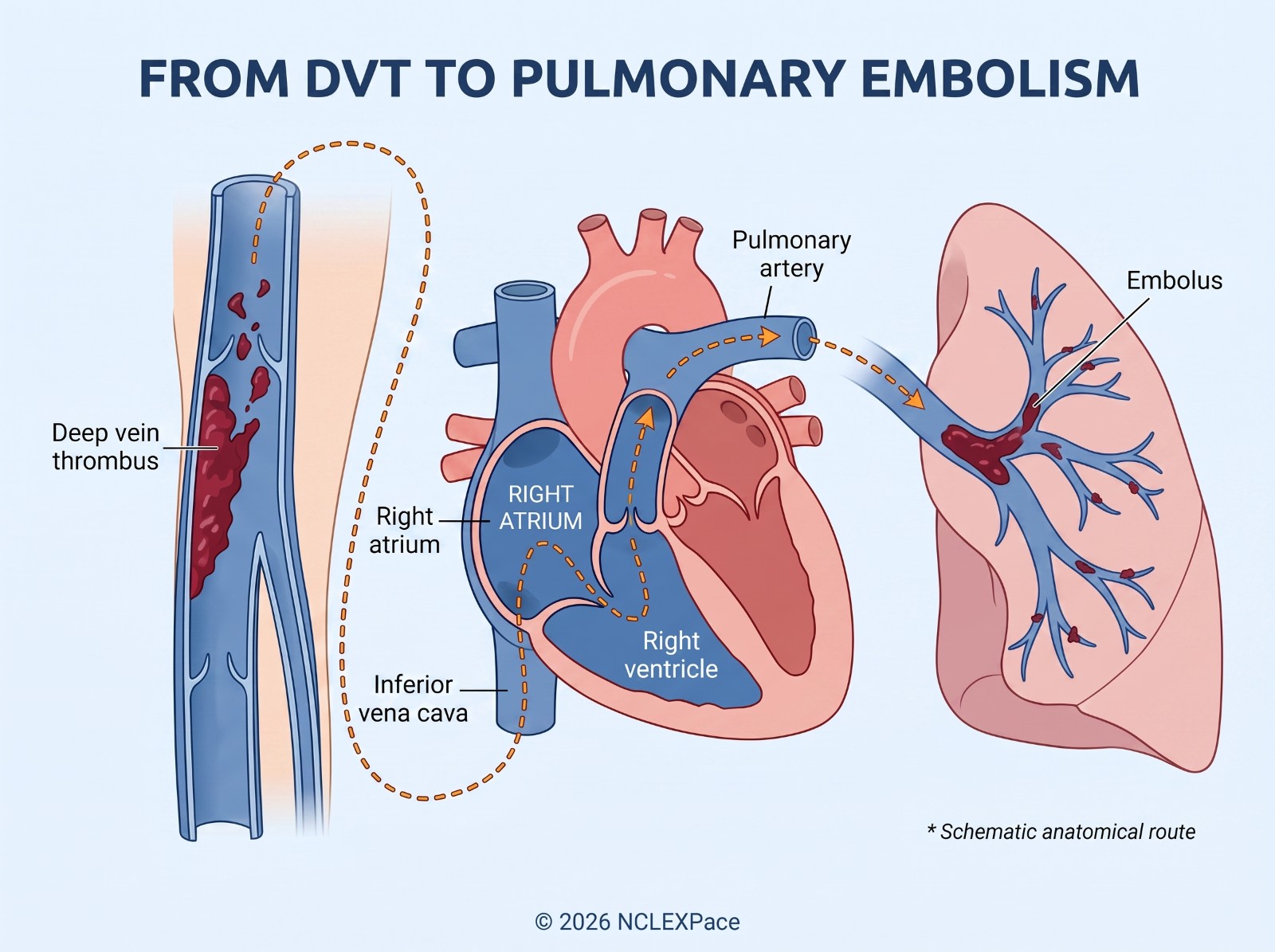
- PE: it is sudden, and the client is hypoxic with clear lung sounds. That combination — dropping SpO₂ with nothing to hear — is the classic pairing.
Step 3 — Different pain, different first action
| Condition | Nurse's first actions | Why this order |
|---|---|---|
| Suspected MI | Oxygen if hypoxic, 12-lead ECG, aspirin, nitroglycerin, notify provider, troponin | The ECG decides whether this client goes to the cath lab; it must happen fast |
| Stable angina | Stop activity, nitroglycerin q5min ×3, reassess between doses | Pain that persists after three doses is no longer stable angina — escalate |
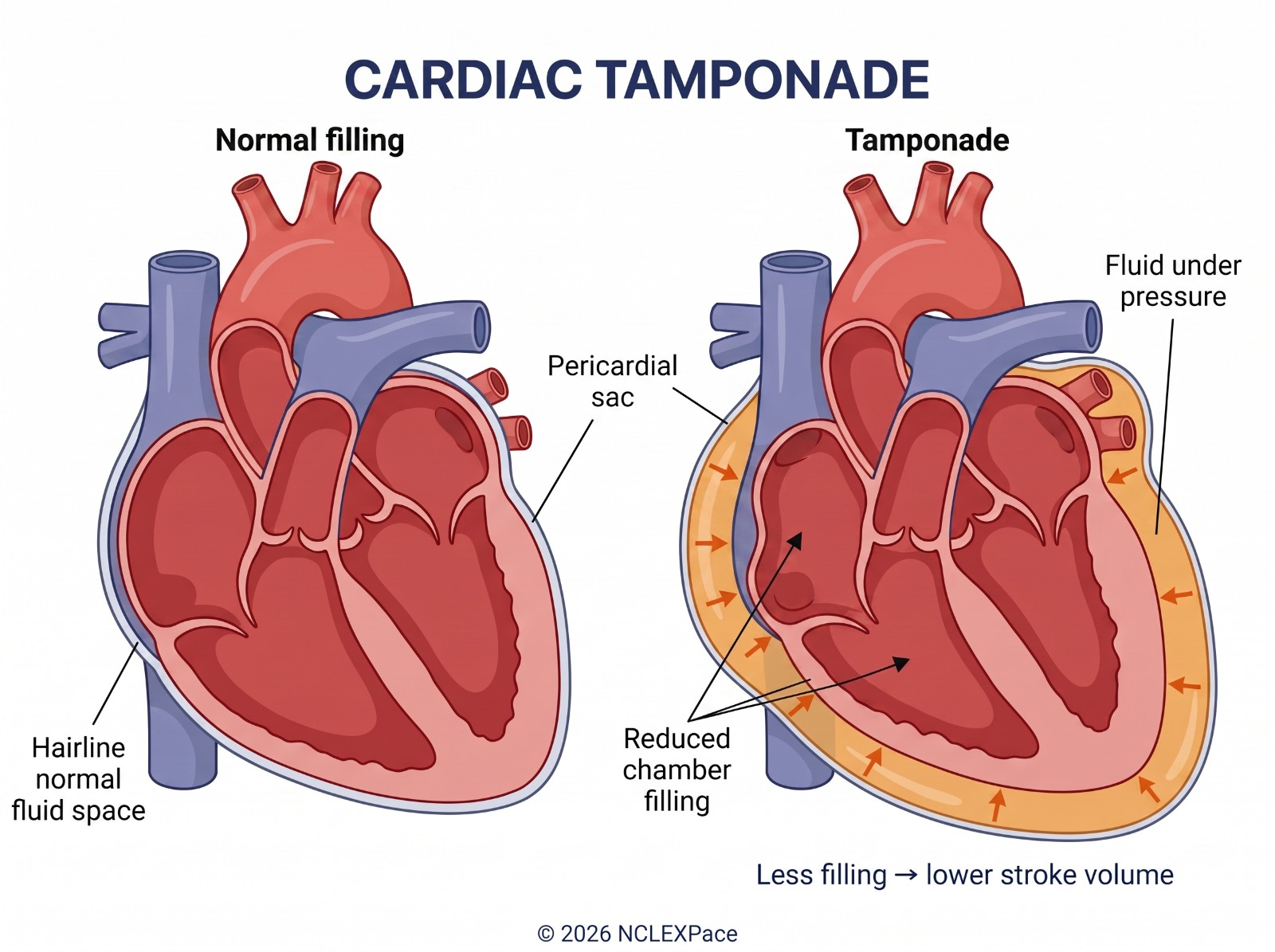
| Pericarditis | Position upright, leaning forward; NSAIDs; monitor for tamponade | Comfort is genuinely therapeutic here, and tamponade is the complication to catch |
| Suspected PE | Oxygen first, high Fowler's, notify provider, prepare anticoagulation | This is an oxygenation emergency before it is anything else |
The complication the exam hides inside pericarditis
Pericarditis questions often turn into cardiac tamponade questions. Watch for Beck's triad: hypotension, muffled heart sounds, and jugular vein distension. Add pulsus paradoxus and you have an emergency requiring pericardiocentesis — not more NSAIDs.
Why nitroglycerin is such a useful clue
The exam uses the response to nitroglycerin as a diagnostic hinge. Relief points to angina. Partial or no relief points to infarction. A client whose pain persists through three sublingual doses five minutes apart has an emergency, and the correct answer is never "give a fourth dose."
NCLEX tip: When a chest-pain stem mentions position, it is steering you to pericarditis. When it mentions sudden onset with clear lungs and falling oxygen, it is steering you to PE. The exam plants these details deliberately — they are not scenery, they are the answer.
5 NCLEX practice questions on this topic
The same questions, player and partial-credit scoring students use inside NCLEXPace: answer, submit, read the full rationale, then Next. Your score is waiting at the end. No account needed for these.
A free account opens 20 more questions, a case study, a video and a cheat sheet. The full bank has 3,200+ questions with rationales, by topic.
Practice more, free →Ready for the full bank? See NCLEXPace plans and prices: one payment for 1, 2, 3 or 6 months.
Frequently asked questions
Common follow-up questions on Body Systems & Clinical Content.
How do I tell angina from a myocardial infarction?
Angina is provoked by exertion, lasts under about 15 minutes, and is relieved by rest and nitroglycerin. Myocardial infarction pain occurs at rest, lasts longer than 20 minutes, is not relieved by nitroglycerin, and is accompanied by diaphoresis, nausea and a sense of impending doom.
What is the classic sign of pericarditis?
Sharp, pleuritic chest pain that is worse lying flat and better sitting up and leaning forward, often with a pericardial friction rub on auscultation and diffuse ST elevation across the ECG rather than in a single territory.
What makes pulmonary embolism different from cardiac chest pain?
Sudden onset of sharp pleuritic pain with dyspnoea, tachypnoea, tachycardia and anxiety, often after immobility, surgery or a long flight. Hypoxia out of proportion to the lung examination is a strong clue.
What is the priority nursing action for acute chest pain?
Assess and stay with the client, apply oxygen if hypoxic, obtain a 12-lead ECG, and follow the MONA elements as prescribed: the immediate goal is to determine whether this is a myocardial infarction while treating it as one.
Sources and references
- Harding MM, Kwong J, Hagler D, Reinisch C. Lewis's Medical-Surgical Nursing: Assessment and Management of Clinical Problems. 12th ed. Elsevier; 2023; Chapter: Coronary Artery Disease and Acute Coronary Syndrome.
- Harding MM, Kwong J, Hagler D, Reinisch C. Lewis's Medical-Surgical Nursing: Assessment and Management of Clinical Problems. 12th ed. Elsevier; 2023; Chapter: Inflammatory and Structural Heart Disorders.
- Rao SV, et al. 2025 ACC/AHA/ACEP/NAEMSP/SCAI Guideline for the Management of Patients With Acute Coronary Syndromes. Circulation. 2025;151(13):e771-e862.
Reviewed by the NCLEXPace team, October 2026.
Keep reading



3,200+ NCLEX questions with think-like-a-nurse rationales, unfolding case studies and adaptive readiness exams. Start with free practice questions, then choose a plan when you are ready.
Create Free Account →