
Acute Kidney Injury: The Three Phases and What Changes in Each
Acute kidney injury moves through three phases: oliguric (urine output falls, potassium and fluid build up), diuretic (large volumes are lost and the client can become dehydrated and hypokalaemic), then recovery. The danger reverses between the first two phases, which is why the exam question is almost always which phase this is and what that changes.

Acute kidney injury: prerenal, intrarenal and postrenal causes, the three phases, and hyperkalaemia as the first thing to treat.
From the Intensive NCLEX Course. See the course; the full video library is part of Pro and Ultimate.
The NCLEX almost never asks “what is acute kidney injury.” It asks which phase is this, and what does that change — because the danger reverses between the first two phases, and the nursing care reverses with it.
Step 1 — Where the injury sits
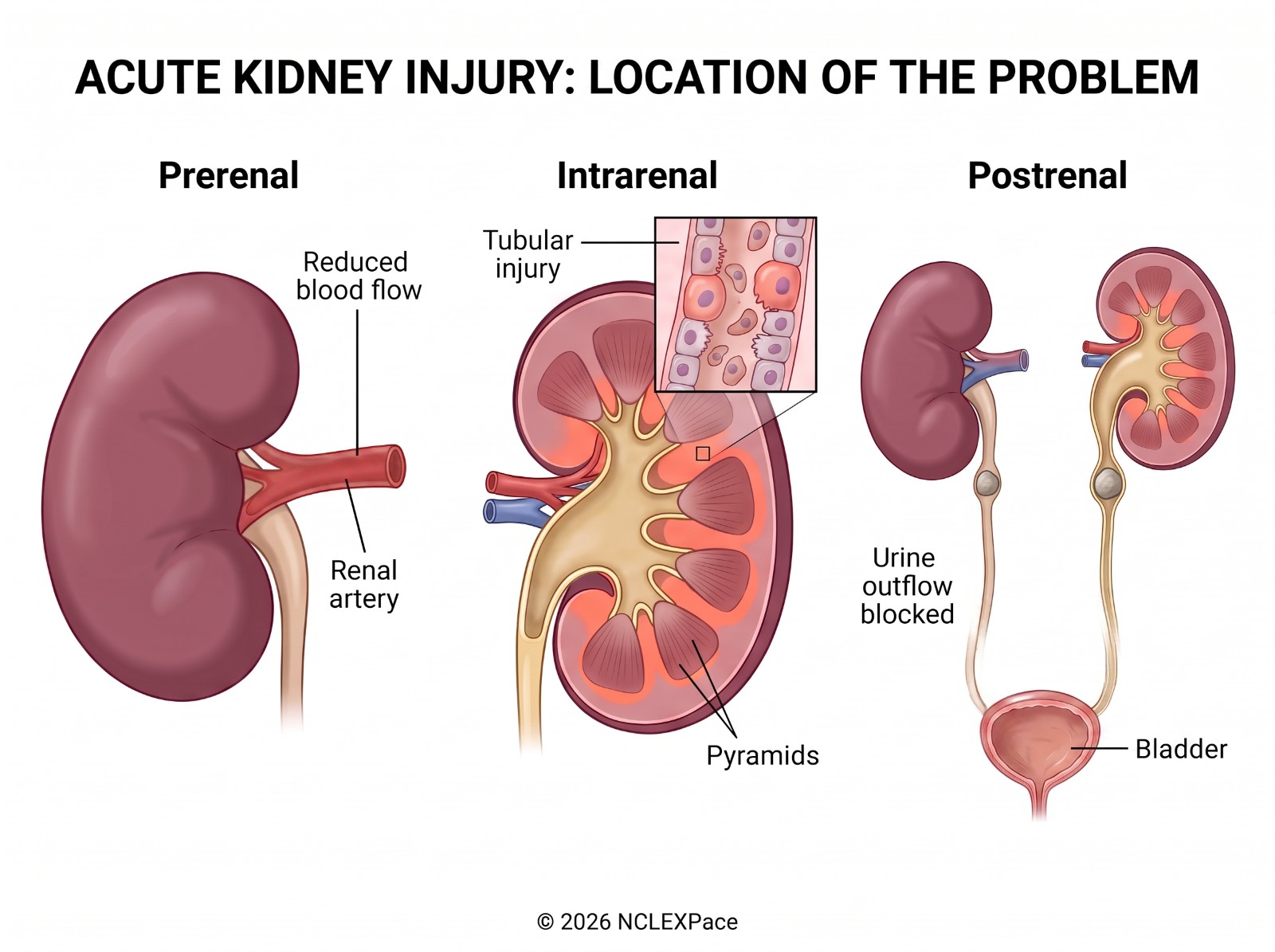
Before phases, locate the problem. Prerenal, intrarenal and postrenal are not trivia — they decide how reversible the injury is and what you fix first.
| Type | Where the problem is | Typical causes | Key clue |
|---|---|---|---|
| Prerenal | Before the kidney — perfusion | Hypovolaemia, haemorrhage, dehydration, shock, heart failure, sepsis | The kidney is fine; it is not getting blood. Most common, most reversible if perfusion is restored quickly |
| Intrarenal | Inside the kidney — the tissue itself | Acute tubular necrosis, nephrotoxic drugs, contrast media, prolonged ischaemia, glomerulonephritis, rhabdomyolysis | Damage to the nephron. Slowest to reverse |
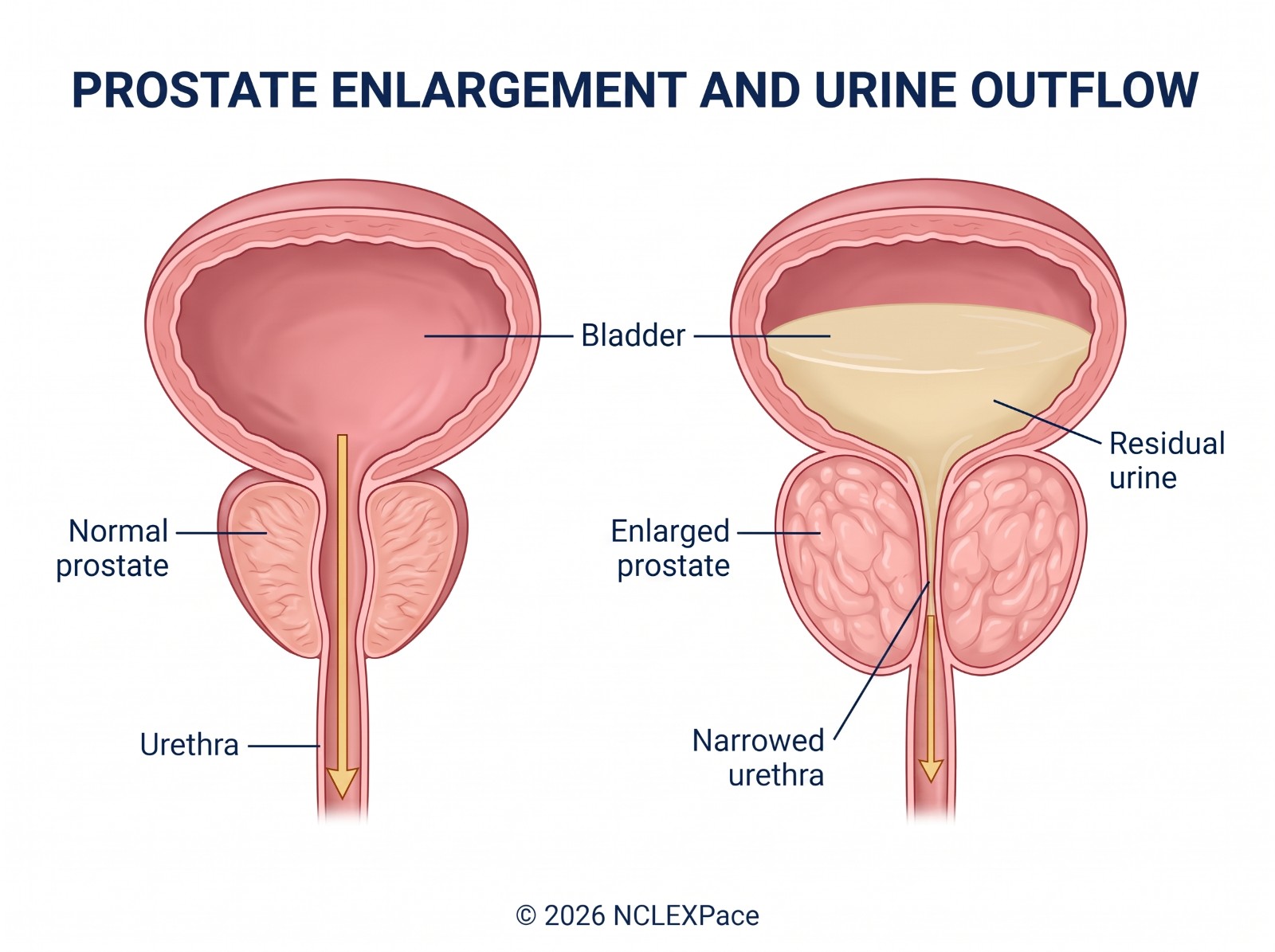
| Postrenal | After the kidney — outflow | Prostatic enlargement, stones, tumour, a blocked urinary catheter | Obstruction. Relieve it and function often returns quickly — always check the catheter |
Nephrotoxic agents worth knowing by name: aminoglycosides, vancomycin, NSAIDs, ACE inhibitors in the wrong setting, amphotericin B, and iodinated contrast. Hydration before and after contrast, and holding metformin around contrast studies, are standard exam points.
Step 2 — The three phases
This table is the article. The client who needed fluid restriction last week may need fluid replacement this week — the exam builds items around exactly that switch.
| Oliguric | Diuretic | Recovery | |
|---|---|---|---|
| Urine output | Under 400 mL/day | Very high — litres per day | Normalising |
| Duration | ~1–3 weeks | ~1–3 weeks | Months |
| Potassium | High — the lethal problem | Low — lost in the urine | Normalising |
| Fluid | Overload — oedema, crackles, raised JVP, hypertension, weight gain | Depletion — hypotension, tachycardia, poor turgor, weight loss | Balanced |
| Waste products | Urea and creatinine climbing | Still elevated, beginning to fall | Falling toward baseline |
| Nursing focus | Restrict fluid, restrict potassium, watch the ECG, daily weights | Replace fluid and electrolytes, watch for dehydration and hypokalaemia | Nephrotoxin avoidance, education, gradual return of function |
Step 3 — Hyperkalaemia is what kills first
In the oliguric phase, potassium has nowhere to go. It is the finding that outranks the creatinine, the urea and the oedema.
| What to watch | Detail |
|---|---|
| ECG changes | Peaked T waves first, then a widening QRS, then a flattening P wave and arrhythmia. Peaked T waves in a client with AKI are an emergency finding |
| Other signs | Muscle weakness, paraesthesia, nausea, irregular pulse |
| Emergency treatment | Calcium gluconate to stabilise the myocardium; insulin with dextrose and salbutamol to shift potassium into cells; then removal with a binding resin or dialysis |
Calcium, insulin and salbutamol buy time — they move or mask potassium. Only excretion or dialysis removes it.
Step 4 — What the nurse does
- Strict intake and output, and daily weights at the same time on the same scale. Weight is the most reliable fluid measure — roughly 1 kg equals 1 litre.
- Fluid allowance in the oliguric phase is often the previous day's output plus around 500 mL for insensible loss.
- Diet: restrict potassium, phosphate and sodium; moderate protein rather than eliminate it; ensure adequate calories so the body does not break down its own protein.
- Review every medication for renal dosing and nephrotoxicity — a genuine nursing responsibility, not a pharmacy one.
- Monitor for uraemia: confusion, lethargy, nausea, pruritus, a metallic taste, and pericardial friction rub.
- Infection prevention — infection is a leading cause of death in AKI.
- Skin and mouth care for oedematous fragile skin and the metallic taste.
Indications for urgent dialysis worth holding as a list: refractory hyperkalaemia, fluid overload unresponsive to diuretics, severe acidosis, uraemic symptoms such as pericarditis or encephalopathy, and certain intoxications.
NCLEX tip: Two reflexes serve you well. When a stem describes AKI, find the urine output first — it tells you the phase, and the phase tells you whether to restrict or replace. And whenever potassium appears in a renal stem, treat it as the priority over every other abnormal value in the list.
Educational use only: this article supports nursing review and does not replace clinical judgment, facility protocols, or instructions from an authorised prescriber.
5 NCLEX practice questions on this topic
The same questions, player and partial-credit scoring students use inside NCLEXPace: answer, submit, read the full rationale, then Next. Your score is waiting at the end. No account needed for these.
A free account opens 20 more questions, a case study, a video and a cheat sheet. The full bank has 3,200+ questions with rationales, by topic.
Practice more, free →Ready for the full bank? See NCLEXPace plans and prices: one payment for 1, 2, 3 or 6 months.
Frequently asked questions
Common follow-up questions on Body Systems & Clinical Content.
What are the three phases of acute kidney injury?
The oliguric phase, with urine output under 400 mL a day and rising potassium and fluid; the diuretic phase, with very large urine volumes risking dehydration and hypokalaemia; and the recovery phase, over months, as function returns toward baseline.
What is the difference between prerenal, intrarenal and postrenal AKI?
Prerenal injury is a perfusion problem before the kidney (hypovolaemia, shock, heart failure) and is the most reversible. Intrarenal injury damages kidney tissue itself, most often acute tubular necrosis from ischaemia or nephrotoxins. Postrenal injury is obstruction to outflow, which is why a blocked catheter is always checked.
Why is potassium the priority in acute kidney injury?
Because the kidney is the main route of potassium excretion, and rising levels cause lethal arrhythmias. Peaked T waves progressing to a widened QRS are emergency findings, and hyperkalaemia outranks every other abnormal value in a renal stem.
What does the nurse monitor in the diuretic phase?
Fluid and electrolyte depletion rather than overload: hypotension, tachycardia, poor skin turgor, falling weight and hypokalaemia. Fluid and electrolytes are replaced in this phase, reversing the restriction applied during the oliguric phase.
When is dialysis needed in acute kidney injury?
For hyperkalaemia unresponsive to treatment, fluid overload that will not respond to diuretics, severe metabolic acidosis, uraemic complications such as pericarditis or encephalopathy, and certain drug intoxications.
Which medications are nephrotoxic?
Aminoglycosides, vancomycin, NSAIDs, amphotericin B and iodinated contrast media, with ACE inhibitors and ARBs adding risk in the setting of poor perfusion. Every medication list is reviewed for renal dosing when kidney function falls.
Sources and references
- Harding MM, Kwong J, Hagler D, Reinisch C. Lewis's Medical-Surgical Nursing: Assessment and Management of Clinical Problems. 12th ed. Elsevier; 2023; Chapter: Acute Kidney Injury and Chronic Kidney Disease.
- Kidney Disease: Improving Global Outcomes (KDIGO) Acute Kidney Injury Work Group. KDIGO Clinical Practice Guideline for Acute Kidney Injury. Kidney International Supplements. 2012;2(1):1-138.
Reviewed by the NCLEXPace team, October 2026.
Keep reading


3,200+ NCLEX questions with think-like-a-nurse rationales, unfolding case studies and adaptive readiness exams. Start with free practice questions, then choose a plan when you are ready.
Create Free Account →