
A Realistic 4-Week NCLEX Study Plan for People Who Just Graduated
Four weeks is the sweet spot for new graduates because the content is closer to the surface than it will ever be again, so the task is converting what you know into exam reasoning rather than relearning everything. The plan runs five to six hours a day, building volume through weeks one to three, front-loading the highest-weight content, adding full case studies, and then tapering to almost nothing in the final days.

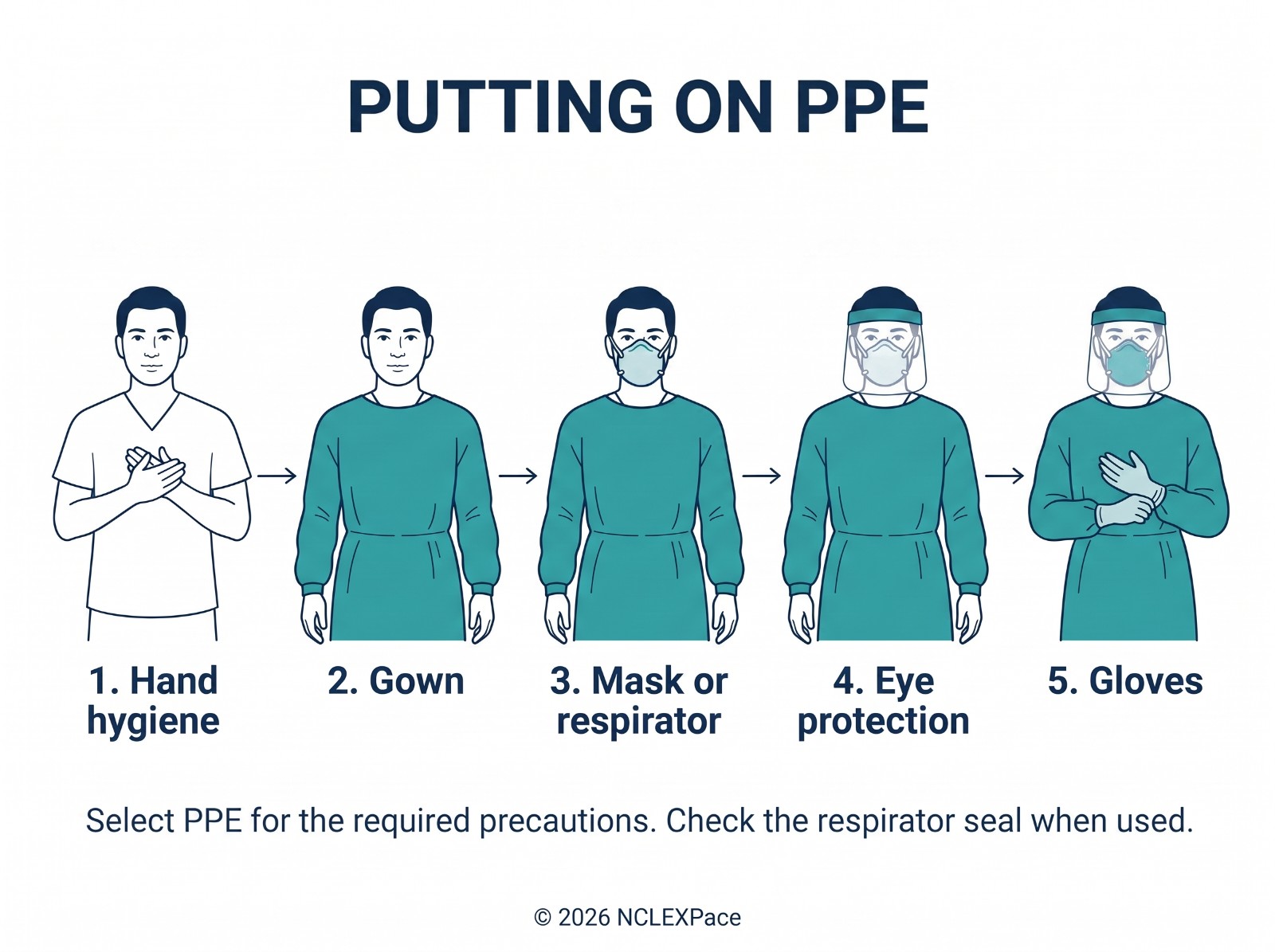
A free sample lesson on the precautions, one of the quick-to-learn, reliably tested topics this plan schedules for the final week.
From the Intensive NCLEX Course. This lesson is a free sample: watch it with a free account.
Four weeks is the sweet spot for new graduates, and there is a reason for it.
You just finished nursing school. The content is closer to the surface than it will ever be again. What you need is not to relearn everything — it is to convert what you know into the specific skill the NCLEX tests, which is reasoning under uncertainty about unfamiliar clients.
Four weeks is enough to do that. It is also short enough that you will not decay.
What you are actually preparing for
Your exam will be 85 to 150 items over five hours, including breaks. On a minimum-length exam, 52 items come from the eight content areas, 18 items are three clinical judgment case studies, and 15 are unscored pretest items.
That means roughly a quarter of your scored items are case study items. If your preparation is all standalone questions, you have skipped a quarter of the exam.
The overall shape
Week 1 — Diagnose and start the highest-weight content Week 2 — Content and question practice at full volume Week 3 — Weak areas plus case studies and mixed practice Week 4 — Full-length simulation and consolidation, tapering to nothing
Volume rises through weeks 1 to 3 and falls in week 4. That final taper is deliberate and most people get it wrong.
The daily template
Roughly five to six hours, five to six days a week. If you can do more, do not — quality collapses and you burn out before test day.
| Block | Duration | Activity |
|---|---|---|
| Morning | 90 min | Content review on the day’s topic |
| Break | 30 min | Actually leave the desk |
| Midday | 90 min | 60–75 questions on that topic, timed |
| Break | 60 min | Lunch, walk, off-screen |
| Afternoon | 90 min | Review every question — right and wrong |
| Evening | 20 min | Retrieval on flashcards from earlier days |
That last 20-minute block does the heaviest lifting per minute of anything in the day, because it is spaced retrieval. Do not skip it.
The review block is longer than most people expect. Reviewing questions is where the learning happens, not answering them. If you are spending less time on review than on answering, your ratio is wrong.
Week 1 — Diagnose and start heavy
Day 1. Take a 75-question mixed assessment, timed. Do not study first. This is diagnosis and a low score is the point — you need to know where you actually stand, not where you feel you stand.
Then map your results against the test plan weights.
Days 2–6. Start with the highest-weight content, because that is where marginal study time pays best:
- Management of Care (15–21%) — prioritization, delegation, assignment, scope, legal and ethical
- Pharmacological and Parenteral Therapies (13–19%) — drug classes, high-alert medications, IV therapy, calculations
- Physiological Adaptation (11–17%) — unstable clients, emergencies, hemodynamics
Those three represent roughly 39–57% of content items. Spend week 1 there.
Day 7. Rest. Fully. Not “light review” — off.
Week 2 — Full volume
Days 8–13. Work through the remaining content areas: Safety and Infection Prevention and Control, Reduction of Risk Potential, Basic Care and Comfort, Health Promotion, Psychosocial Integrity.
Same daily template. Target 75–100 questions a day by mid-week.
Introduce case studies now — at least one full six-item set daily. Not standalone items pulled from a case; the whole unfolding set. The skill is following a client through a developing situation, and isolated items do not build it.
Day 14. Second assessment, 100 questions mixed. Compare against day 1. You are looking for movement, not a magic number.
Week 3 — Weak areas and integration
Days 15–20. Your question log now tells you where you are losing points. Work those areas.
Shift the ratio toward practice: 60–70% questions, 30–40% content. Content review at this stage should be targeted repair, not comprehensive re-reading.
Two case studies daily. Minimum.
Add mixed, untitled practice sets — questions not labeled by topic. Knowing a question is a cardiac question is a hint the real exam does not give you.
Day 21. Rest.
Week 4 — Simulate, consolidate, taper
Day 22. Full-length simulation. 150 questions, five hours, one break, no phone. This is a stamina rehearsal more than a knowledge test, and it is the single most useful day of the month. Most candidates discover their concentration collapses around hour three — better to find that out now.
Days 23–25. Review the simulation in depth. Then targeted work on whatever it exposed. Keep doing case studies.
Days 26–27. Light. 50 questions a day. Review high-yield material you have already learned — lab values, antidotes, precautions, positioning. Do not start anything new.
Day 28 — the day before. Nothing, or close to it. Thirty minutes of skimming familiar material if it calms you. Then stop. Sleep matters more than any content you could add in the final twelve hours.
The rules that make it work
Review every question, including the ones you got right. A correct answer for the wrong reason is a future wrong answer. If you cannot say why the three distractors are wrong, you did not really get it right.
Keep a question log from day one. Article 29 covers the format. Without it, week 3 has no direction.
Do not chase percentages. Practice percentages are not predictions. Article 35 explains why.
Protect one full rest day a week. The spacing effect works during the gaps, not only during the sessions.
Do not extend past four weeks by default. New graduates who study for three months often perform worse, not better — content decays, anxiety compounds, and life pressure builds.
If you fall behind
You will. Everyone does.
Do not restart the plan. Skip forward to where you should be and accept the gap. A partially completed four-week plan beats a perfectly completed six-week plan that ends with you exhausted.
If you fall badly behind, protect two things above all: the full-length simulation and case study practice. Those are the two things nothing else substitutes for.
Exam facts accessed August 2026. This plan is a framework built from exam structure and evidence-based study method; no NCLEX study schedule has been validated against outcomes in published research.
5 NCLEX practice questions to try now
A mixed set from the NCLEXPace bank, in the same player with the same partial-credit scoring students use inside the platform: answer, submit, read the full rationale, then Next. Your score is waiting at the end. No account needed for these.
A free account opens 20 more questions, a case study, a video and a cheat sheet. The full bank has 3,200+ questions with rationales, by topic.
Practice more, free →Ready for the full bank? See NCLEXPace plans and prices: one payment for 1, 2, 3 or 6 months.
Frequently asked questions
Common follow-up questions on Study Plans & Timelines.
Why four weeks rather than longer for a new graduate?
Four weeks is enough to convert what you already know into exam performance, and it is short enough that you will not decay. New graduates who study for three months often perform worse, not better, because content decays, anxiety compounds, and life pressure builds. Do not extend past four weeks by default.
How should I split my time between content and questions each day?
The daily template is roughly five to six hours: 90 minutes of content review, 60 to 75 timed questions on that topic, then a 90-minute block reviewing every question, right and wrong, plus a 20-minute evening retrieval block. The review block is longer than most people expect because reviewing questions is where the learning happens, not answering them. If you spend less time on review than on answering, your ratio is wrong.
Which content should I study first?
Start with the highest-weight content, because that is where marginal study time pays best: Management of Care at 15 to 21 percent, Pharmacological and Parenteral Therapies at 13 to 19 percent, and Physiological Adaptation at 11 to 17 percent. Those three represent roughly 39 to 57 percent of content items, so week one goes there. Week two covers the remaining content areas.
Do I need to practice case studies specifically?
Yes. On a minimum-length exam roughly a quarter of your scored items are case study items, so if your preparation is all standalone questions you have skipped a quarter of the exam. Introduce case studies in week two with at least one full six-item set daily, using the whole unfolding set rather than isolated items, because the skill is following a client through a developing situation.
What do I do if I fall behind the plan?
You will fall behind, and everyone does. Do not restart the plan; skip forward to where you should be and accept the gap, because a partially completed four-week plan beats a perfectly completed six-week plan that ends with you exhausted. If you fall badly behind, protect the full-length simulation and case study practice above all, because nothing else substitutes for them.
Sources and references
- National Council of State Boards of Nursing. 2026 NCLEX-RN Test Plan (effective April 1, 2026). Chicago, IL: NCSBN; 2026. nclex.com, Test Plans.
- Dunlosky J, Rawson KA, Marsh EJ, Nathan MJ, Willingham DT. Improving Students' Learning With Effective Learning Techniques: Promising Directions From Cognitive and Educational Psychology. Psychol Sci Public Interest. 2013;14(1):4-58.
- Roediger HL, Karpicke JD. Test-Enhanced Learning: Taking Memory Tests Improves Long-Term Retention. Psychol Sci. 2006;17(3):249-255.
Reviewed by the NCLEXPace team, October 2026.
Keep reading



3,200+ NCLEX questions with think-like-a-nurse rationales, unfolding case studies and adaptive readiness exams. Start with free practice questions, then choose a plan when you are ready.
Create Free Account →