Antidotes and Reversal Agents: The Only List You Need
Antidote questions are pure memorization with one right answer, and the list is short, about 18 drug-to-antidote pairs. The five tested most are acetaminophen reversed by acetylcysteine, opioids by naloxone, heparin by protamine, warfarin by vitamin K, and magnesium sulfate by calcium gluconate. The highest-value extra point is that naloxone wears off faster than most opioids, so the client can stop breathing again and must keep being monitored.

Opioids, naloxone and the safety checks around anesthesia and paralytics, including why naloxone can wear off before the opioid does.
From the Intensive NCLEX Course. This lesson is a free sample: watch it with a free account.
This is one of the easiest ways to gain points. Antidote questions have one right answer and no reasoning required. Pure memorization, and a short list.
The main list
| Drug or poison | Antidote |
|---|---|
| Acetaminophen | Acetylcysteine |
| Opioids | Naloxone |
| Benzodiazepines | Flumazenil |
| Heparin | Protamine sulfate |
| Warfarin | Vitamin K (phytonadione) |
| Dabigatran | Idarucizumab |
| Factor Xa inhibitors (-xaban drugs) | Andexanet alfa |
| Digoxin | Digoxin immune fab |
| Magnesium sulfate | Calcium gluconate |
| Iron | Deferoxamine |
| Beta blockers | Glucagon |
| Calcium channel blockers | Calcium, glucagon, insulin with glucose |
| Organophosphates / insecticides | Atropine and pralidoxime |
| Cyanide | Hydroxocobalamin |
| Ethylene glycol / methanol | Fomepizole |
| Lead | Chelating agents (succimer, EDTA, dimercaprol) |
| Anticholinergic overdose | Physostigmine |
| Nondepolarizing neuromuscular blockers | Neostigmine, sugammadex |
The ones tested most
If you only learn five, learn these:
Acetaminophen → acetylcysteine. Acetaminophen overdose destroys the liver. Very common overdose.
Opioids → naloxone. With one important extra point below.
Heparin → protamine.
Warfarin → vitamin K.
Magnesium → calcium gluconate. Especially in pregnancy care.
The extra points that get tested
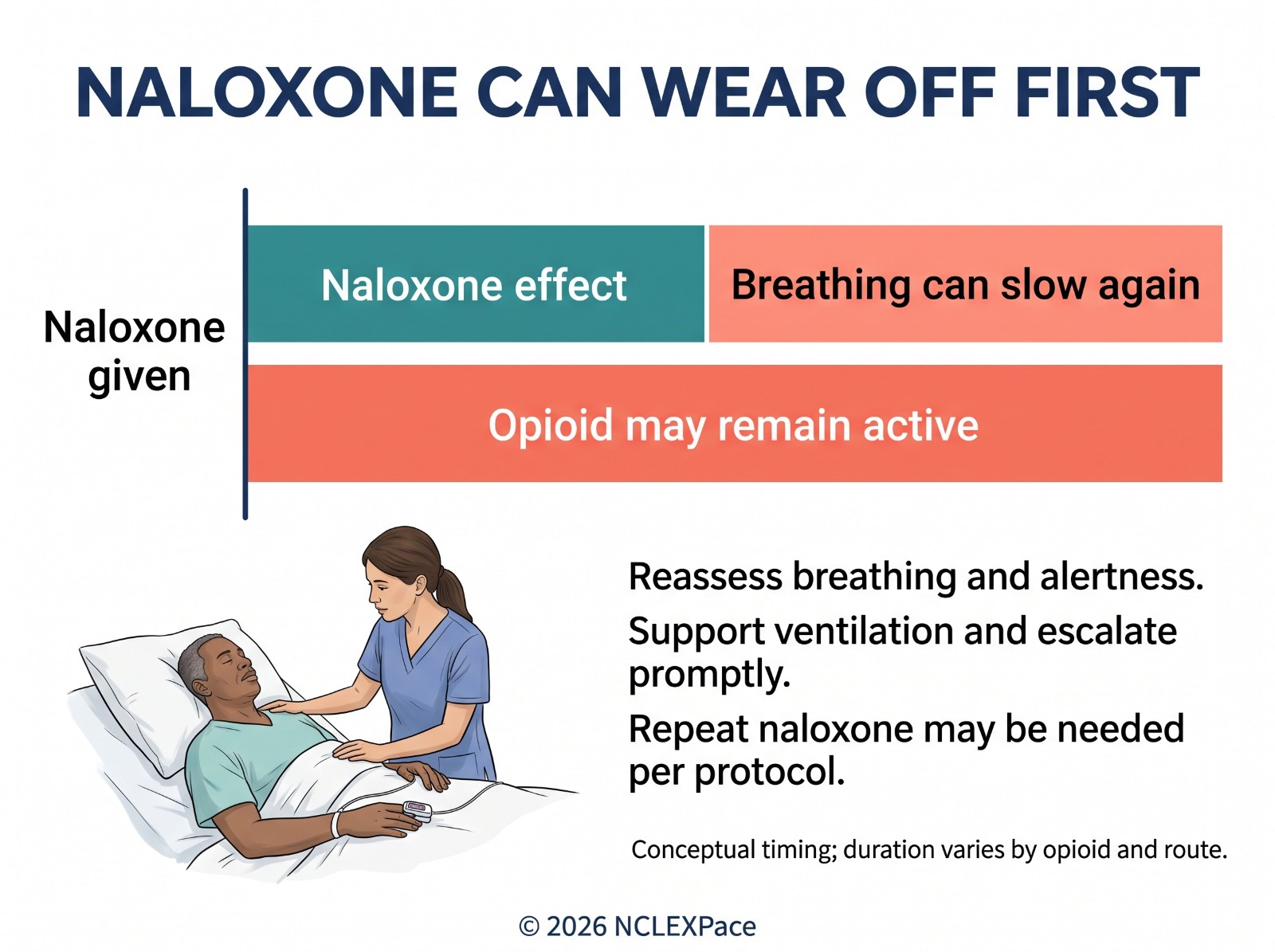
Naloxone wears off faster than most opioids.
You give naloxone, the client wakes up and breathes — and then 30 to 60 minutes later they stop breathing again, because the opioid is still there and the naloxone is gone.
Keep monitoring. Repeat doses may be needed.
This is a favorite exam point. A wrong answer is “the client is fine now, no further monitoring needed.”
Naloxone can cause sudden withdrawal in someone dependent on opioids — pain, agitation, vomiting, high blood pressure.
Flumazenil can cause seizures, especially in clients who take benzodiazepines regularly or who also took a tricyclic antidepressant. It is used carefully.
Vitamin K works slowly. For serious bleeding on warfarin, clotting factors are given as well, because vitamin K takes hours.
Magnesium toxicity is a classic obstetric scenario. Signs in order:
- Loss of deep tendon reflexes — the earliest sign
- Respiratory depression
- Low urine output
- Cardiac arrest
Nursing: check reflexes, respiratory rate, and urine output every hour. Loss of reflexes is the first warning. Stop the infusion and give calcium gluconate.
Digoxin immune fab is used for severe toxicity — dangerous rhythms or very high potassium, not just a mildly high level.
Memory aids
Heparin has a P → Protamine.
Warfarin and Vitamin K are enemies — vitamin K reverses it, and vitamin K in food reduces its effect.
Magnesium and Calcium balance each other — too much magnesium, give calcium.
“Nal” in naloxone = the opioid blocker. Naloxone and naltrexone both block opioids.
How to study this
Make flashcards. One drug, one antidote. About 18 cards.
Review them daily for two weeks. Short daily review beats one long session.
Do them both directions. “What reverses heparin?” and “What does protamine reverse?”
This is the single highest return per minute in your whole pharmacology study. Eighteen facts, and they appear on nearly every exam.
The short version
Learn 18 pairs. Add these extras:
- Naloxone wears off — keep watching
- Magnesium toxicity: reflexes go first
- Vitamin K is slow
Antidote protocols and dosing change. Check a current poison control or drug reference in practice.
5 NCLEX practice questions on this topic
The same questions, player and partial-credit scoring students use inside NCLEXPace: answer, submit, read the full rationale, then Next. Your score is waiting at the end. No account needed for these.
A free account opens 20 more questions, a case study, a video and a cheat sheet. The full bank has 3,200+ questions with rationales, by topic.
Practice more, free →Ready for the full bank? See NCLEXPace plans and prices: one payment for 1, 2, 3 or 6 months.
Frequently asked questions
Common follow-up questions on Pharmacology.
Which antidotes are tested most often?
If you only learn five, learn these: acetaminophen is reversed by acetylcysteine, opioids by naloxone, heparin by protamine sulfate, warfarin by vitamin K (phytonadione), and magnesium sulfate by calcium gluconate. Magnesium and calcium especially come up in pregnancy care, and acetaminophen overdose, which destroys the liver, is a very common overdose.
Why does a client need continued monitoring after naloxone?
Naloxone wears off faster than most opioids. The client wakes up and breathes, and then 30 to 60 minutes later they can stop breathing again, because the opioid is still there and the naloxone is gone. Repeat doses may be needed, so a wrong answer is that the client is fine now and needs no further monitoring. Naloxone can also cause sudden withdrawal in someone opioid-dependent.
What is the order of magnesium toxicity signs and its antidote?
The signs appear in order: loss of deep tendon reflexes, the earliest sign, then respiratory depression, then low urine output, then cardiac arrest. Check reflexes, respiratory rate, and urine output every hour. If toxicity develops, stop the infusion and give calcium gluconate, since loss of reflexes is the first warning.
Why does vitamin K not stop serious warfarin bleeding on its own?
Vitamin K works slowly, taking hours. So for serious bleeding on warfarin, clotting factors are given as well. Flumazenil, the benzodiazepine reversal agent, carries its own caution: it can cause seizures, especially in clients who take benzodiazepines regularly or who also took a tricyclic antidepressant.
What is the best way to study the antidote list?
Make flashcards, one drug and one antidote, about 18 cards, and review them daily for two weeks, because short daily review beats one long session. Do them both directions, asking both what reverses heparin and what protamine reverses. This is the single highest return per minute in your whole pharmacology study, since the facts appear on nearly every exam.
Sources and references
- Burchum JR, Rosenthal LD. Lehne's Pharmacology for Nursing Care. 11th ed. Elsevier; 2022; Chapter: Management of Poisoning.
- Burchum JR, Rosenthal LD. Lehne's Pharmacology for Nursing Care. 11th ed. Elsevier; 2022; Chapter: Anticoagulant, Antiplatelet, and Thrombolytic Drugs.
Reviewed by the NCLEXPace team, October 2026.
Keep reading
3,200+ NCLEX questions with think-like-a-nurse rationales, unfolding case studies and adaptive readiness exams. Start with free practice questions, then choose a plan when you are ready.
Create Free Account →