Dosage Calculation Made Simple: One Method for Everything
Use one method for every dosage calculation: dimensional analysis, which is just cancelling units. You start with what you have, multiply by fractions that cancel unwanted units, and end with what you want, so if the units cancel correctly the setup is correct and the units check your work. Always convert units first, round once at the end, and sanity-check the answer.

Dosage calculation worked step by step: tablets and liquids, weight-based doses, IV rates in mL per hour, and drops per minute.
From the Intensive NCLEX Course. See the course; the full video library is part of Pro and Ultimate.
Most students learn three or four different formulas and get confused about which to use.
Use one method for everything. It is called dimensional analysis, and it is just cancelling units.
The idea
You start with what you have. You multiply by fractions that cancel unwanted units. You end with what you want.
If the units cancel correctly, the math is set up correctly.
That is the whole benefit — the units check your work for you.
Setup 1: Simple tablet or liquid dose
Order: 500 mg. Available: 250 mg per tablet. How many tablets?
Start with what you want to end with, and build toward it:
500 mg × 1 tablet = 2 tablets 250 mg
The mg cancels. You are left with tablets.
Another:
Order: 125 mg. Available: 250 mg in 5 mL. How many mL?
125 mg × 5 mL = 625 = 2.5 mL 250 mg 250
The mg cancels. You are left with mL.
Setup 2: Dose based on body weight
Order: 5 mg per kg per dose. Client weighs 154 pounds. Available: 100 mg in 2 mL. How many mL per dose?
Step 1 — convert pounds to kg. Divide by 2.2.
154 ÷ 2.2 = 70 kg
Step 2 — find the dose.
70 kg × 5 mg/kg = 350 mg
Step 3 — find the volume.
350 mg × 2 mL = 700 = 7 mL 100 mg 100
Answer: 7 mL
Always convert pounds to kilograms first. Forgetting this is the most common error in weight-based questions.
Setup 3: IV rate in mL per hour
Order: 1,000 mL over 8 hours. What is the pump rate?
1000 mL = 125 mL/hour 8 hours
Simple division. Total volume divided by total hours.
Another:
Order: 500 mL over 4 hours.
500 ÷ 4 = 125 mL/hour
Setup 4: Drops per minute
Used when there is no pump — gravity tubing.
The formula:
gtt/min = volume (mL) × drop factor (gtt/mL) time (minutes)
Order: 1,000 mL over 8 hours. Drop factor: 15 gtt/mL.
Step 1 — convert hours to minutes.
8 hours × 60 = 480 minutes
Step 2 — plug in.
1000 × 15 = 15,000 = 31.25 480 480
Answer: 31 gtt/min (round to a whole drop — you cannot give a partial drop)
The rounding rules
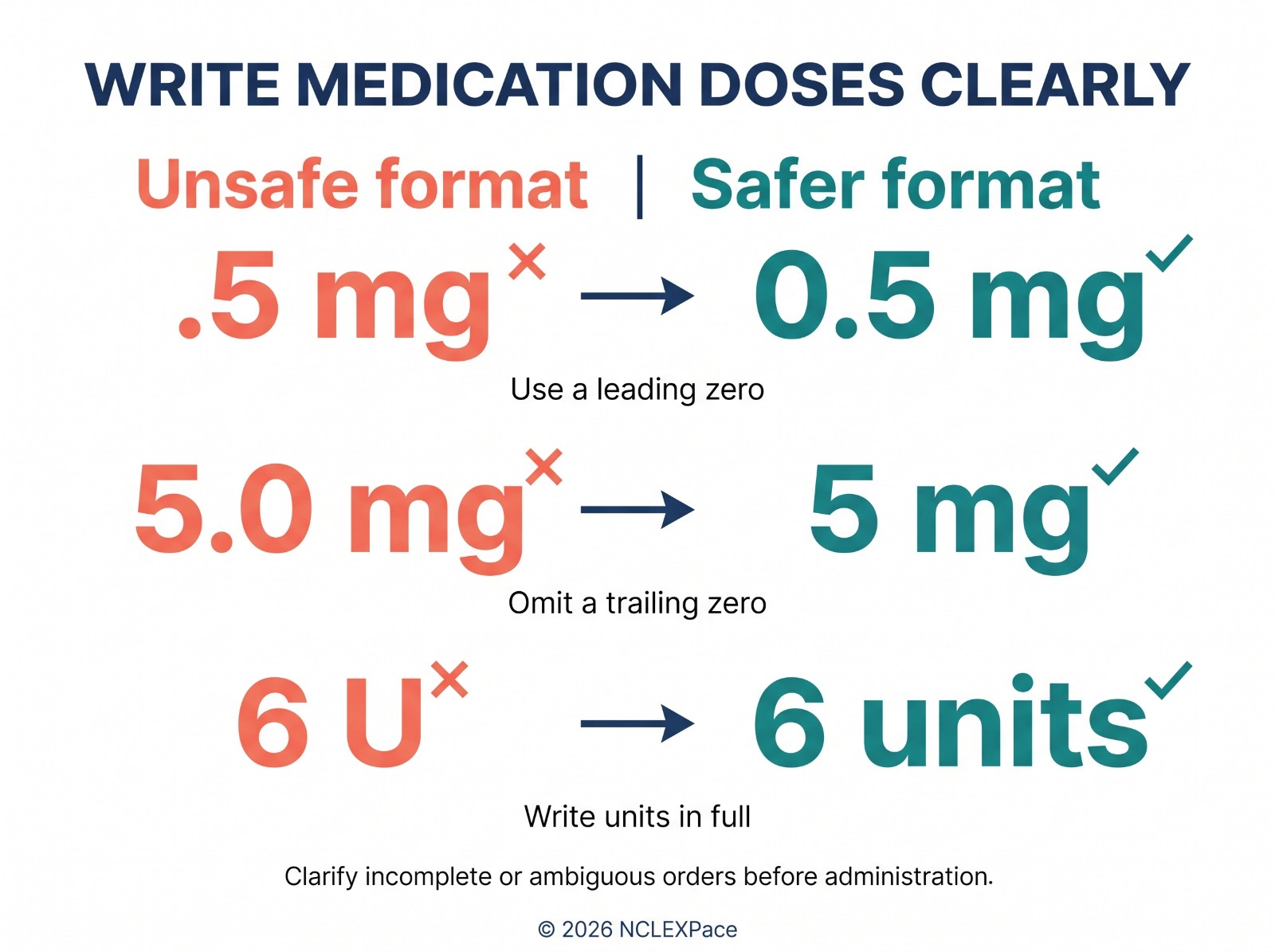
Drops per minute: round to a whole number. You cannot give part of a drop.
Tablets: usually whole or half tablets. If you calculate 1.5 tablets and the tablet is scored, that may be fine. If you calculate 2.7 tablets, something is wrong — recheck.
mL: usually to the tenth (one decimal place), unless told otherwise.
Follow the instruction in the question. If it says round to the nearest whole number, do that.
Do not put units in the answer box unless the question asks for them.
The safety check
After every calculation, ask: does this make sense?
- 15 tablets? Almost certainly wrong.
- 0.02 mL? Too small to measure — probably wrong.
- 400 mL/hour on a routine IV? Very high — recheck.
If the number looks strange, it usually is. Redo the problem.
This habit catches most calculation errors, and it is also good nursing.
The five errors students make
1. Not converting units. Pounds to kg. Grams to mg. Hours to minutes. Convert first, always.
2. Flipping the fraction. If your units do not cancel, you flipped something. That is the signal.
3. Misreading the available strength. “250 mg per 5 mL” is not “250 mg per mL.”
4. Rounding too early. Do the whole calculation, then round once at the end.
5. Not sanity-checking. See above.
Practicing
Do 5 calculation problems every day. Not 50 once a week. Daily practice builds speed and accuracy.
Write out the units every time. Even for easy problems. The habit protects you when problems get harder.
Use the on-screen calculator during practice. The exam gives you one. Get used to it.
Time yourself. Aim for about 2 minutes per problem. You have roughly 2 minutes per question overall, and calculations take longer than average.
The short version
One method: write what you have, multiply by fractions, cancel units, end with what you want.
Convert units first. Round once at the end. Sanity-check the answer.
Practice 5 problems a day.
5 NCLEX practice questions on this topic
The same questions, player and partial-credit scoring students use inside NCLEXPace: answer, submit, read the full rationale, then Next. Your score is waiting at the end. No account needed for these.
A free account opens 20 more questions, a case study, a video and a cheat sheet. The full bank has 3,200+ questions with rationales, by topic.
Practice more, free →Ready for the full bank? See NCLEXPace plans and prices: one payment for 1, 2, 3 or 6 months.
Frequently asked questions
Common follow-up questions on Pharmacology.
What is dimensional analysis?
You start with what you have, multiply by fractions that cancel unwanted units, and end with what you want. If the units cancel correctly, the math is set up correctly, so the units check your work for you. That is why you use one method for everything instead of memorizing several formulas and getting confused about which to use.
How do you handle weight-based doses?
Always convert pounds to kilograms first by dividing by 2.2, because forgetting this is the most common error in weight-based questions. Then find the dose by multiplying weight in kilograms by the ordered mg/kg, and finally find the volume using the available strength. For example, a 154-pound client is 70 kg, and at 5 mg/kg that is 350 mg.
How do you calculate drops per minute?
Use gtt/min equals volume in mL times the drop factor in gtt/mL, divided by time in minutes. Convert hours to minutes first. Round drops per minute to a whole number, because you cannot give a partial drop.
What are the rounding rules?
Round drops per minute to a whole number. Tablets are usually whole or half tablets, so if you calculate 2.7 tablets something is wrong and you should recheck. Millilitres are usually to the tenth unless told otherwise, and you should follow the instruction in the question and not put units in the answer box unless asked.
What is the safety check?
After every calculation, ask whether the answer makes sense: 15 tablets, 0.02 mL, or 400 mL/hour on a routine IV are almost certainly wrong. If the number looks strange, it usually is, so redo the problem. This habit catches most calculation errors, and it is also good nursing.
Sources and references
- Potter PA, Perry AG, Stockert PA, Hall AM. Fundamentals of Nursing. 10th ed. Elsevier; 2021; Chapter: Medication Administration.
Reviewed by the NCLEXPace team, October 2026.
Keep reading
3,200+ NCLEX questions with think-like-a-nurse rationales, unfolding case studies and adaptive readiness exams. Start with free practice questions, then choose a plan when you are ready.
Create Free Account →