
Content Review vs. Question Practice: The 30/70 Split and Why It Works
Question practice should dominate NCLEX study because retrieving information from memory strengthens retention more than re-exposing yourself to it, but you cannot practice-test knowledge you never had, so you need both, weighted toward questions. Roughly 30 percent content review and 70 percent question practice is a defensible working ratio, and it should shift over time from about 50/50 early to 15/85 late.

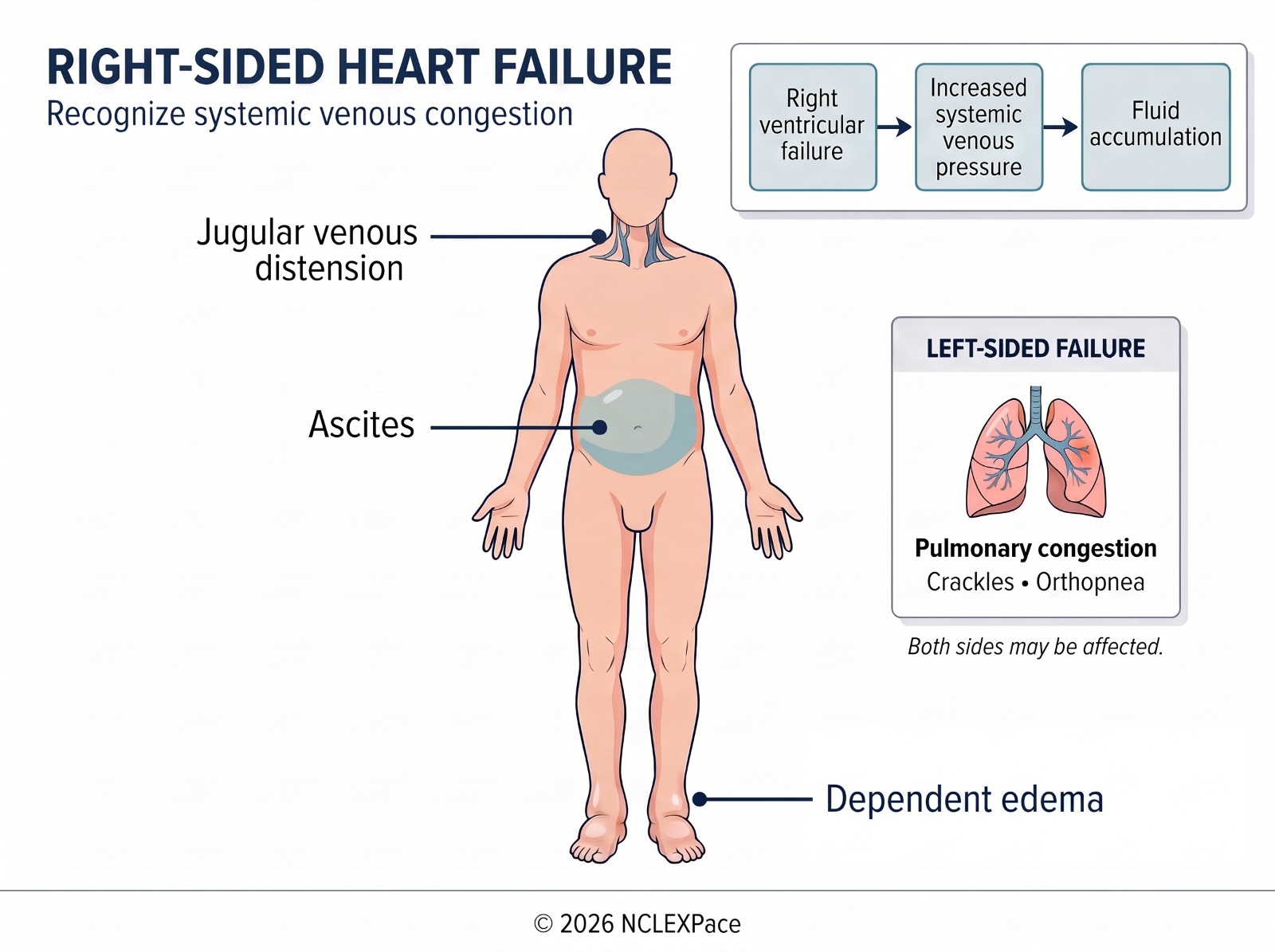
The heart failure lesson, free to watch: do the 30 percent content review here, then spend the 70 percent on the questions below.
From the Intensive NCLEX Course. This lesson is a free sample: watch it with a free account.
Two ways to spend an hour: read about heart failure, or answer questions about heart failure and study why you got them wrong.
They are not equivalent, and the research on which is better is unusually clear.
The evidence
Dunlosky and colleagues reviewed ten widely used study techniques and rated each for utility. Practice testing and distributed practice received the only high ratings. Rereading and highlighting — the two techniques students use most — were rated low utility.
Roediger and Karpicke’s work on the testing effect showed why: retrieving information from memory strengthens retention more than re-exposing yourself to it. Karpicke and Blunt found retrieval practice beat elaborative concept mapping.
So the direction is not in dispute. Question practice should dominate.
Why not 100% questions
Because retrieval requires something to retrieve.
You cannot practice-test your way to knowledge you never had. If you do not know what beta blockers do, no volume of beta blocker questions will teach you efficiently — you will get them wrong, read a rationale, forget it, and repeat.
Content review is how you get material into memory. Question practice is how you strengthen and apply it. You need both, in that order, weighted toward the second.
Roughly 30% content review, 70% question practice is a defensible working ratio. It is not a research-derived constant — no study establishes an optimal split for NCLEX preparation — but it reflects the direction the evidence points and it works in practice.
The ratio should move
A fixed split for eight weeks is wrong. It should shift.
| Stage | Content | Questions | Why |
|---|---|---|---|
| Early (first quarter) | ~50% | ~50% | Rebuilding the base |
| Middle (middle half) | ~30% | ~70% | The working ratio |
| Late (final quarter) | ~15% | ~85% | Application and repair only |
By the final stretch, content review should be targeted repair driven by your error log — not comprehensive re-reading. If you are still reading chapters end to end in the last week, something has gone wrong.
What counts as content review
Not all content review is equal, and most of what candidates call content review is the low-utility kind.
Low value: reading a chapter start to finish, highlighting, rewatching lectures passively, copying notes.
Higher value: reading a targeted section to fix a specific identified gap; building a comparison table from memory and then checking it; explaining a concept aloud without looking; drawing a pathophysiology sequence and filling it in from recall.
Notice the pattern — the higher-value versions all involve retrieval. Even your content review should make you produce something rather than consume something.
What counts as question practice
Also not all equal.
Low value: answering questions and glancing at the score; redoing questions you have memorized; only doing questions labeled by topic.
Higher value: timed sets under realistic conditions; mixed, untitled sets; full six-item case studies; and above all, full review of every question, right and wrong.
That last one is where the 70% actually earns its keep. When people say “questions did not help me,” they almost always mean they answered a lot of questions and reviewed almost none.
Splitting the 70
Your question time divides again, and this is the part people skip:
Roughly half answering. Roughly half reviewing.
A 90-minute question block is about 45 minutes of answering — 35 to 45 questions — and about 45 minutes of review.
If that feels like too few questions, notice what you are optimizing for. Volume is not the goal.
A worked hour
Six-hour study day, middle stage:
- ~110 minutes content (30%) — targeted review of the day’s topic, active recall format
- ~250 minutes questions (70%) — about 125 minutes answering (roughly 100 questions), about 125 minutes reviewing
Ninety-minute evening block, working full time:
- 25 minutes content
- 35 minutes questions (~30 items)
- 30 minutes review
Under pressure, protect the review block. Cut content first, answering second, review last.
Signs your ratio is wrong
Too much content: you feel like you know the material but your practice scores are flat; you have read the same chapters repeatedly; you feel unready to “start questions yet.” That last feeling is a trap — you start questions to build readiness, not after achieving it.
Too many questions: you cannot explain why the wrong answers are wrong; the same errors keep recurring; you are seeing content in questions you have never studied. That means you have gaps that need real content work, not more items.
The thing to stop doing
Rereading your notes.
It is the most common NCLEX study behavior and it was rated low utility in the largest review of study techniques available. It feels productive because familiarity increases — you recognize the material more easily each pass — and familiarity is easily mistaken for knowing.
Recognition is not retrieval. On the exam, nobody shows you your notes and asks whether they look familiar. They give you an unfamiliar client and ask what you would do.
Practice being asked.
The 30/70 ratio is a practical recommendation reflecting the direction of the evidence; no study establishes an optimal content-to-questions ratio for NCLEX preparation.
5 NCLEX practice questions to try now
A mixed set from the NCLEXPace bank, in the same player with the same partial-credit scoring students use inside the platform: answer, submit, read the full rationale, then Next. Your score is waiting at the end. No account needed for these.
A free account opens 20 more questions, a case study, a video and a cheat sheet. The full bank has 3,200+ questions with rationales, by topic.
Practice more, free →Ready for the full bank? See NCLEXPace plans and prices: one payment for 1, 2, 3 or 6 months.
Frequently asked questions
Common follow-up questions on Study Plans & Timelines.
Why not spend 100 percent of study on questions?
Because retrieval requires something to retrieve, and you cannot practice-test your way to knowledge you never had. If you do not know what beta blockers do, no volume of beta blocker questions will teach you efficiently. Content review gets material into memory, and question practice strengthens and applies it, in that order.
Should the 30/70 ratio stay fixed?
No, it should move from about 50 percent content and 50 percent questions early, to 30/70 in the middle, to about 15 percent content and 85 percent questions late. By the final stretch, content review should be targeted repair driven by your error log, not comprehensive re-reading. If you are still reading chapters end to end in the last week, something has gone wrong.
How should question time itself be divided?
Roughly half answering and half reviewing. A 90-minute question block is about 45 minutes answering 35 to 45 questions and about 45 minutes of review. Under time pressure, protect the review block, cutting content first, answering second, and review last.
What counts as high-value content review?
Reading a targeted section to fix a specific identified gap, building a comparison table from memory and then checking it, explaining a concept aloud without looking, or drawing a pathophysiology sequence and filling it in from recall. The higher-value versions all involve retrieval. Reading a chapter start to finish, highlighting, and copying notes are the low-value kind.
Why should I stop rereading my notes?
Rereading was rated low utility in the largest review of study techniques available, yet it is the most common NCLEX study behavior. It feels productive because familiarity increases, and familiarity is easily mistaken for knowing. But recognition is not retrieval, and the exam gives you an unfamiliar client and asks what you would do.
Sources and references
- Dunlosky J, Rawson KA, Marsh EJ, Nathan MJ, Willingham DT. Improving Students' Learning With Effective Learning Techniques: Promising Directions From Cognitive and Educational Psychology. Psychol Sci Public Interest. 2013;14(1):4-58.
- Karpicke JD, Blunt JR. Retrieval Practice Produces More Learning Than Elaborative Studying With Concept Mapping. Science. 2011;331(6018):772-775.
- Roediger HL, Karpicke JD. Test-Enhanced Learning: Taking Memory Tests Improves Long-Term Retention. Psychol Sci. 2006;17(3):249-255.
Reviewed by the NCLEXPace team, October 2026.
Keep reading



3,200+ NCLEX questions with think-like-a-nurse rationales, unfolding case studies and adaptive readiness exams. Start with free practice questions, then choose a plan when you are ready.
Create Free Account →