
Preeclampsia vs HELLP on the NCLEX: Findings and First Actions
Preeclampsia is new hypertension at or after 20 weeks with proteinuria or end-organ signs; HELLP syndrome adds Haemolysis, Elevated Liver enzymes and Low Platelets and can occur even without severe hypertension. Right upper quadrant or epigastric pain is the finding that should raise HELLP, and magnesium sulfate is given for seizure prophylaxis, not to lower blood pressure.

Free sample lesson: preeclampsia, eclampsia and HELLP, with magnesium sulfate and its toxicity.
From the Intensive NCLEX Course. This lesson is a free sample: watch it with a free account.
Preeclampsia questions turn on recognising the point at which "monitor closely" becomes "act now". HELLP is that point, and so is magnesium toxicity — both are recognisable from a small set of findings the exam reuses.
Step 1 — The spectrum
| Preeclampsia | With severe features | HELLP | Eclampsia | |
|---|---|---|---|---|
| Blood pressure | ≥ 140/90 after 20 weeks | ≥ 160/110 | May be only mildly raised | Raised |
| Protein | Present | Present | Present | Present |
| Key extra findings | Oedema, weight gain | Headache, visual changes, epigastric or RUQ pain, low platelets, rising creatinine | Hemolysis, Elevated Liver enzymes, Low Platelets | Seizure |
| What it means | Monitor closely | Deliver, usually | Emergency — organ damage under way | Emergency |
The three severe features to react to
Headache that will not settle. Visual changes — blurring, spots, flashing. Epigastric or right upper quadrant pain. These are not discomforts of pregnancy in this context: the headache signals cerebral irritability and impending seizure, and the epigastric pain is the liver. Any of the three in a preeclamptic client is a reportable emergency finding.
Step 2 — HELLP, and why it is missed
HELLP is a laboratory diagnosis. The blood pressure can be almost unremarkable, so a client can look less sick than she is.
| Letter | Lab | Meaning |
|---|---|---|
| Hemolysis | Falling haemoglobin, rising bilirubin | Red cells are being destroyed |
| Elevated Liver enzymes | AST and ALT up | Liver injury — this is the epigastric pain |
| Low Platelets | Under 100,000 | Bleeding risk — the most dangerous element |
The consequence of the low platelets is what the exam tests: bleeding precautions. No intramuscular injections where avoidable, pressure held longer at puncture sites, soft toothbrush, watch for petechiae and bleeding gums, and epidural anaesthesia may be contraindicated.
Step 3 — Magnesium sulfate, and its toxicity
Magnesium is given to prevent seizures, not to lower blood pressure. That distinction gets asked directly.
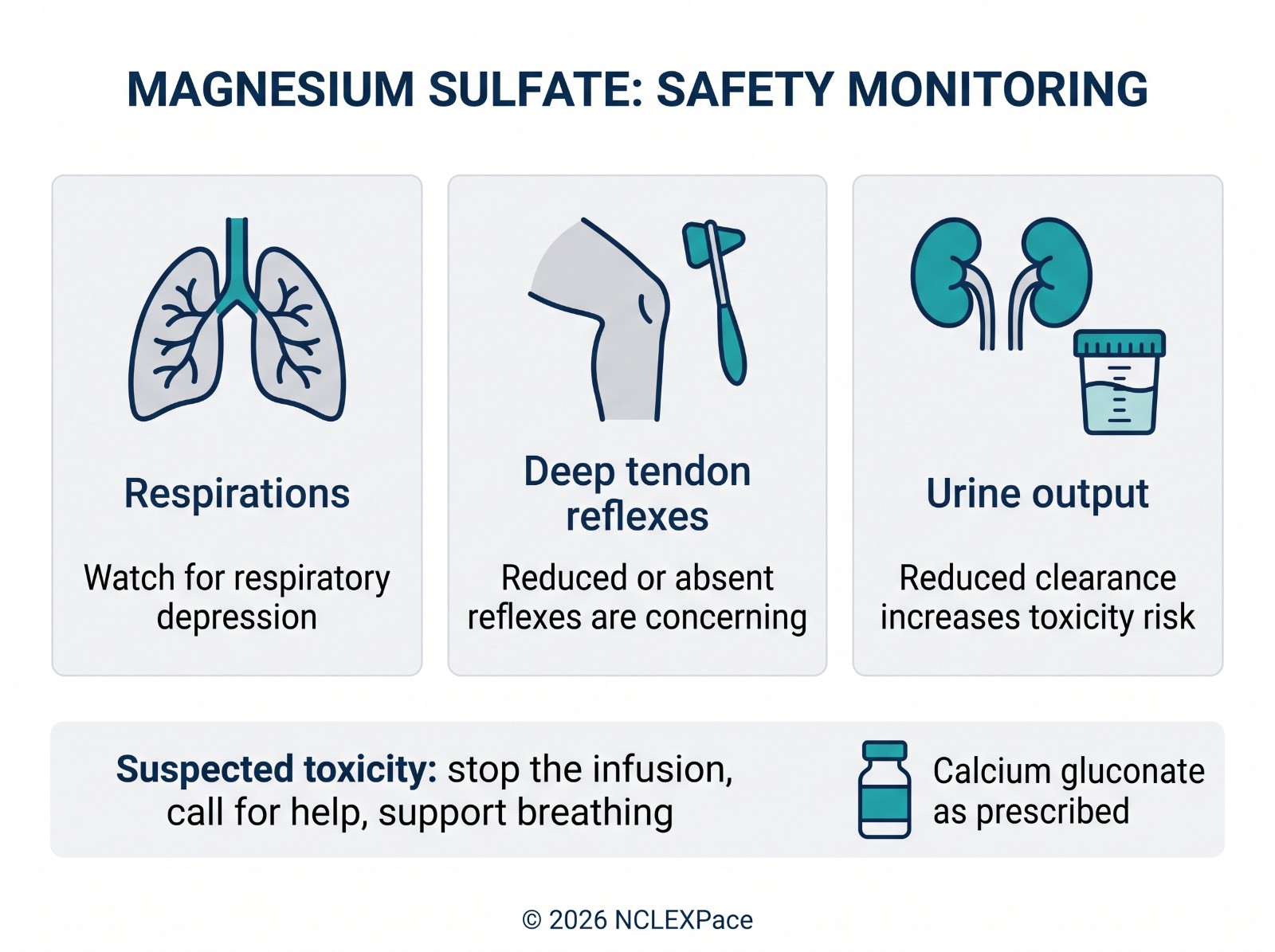
| Monitor | Reassuring | Stop the infusion and notify |
|---|---|---|
| Deep tendon reflexes | Present | Absent — the earliest sign of toxicity |
| Respiratory rate | Over 12/min | Under 12/min |
| Urine output | At least 30 mL/hr | Under 30 mL/hr — magnesium is excreted renally and will accumulate |
| Level of consciousness | Alert, mildly flushed and warm is expected | Increasing drowsiness, slurred speech |
The antidote is calcium gluconate, and it should be at the bedside whenever magnesium is running. Expect the exam to ask for it by name.
Order of the signs, which is the question underneath the question: reflexes go first, then respirations, then cardiac. So an absent patellar reflex with a respiratory rate of 14 is early toxicity — act on the reflex rather than waiting for the breathing to fall.
Step 4 — If she seizes
Eclampsia. In order:
- Stay with her and turn her to her side. Do not leave, do not restrain, do not put anything in her mouth.
- Protect the airway — suction available, oxygen ready.
- Call for help without leaving the bedside.
- Note the time and duration; magnesium is given or increased per orders.
- Assess the fetus after the seizure, not during — you cannot help the fetus while the mother is unprotected.
The environment matters beforehand: seizure precautions mean a quiet, dim room, side rails padded and up, suction and oxygen at hand, and minimal disturbance. An option offering to "reduce stimulation" in a client with severe features is usually correct.
It does not end at delivery
Postpartum preeclampsia and eclampsia are real, and seizures can occur up to 48 hours or more after birth. Magnesium is typically continued for 24 hours postpartum, and a discharged client needs teaching about headache, visual changes and epigastric pain.
NCLEX tip: Magnesium sulfate prevents seizures — it is not an antihypertensive. And check reflexes before anything else: they disappear before the respiratory rate falls, which makes them the earliest warning you have.
5 NCLEX practice questions on this topic
The same questions, player and partial-credit scoring students use inside NCLEXPace: answer, submit, read the full rationale, then Next. Your score is waiting at the end. No account needed for these.
A free account opens 20 more questions, a case study, a video and a cheat sheet. The full bank has 3,200+ questions with rationales, by topic.
Practice more, free →Ready for the full bank? See NCLEXPace plans and prices: one payment for 1, 2, 3 or 6 months.
Frequently asked questions
Common follow-up questions on Maternity, Newborn & Pediatrics.
What does HELLP stand for?
Haemolysis, Elevated Liver enzymes, and Low Platelets. It is a severe variant of preeclampsia and may present with relatively modest blood pressure elevation, which is what makes it dangerous to miss.
What are the signs of severe preeclampsia?
Blood pressure of 160/110 mmHg or higher, severe headache unrelieved by analgesia, visual disturbances, right upper quadrant or epigastric pain, hyperreflexia with clonus, oliguria, and a platelet count below 100,000/mm³.
What must be monitored during magnesium sulfate infusion?
Deep tendon reflexes, respiratory rate, urine output and level of consciousness. Loss of patellar reflexes is the earliest warning of toxicity, followed by respiratory depression below 12 breaths per minute and urine output under 30 mL per hour. Calcium gluconate is the antidote and must be immediately available.
Why is epigastric pain significant in preeclampsia?
It suggests hepatic involvement from liver capsule distension and is a warning sign of HELLP syndrome or impending eclampsia. It is treated as an emergency finding requiring immediate provider notification, not as indigestion.
Sources and references
- Lowdermilk DL, Perry SE, Cashion K, Alden KR, Olshansky EF. Maternity & Women's Health Care. 12th ed. Elsevier; 2020; Chapter: Hypertensive Disorders.
- American College of Obstetricians and Gynecologists. Gestational Hypertension and Preeclampsia: ACOG Practice Bulletin No. 222. Obstetrics & Gynecology. 2020;135(6):e237-e260.
Reviewed by the NCLEXPace team, October 2026.
Keep reading



3,200+ NCLEX questions with think-like-a-nurse rationales, unfolding case studies and adaptive readiness exams. Start with free practice questions, then choose a plan when you are ready.
Create Free Account →