
Fetal Heart Tracings: VEAL CHOP Explained Like a Nurse Thinks
VEAL CHOP pairs each deceleration with its cause: Variable with Cord compression, Early with Head compression, Accelerations with an Okay baby, and Late with Placental insufficiency. Early decelerations and accelerations are reassuring and need no action; variable and late decelerations require intervention, starting with repositioning the mother onto her side.

Fetal heart rate monitoring: baseline, variability, the decelerations and the interventions in order.
From the Intensive NCLEX Course. See the course; the full video library is part of Pro and Ultimate.
Fetal monitoring questions look intimidating because they arrive as a strip description rather than a diagnosis. They are actually among the most predictable items on the NCLEX, because there are only four patterns and each one has a fixed cause and a fixed response.
Step 1 — Read the baseline before you read the decelerations
Every tracing question starts with two numbers that decide whether you are even worried yet.
| What to check | Reassuring | Concerning |
|---|---|---|
| Baseline FHR | 110–160 bpm | Under 110 (bradycardia) or over 160 (tachycardia) for 10+ minutes |
| Variability | Moderate (6–25 bpm) — the single best sign of fetal wellbeing | Absent or minimal — the fetus has stopped compensating |
| Accelerations | Present | Absent alongside other findings |
Moderate variability is the finding students most often skip past, and it is the most reassuring thing on the strip. A tracing with decelerations and moderate variability is far less alarming than a flat tracing with none.
Step 2 — VEAL CHOP, and what each half means
The mnemonic pairs a pattern with its cause. Line them up:
| V·E·A·L (what you see) | C·H·O·P (why) | Action needed? |
|---|---|---|
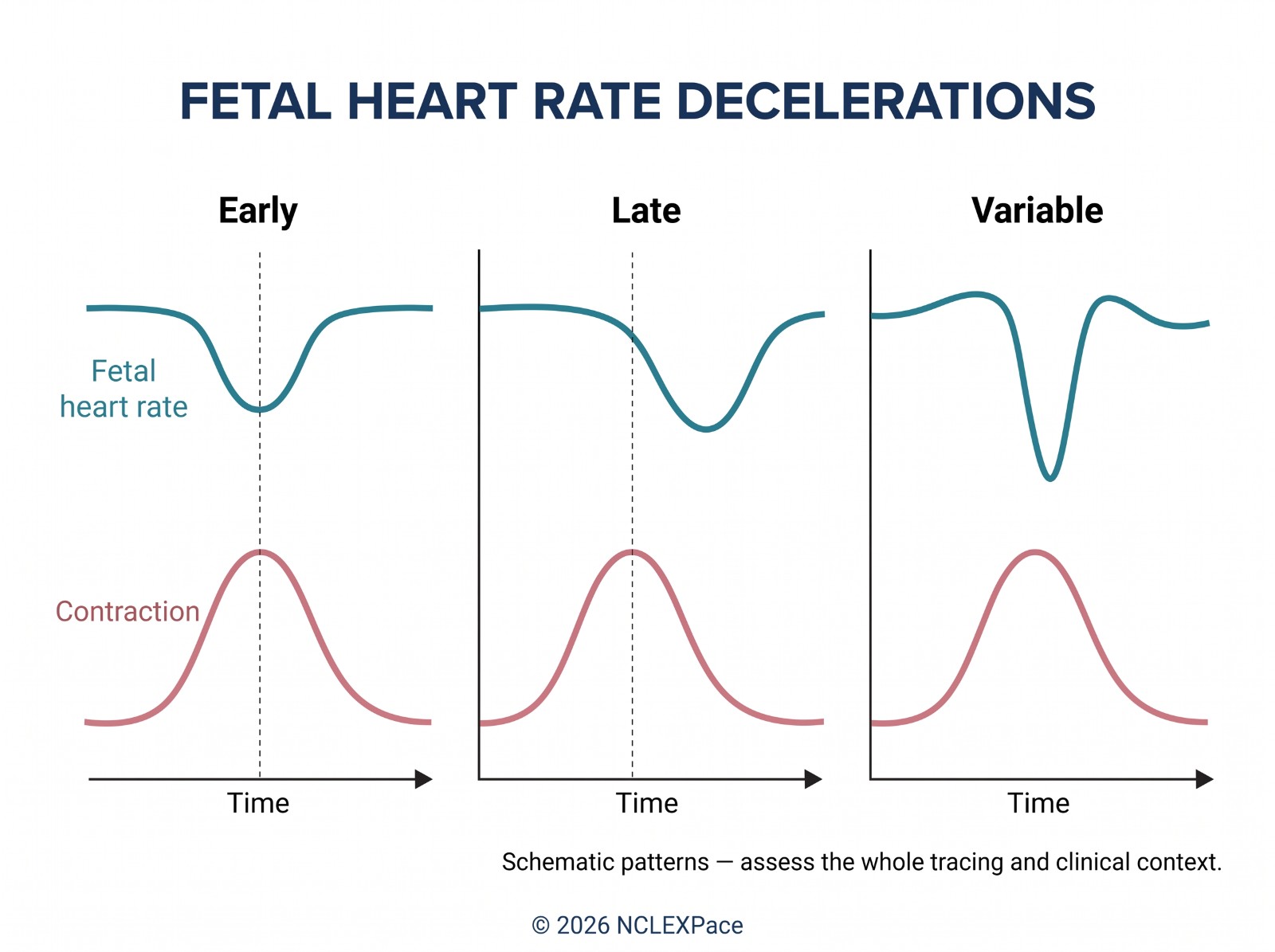
| Variable decelerations Abrupt drops, any time, V or W shaped | Cord compression | Yes — reposition first |
| Early decelerations Mirror the contraction, gradual | Head compression | No — benign, normal in labor |
| Accelerations Rises above baseline | Okay / well oxygenated | No — this is the good one |
| Late decelerations Begin after the contraction peaks, return after it ends | Placental insufficiency | Yes — the most ominous pattern |
The timing detail that separates early from late
Both are gradual, and both are drops. The difference is entirely when the lowest point falls relative to the contraction peak. Early decelerations bottom out with the peak — they mirror the contraction. Late decelerations bottom out after the peak and are slow to recover. If a stem gives you timing, it is giving you the answer.
Step 3 — The interventions, in order
Late and variable decelerations share most of their response, and the exam wants the order.
| Order | Intervention | Why it comes here |
|---|---|---|
| 1 | Reposition — left lateral first | Takes the uterus off the vena cava and relieves cord pressure. Costs nothing, works fastest |
| 2 | Stop oxytocin if it is running | Contractions are the stressor; removing them is treating the cause |
| 3 | Oxygen 8–10 L by non-rebreather | Raises what is available to cross the placenta |
| 4 | Increase IV fluids | Improves maternal perfusion of the placenta |
| 5 | Notify the provider | After you have started fixing it, not instead of |
A memory hook for the late-deceleration bundle: LION — Left side, IV fluids, Oxygen, Notify.
Where variable decelerations differ
Variables are a cord problem, so repositioning matters even more — and if repositioning fails, the next step is amnioinfusion to cushion the cord. If a variable deceleration is accompanied by visible or palpable cord, that is a prolapsed cord: an obstetric emergency where the nurse holds the presenting part off the cord with a gloved hand, puts the client in knee-chest or Trendelenburg, and calls for help without leaving the bedside.
Step 4 — Work an example
A client at 39 weeks in active labor on an oxytocin infusion has a baseline of 140 with moderate variability. The nurse notes decelerations beginning after the peak of each contraction, returning to baseline after the contraction ends. What is the nurse's first action?
| Option | Verdict |
|---|---|
| Document the reassuring tracing | Wrong. "After the peak" is a late deceleration, not reassuring |
| Reposition to the left side | Correct. Fastest intervention, treats maternal perfusion immediately |
| Notify the provider | Necessary, but not first — start the interventions you own |
| Increase the oxytocin to speed delivery | Dangerous. More contractions means less placental perfusion |
NCLEX tip: Late decelerations plus absent variability is the worst combination on any strip — the fetus is no longer compensating. If a question pairs those two findings, the answer is an emergency response, not a monitoring plan.
5 NCLEX practice questions on this topic
The same questions, player and partial-credit scoring students use inside NCLEXPace: answer, submit, read the full rationale, then Next. Your score is waiting at the end. No account needed for these.
A free account opens 20 more questions, a case study, a video and a cheat sheet. The full bank has 3,200+ questions with rationales, by topic.
Practice more, free →Ready for the full bank? See NCLEXPace plans and prices: one payment for 1, 2, 3 or 6 months.
Frequently asked questions
Common follow-up questions on Maternity, Newborn & Pediatrics.
What does VEAL CHOP stand for?
Variable decelerations = Cord compression; Early decelerations = Head compression; Accelerations = Okay (reassuring); Late decelerations = Placental insufficiency. The mnemonic lines the four tracing patterns up against their four causes.
Which fetal heart rate patterns are reassuring?
Accelerations and early decelerations. Accelerations indicate adequate fetal oxygenation, and early decelerations mirror contractions because of normal head compression during descent: neither requires intervention.
What is the first action for late decelerations?
Reposition the mother onto her left side to relieve pressure on the vena cava and improve placental perfusion, then stop any oxytocin infusion, give oxygen by non-rebreather mask, increase the intravenous fluid rate, and notify the provider.
Why are late decelerations more concerning than variable ones?
Late decelerations reflect uteroplacental insufficiency (the placenta is not delivering enough oxygen) and indicate fetal hypoxia. Variable decelerations reflect cord compression, which is usually correctable with position change and is less ominous when it resolves.
Sources and references
- Lowdermilk DL, Perry SE, Cashion K, Alden KR, Olshansky EF. Maternity & Women's Health Care. 12th ed. Elsevier; 2020; Chapter: Fetal Assessment During Labor.
- American College of Obstetricians and Gynecologists. Intrapartum Fetal Heart Rate Monitoring: Nomenclature, Interpretation, and General Management Principles. ACOG Practice Bulletin No. 106. Obstet Gynecol. 2009;114(1):192-202.
Reviewed by the NCLEXPace team, October 2026.
Keep reading



3,200+ NCLEX questions with think-like-a-nurse rationales, unfolding case studies and adaptive readiness exams. Start with free practice questions, then choose a plan when you are ready.
Create Free Account →