
Growth, Development, and Immunizations
The NCLEX tests developmental milestones as safety questions: what a child should be doing at a given age, and what is unsafe for that stage. Live vaccines including MMR, varicella, rotavirus and live nasal influenza are contraindicated in immunocompromised children and in pregnancy, while inactivated vaccines are safe and especially important for those same vulnerable children.

Growth and development milestones by age, with the safety and immunization questions that go with them.
From the Intensive NCLEX Course. See the course; the full video library is part of Pro and Ultimate.
Development by age — the milestones tested most
Infant (0 to 12 months)
- 2 months — social smile, lifts head
- 4 months — rolls front to back, reaches for objects
- 6 months — sits with support, rolls both ways, transfers objects hand to hand, begins solid foods
- 9 months — sits alone, crawls, pincer grasp developing, stranger anxiety
- 12 months — pulls to stand, may walk, says a few words, birth weight roughly triples
Toddler (1 to 3 years)
- 15 months — walks alone
- 18 months — runs, uses a spoon, says many words
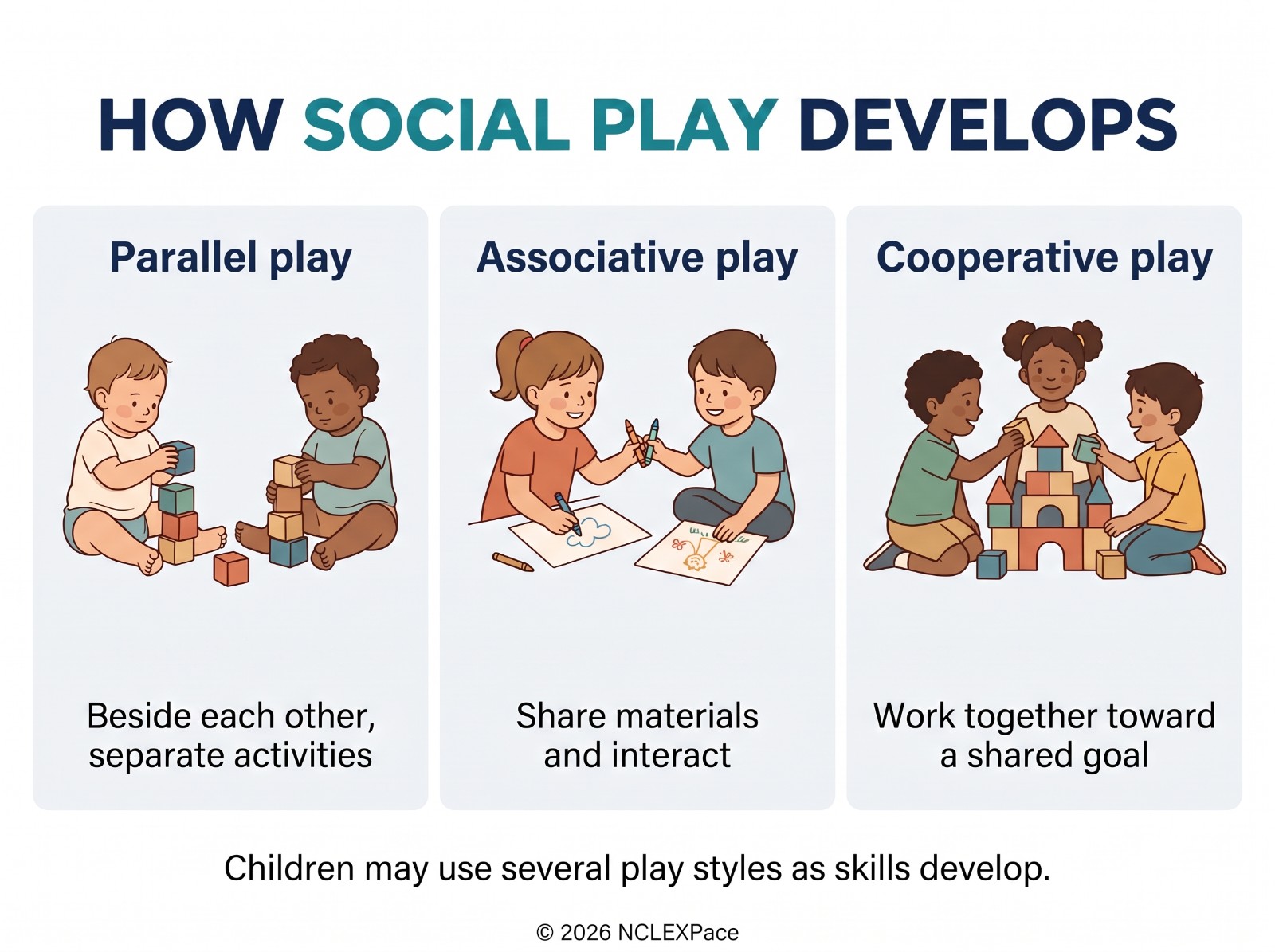
- 2 years — climbs stairs, two-word phrases, parallel play (plays beside other children, not with them)
- 3 years — rides a tricycle, speaks in sentences, toilet training usually complete
Preschool (3 to 5 years)
- Associative play, imaginative play
- Fears about body injury are common — use bandages, they matter to this age group
- Magical thinking — may believe illness is a punishment
School age (6 to 12 years)
- Cooperative play, rules matter
- Wants to be competent and productive
- Understands explanations — include them
- Privacy becomes important
Adolescent (13 to 18 years)
- Identity development
- Peers matter more than parents
- Body image is sensitive
- Wants independence and confidentiality
- Risk-taking behavior is common
Preparing children for procedures — matched to age
| Age | How to prepare |
|---|---|
| Infant | Keep the parent present, minimize separation, comfort after |
| Toddler | Explain right before, very simply. Allow choices where real. Expect protest. |
| Preschool | Explain shortly before in simple words. Use dolls or play. Reassure it is not a punishment. Bandages matter. |
| School age | Explain a few days ahead. Give details. Let them help. |
| Adolescent | Explain in advance, with full information. Respect privacy and confidentiality. Include them in decisions. |
The pattern: the younger the child, the shorter the notice. Long advance warning increases fear in young children.
Safety by age — a common question type
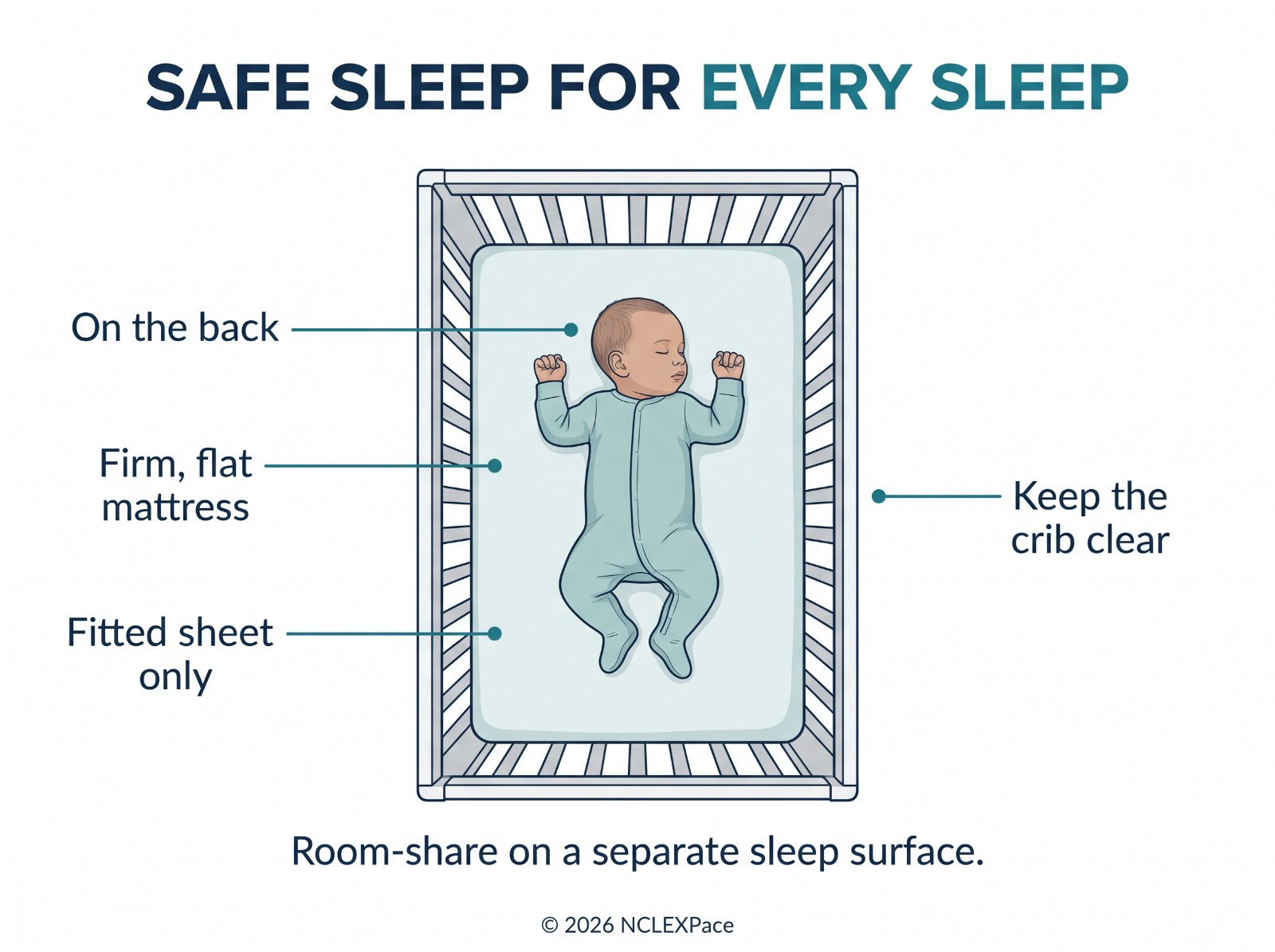
Infant: falls, choking on small objects, suffocation, car seat rear-facing, safe sleep on the back, water temperature.
Toddler: poisoning, drowning, falls, burns, car seat. Toddlers put everything in their mouths.
Preschool: playground injuries, street safety, drowning, stranger safety.
School age: bicycle helmets, sports injuries, water safety, seat belts.
Adolescent: motor vehicle accidents, substance use, sexual health, firearms, mental health.
The most common cause of injury changes with age — and the exam expects you to match the risk to the stage.
Immunizations
The general pattern:
- Hepatitis B — first dose at birth
- 2, 4, and 6 months — a series including DTaP, polio, Hib, pneumococcal, and rotavirus
- 12 to 15 months — MMR and varicella
- Boosters in the preschool years and again in adolescence
- Adolescents — Tdap booster, meningococcal, HPV
The exact schedule is set by national guidelines and is updated regularly. Always check the current schedule.
What the exam actually tests is the principles, not the dates:
Live vaccines — MMR, varicella, rotavirus, and live influenza.
Live vaccines are generally avoided in:
- Pregnancy
- Severely immunocompromised clients — including those on chemotherapy or high-dose steroids
Household contacts of immunocompromised people can usually still receive most vaccines — check current guidance.
Not reasons to delay a vaccine:
- A mild illness
- A low-grade fever
- Current antibiotic use
- Mild reaction to a previous dose
Reasons to hold or reconsider:
- A severe allergic reaction to a previous dose or a component
- Moderate to severe acute illness
Teaching parents: soreness, redness, and a mild fever are expected. Acetaminophen may be used as directed. Report a high fever, a severe reaction, or unusual crying.
The short version
- 6 months: transfers objects. 2 years: parallel play. 3 years: tricycle.
- The younger the child, the shorter the notice before a procedure
- Preschoolers fear body injury — bandages matter
- Adolescents: privacy and confidentiality
- Live vaccines: avoid in pregnancy and severe immunosuppression
- A mild illness is not a reason to delay a vaccine
Immunization schedules are set by national guidelines and updated regularly. Always use the current schedule. Developmental milestone ages vary between sources.
5 NCLEX practice questions on this topic
The same questions, player and partial-credit scoring students use inside NCLEXPace: answer, submit, read the full rationale, then Next. Your score is waiting at the end. No account needed for these.
A free account opens 20 more questions, a case study, a video and a cheat sheet. The full bank has 3,200+ questions with rationales, by topic.
Practice more, free →Ready for the full bank? See NCLEXPace plans and prices: one payment for 1, 2, 3 or 6 months.
Frequently asked questions
Common follow-up questions on Maternity, Newborn & Pediatrics.
Which vaccines are live and who cannot receive them?
MMR, varicella, rotavirus, live attenuated influenza and yellow fever. They are contraindicated in significantly immunocompromised children (those on chemotherapy or high-dose corticosteroids, or with congenital immunodeficiency) and in pregnancy.
What are the key milestones by age?
By 2 months a social smile; by 6 months rolling both ways and sitting with support; by 9 months pulling to stand and waving; by 12 months a few words and first steps; by 2 years two-word phrases and running; by 3 years riding a tricycle and speaking in sentences.
What safety teaching matches each developmental stage?
Infants: back to sleep, bare crib, no small objects. Toddlers: poison and water safety, stair gates, rear-facing car seat until at least 2 years. Preschoolers: street and stranger safety, helmets. School-age: bicycle and sports safety. Adolescents: driving, substance use and risk-taking.
What should the nurse do if a child misses a vaccine dose?
Resume the schedule from where it stopped rather than restarting the series. The catch-up schedule continues from the last documented dose, and a lapse between doses does not require beginning again.
Sources and references
- Potter PA, Perry AG, Stockert PA, Hall AM. Fundamentals of Nursing. 10th ed. Elsevier; 2021; Chapter: Conception Through Adolescence.
- Zubler JM, et al. Evidence-Informed Milestones for Developmental Surveillance Tools. Pediatrics. 2022;149(3):e2021052138.
- Centers for Disease Control and Prevention. Child and Adolescent Immunization Schedule by Age, United States, 2025. Advisory Committee on Immunization Practices.
Reviewed by the NCLEXPace team, October 2026.
Keep reading



3,200+ NCLEX questions with think-like-a-nurse rationales, unfolding case studies and adaptive readiness exams. Start with free practice questions, then choose a plan when you are ready.
Create Free Account →