IV Rates, Drop Factors, and Titration Problems
IV rate problems are just multi-step arithmetic: mL per hour is volume divided by hours, and drops per minute is volume times the tubing's drop factor divided by the time in minutes. Titration follows the same five steps every time: dose per minute, dose per hour, convert units, find the concentration, then divide to get the rate. Never speed up an IV to catch up without an order.

The same lesson works every IV problem: mL per hour, how long a bag lasts, drops per minute and titration, with the conversions you need.
From the Intensive NCLEX Course. See the course; the full video library is part of Pro and Ultimate.
These are the calculations that feel hardest. They are not — they just have more steps.
Problem type 1: mL per hour
The simplest. Total volume divided by total hours.
1,000 mL over 10 hours
1000 ÷ 10 = 100 mL/hour
250 mL over 30 minutes
Convert to hours first: 30 minutes = 0.5 hours
250 ÷ 0.5 = 500 mL/hour
Problem type 2: How long will this last?
Reverse the same idea.
1,000 mL running at 125 mL/hour. How long will it take?
1000 ÷ 125 = 8 hours
To find the finish time, add to the start time. Started at 0800 + 8 hours = 1600
Problem type 3: Drops per minute
Used with gravity tubing and no pump.
The formula:
gtt/min = volume (mL) × drop factor (gtt/mL) time (minutes)
Drop factor is printed on the tubing box.
- Macrodrip tubing: usually 10, 15, or 20 gtt/mL — used for most adult IVs
- Microdrip tubing: always 60 gtt/mL — used for children and small volumes
Worked example:
500 mL over 4 hours with 20 gtt/mL tubing
Time in minutes: 4 × 60 = 240
500 × 20 = 10,000 = 41.67 240 240
Answer: 42 gtt/min
The microdrip shortcut
With 60 gtt/mL tubing, gtt/min equals mL/hour.
Why? Because 60 gtt/mL divided by 60 minutes cancels out.
75 mL/hour with microdrip tubing = 75 gtt/min
No calculation needed. Worth knowing.
Problem type 4: Titration
Titration means adjusting the rate to reach an effect — usually a target blood pressure or heart rate.
These look intimidating. They are just unit cancellation with more steps.
Example:
Order: dopamine at 5 mcg/kg/min. Client weighs 70 kg. Bag: 400 mg in 250 mL. What is the pump rate in mL/hour?
Step 1 — dose per minute.
70 kg × 5 mcg/kg/min = 350 mcg/min
Step 2 — dose per hour.
350 mcg/min × 60 min = 21,000 mcg/hour
Step 3 — convert to mg.
21,000 mcg ÷ 1,000 = 21 mg/hour
Step 4 — find the concentration.
400 mg ÷ 250 mL = 1.6 mg per mL
Step 5 — find the rate.
21 mg/hour ÷ 1.6 mg/mL = 13.1 mL/hour
Answer: about 13 mL/hour
The titration steps, always the same
- Dose per minute — multiply weight by the ordered rate (if weight-based)
- Dose per hour — multiply by 60
- Convert units if needed (mcg to mg: divide by 1,000)
- Concentration — total drug divided by total volume
- Rate — dose per hour divided by concentration
Follow the same five steps every time and titration stops being scary.
The conversions you must know
| From | To | Do this |
|---|---|---|
| pounds | kilograms | divide by 2.2 |
| kilograms | pounds | multiply by 2.2 |
| grams | milligrams | multiply by 1,000 |
| milligrams | micrograms | multiply by 1,000 |
| liters | milliliters | multiply by 1,000 |
| hours | minutes | multiply by 60 |
Going to a smaller unit? Multiply. Going to a bigger unit? Divide.
Nursing points that come with these questions
Always use a pump for: high-alert drugs, titrated drips, children, and anything where an error is dangerous.
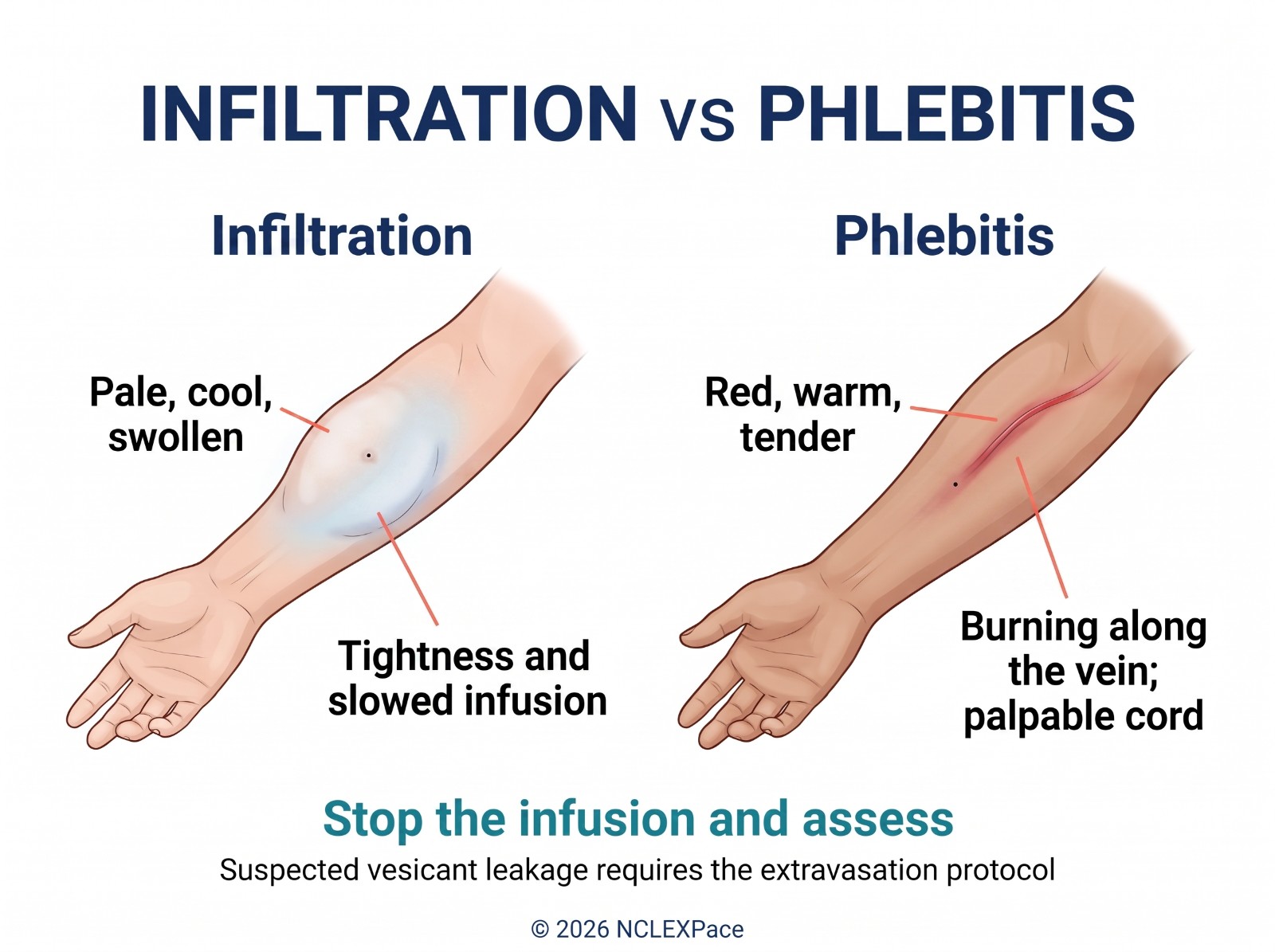
Check the site regularly. Look for swelling, redness, pain, coolness, or leaking. These suggest the IV has infiltrated.
Never speed up an IV to catch up without an order. This is a common wrong answer. If an IV is behind, assess the client and contact the provider.
Know why the rate matters. Too fast can cause fluid overload — especially in older adults, small children, and clients with heart or kidney failure. Signs: shortness of breath, crackles in the lungs, swelling, high blood pressure, distended neck veins.
The short version
- mL/hour = volume ÷ hours
- gtt/min = (volume × drop factor) ÷ minutes
- Microdrip (60 gtt/mL): gtt/min = mL/hour
- Titration: dose/min → dose/hour → convert → concentration → rate
- Never speed up an IV to catch up
5 NCLEX practice questions on this topic
The same questions, player and partial-credit scoring students use inside NCLEXPace: answer, submit, read the full rationale, then Next. Your score is waiting at the end. No account needed for these.
A free account opens 20 more questions, a case study, a video and a cheat sheet. The full bank has 3,200+ questions with rationales, by topic.
Practice more, free →Ready for the full bank? See NCLEXPace plans and prices: one payment for 1, 2, 3 or 6 months.
Frequently asked questions
Common follow-up questions on Pharmacology.
How do I calculate drops per minute?
Use gtt/min = (volume in mL x drop factor in gtt/mL) divided by time in minutes, where the drop factor is printed on the tubing box. Macrodrip tubing is usually 10, 15, or 20 gtt/mL for most adult IVs, and microdrip tubing is always 60 gtt/mL for children and small volumes. For 500 mL over 4 hours with 20 gtt/mL tubing, that is (500 x 20) divided by 240, which is 42 gtt/min.
What is the microdrip shortcut?
With 60 gtt/mL tubing, gtt/min equals mL/hour, because the 60 gtt/mL divided by 60 minutes cancels out. So 75 mL/hour with microdrip tubing is simply 75 gtt/min, with no calculation needed.
What are the steps for a titration problem?
Dose per minute (multiply weight by the ordered rate if it is weight-based), dose per hour (multiply by 60), convert units if needed (mcg to mg is divide by 1,000), concentration (total drug divided by total volume), then rate (dose per hour divided by concentration). Following the same five steps every time makes titration manageable rather than scary.
Can I speed up an IV that has fallen behind?
No. Never speed up an IV to catch up without an order; this is a common wrong answer. If an IV is behind, assess the client and contact the provider. Running fluids too fast can cause fluid overload, especially in older adults, small children, and clients with heart or kidney failure, with signs such as shortness of breath, crackles, swelling, and distended neck veins.
How do I convert between weight and dose units?
Divide pounds by 2.2 to get kilograms, and multiply kilograms by 2.2 to get pounds. Going from a larger unit to a smaller one you multiply (grams to milligrams, milligrams to micrograms, and liters to milliliters are all times 1,000; hours to minutes is times 60); going to a bigger unit you divide.
Sources and references
- Potter PA, Perry AG, Stockert PA, Hall AM. Fundamentals of Nursing. 10th ed. Elsevier; 2021; Chapter: Fluid, Electrolyte, and Acid-Base Balance.
- Potter PA, Perry AG, Stockert PA, Hall AM. Fundamentals of Nursing. 10th ed. Elsevier; 2021; Chapter: Medication Administration.
Reviewed by the NCLEXPace team, October 2026.
Keep reading
3,200+ NCLEX questions with think-like-a-nurse rationales, unfolding case studies and adaptive readiness exams. Start with free practice questions, then choose a plan when you are ready.
Create Free Account →