
Croup vs Epiglottitis vs RSV: The Airway Question the NCLEX Repeats
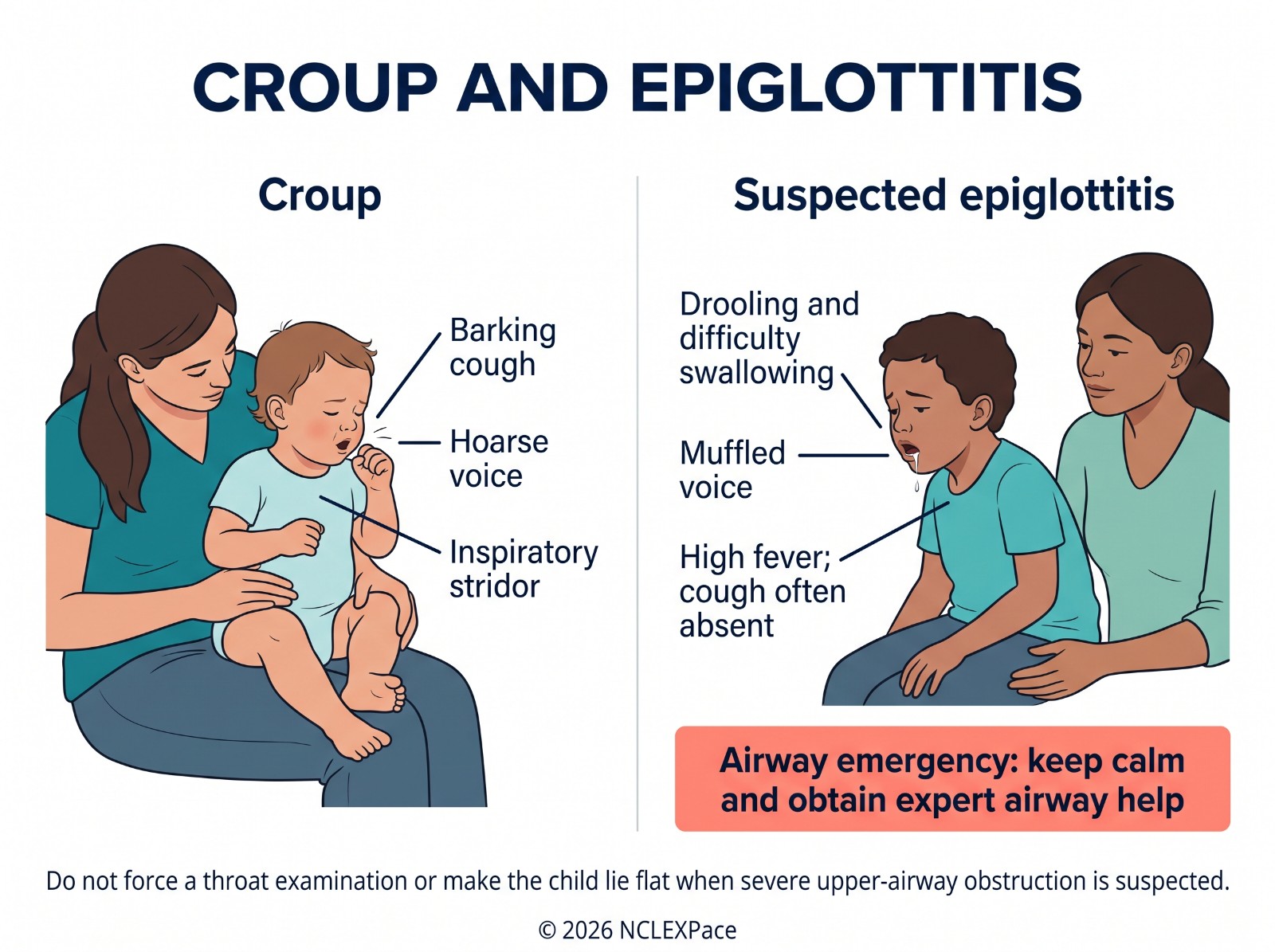
Croup produces a barking seal-like cough with inspiratory stridor and is usually managed at home or with corticosteroids; epiglottitis produces drooling, dysphagia, distress and a muffled voice with no cough and is an airway emergency. Never inspect the throat or place anything in the mouth of a child with suspected epiglottitis. It can trigger complete airway obstruction.

Free sample lesson: RSV, bronchiolitis and croup, and the airway question the exam loves.
From the Intensive NCLEX Course. This lesson is a free sample: watch it with a free account.
This comparison appears again and again because one of the three is an emergency where the wrong nursing action can kill the child. Getting them apart takes three questions.
Step 1 — Side by side
| Feature | Croup | Epiglottitis | RSV / bronchiolitis |
|---|---|---|---|
| Cause | Viral | Bacterial (H. influenzae type b) | Viral — respiratory syncytial virus |
| Age | 6 months – 3 years | 2 – 8 years | Under 2, worst under 6 months |
| Onset | Gradual, often at night | Sudden — hours | Gradual, starts like a cold |
| Cough | Barking, seal-like; stridor | None or minimal | Wheeze, tight cough |
| Drooling | No | Yes — cannot swallow | No |
| Position | Any | Tripod — upright, leaning forward, chin out | Any |
| Fever | Low grade | High | Low grade |
| Look | Uncomfortable but interactive | Anxious, still, frightened | Congested, feeding poorly |
Step 2 — The three questions that separate them
- Is there a barking cough? Yes → croup.
- Is the child drooling and sitting forward? Yes → epiglottitis. Emergency.
- Is the child under two with a wheeze and a poor feed? Yes → RSV.
The classic epiglottitis shorthand is the four Ds: drooling, dysphagia, dysphonia, distress — with no cough. Absence of a cough alongside sudden severe illness is the tell.
Step 3 — What never to do in epiglottitis
Never inspect the throat. No tongue depressor, no throat culture, nothing in the mouth. The epiglottis is swollen and touching it can trigger complete laryngospasm and total airway obstruction. This is the highest-yield "which action is contraindicated" item in paediatrics.
What you do instead:
- Keep the child calm and with the parent. Crying worsens obstruction — do not separate them, do not insist on lying down.
- Leave them in the position they have chosen. Tripod is protective.
- Have intubation equipment and skilled help at the bedside before anything else happens.
- Nothing by mouth, IV access when it can be done without distress.
The reason it is now rare is the Hib vaccine, which is why an exam stem often mentions an unimmunised child.
Step 4 — Croup and RSV management
| Croup | RSV / bronchiolitis | |
|---|---|---|
| Mainstay | Cool humidified air; nebulised epinephrine and corticosteroids if severe | Supportive — suction, oxygen, hydration. Antibiotics do nothing, it is viral |
| Home advice | Cool night air or a steamy bathroom; keep the child calm | Small frequent feeds, nasal saline and bulb suction before feeds |
| Isolation | Standard | Contact precautions — RSV spreads on hands and surfaces |
| Watch for | Stridor at rest, rising effort, exhaustion | Apnoea in young infants; feeding failure; rising respiratory rate |
For RSV in an infant, feeding is the vital sign that matters. A baby too breathless to feed is a baby who needs admission, whatever the saturation reads.
The sign that outranks the diagnosis
In any of the three, a child who becomes quiet, pale and still after being distressed is not settling — they are tiring. Decreasing effort with continuing illness means impending respiratory failure, and it is the finding to escalate on immediately.
NCLEX tip: Drooling plus no cough plus a frightened child sitting forward means epiglottitis, and the correct answer never involves looking in the mouth. If an option offers to visualise the throat or obtain a culture, eliminate it before reading the rest.
5 NCLEX practice questions on this topic
The same questions, player and partial-credit scoring students use inside NCLEXPace: answer, submit, read the full rationale, then Next. Your score is waiting at the end. No account needed for these.
A free account opens 20 more questions, a case study, a video and a cheat sheet. The full bank has 3,200+ questions with rationales, by topic.
Practice more, free →Ready for the full bank? See NCLEXPace plans and prices: one payment for 1, 2, 3 or 6 months.
Frequently asked questions
Common follow-up questions on Maternity, Newborn & Pediatrics.
How do I tell croup from epiglottitis?
Croup has a barking cough with gradual onset over days and the child can usually swallow. Epiglottitis has sudden onset over hours with the four Ds (drooling, dysphagia, dysphonia and distress) high fever, a tripod position and no cough.
Why must the throat never be examined in suspected epiglottitis?
Any stimulation of the inflamed epiglottis, including a tongue depressor or throat swab, can cause laryngospasm and complete airway obstruction. Keep the child calm with the parent, do not lie them flat, and prepare for intubation by a skilled provider.
What is the treatment for croup?
Cool humidified air or a walk outside in cool air for mild cases, corticosteroids such as dexamethasone, and nebulized racemic epinephrine for moderate to severe stridor at rest. Keeping the child calm matters because crying worsens airway narrowing.
What are the priorities for a child with RSV bronchiolitis?
Contact isolation with strict hand hygiene, suctioning the nares before feeds, maintaining hydration, monitoring oxygen saturation, and positioning with the head of the bed elevated. Infants under two months, those born prematurely and those with cardiac disease are at highest risk of apnoea.
Sources and references
- Hockenberry MJ, Wilson D, Rodgers CC. Wong's Nursing Care of Infants and Children. 11th ed. Elsevier; 2019; Chapter: The Child with Respiratory Dysfunction.
- Ralston SL, et al. Clinical Practice Guideline: The Diagnosis, Management, and Prevention of Bronchiolitis. Pediatrics. 2014;134(5):e1474-e1502.
Reviewed by the NCLEXPace team, October 2026.
Keep reading



3,200+ NCLEX questions with think-like-a-nurse rationales, unfolding case studies and adaptive readiness exams. Start with free practice questions, then choose a plan when you are ready.
Create Free Account →