
Tracheostomy Care and Suctioning: Steps and Emergencies
Suction only on the way out, never on the way in, and keep each pass under about 10 seconds: suctioning removes oxygen along with secretions. Hyperoxygenate before and between passes, limit yourself to two or three passes, and keep an obturator, a spare tube of the same size and one a size smaller at the bedside for the moment the tube comes out.

Oxygen therapy, intubation and tracheostomy: suctioning technique, routine care, what lives at the bedside and the emergencies.
From the Intensive NCLEX Course. See the course; the full video library is part of Pro and Ultimate.
Two reflexes carry this topic: suction only on the way out, never on the way in, keeping each pass under about 10 seconds — and keep an obturator and spare tubes at the bedside for the moment the tube comes out.
Suctioning: when, and how
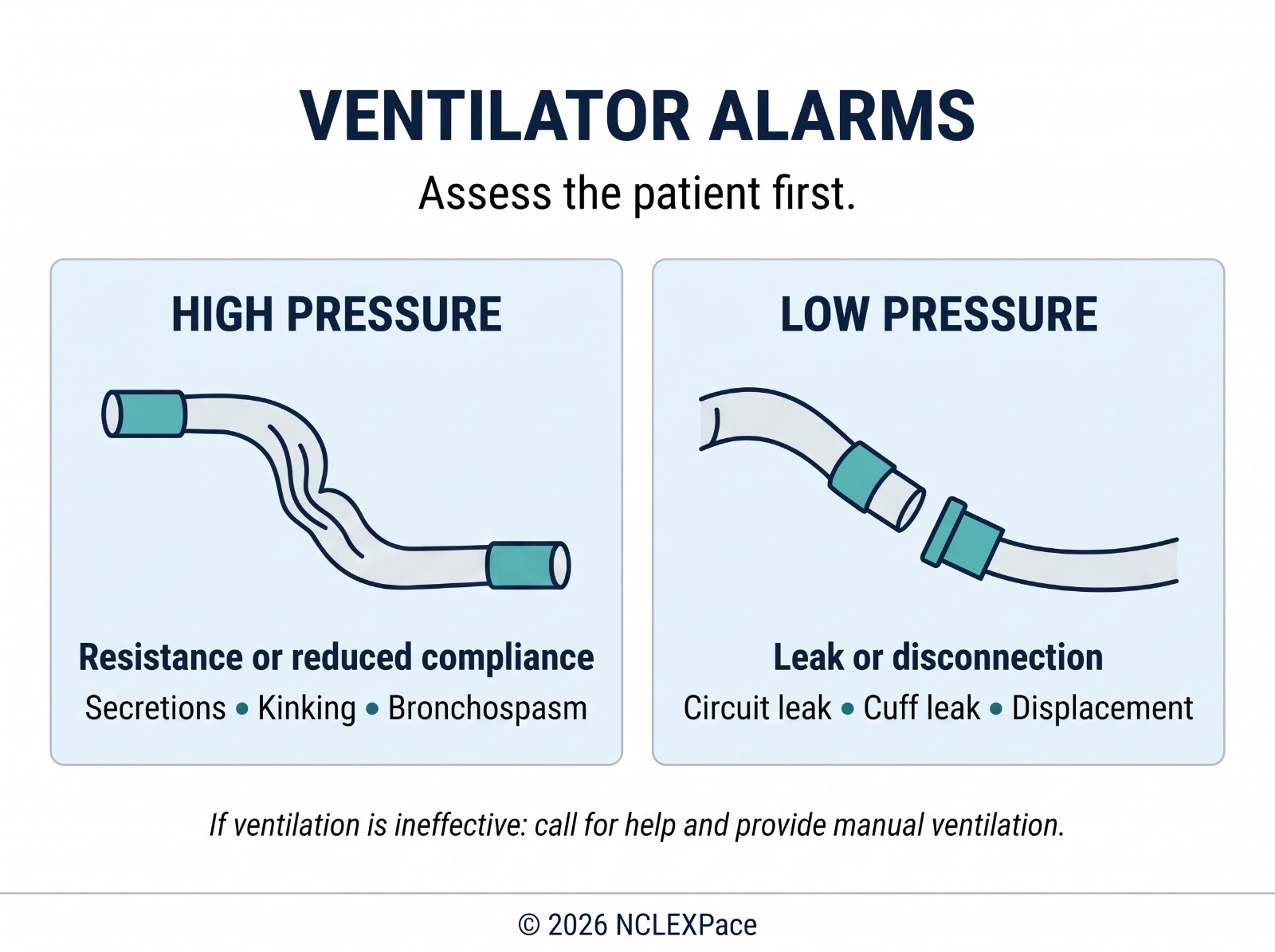
Suction on assessment, not on a schedule. The indications are audible or visible secretions, coarse crackles or gurgling, a rising respiratory rate or work of breathing, falling oxygen saturation, restlessness, or a high-pressure ventilator alarm.
| Step | Detail |
|---|---|
| 1 | Assess — confirm the client actually needs it |
| 2 | Hyperoxygenate for 30–60 seconds before the first pass |
| 3 | Sterile technique — sterile gloves and catheter for tracheal suctioning |
| 4 | Insert with suction OFF, until resistance is met, then withdraw about 1 cm |
| 5 | Apply suction on withdrawal only, rotating the catheter as you come out |
| 6 | 10 seconds maximum per pass |
| 7 | Reoxygenate and let the client recover between passes; no more than three passes |
| 8 | Reassess — breath sounds, saturation, colour, secretions documented |
Stop immediately for bradycardia, a significant drop in saturation, a new arrhythmia, or frank bleeding — reoxygenate and reassess first. Vagal stimulation from suctioning is a real cause of bradycardia and a common exam stem. And do not instil normal saline into the airway to loosen secretions — it does not thin them, it pushes organisms downward, and it drops saturation. Systemic hydration and humidified air are what actually help.
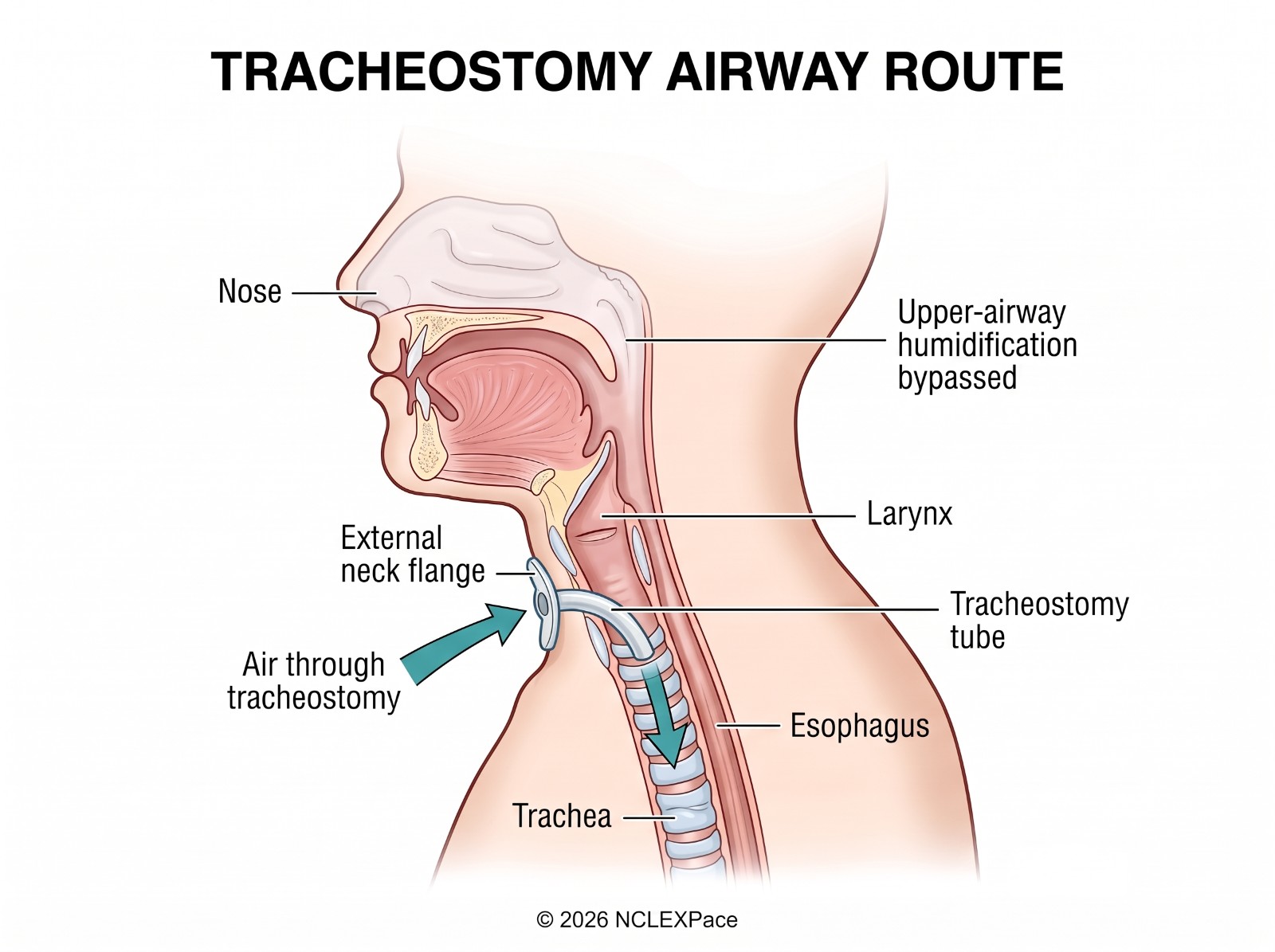
Routine tracheostomy care
- Two people where policy requires it — one holds the tube while the other changes the ties, so it cannot be displaced.
- Never cut the old ties until the new ones are secure. Tie with roughly one finger-width of slack.
- Clean the stoma with sterile technique, working from the stoma outward; assess for redness, swelling, odour or breakdown.
- Use a pre-cut or manufactured tracheostomy dressing — never cut gauze yourself, because loose fibres can be aspirated.
- Clean or replace the inner cannula per policy.
- Provide humidification — the upper airway that normally warms and moistens air has been bypassed.
- Mouth care regularly; the client cannot clear their own mouth well.
What lives at the bedside
| Item | Why |
|---|---|
| Obturator for the current tube | Needed to reinsert the same tube |
| Spare tube, same size | For replacement |
| Spare tube, one size smaller | If the stoma has narrowed and the correct size will not pass |
| Suction, oxygen, ambu bag | Immediate airway support |
| Sterile saline, dressings, spare ties | Care and securing |
The emergencies
| What happens | What you do |
|---|---|
| Accidental decannulation — the tube comes out | Stay with the client. Hold the stoma open with a tracheal dilator or curved haemostat and reinsert the spare tube with its obturator; remove the obturator immediately so air can pass. If it will not go, use the smaller tube. If you cannot reinsert, cover the stoma and ventilate with a bag-valve-mask over the mouth and nose, and call for help |
| Within the first 72 hours after surgery | The tract is immature and reinsertion is far more likely to create a false passage — call for help immediately rather than repeatedly attempting it |
| Obstruction — no air movement, distress | Suction. If that fails, remove and clean or replace the inner cannula. If still obstructed, escalate |
| Bleeding — new, bright or pulsatile | Escalate urgently. Pulsatile bleeding can signal erosion into a major vessel |
NCLEX tip: Two answers repeat. Suction is applied only on withdrawal, so any option describing suction during insertion is wrong. And in a fresh tracheostomy that has come out, the correct answer calls for help rather than persisting with reinsertion attempts.
Educational use only: this article supports nursing review and does not replace clinical judgment, facility protocols, or instructions from an authorised prescriber.
5 NCLEX practice questions on this topic
The same questions, player and partial-credit scoring students use inside NCLEXPace: answer, submit, read the full rationale, then Next. Your score is waiting at the end. No account needed for these.
A free account opens 20 more questions, a case study, a video and a cheat sheet. The full bank has 3,200+ questions with rationales, by topic.
Practice more, free →Ready for the full bank? See NCLEXPace plans and prices: one payment for 1, 2, 3 or 6 months.
Frequently asked questions
Common follow-up questions on Body Systems & Clinical Content.
How long should a suction pass last?
No more than about 10 seconds of applied suction per pass, with hyperoxygenation before and between passes and no more than two or three passes in a session. Suctioning removes oxygen along with secretions, so longer passes cause the hypoxia they are meant to relieve.
Should suction be applied while inserting the catheter?
No. The catheter is advanced with suction off, and suction is applied only during withdrawal while rotating the catheter. Suctioning on insertion strips oxygen from the airway and traumatises the mucosa on the way down.
What equipment must be kept at the bedside of a client with a tracheostomy?
The obturator for the current tube, a spare tube of the same size, a spare tube one size smaller, suction equipment, oxygen and a bag-valve-mask, plus sterile dressings and spare ties. These are checked at the start of every shift.
What should the nurse do if a tracheostomy tube is accidentally dislodged?
Stay with the client, hold the stoma open with a tracheal dilator, and reinsert the spare tube using the obturator: removing the obturator at once so air can pass. If the tracheostomy is less than about 72 hours old, call for help immediately rather than making repeated attempts, because the tract is immature and a false passage is easily created.
Should saline be instilled before suctioning?
No. Instilled saline does not thin secretions, can push organisms further into the lungs and reduces oxygen saturation. Systemic hydration and humidified inspired air are what genuinely loosen secretions.
Sources and references
- Potter PA, Perry AG, Stockert PA, Hall AM. Fundamentals of Nursing. 10th ed. Elsevier; 2021; Chapter: Oxygenation.
- Blakeman TC, et al. AARC Clinical Practice Guidelines: Artificial Airway Suctioning. Respir Care. 2022;67(2):258-271.
Reviewed by the NCLEXPace team, October 2026.
Keep reading


3,200+ NCLEX questions with think-like-a-nurse rationales, unfolding case studies and adaptive readiness exams. Start with free practice questions, then choose a plan when you are ready.
Create Free Account →