
Kidney Map: Acute vs. Chronic Failure, Dialysis, and Fluid Balance
Acute kidney injury is sudden and often reversible while chronic kidney disease is gradual and permanent, but the exam's main concern in either is high potassium, because it causes fatal heart rhythms. In the oliguric (low output) phase the risk is fluid overload and high potassium; in the diuretic (high output) phase it flips to dehydration and low electrolytes. Daily weight is the best measure of fluid status.

Hemodialysis and peritoneal dialysis: the access, the exchange, the complications, and what the nurse checks before, during and after.
From the Intensive NCLEX Course. See the course; the full video library is part of Pro and Ultimate.
Acute kidney injury vs. chronic kidney disease
| Acute (AKI) | Chronic (CKD) | |
|---|---|---|
| Onset | Sudden — hours to days | Gradual — months to years |
| Reversible? | Often yes | No |
| Causes | Dehydration, low blood pressure, contrast dye, some drugs, obstruction | Diabetes, high blood pressure, long-term kidney disease |
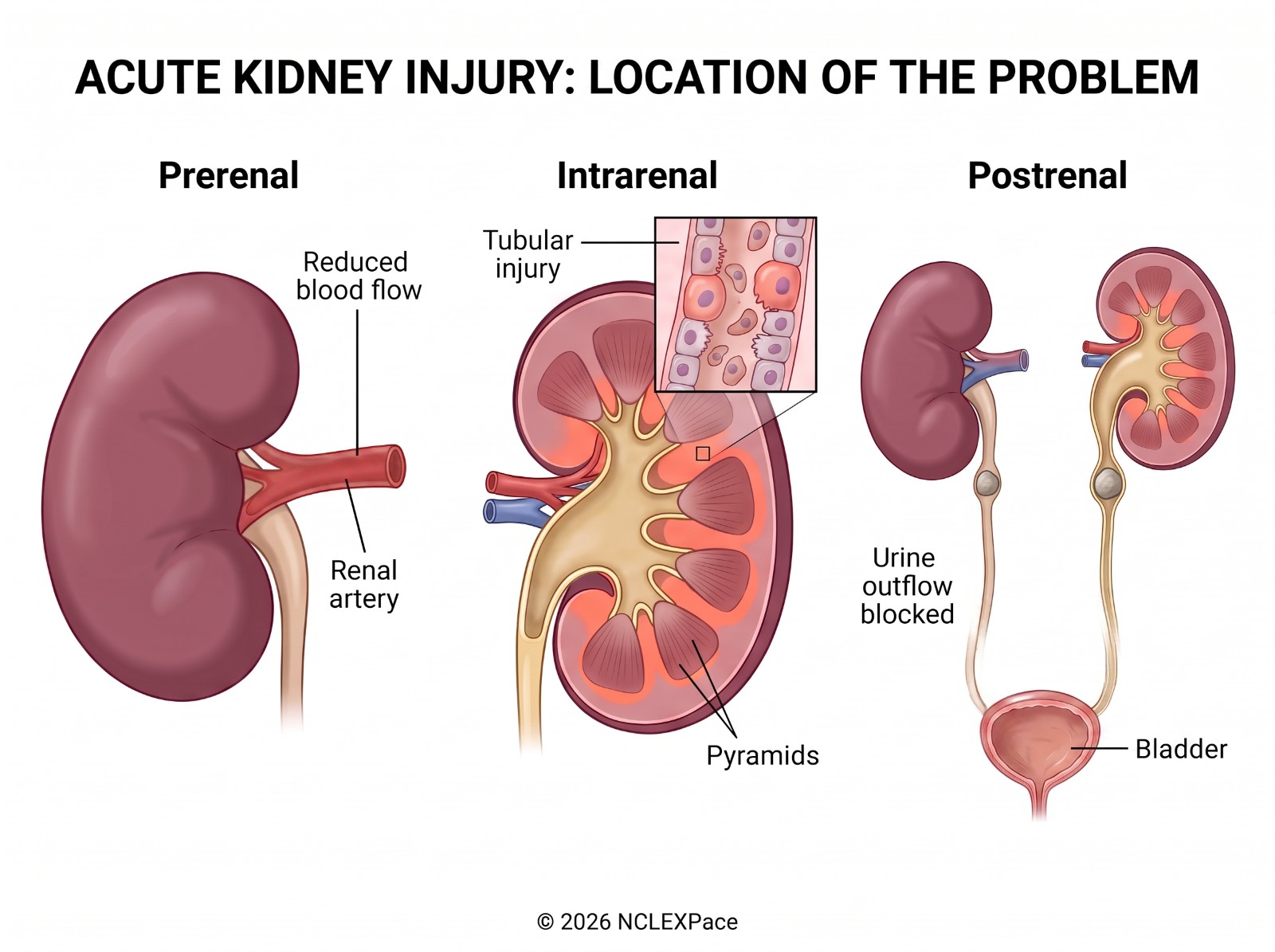
The three causes of AKI, grouped by where the problem is:
- Before the kidney — not enough blood reaching it. Dehydration, blood loss, shock, heart failure. Most common.
- In the kidney — direct damage. Contrast dye, some antibiotics, NSAIDs.
- After the kidney — something blocking outflow. Enlarged prostate, stones, tumor.
- Onset — the injury happens
- Oliguric — low urine output, usually under 400 mL a day. This is when potassium rises and becomes dangerous.
- Diuretic — urine output increases a lot. Now the risk is dehydration and losing too much electrolyte.
- Recovery — function gradually improves
The exam tests the direction of the risk: low output phase = fluid overload and high potassium. High output phase = dehydration and low electrolytes.
What kidney failure does to labs
| Lab | Direction |
|---|---|
| BUN | Up |
| Creatinine | Up — the key marker |
| Potassium | UP — the dangerous one |
| Phosphorus | Up |
| Calcium | Down |
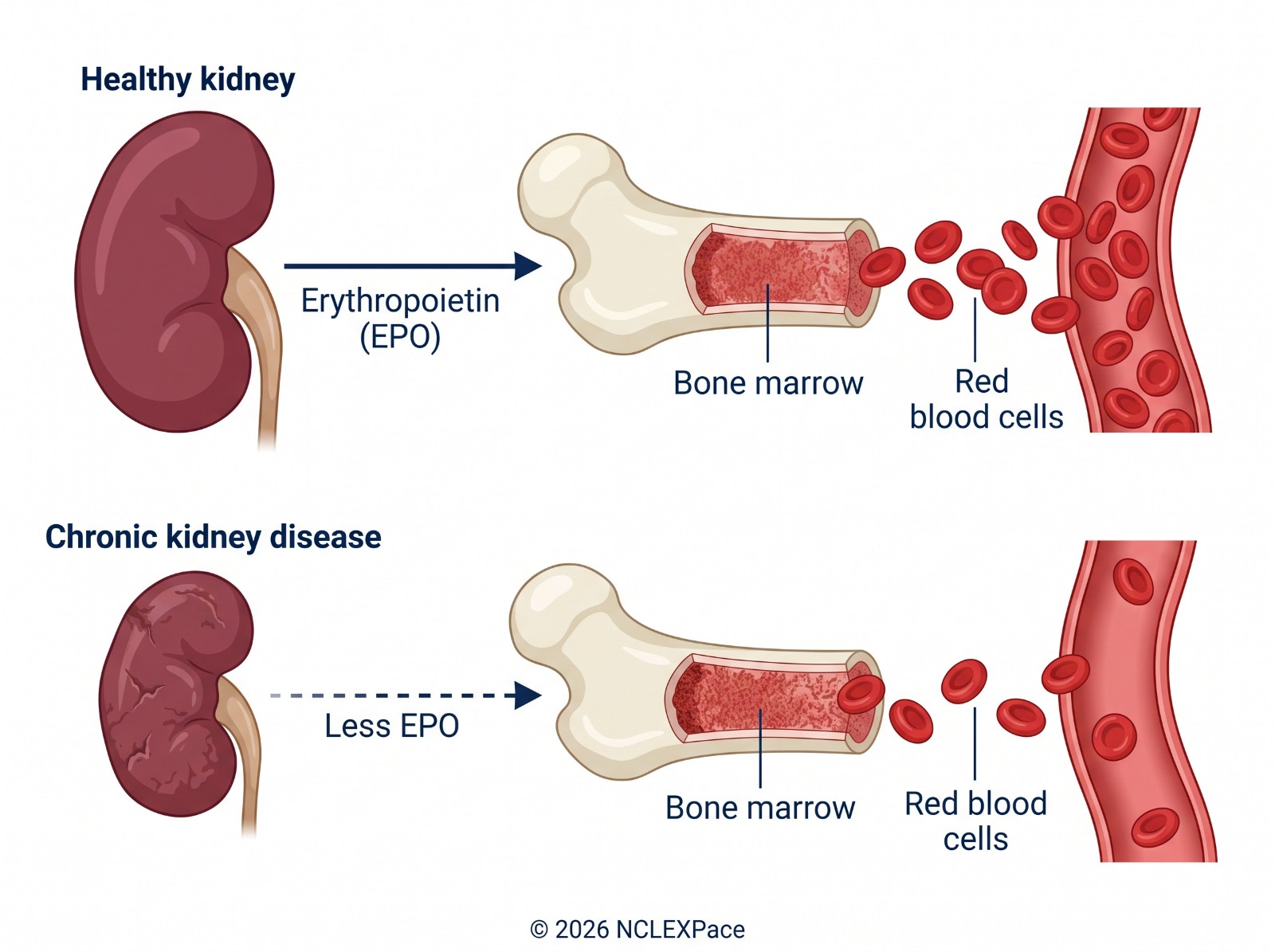
| Hemoglobin | Down (the kidney makes the hormone that drives red cell production) |
| pH | Down — metabolic acidosis |
The single biggest danger is high potassium, because it causes fatal heart rhythms. Any question about a client in kidney failure should make you think about potassium and the heart.
Nursing care
- Strict intake and output
- Daily weight — the best measure of fluid status
- Monitor potassium and the heart rhythm
- Fluid restriction as ordered
- Diet: usually low potassium, low phosphorus, low sodium, with protein adjusted to the stage and whether the client is on dialysis
- Check every medication — many drugs are cleared by the kidneys and need dose changes
- Avoid NSAIDs and contrast dye where possible
Hemodialysis
The access site is the most tested topic.
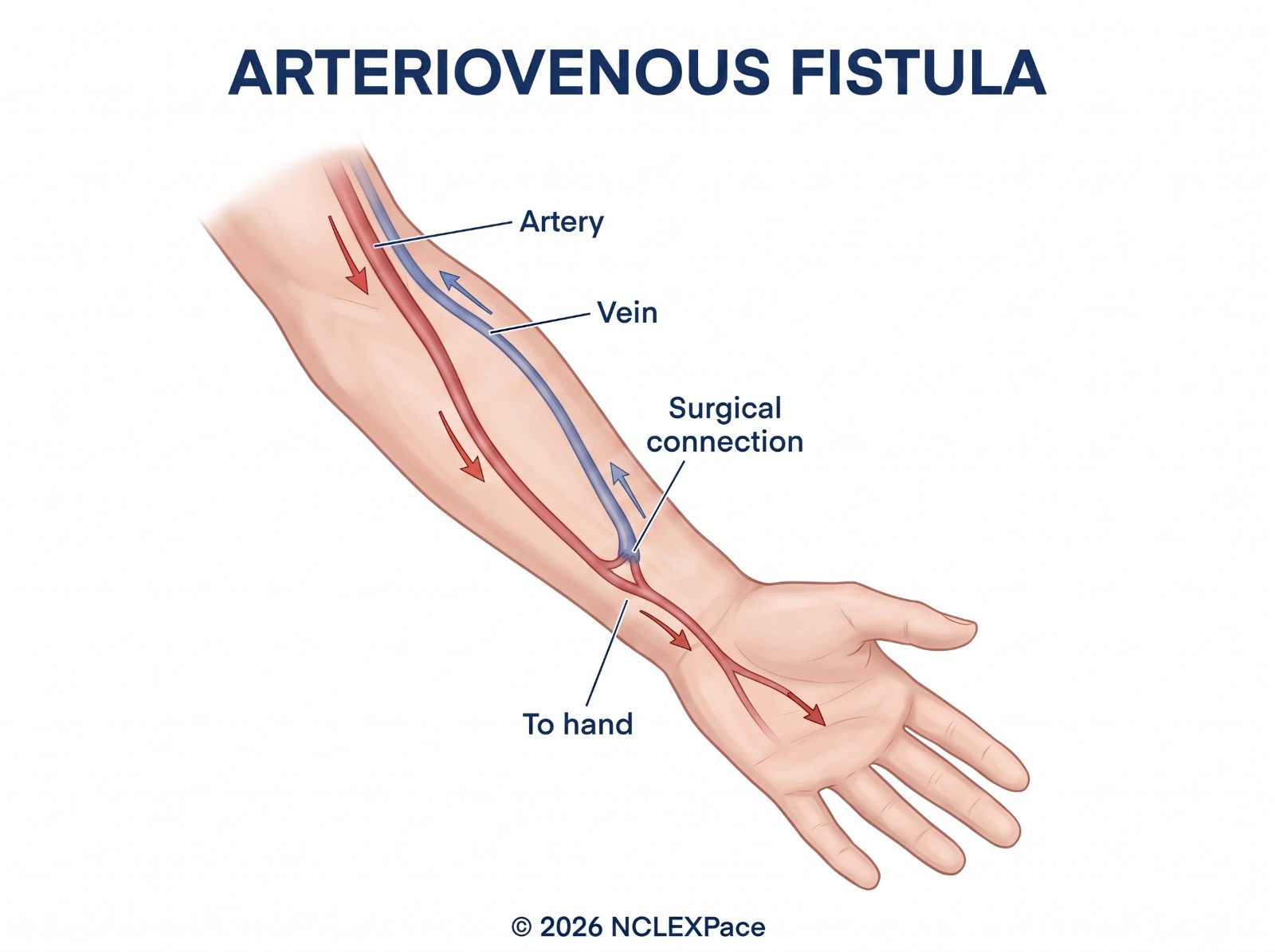
An arteriovenous fistula or graft is a surgically created connection in the arm.
Check it every shift:
- Feel for a thrill — a buzzing vibration
- Listen for a bruit — a whooshing sound
Both present = the access is working. Either missing = report immediately.
In that arm, NEVER:
- Take blood pressure
- Draw blood
- Start an IV
- Apply anything tight
Put a sign above the bed. Teach the client to protect it.
Before dialysis: weigh the client, check vital signs, and hold medications that would be removed by dialysis or would drop blood pressure, as ordered. Blood pressure medications are commonly held.
After dialysis: weigh again, check vital signs, watch for low blood pressure, check the site for bleeding, assess for headache or confusion.
The weight difference before and after shows how much fluid was removed.
Complications: low blood pressure during treatment, muscle cramps, bleeding, infection.
Peritoneal dialysis
Fluid goes into the abdomen, sits, and drains out.
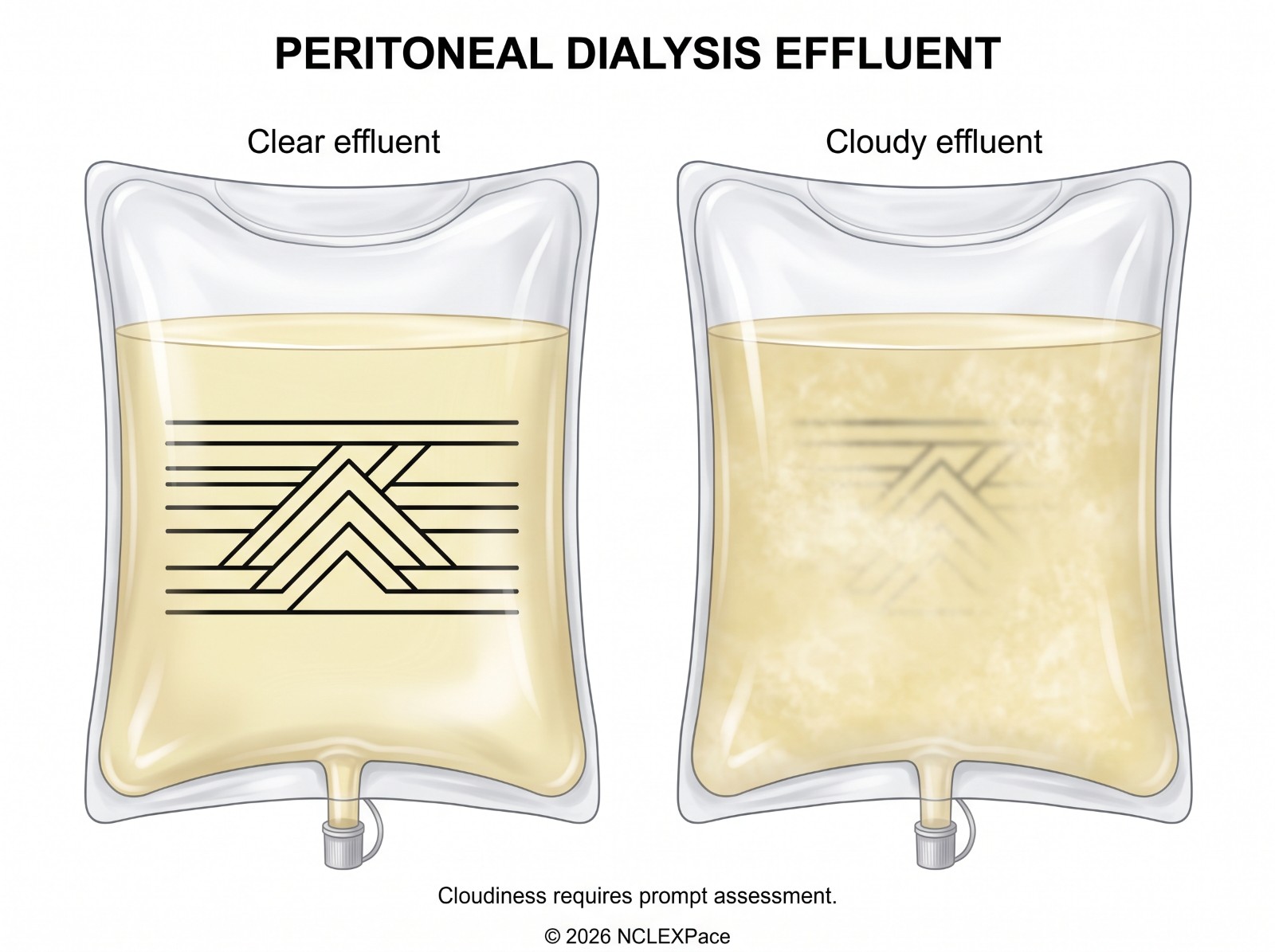
The most tested point: the drained fluid should be clear.
Cloudy drainage means infection of the abdominal lining (peritonitis). Report it immediately. Other signs: abdominal pain, fever, tenderness.
Other points:
- Use strict sterile technique with every exchange
- Warm the fluid before instilling — cold fluid causes cramping
- If the fluid does not drain well: reposition the client, check for kinks, check for constipation
- Record the amount in and the amount out
- Weigh the client with the abdomen empty for consistency
Fluid balance
Signs of too much fluid:
- Weight gain
- Swelling
- Distended neck veins
- Crackles in the lungs
- Shortness of breath
- High blood pressure
- Bounding pulse
Signs of too little fluid:
- Weight loss
- Dry mouth and skin
- Poor skin turgor
- Fast heart rate
- Low blood pressure
- Concentrated, dark urine
- Low urine output
- Dizziness on standing
Daily weight is the most reliable measure of fluid change. One kilogram of weight is about one liter of fluid.
The short version
- AKI is sudden and often reversible. CKD is gradual and permanent.
- Low urine output phase = high potassium and fluid overload
- High potassium is the main killer in kidney failure
- Fistula: feel for a thrill, listen for a bruit, no BP or blood draws in that arm
- Peritoneal dialysis: cloudy drainage = peritonitis = report
- Daily weight is the best fluid measure
5 NCLEX practice questions on this topic
The same questions, player and partial-credit scoring students use inside NCLEXPace: answer, submit, read the full rationale, then Next. Your score is waiting at the end. No account needed for these.
A free account opens 20 more questions, a case study, a video and a cheat sheet. The full bank has 3,200+ questions with rationales, by topic.
Practice more, free →Ready for the full bank? See NCLEXPace plans and prices: one payment for 1, 2, 3 or 6 months.
Frequently asked questions
Common follow-up questions on Body Systems & Clinical Content.
What are the phases of acute kidney injury and their risks?
Onset (the injury happens), oliguric (low urine output, usually under 400 mL a day, when potassium rises and becomes dangerous), diuretic (urine output increases a lot, so the risk becomes dehydration and losing too much electrolyte), and recovery (function gradually improves). The exam tests the direction of the risk: the low output phase means fluid overload and high potassium, the high output phase means dehydration and low electrolytes.
Why is high potassium the main danger in kidney failure?
Because it causes fatal heart rhythms. In kidney failure BUN, creatinine, potassium, and phosphorus rise while calcium, hemoglobin, and pH fall, but potassium is the dangerous one. Any question about a client in kidney failure should make you think about potassium and the heart.
How do you care for a hemodialysis fistula or graft?
Check it every shift by feeling for a thrill (a buzzing vibration) and listening for a bruit (a whooshing sound); both present means the access is working, and either one missing must be reported immediately. In that arm never take blood pressure, draw blood, start an IV, or apply anything tight, and put a sign above the bed so the access is protected.
What does cloudy drainage mean in peritoneal dialysis?
Cloudy drained fluid means peritonitis, an infection of the abdominal lining, and must be reported immediately; other signs are abdominal pain, fever, and tenderness. The drained fluid should be clear. Every exchange uses strict sterile technique, and the fluid is warmed before instilling because cold fluid causes cramping.
What should be checked before and after hemodialysis?
Before dialysis, weigh the client, check vital signs, and hold medications that would be removed by dialysis or would drop blood pressure as ordered; blood pressure medications are commonly held. After dialysis, weigh again, check vital signs, watch for low blood pressure, check the site for bleeding, and assess for headache or confusion. The weight difference before and after shows how much fluid was removed.
Sources and references
- Harding MM, Kwong J, Hagler D, Reinisch C. Lewis's Medical-Surgical Nursing: Assessment and Management of Clinical Problems. 12th ed. Elsevier; 2023; Chapter: Acute Kidney Injury and Chronic Kidney Disease.
- Kidney Disease: Improving Global Outcomes (KDIGO) CKD Work Group. KDIGO 2024 Clinical Practice Guideline for the Evaluation and Management of Chronic Kidney Disease. Kidney International. 2024;105(4S):S117-S314.
- Kidney Disease: Improving Global Outcomes (KDIGO) Acute Kidney Injury Work Group. KDIGO Clinical Practice Guideline for Acute Kidney Injury. Kidney International Supplements. 2012;2(1):1-138.
Reviewed by the NCLEXPace team, October 2026.
Keep reading



3,200+ NCLEX questions with think-like-a-nurse rationales, unfolding case studies and adaptive readiness exams. Start with free practice questions, then choose a plan when you are ready.
Create Free Account →