
Immobility and VTE: Prevent the Clot Before It Travels
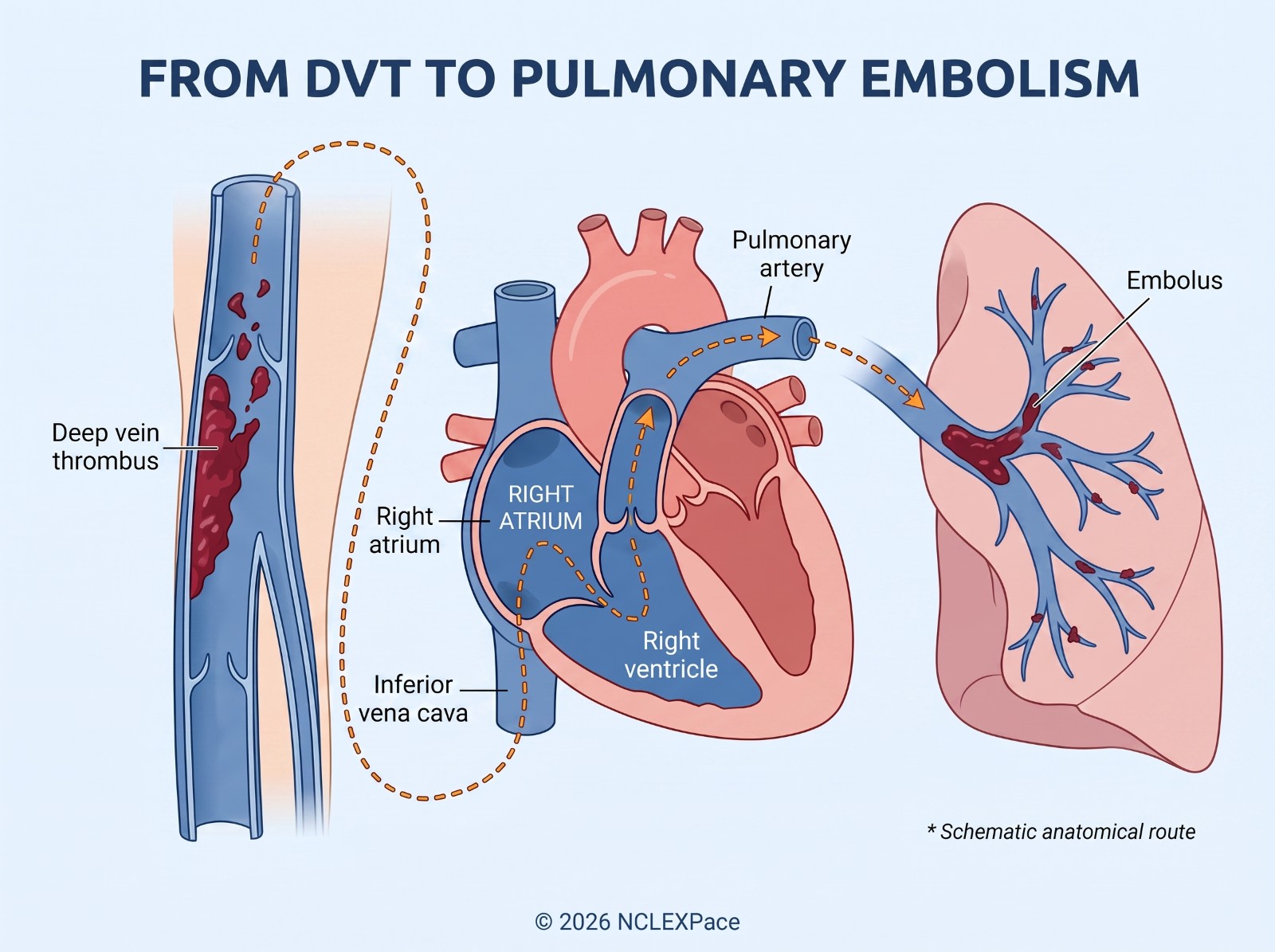
Immobility slows venous return, and when stasis combines with vessel injury and increased clotting tendency (Virchow's triad) clots form. Prevention is active nursing: early safe mobility, correctly applied prescribed compression, and prophylactic anticoagulation. Never massage a leg with suspected DVT, and treat sudden breathlessness as a possible pulmonary embolism.

DVT and pulmonary embolism: who is at risk, the prevention that works, the findings, and the anticoagulant care.
From the Intensive NCLEX Course. See the course; the full video library is part of Pro and Ultimate.
Venous thromboembolism (VTE) covers deep-vein thrombosis (DVT) and pulmonary embolism (PE). Immobility slows venous return, particularly in the legs; when stasis combines with vessel injury and increased clotting tendency — Virchow's triad — the risk of thrombosis rises. Prevention is not passive: it is active nursing.
Who is at higher risk?
Risk increases with surgery, hospitalisation, prolonged bed rest, previous VTE, active cancer, pregnancy or the postpartum period, oestrogen exposure, trauma, increasing age, obesity and certain medical conditions. Risk assessment matters because prophylaxis should be individualised.
Prevention is active nursing care
- Encourage early and safe mobility, regular repositioning, leg and ankle exercises, and adequate hydration when appropriate.
- Apply prescribed intermittent pneumatic compression or graduated compression stockings correctly; remove them for skin and neurovascular assessment as directed, and verify the tubing is connected and the device is actually functioning.
- Administer prescribed anticoagulant prophylaxis and monitor for bleeding.
Mechanical prophylaxis is not a decoration at the foot of the bed — a device that is ordered but not worn does not protect the patient.
Recognise DVT and PE
| DVT | PE | |
|---|---|---|
| What you see | Unilateral swelling, warmth, tenderness or colour change in a leg | Sudden shortness of breath, pleuritic chest pain, tachycardia, hypoxaemia, anxiety, syncope or haemodynamic instability |
| What it is | A clot in a deep vein | A clot that has embolised to the lung |
| Nurse action | Do not massage the leg; notify, elevate as ordered, anticoagulation per order | Immediate escalation, oxygen and supportive care — this is an emergency |
Do not massage a leg with suspected DVT — it can dislodge the clot. And treat sudden breathlessness in an at-risk client as a possible PE until proven otherwise.
The common NCLEX distinction
Prevention questions usually prioritise mobility and ordered prophylaxis. Emergency questions prioritise oxygenation, rapid assessment and escalation when acute respiratory symptoms suggest a clot may have embolised. Read the stem to tell which question you are being asked.
NCLEX tip: Immobility is modifiable. Mobilise safely, use prescribed prophylaxis correctly, watch for unilateral leg changes, and treat sudden respiratory deterioration in an at-risk client as an emergency — never as something to reassess later.
Educational use only: this article supports nursing review and does not replace clinical judgment, facility protocols, or instructions from an authorised prescriber.
5 NCLEX practice questions on this topic
The same questions, player and partial-credit scoring students use inside NCLEXPace: answer, submit, read the full rationale, then Next. Your score is waiting at the end. No account needed for these.
A free account opens 20 more questions, a case study, a video and a cheat sheet. The full bank has 3,200+ questions with rationales, by topic.
Practice more, free →Ready for the full bank? See NCLEXPace plans and prices: one payment for 1, 2, 3 or 6 months.
Frequently asked questions
Common follow-up questions on Body Systems & Clinical Content.
What is Virchow's triad?
The three conditions that together promote clot formation: venous stasis, vessel wall injury and increased clotting tendency. Immobility drives the stasis component, which is why hospitalised and bed-rested clients are at higher risk of VTE.
How does the nurse prevent VTE from immobility?
Through active care: early and safe mobility, repositioning, leg and ankle exercises and hydration; correctly applied prescribed compression devices or stockings that are actually worn and functioning; and prescribed anticoagulant prophylaxis with monitoring for bleeding.
Why should you never massage a leg with a suspected DVT?
Massage can dislodge the clot and send it to the lungs as a pulmonary embolism. A suspected DVT (unilateral swelling, warmth, tenderness or colour change) is reported and managed with elevation and anticoagulation as ordered, never rubbed.
What are the signs of a pulmonary embolism?
Sudden shortness of breath, pleuritic chest pain, tachycardia, low oxygen saturation, anxiety, syncope or haemodynamic instability. Suspected PE requires immediate escalation, oxygen and supportive care.
How do prevention and emergency VTE questions differ?
Prevention questions prioritise mobility and correctly used prophylaxis. Emergency questions prioritise oxygenation, rapid assessment and escalation when acute respiratory symptoms suggest a clot has embolised: the stem tells you which is being asked.
Sources and references
- Harding MM, Kwong J, Hagler D, Reinisch C. Lewis's Medical-Surgical Nursing: Assessment and Management of Clinical Problems. 12th ed. Elsevier; 2023; Chapter: Vascular Disorders.
- Potter PA, Perry AG, Stockert PA, Hall AM. Fundamentals of Nursing. 10th ed. Elsevier; 2021; Chapter: Immobility.
- Schunemann HJ, et al. American Society of Hematology 2018 Guidelines for Management of Venous Thromboembolism: Prophylaxis for Hospitalized and Nonhospitalized Medical Patients. Blood Adv. 2018;2(22):3198-3225.
Reviewed by the NCLEXPace team, October 2026.
Keep reading
3,200+ NCLEX questions with think-like-a-nurse rationales, unfolding case studies and adaptive readiness exams. Start with free practice questions, then choose a plan when you are ready.
Create Free Account →