Anticoagulants on the NCLEX: Heparin vs Warfarin vs DOACs
Lock in the two pairings the NCLEX tests relentlessly: heparin is monitored by aPTT and reversed by protamine sulfate, while warfarin is monitored by PT/INR and reversed by vitamin K. The warfarin diet teaching students get backwards is that clients keep their vitamin K intake consistent rather than avoiding green vegetables, and the platelet complication to watch for is heparin-induced thrombocytopenia, where platelets fall and the client paradoxically clots.

Heparin, warfarin and the DOACs: what to monitor, the bleeding precautions, and the reversal agent for each.
From the Intensive NCLEX Course. See the course; the full video library is part of Pro and Ultimate.
Three anticoagulant families, three different monitoring rules, two antidotes. The NCLEX tests the pairings relentlessly because getting one wrong causes a bleed or a clot.
Step 1 — The comparison
| Heparin (unfractionated) | Enoxaparin (LMWH) | Warfarin | DOACs | |
|---|---|---|---|---|
| Route | IV or subcutaneous | Subcutaneous | Oral | Oral |
| Onset | Immediate | Rapid | Slow — 3 to 5 days | Rapid |
| Monitor with | aPTT (1.5–2× normal) | Usually no routine monitoring | PT / INR | No routine monitoring |
| Antidote | Protamine sulfate | Protamine (partial) | Vitamin K (phytonadione) | Specific reversal agents; not always available |
| In pregnancy | Safe | Safe | Contraindicated — teratogenic | Avoided |
| Special risk | HIT — falling platelets | HIT, less commonly | Many interactions | Renal dosing matters |
The pairing to lock in
Heparin → aPTT → protamine. Warfarin → INR → vitamin K. Students mix the antidotes under pressure. One way to hold it: warfarin works by blocking vitamin K, so vitamin K is what undoes it.
Step 2 — Target ranges
| Value | Normal | Therapeutic on treatment |
|---|---|---|
| aPTT | 30–40 seconds | 1.5–2× normal, roughly 46–70 seconds |
| INR | 0.8–1.1 | 2.0–3.0 for most indications; 2.5–3.5 for mechanical valves |
| Platelets | 150,000–400,000 | Watch for a fall on heparin |
An INR of 5.2 is a hold-and-report finding. An INR of 1.2 in a client on warfarin for atrial fibrillation is subtherapeutic — they are at risk of clotting, not bleeding, and the question may be asking about that direction instead.
Step 3 — The vitamin K teaching students get backwards
A client on warfarin is not told to avoid green vegetables. They are told to keep their intake consistent.
Warfarin dosing is titrated against whatever the client normally eats. Sudden change in either direction is what causes trouble: a big spinach salad drops the INR toward clotting, and cutting out greens entirely pushes it up toward bleeding. So the correct teaching is steady, not zero — and an option telling the client to eliminate leafy greens is wrong.
Other warfarin teaching that gets asked: avoid alcohol excess, check before starting any new drug or herbal product, and never take aspirin or NSAIDs without asking.
Step 4 — Heparin-induced thrombocytopenia
HIT is the complication the exam wants you to catch. Platelets fall — typically 5 to 10 days into heparin therapy — and paradoxically the client clots rather than bleeds.
The nursing action is not to transfuse platelets. It is to stop all heparin, including flushes and heparin-coated lines, and notify the provider. Any drop of roughly 50% from baseline is significant.
Administration details that appear as safety questions
| Rule | Detail |
|---|---|
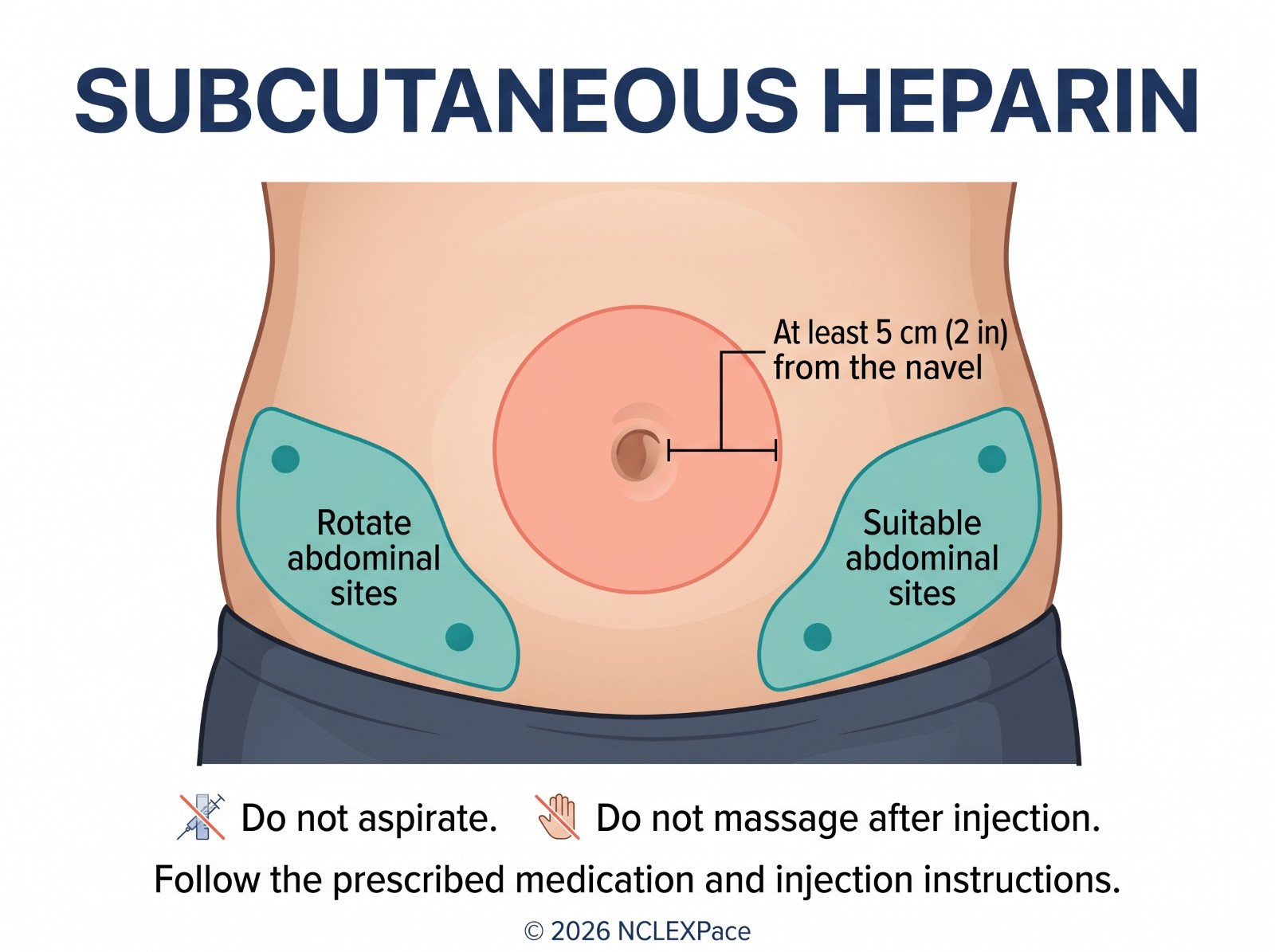
| Subcutaneous heparin and enoxaparin | Abdomen, at least 2 inches from the umbilicus. Do not aspirate, do not massage — both cause bruising |
| Enoxaparin air bubble | Do not expel it — the prefilled syringe is designed with it |
| Rotate sites | Reduces haematoma |
| IV heparin | Always on a pump, double-checked. It is a high-alert medication |
| Overlap period | Heparin continues until warfarin's INR is therapeutic — warfarin takes days, so stopping heparin early leaves the client unprotected |
What to teach every client on any of them
Soft toothbrush, electric razor, no contact sport, report black stools, pink or red urine, nosebleeds, unusual bruising or a headache after a knock. Carry identification stating they are anticoagulated. Bleeding you can see is easier than bleeding you cannot — a headache or abdominal pain after minor trauma matters.
NCLEX tip: Heparin with aPTT and protamine; warfarin with INR and vitamin K. And the diet answer is consistency, never avoidance — if an option tells a warfarin client to stop eating green vegetables, eliminate it.
5 NCLEX practice questions on this topic
The same questions, player and partial-credit scoring students use inside NCLEXPace: answer, submit, read the full rationale, then Next. Your score is waiting at the end. No account needed for these.
A free account opens 20 more questions, a case study, a video and a cheat sheet. The full bank has 3,200+ questions with rationales, by topic.
Practice more, free →Ready for the full bank? See NCLEXPace plans and prices: one payment for 1, 2, 3 or 6 months.
Frequently asked questions
Common follow-up questions on Pharmacology.
Which lab monitors which anticoagulant, and what are the antidotes?
Heparin is monitored with aPTT, targeted at 1.5 to 2 times normal, and reversed with protamine sulfate. Warfarin is monitored with PT/INR, therapeutic at 2.0 to 3.0 for most indications, and reversed with vitamin K. One way to hold it is that warfarin works by blocking vitamin K, so vitamin K is what undoes it.
What is the correct vitamin K teaching for a client on warfarin?
A client on warfarin is not told to avoid green vegetables; they are told to keep their intake consistent. Warfarin dosing is titrated against whatever the client normally eats, so a sudden change in either direction causes trouble: a big spinach salad drops the INR toward clotting, and cutting out greens entirely pushes it up toward bleeding. An option telling the client to eliminate leafy greens is wrong.
What is heparin-induced thrombocytopenia and what do I do?
HIT is the complication the exam wants you to catch. Platelets fall, typically 5 to 10 days into heparin therapy, and the client paradoxically clots rather than bleeds. The nursing action is not to transfuse platelets but to stop all heparin, including flushes and heparin-coated lines, and notify the provider. Any drop of roughly 50 percent from baseline is significant.
How do I give subcutaneous heparin or enoxaparin correctly?
Give it in the abdomen, at least 2 inches from the umbilicus, and do not aspirate or massage, because both cause bruising. Do not expel the air bubble in a prefilled enoxaparin syringe, since it is designed with it. Rotate sites to reduce haematoma. IV heparin is a high-alert medication and is always given on a pump and double-checked.
Why is heparin continued when starting warfarin?
Warfarin has a slow onset of 3 to 5 days, so heparin continues until warfarin's INR is therapeutic. Stopping heparin early leaves the client unprotected during that overlap. This is why an INR of 1.2 in a client on warfarin for atrial fibrillation is subtherapeutic and means they are at risk of clotting, not bleeding.
Sources and references
- Burchum JR, Rosenthal LD. Lehne's Pharmacology for Nursing Care. 11th ed. Elsevier; 2022; Chapter: Anticoagulant, Antiplatelet, and Thrombolytic Drugs.
- Stevens SM, et al. Antithrombotic Therapy for VTE Disease: Second Update of the CHEST Guideline and Expert Panel Report. Chest. 2021;160(6):e545-e608.
Reviewed by the NCLEXPace team, October 2026.
Keep reading

3,200+ NCLEX questions with think-like-a-nurse rationales, unfolding case studies and adaptive readiness exams. Start with free practice questions, then choose a plan when you are ready.
Create Free Account →