
Burns on the NCLEX: Airway First, the Rule of Nines, and the Phases
Airway comes first in every burn question: singed nasal hairs, soot around the mouth, hoarseness or a fire in an enclosed space all mean the airway may swell shut. Use the Rule of Nines to estimate size. And know the potassium reversal: high in the emergent phase as damaged cells release it, low in the acute phase as it moves back into cells and is lost in urine.

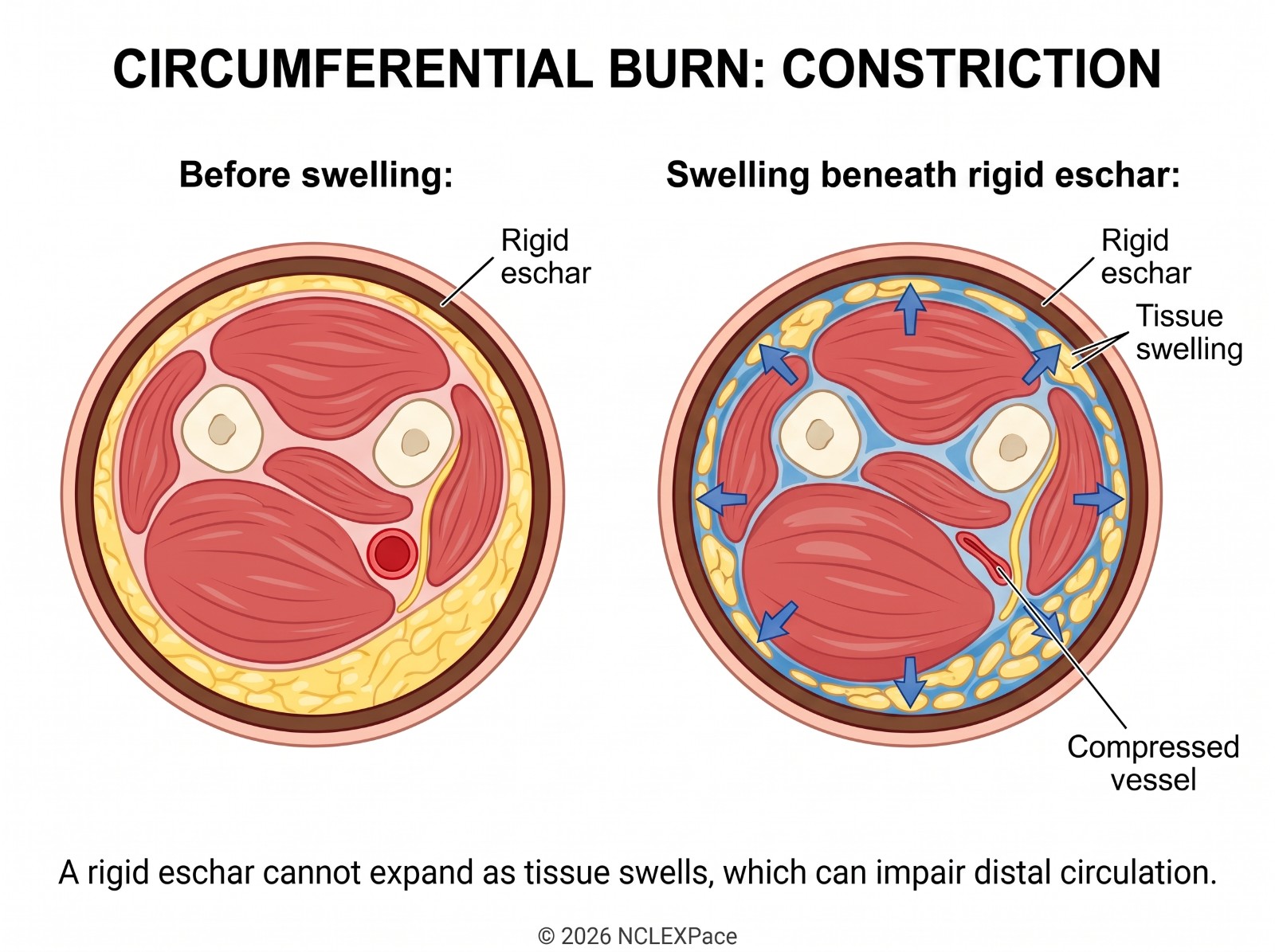
Burns: airway first, the Rule of Nines, the three phases of care, fluid resuscitation and the circumferential burn.
From the Intensive NCLEX Course. See the course; the full video library is part of Pro and Ultimate.
Burn stems look like they are about skin. They are about airway, then fluid, then potassium — in that order. Get the reflex right and the questions answer themselves.
Airway first, always
Before the burn size, before the fluids, look for inhalation injury:
- Burns to the face, neck or chest
- Singed nasal hairs or eyebrows
- Soot around the mouth or nose
- Hoarse voice or a change in voice
- Coughing up black-tinged sputum
- Difficulty swallowing
- Burns from a fire in an enclosed space
Any of these means the airway may swell shut. Assess and secure the airway before anything else — swelling worsens over the first hours.
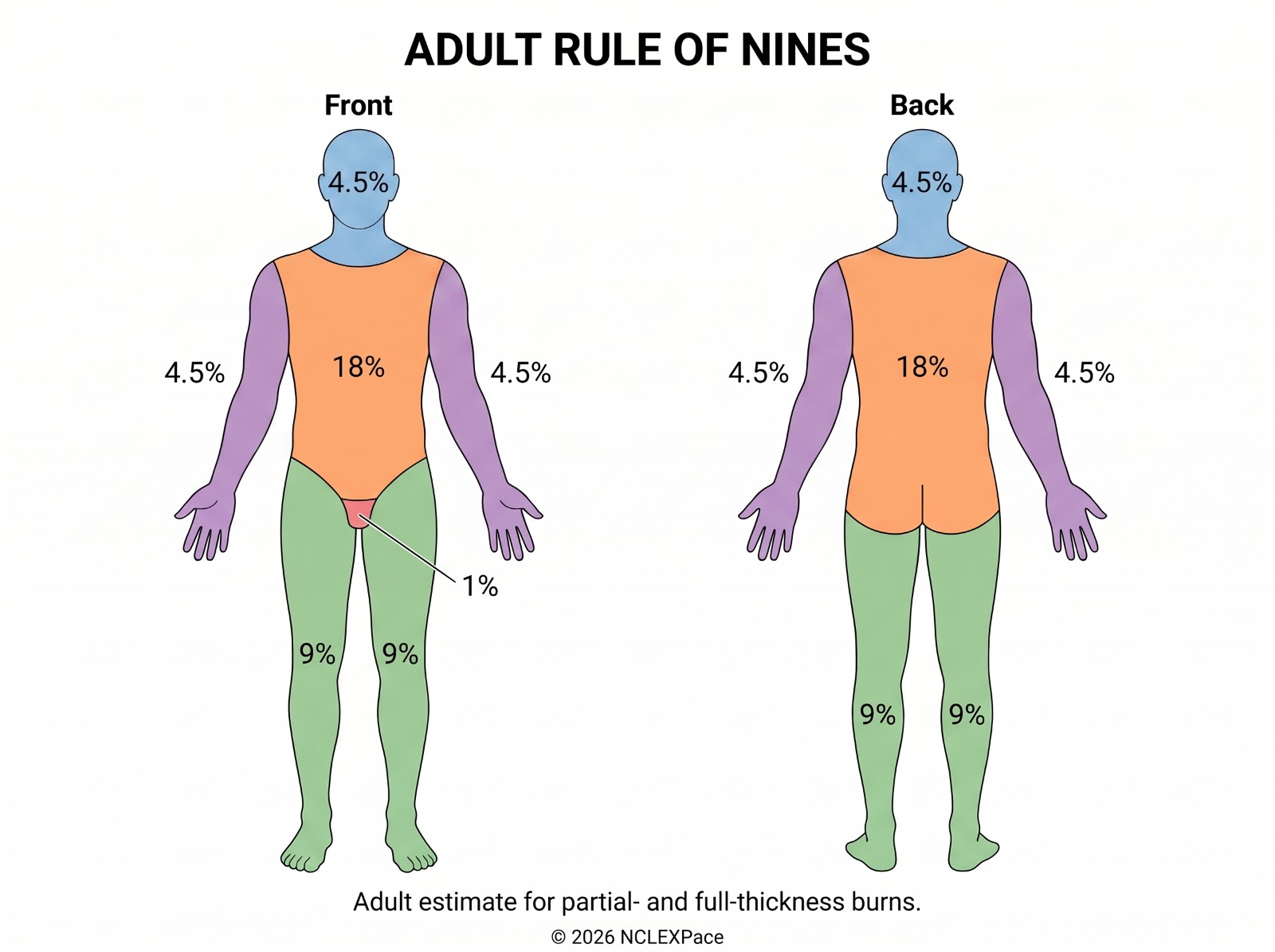
Estimating burn size — the Rule of Nines (adult)
| Body area | Percent |
|---|---|
| Head and neck | 9% |
| Each arm | 9% (18% for both) |
| Each leg | 18% (36% for both) |
| Front of trunk | 18% |
| Back of trunk | 18% |
| Perineum | 1% |
Children have different proportions — a larger head and smaller legs — so a modified chart is used.
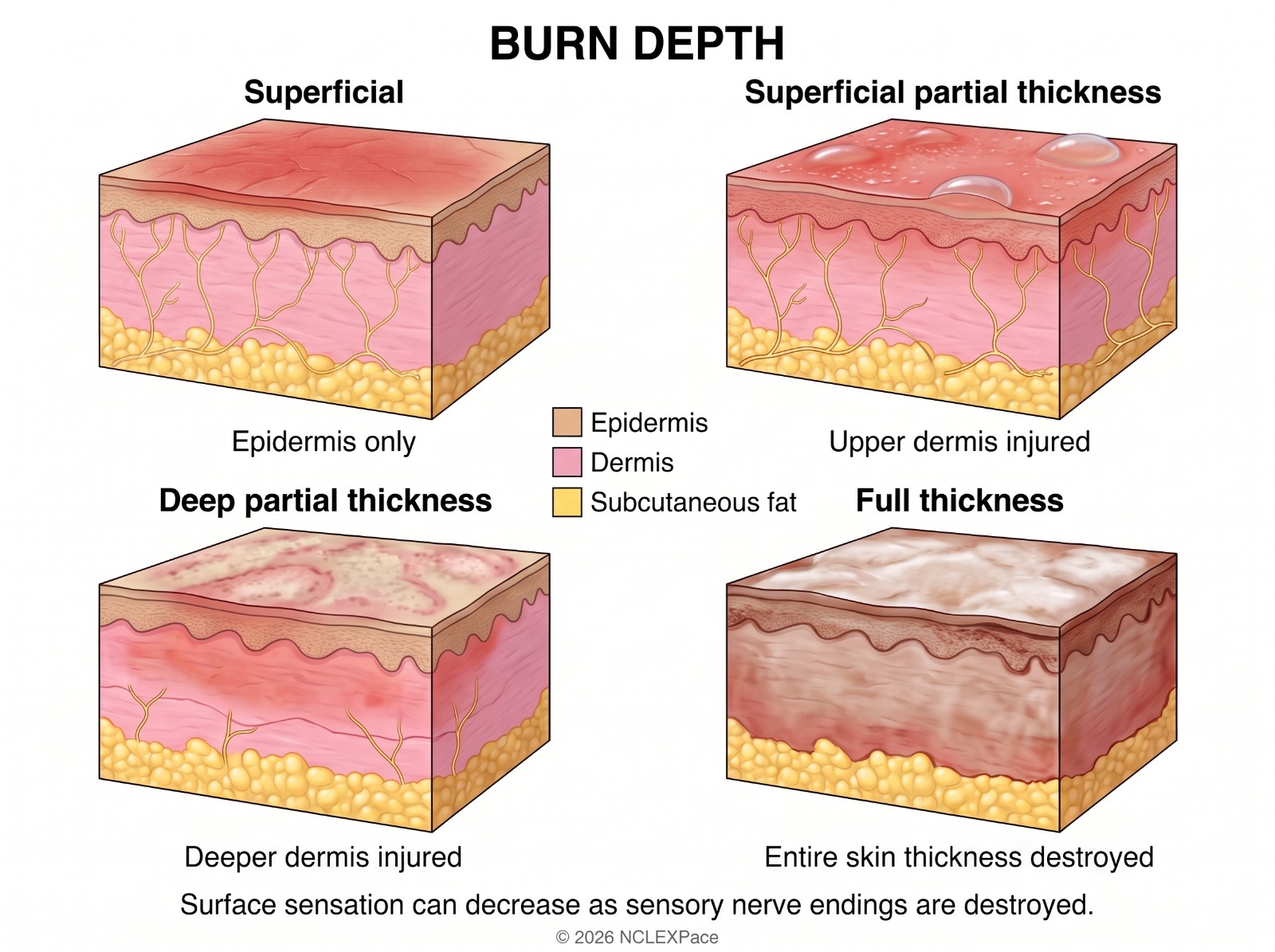
The three phases
| Phase | What is happening | Potassium | Nursing focus |
|---|---|---|---|
| Emergent (first 24–48 h) | Fluid shifts out of the vessels into the tissues — massive swelling, low blood volume, risk of shock, concentrated blood | HIGH — released from damaged cells | Fluid replacement is the priority |
| Acute | Fluid shifts back into the vessels — risk of fluid overload; infection becomes the main danger | LOW — moves back into cells and is lost in urine | Wound care and nutrition |
| Rehabilitation | Scarring, contractures, function and emotional recovery | Normalising | Mobility, contracture prevention, psychosocial support |
The potassium reversal between the first two phases is commonly tested: high in the emergent phase, low in the acute phase.
The rest of burn care
- Nutrition: burn clients need very high calories and very high protein to heal — a heavily tested point, with amounts far above normal.
- Pain: IV route in the early phase. Absorption from muscle and skin is unreliable when circulation is affected.
- Infection prevention is the main cause of death after the first phase — strict aseptic technique with wound care.
Burns and shock
A large burn causes hypovolaemic shock, because fluid leaves the circulation for the tissues during the emergent phase. The early picture is a fast heart rate, restlessness and a normal blood pressure — not a low one. Hypotension is late.
The emergency order of priorities
For any emergency, work the ABCDE sequence:
- Airway
- Breathing
- Circulation
- Disability — neurological status
- Exposure — look for other injuries, then keep the client warm
In trauma, always look for what you have not found yet. Undress and examine, then cover to prevent heat loss.
NCLEX tip: If a burn stem lists soot, singed hairs or a hoarse voice among the findings, the answer is the airway — every time, regardless of how large the burn is or how stable the blood pressure looks right now.
Educational use only: fluid resuscitation formulas and burn-centre referral criteria vary. Follow current burn-care guidance and facility protocol.
5 NCLEX practice questions on this topic
The same questions, player and partial-credit scoring students use inside NCLEXPace: answer, submit, read the full rationale, then Next. Your score is waiting at the end. No account needed for these.
A free account opens 20 more questions, a case study, a video and a cheat sheet. The full bank has 3,200+ questions with rationales, by topic.
Practice more, free →Ready for the full bank? See NCLEXPace plans and prices: one payment for 1, 2, 3 or 6 months.
Frequently asked questions
Common follow-up questions on Body Systems & Clinical Content.
What is the priority in a burn client?
The airway. Signs of inhalation injury (facial burns, singed nasal hairs, soot around the mouth, a hoarse voice, or a fire in an enclosed space) mean the airway may swell shut, and it is assessed and secured before fluid, pain or wound care because swelling worsens over the first hours.
What is the Rule of Nines in an adult?
Head and neck 9%, each arm 9%, each leg 18%, front of trunk 18%, back of trunk 18%, and perineum 1%. Children use a modified chart because they have a proportionally larger head and smaller legs.
Why is potassium high then low in burns?
In the emergent phase, damaged cells release potassium into the blood, so it runs high. In the acute phase, potassium moves back into cells and is lost in the urine, so it runs low. This reversal between the two phases is a frequently tested point.
What are the three phases of burn care?
The emergent phase over the first 24–48 hours, when fluid shifts out of the vessels and replacement is the priority; the acute phase, when fluid shifts back and infection and nutrition dominate; and the rehabilitation phase, focused on scarring, contractures, function and emotional recovery.
What kind of shock do large burns cause?
Hypovolaemic shock, because fluid leaves the circulation for the tissues during the emergent phase. The early picture is tachycardia and restlessness with a normal blood pressure; hypotension is a late sign.
Sources and references
- Harding MM, Kwong J, Hagler D, Reinisch C. Lewis's Medical-Surgical Nursing: Assessment and Management of Clinical Problems. 12th ed. Elsevier; 2023; Chapter: Burns.
- American Burn Association. Advanced Burn Life Support (ABLS) Provider Manual. 2018 update. Chicago, IL: American Burn Association.
Reviewed by the NCLEXPace team, October 2026.
Keep reading



3,200+ NCLEX questions with think-like-a-nurse rationales, unfolding case studies and adaptive readiness exams. Start with free practice questions, then choose a plan when you are ready.
Create Free Account →