Pain Management and Naloxone: Relieve Pain, Protect Breathing
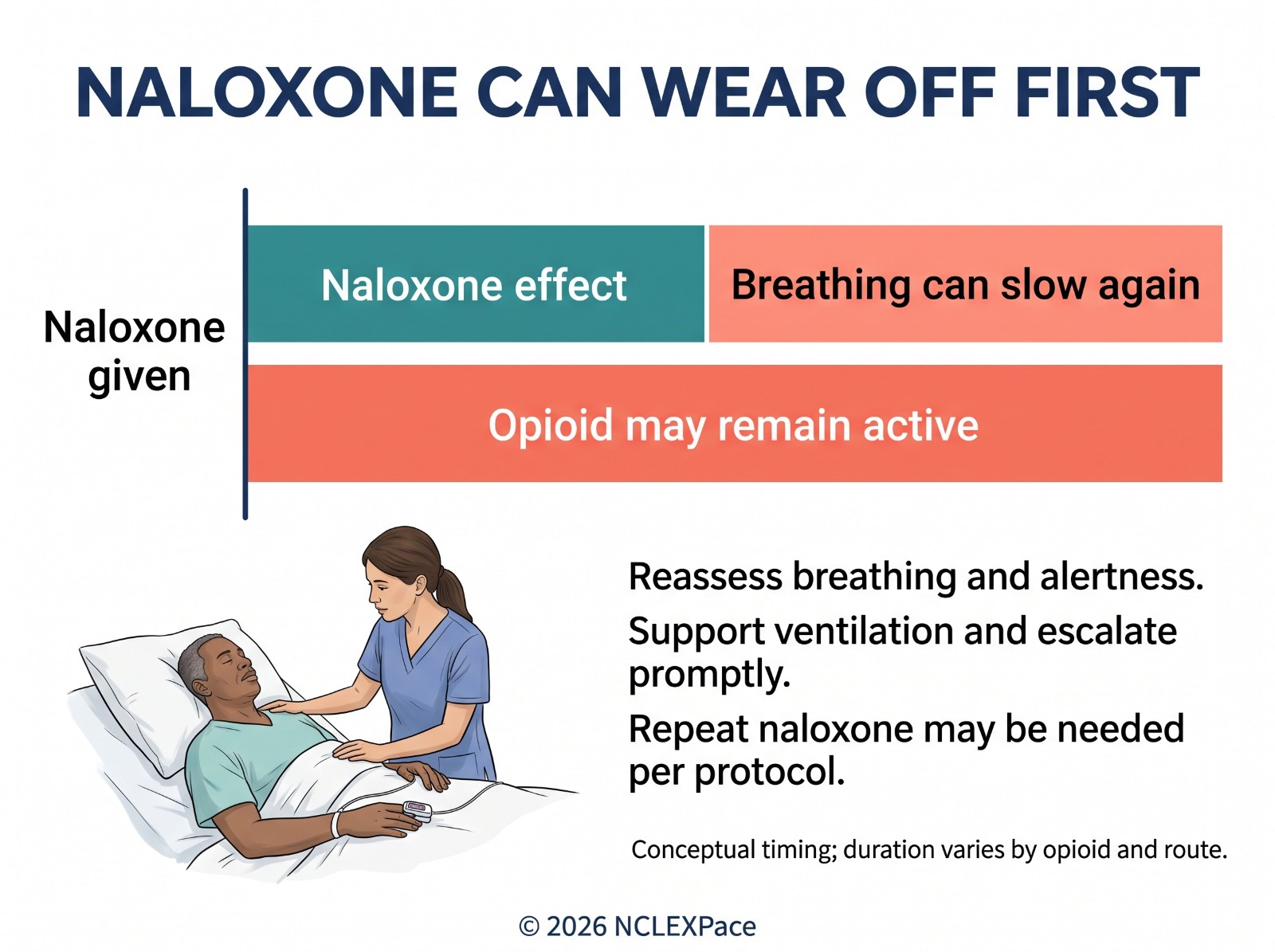
The most dangerous opioid effect is respiratory depression, and increasing sedation precedes it. When an opioid-treated patient is hard to arouse and breathing inadequately, airway and ventilation come before the pain score. Naloxone reverses the opioid but wears off faster than many of them, so the patient can re-sedate and must be watched.

Pain assessment, the multimodal approach, opioid safety and naloxone, including why the client needs monitoring after naloxone works.
From the Intensive NCLEX Course. This lesson is a free sample: watch it with a free account.
Pain questions are safety questions in disguise. The most dangerous opioid effect is respiratory depression, and increasing sedation precedes it. When an opioid-treated patient is hard to arouse and breathing inadequately, airway and ventilation come before the pain score.
Start by believing the patient — and assessing more than a number
Good pain care begins with believing the patient's report and assessing location, quality, timing, functional impact, previous response, sedation, respiratory status, comorbidities and treatment goals. The aim is safer function and comfort — not automatically a pain score of zero.
Use a multimodal approach
When appropriate, pain plans combine positioning, ice or heat, relaxation, mobility, physical strategies, acetaminophen, anti-inflammatory medication, regional techniques, adjuvant medicines and opioids. Each option has contraindications and monitoring requirements. Opioids may be necessary, especially for severe acute pain, but require an individualised benefit–risk assessment.
Recognise opioid overdose
| What to watch | Detail |
|---|---|
| The danger | Respiratory depression — the most dangerous opioid effect, and increasing sedation precedes it |
| Warning signs | Inability to awaken, slow or shallow breathing, cyanosis, limpness, a slow or irregular pulse. Pinpoint pupils may occur — but do not wait for every classic sign |
| Sedation vs rate | Respiratory rate alone can mislead; rising sedation can precede obvious respiratory failure |
Naloxone is a rescue medication, not the finish line
Naloxone rapidly reverses opioid effects, particularly respiratory depression. In a suspected overdose: activate emergency support, support the airway and breathing, administer naloxone per protocol, and monitor continuously.
- It wears off before many opioids do. Additional doses may be required, and a patient who wakes after naloxone can become sedated again — so they are watched, not left.
- Naloxone may precipitate acute withdrawal in an opioid-dependent patient — agitation, pain, nausea, vomiting, sweating or tachycardia. Those effects require management, but ventilation and survival take priority.
What to reassess after analgesia
Reassess pain and function, respiratory rate and quality, sedation level, oxygenation when appropriate, blood pressure, adverse effects, and whether the intervention achieved its intended goal.
NCLEX tip: When an opioid-treated patient is difficult to arouse and breathing inadequately, airway and ventilation come before the pain score. Give naloxone as ordered, obtain emergency help, and watch for recurrent toxicity — because the reversal fades before the opioid does.
Educational use only: this article supports nursing review and does not replace clinical judgment, facility protocols, or instructions from an authorised prescriber.
5 NCLEX practice questions on this topic
The same questions, player and partial-credit scoring students use inside NCLEXPace: answer, submit, read the full rationale, then Next. Your score is waiting at the end. No account needed for these.
A free account opens 20 more questions, a case study, a video and a cheat sheet. The full bank has 3,200+ questions with rationales, by topic.
Practice more, free →Ready for the full bank? See NCLEXPace plans and prices: one payment for 1, 2, 3 or 6 months.
Frequently asked questions
Common follow-up questions on Pharmacology.
What is the most dangerous effect of opioids?
Respiratory depression. Increasing sedation typically precedes it, so a patient who is becoming difficult to arouse is the warning sign: airway and ventilation take priority over the pain score at that point.
How does the nurse recognise opioid overdose?
Inability to awaken, slow or shallow breathing, cyanosis, limpness and a slow or irregular pulse; pinpoint pupils may be present. The nurse acts on inadequate breathing and arousability without waiting for every classic sign.
Why must a patient be watched after naloxone?
Naloxone wears off faster than many opioids, so a patient who wakes and breathes well can become sedated and hypoventilate again. Continuous monitoring and repeat doses may be needed until the opioid itself has cleared.
Can naloxone cause harm in an opioid-dependent patient?
It can precipitate acute withdrawal: agitation, pain, nausea, vomiting, sweating or tachycardia. Those effects are managed, but restoring ventilation and survival always takes priority over the discomfort of withdrawal.
What is reassessed after giving pain medication?
Pain and function, respiratory rate and quality, sedation level, oxygenation when appropriate, blood pressure, adverse effects, and whether the intervention met its goal. Sedation level is watched closely because it can rise before respiratory rate visibly falls.
Sources and references
- Harding MM, Kwong J, Hagler D, Reinisch C. Lewis's Medical-Surgical Nursing: Assessment and Management of Clinical Problems. 12th ed. Elsevier; 2023; Chapter: Pain.
- Burchum JR, Rosenthal LD. Lehne's Pharmacology for Nursing Care. 11th ed. Elsevier; 2022; Chapter: Opioid Analgesics, Opioid Antagonists, and Nonopioid Centrally Acting Analgesics.
- Dowell D, Ragan KR, Jones CM, Baldwin GT, Chou R. CDC Clinical Practice Guideline for Prescribing Opioids for Pain - United States, 2022. MMWR Recommendations and Reports. 2022;71(3):1-95.
Reviewed by the NCLEXPace team, October 2026.
Keep reading
3,200+ NCLEX questions with think-like-a-nurse rationales, unfolding case studies and adaptive readiness exams. Start with free practice questions, then choose a plan when you are ready.
Create Free Account →