Medication Routes and the Errors the NCLEX Tests
Giving the right drug the wrong way is still a medication error, so the exam tests route technique closely. Do not crush enteric-coated, extended-release, or sublingual tablets; give adult IM injections in the ventrogluteal site and infants in the vastus lateralis, never dorsogluteal; give heparin in the abdomen without aspirating or massaging; and always document after giving, never before.

The rights of medication administration, the routes, and the errors the exam asks you to catch before they reach the client.
From the Intensive NCLEX Course. See the course; the full video library is part of Pro and Ultimate.
Giving the right drug the wrong way is still a medication error. Here is what gets tested.
The rights of medication administration
Traditionally five, now often taught as more:
- Right client — two identifiers, never the room number
- Right drug
- Right dose
- Right route
- Right time
- Right documentation — after giving, never before
- Right reason
- Right response — did it work?
Documenting before giving is always wrong. It appears as a distractor.
By mouth (PO)
Do not crush:
- Enteric-coated tablets — the coating protects the stomach or protects the drug from stomach acid
- Extended-release / sustained-release — crushing releases the whole dose at once, which can be dangerous
- Sublingual tablets — they are meant to dissolve under the tongue
If a client cannot swallow a pill that must not be crushed, do not crush it. Contact the prescriber for a different form.
Check for a liquid form rather than crushing.
Sublingual: under the tongue, let it dissolve, do not swallow, no food or drink until dissolved.
Buccal: between the cheek and gum.
Injections
Subcutaneous
- Small volumes, usually up to about 1 mL
- Angle: 45 to 90 degrees depending on the amount of tissue
- Sites: abdomen, upper outer arm, thigh, upper back
- Insulin: rotate sites within one area
- Heparin: abdomen, 2 inches from the belly button, do not aspirate, do not massage
Intramuscular
- Larger volumes
- Angle: 90 degrees
Sites:
- Ventrogluteal — the preferred site for adults. Away from major nerves and blood vessels.
- Vastus lateralis — the thigh. Preferred for infants.
- Deltoid — small volumes only, usually up to about 1 mL. Common for vaccines.
- Dorsogluteal — no longer recommended. Risk of sciatic nerve injury.
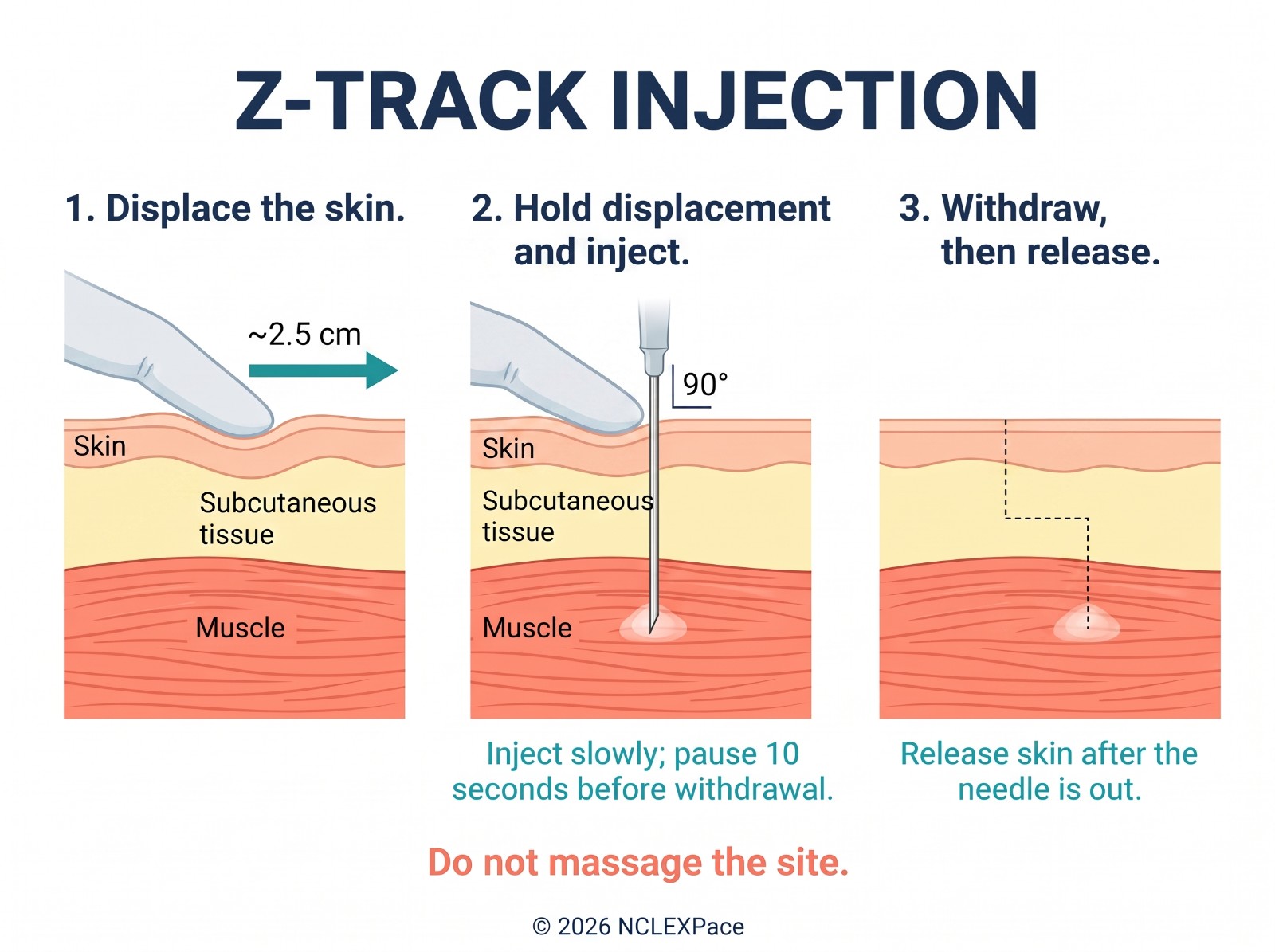
Z-track technique: pull the skin to one side, inject, wait, withdraw, release the skin. This traps the drug in the muscle and prevents it leaking into tissue.
Used for drugs that stain or irritate tissue, such as iron dextran. Many facilities now use Z-track for all IM injections.
Intradermal
- Very small amounts, just under the skin surface
- Angle: 5 to 15 degrees, bevel up
- Used for TB skin tests and allergy testing
- A small bleb or wheal should form. If it does not, the injection went too deep and must be repeated at another site.
- Do not massage.
Eye drops
- Wash hands, put on gloves
- Have the client look up
- Pull the lower lid down to make a pocket
- Drop into the pocket, not directly onto the eyeball
- Do not touch the dropper to the eye or lashes
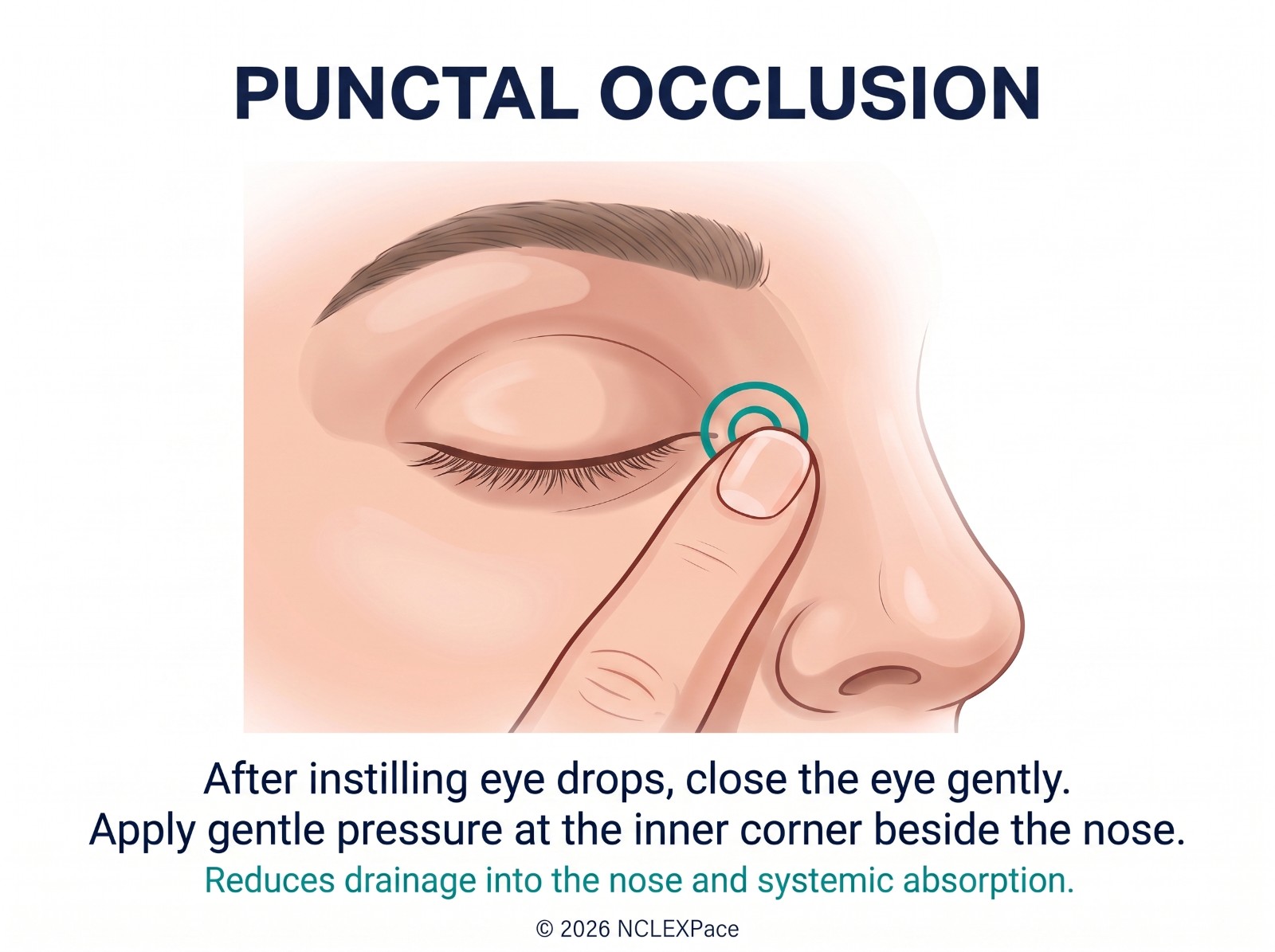
- Have the client close the eye gently — do not squeeze shut
- Press on the inner corner for 30 to 60 seconds to stop the drug draining into the throat and being absorbed
- Wait about 5 minutes between different drops
- Drops before ointment if both are ordered
Ear drops
Position depends on age:
- Adults and children over 3: pull the ear up and back
- Children under 3: pull the ear down and back
Other points:
- Warm the drops to room temperature — cold drops cause dizziness
- Have the client lie with the affected ear up for a few minutes after
- Never insert the dropper into the canal
Inhalers
Metered dose inhaler:
- Shake it
- Breathe out fully
- Use a spacer if available — it improves delivery
- Press and breathe in slowly and deeply
- Hold breath about 10 seconds
- Wait about a minute between puffs
If both a bronchodilator and a steroid are ordered: bronchodilator first. It opens the airways so the steroid gets deeper.
After an inhaled steroid: rinse the mouth. This prevents oral yeast infection (thrush). Heavily tested.
Transdermal patches
- Remove the old patch before applying a new one. Leaving old patches on causes overdose. Commonly tested.
- Rotate sites
- Apply to clean, dry, hairless skin
- Do not cut a patch unless the manufacturer says it is allowed
- Wear gloves — you can absorb the drug through your own skin
- Write the date and time on the patch
- Do not apply heat over a patch — it speeds absorption
Rectal
- Position on the left side
- Insert past the internal sphincter
- Have the client stay lying down for a few minutes
- Useful when a client is vomiting or cannot swallow
IV
- Check the site before every dose
- Check compatibility before mixing anything
- Flush per policy
- Know which drugs can be given IV push and which cannot
- Potassium is never IV push
The errors that appear most
Crushing something that should not be crushed.
Not removing the old patch.
Not rinsing after an inhaled steroid.
Massaging a heparin site.
Using the dorsogluteal site.
Documenting before giving.
Using the room number to identify a client.
Steroid before bronchodilator (wrong order).
Aspirating for heparin or insulin (do not).
The short version
- Do not crush enteric-coated, extended-release, or sublingual
- Ventrogluteal for adult IM, vastus lateralis for infants, never dorsogluteal
- Heparin: abdomen, no aspirate, no massage
- Eye drops: into the pocket, press the inner corner
- Ear drops: up and back for adults, down and back for under 3
- Inhalers: bronchodilator first, rinse after steroids
- Patches: remove the old one first
- Document after giving, never before
Injection site and administration technique recommendations change. Check current guidance and your facility’s policy.
5 NCLEX practice questions on this topic
The same questions, player and partial-credit scoring students use inside NCLEXPace: answer, submit, read the full rationale, then Next. Your score is waiting at the end. No account needed for these.
A free account opens 20 more questions, a case study, a video and a cheat sheet. The full bank has 3,200+ questions with rationales, by topic.
Practice more, free →Ready for the full bank? See NCLEXPace plans and prices: one payment for 1, 2, 3 or 6 months.
Frequently asked questions
Common follow-up questions on Pharmacology.
Which oral medications should never be crushed?
Enteric-coated tablets (the coating protects the stomach or protects the drug from stomach acid), extended-release or sustained-release tablets (crushing releases the whole dose at once, which can be dangerous), and sublingual tablets (they are meant to dissolve under the tongue). If a client cannot swallow a pill that must not be crushed, do not crush it; contact the prescriber for a different form or check for a liquid.
Which IM injection sites does the NCLEX prefer?
Ventrogluteal is the preferred site for adults because it is away from major nerves and blood vessels, and vastus lateralis (the thigh) is preferred for infants. The deltoid is used for small volumes only, usually up to about 1 mL, such as vaccines. The dorsogluteal site is no longer recommended because of the risk of sciatic nerve injury.
How is heparin given subcutaneously?
In the abdomen, about 2 inches from the belly button. Do not aspirate and do not massage the site. These appear as tested errors: aspirating for heparin or insulin, or massaging a heparin site, are wrong.
What teaching goes with inhalers?
If both a bronchodilator and a steroid are ordered, give the bronchodilator first because it opens the airways so the steroid gets deeper. After an inhaled steroid, rinse the mouth to prevent oral yeast infection (thrush), which is heavily tested. With a metered dose inhaler, shake it, breathe out fully, use a spacer if available, press and breathe in slowly and deeply, hold the breath about 10 seconds, and wait about a minute between puffs.
What is the key rule for transdermal patches?
Remove the old patch before applying a new one, because leaving old patches on causes overdose; this is commonly tested. Also rotate sites, apply to clean, dry, hairless skin, wear gloves so you do not absorb the drug yourself, write the date and time on the patch, and do not apply heat over it because heat speeds absorption.
Sources and references
- Potter PA, Perry AG, Stockert PA, Hall AM. Fundamentals of Nursing. 10th ed. Elsevier; 2021; Chapter: Medication Administration.
- The Joint Commission. National Patient Safety Goals for the Hospital Program. Oakbrook Terrace, IL: The Joint Commission; 2025.
Reviewed by the NCLEXPace team, October 2026.
Keep reading

3,200+ NCLEX questions with think-like-a-nurse rationales, unfolding case studies and adaptive readiness exams. Start with free practice questions, then choose a plan when you are ready.
Create Free Account →