Insulin: Types, Timing, and the Questions Built On Them
Insulin questions are almost always about timing, because the peak is when low blood sugar happens. Rapid-acting peaks in about 1 to 2 hours and is given with food, regular peaks in about 2 to 3 hours and is given 30 minutes before food, NPH peaks in about 4 to 12 hours, and long-acting has little or no peak. When mixing, draw clear before cloudy, and treat low blood sugar with 15 grams of fast carbohydrate, wait 15 minutes, and recheck.

Insulin types and timing, the oral diabetes medicines, and the nursing care of diabetic ketoacidosis in one lesson.
From the Intensive NCLEX Course. See the course; the full video library is part of Pro and Ultimate.
Insulin questions are almost always about timing. When does it start working? When does it peak? That is when low blood sugar happens.
Learn the timing and you can answer most insulin questions.
The four types
| Type | Examples | Starts | Peaks | Lasts |
|---|---|---|---|---|
| Rapid-acting | lispro, aspart, glulisine | ~15 min | ~1–2 hr | ~3–5 hr |
| Short-acting (regular) | regular insulin | ~30–60 min | ~2–3 hr | ~5–8 hr |
| Intermediate | NPH | ~1–2 hr | ~4–12 hr | ~12–18 hr |
| Long-acting | glargine, detemir | ~1–2 hr | little or no peak | ~24 hr |
These are typical ranges. Products vary — check a current reference.
What the timing means for nursing
Rapid-acting: give it with the meal or just before. If the tray has not arrived, do not give it yet. A client who gets rapid insulin and then does not eat will go low.
Regular: give about 30 minutes before the meal.
NPH: the peak is long and in the middle of the day. Low blood sugar risk is highest during the peak. If a client gets NPH at 7 a.m., watch them from late morning into the afternoon.
Long-acting: usually once a day, same time each day. No real peak, so low blood sugar risk is spread out. Do not mix long-acting insulin with any other insulin in the same syringe.
The classic exam question
A client received NPH insulin at 0700. When is the client at greatest risk for low blood sugar?
Work it out: NPH peaks about 4 to 12 hours after the dose. 0700 plus 4 to 12 hours = 1100 to 1900.
The answer will be somewhere in the late morning to evening range.
This question type appears constantly. Learn the peaks and you get it every time.
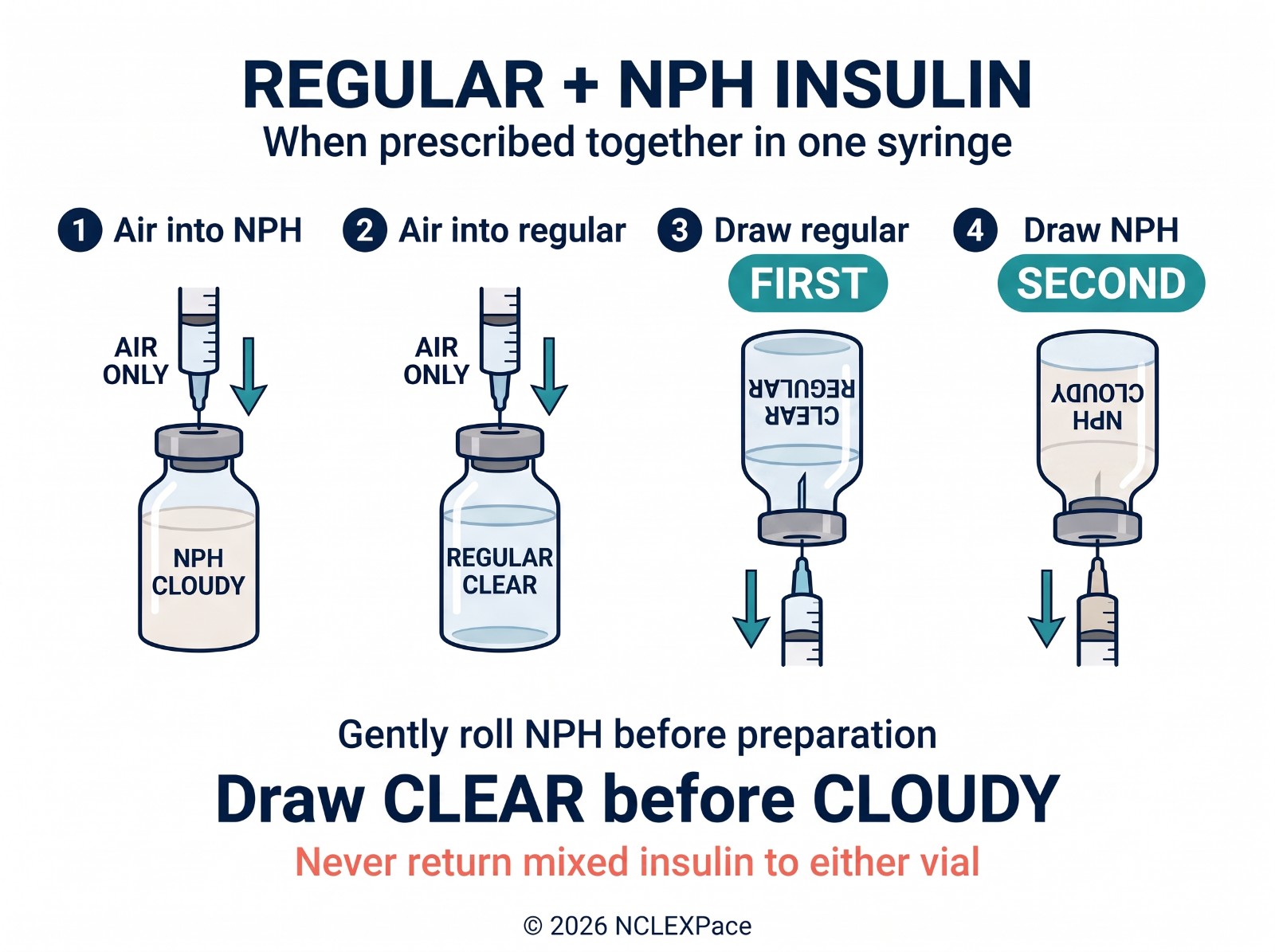
Mixing insulin
Only regular and NPH are commonly mixed.
The order: clear before cloudy. Regular insulin is clear. NPH is cloudy.
Why? So you do not contaminate the clear vial with the cloudy one.
The steps:
- Inject air into the NPH vial (cloudy) — do not draw anything up
- Inject air into the regular vial (clear)
- Draw up the regular insulin (clear)
- Draw up the NPH insulin (cloudy)
Memory aid: air into cloudy, air into clear, draw clear, draw cloudy. Or simply: “clear before cloudy.”
Do not mix: glargine or detemir with anything. They must be given separately.
Other insulin facts that get tested
Only regular insulin can be given IV. No other type. Used for diabetic ketoacidosis and other emergencies.
NPH is cloudy. Roll it gently between your hands to mix. Do not shake. All other insulins are clear — if a clear insulin looks cloudy, do not use it.
Insulin syringes only. Marked in units.
Rotate injection sites to avoid tissue changes that affect absorption. Rotate within one area rather than jumping between body areas, since absorption differs by site.
Absorption is fastest in the abdomen, then arms, then thighs, then buttocks.
Storage: unopened insulin goes in the refrigerator. The vial or pen in use can usually stay at room temperature for a set number of days — check the product. Do not freeze. Do not use insulin that has been frozen or left in heat.
Exercise lowers blood sugar. A client exercising more than usual may need a snack or a dose adjustment.
Illness raises blood sugar. Clients should not stop insulin when sick, even if eating less. This is called sick day management and it is commonly tested. They should check blood sugar more often and stay hydrated.
Low blood sugar
Signs: shaky, sweaty, fast heart rate, hungry, confused, irritable, headache, pale. Later: seizure, unconscious.
Treatment if awake and able to swallow:
- Give 15 grams of fast-acting carbohydrate — 4 oz juice, regular soda, glucose tablets
- Wait 15 minutes
- Recheck the blood sugar
- Repeat if still low
- Once normal, give a snack with protein if the next meal is not soon
If not awake or unable to swallow: IV dextrose, or glucagon if no IV access. Never give anything by mouth to someone who cannot swallow safely.
Warning signs can be hidden
Beta blockers can mask the signs of low blood sugar — especially the fast heart rate and shakiness. A client on both insulin and a beta blocker may go very low without the usual warning.
Sweating usually still occurs. Teach these clients to check their blood sugar more often rather than relying on how they feel.
The short version
- Rapid: peaks 1–2 hr. Give with food.
- Regular: peaks 2–3 hr. Give 30 min before food. Only one that goes IV.
- NPH: peaks 4–12 hr. Cloudy. Watch for lows during the peak.
- Long-acting: no real peak. Do not mix.
- Mixing: clear before cloudy.
- Low blood sugar: 15 grams, wait 15 minutes, recheck.
Insulin onset, peak, and duration vary by product and by person. Check a current drug reference before clinical use.
5 NCLEX practice questions on this topic
The same questions, player and partial-credit scoring students use inside NCLEXPace: answer, submit, read the full rationale, then Next. Your score is waiting at the end. No account needed for these.
A free account opens 20 more questions, a case study, a video and a cheat sheet. The full bank has 3,200+ questions with rationales, by topic.
Practice more, free →Ready for the full bank? See NCLEXPace plans and prices: one payment for 1, 2, 3 or 6 months.
Frequently asked questions
Common follow-up questions on Pharmacology.
When is a client on NPH insulin at greatest risk for low blood sugar?
During the peak, which is about 4 to 12 hours after the dose. For NPH given at 0700, that puts the highest risk from roughly 1100 to 1900, late morning into the evening. This calculation appears constantly, so learning the peaks answers it every time.
How do you mix regular and NPH insulin in one syringe?
Clear before cloudy: regular insulin is clear and NPH is cloudy. Inject air into the NPH (cloudy) vial without drawing any up, inject air into the regular (clear) vial, draw up the regular insulin, then draw up the NPH. Drawing clear first avoids contaminating the clear vial with the cloudy one.
Which insulin can be given IV?
Only regular insulin can be given IV; no other type can. It is used for diabetic ketoacidosis and other emergencies. Long-acting insulins such as glargine and detemir must never be mixed with anything and are given separately.
How do you treat low blood sugar in a client who is awake?
Give 15 grams of fast-acting carbohydrate such as 4 oz of juice, regular soda, or glucose tablets, wait 15 minutes, then recheck the blood sugar and repeat if still low. Once it is normal, give a snack with protein if the next meal is not soon. If the client cannot swallow safely, use IV dextrose or glucagon instead, and never give anything by mouth.
Why can beta blockers be dangerous for a client on insulin?
Beta blockers can mask the warning signs of low blood sugar, especially the fast heart rate and shakiness, so a client on both insulin and a beta blocker may go very low without the usual warning. Sweating usually still occurs. Teach these clients to check their blood sugar more often rather than relying on how they feel.
Sources and references
- Burchum JR, Rosenthal LD. Lehne's Pharmacology for Nursing Care. 11th ed. Elsevier; 2022; Chapter: Drugs for Diabetes Mellitus.
- American Diabetes Association Professional Practice Committee. Standards of Care in Diabetes-2026. Diabetes Care. 2026;49(Supplement 1).
Reviewed by the NCLEXPace team, October 2026.
Keep reading


3,200+ NCLEX questions with think-like-a-nurse rationales, unfolding case studies and adaptive readiness exams. Start with free practice questions, then choose a plan when you are ready.
Create Free Account →