
Medication Errors and Incident Reports: What to Do First
If you make a medication error, assess the client first, because the client's safety comes before reporting or documenting, then notify the provider, follow any orders, keep monitoring, document the facts in the chart, and complete an incident report. The incident report is a quality-improvement tool that is not part of the medical record, and you never document in the chart that a report was filed.

Safe medication administration: preventing errors, and what to do first when one happens.
From the Intensive NCLEX Course. See the course; the full video library is part of Pro and Ultimate.
If you make a medication error
The order matters, and the first step is not what most people say.
1. Assess the client.
This is always first. What did the error do? Check vital signs, level of consciousness, and anything specific to that drug. The client’s safety comes before reporting, documenting, or anything else.
Report what happened, what you have assessed, and the client’s current condition.
3. Follow any orders — monitoring, an antidote, additional assessments.
4. Continue monitoring for as long as needed.
5. Document the facts in the medical record.
Record what was given, when, the client’s response, who was notified, and what was done.
6. Complete an incident report.
The most commonly missed point: assess the client first.
A question offering “notify the provider” and “assess the client” wants assess — unless the stem has already told you the assessment was done.
Incident reports — the rules
What they are for: tracking events so the facility can identify patterns and improve safety. They are a quality improvement tool.
The rules that get tested:
1. An incident report is NOT part of the medical record.
2. Do NOT document in the chart that an incident report was filed.
Write the facts of what happened in the chart. Do not write “incident report completed.” This is one of the most reliably tested points in the topic.
3. Record facts only. No opinions, no blame, no speculation about cause.
- Good: “Client found on the floor beside the bed at 0230. Client states, ‘I was going to the bathroom.’ No visible injury. Vital signs stable. Provider notified.”
- Bad: “Client fell because the aide did not answer the call light.”
4. Complete it promptly, usually before the end of the shift.
5. The person who discovered or witnessed the event completes it.
6. Do not photocopy it or place it in the chart.
When to file one
- Medication errors — including near misses and errors caught before reaching the client
- Falls
- Equipment failure
- Needlestick or other exposure
- Client or visitor injury
- Missing belongings
- Any unexpected event
Near misses matter. An error caught before it reached the client is still reported, because the system problem is the same.
Reporting culture
The exam takes the position that reporting errors is professional and required, not a personal failure.
Wrong answers include:
- Not reporting because no harm occurred
- Not reporting because you would get in trouble
- Asking a colleague to fix it quietly
- Only telling the next shift
- Documenting the error in the chart as if it were routine care
Right answers involve: assessing the client, telling the provider, telling your supervisor, documenting the facts, and filing the report.
Errors made by someone else
If you discover another person’s error:
- Assess the client
- Notify the provider
- Report through the chain of command
- Document the facts
You do not cover for a colleague, and you do not confront and drop it. Client safety is the priority. See Article 52.
Preventing errors
- Use the rights of medication administration every time
- Two identifiers, never the room number
- Independent double checks for high-alert drugs
- Never give a medication you did not prepare
- Question anything unclear — a strange dose, an unclear order, hard-to-read writing
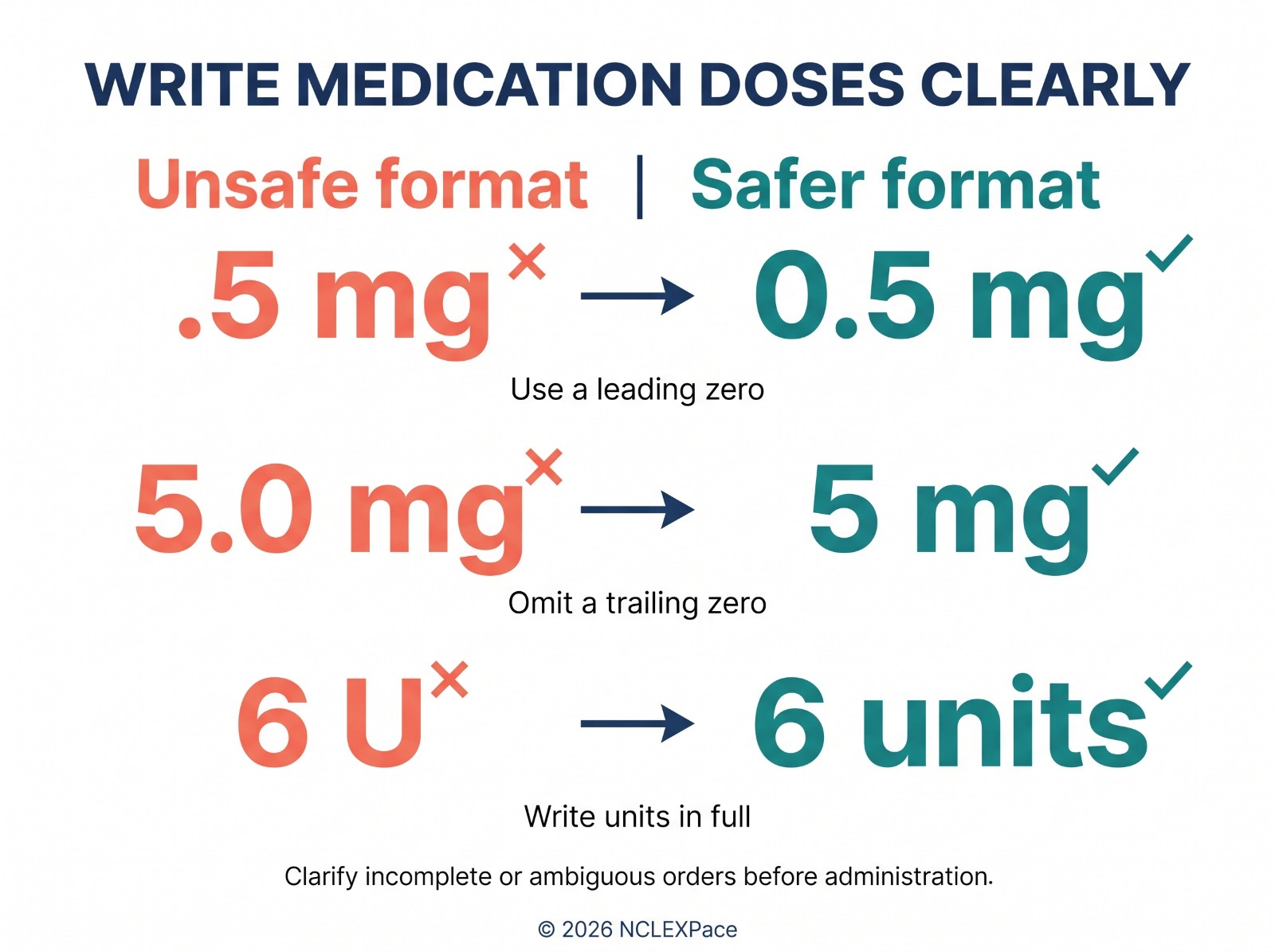
- Do not use unsafe abbreviations — never abbreviate “units” as U
- Minimize interruptions during medication preparation
The short version
- Assess the client FIRST. Then notify, document, and file the report.
- The incident report is not part of the chart
- Never document in the chart that a report was filed
- Facts only, no blame
- Report near misses too
Incident reporting procedures vary by facility. Follow your own policy.
Psychosocial Integrity is 6 to 12 percent of your content questions. It is under-studied by most candidates, which makes it a good place to gain points.
5 NCLEX practice questions on this topic
The same questions, player and partial-credit scoring students use inside NCLEXPace: answer, submit, read the full rationale, then Next. Your score is waiting at the end. No account needed for these.
A free account opens 20 more questions, a case study, a video and a cheat sheet. The full bank has 3,200+ questions with rationales, by topic.
Practice more, free →Ready for the full bank? See NCLEXPace plans and prices: one payment for 1, 2, 3 or 6 months.
Frequently asked questions
Common follow-up questions on Infection Control, Safety & Risk Reduction.
What is the first thing to do after a medication error?
Assess the client. This is always first: check vital signs, level of consciousness, and anything specific to that drug, because the client's safety comes before reporting or documenting. When a question offers both 'assess the client' and 'notify the provider', it wants assess, unless the stem has already told you the assessment was done.
Is an incident report part of the medical record?
No. An incident report is a quality-improvement tool for tracking events so the facility can spot patterns, and it is not part of the medical record. You write the facts of what happened in the chart, but you do not document that an incident report was filed, and you do not photocopy it or place it in the chart. This is one of the most reliably tested points in the topic.
What should an incident report contain?
Facts only, with no opinions, no blame, and no speculation about cause. A good entry states what was observed, such as a client found on the floor beside the bed with vital signs stable and the provider notified, rather than assigning blame like saying the client fell because the aide did not answer the call light. It is completed promptly, usually before the end of the shift, by the person who discovered or witnessed the event.
Do I report an error that did not reach the client?
Yes. Near misses and errors caught before reaching the client are still reported, because the system problem is the same. Not reporting because no harm occurred, or because you might get in trouble, are wrong answers. The exam treats reporting errors as professional and required, not a personal failure.
What do I do if I discover someone else's error?
Assess the client, notify the provider, report through the chain of command, and document the facts. You do not cover for a colleague, and you do not confront them and then drop it. Client safety is the priority.
Sources and references
- Potter PA, Perry AG, Stockert PA, Hall AM. Fundamentals of Nursing. 10th ed. Elsevier; 2021; Chapter: Medication Administration.
- Burchum JR, Rosenthal LD. Lehne's Pharmacology for Nursing Care. 11th ed. Elsevier; 2022; Chapter: Adverse Drug Reactions and Medication Errors.
- The Joint Commission. Official "Do Not Use" List of Abbreviations. Oakbrook Terrace, IL: The Joint Commission; accessed October 2026.
Reviewed by the NCLEXPace team, October 2026.
Keep reading
3,200+ NCLEX questions with think-like-a-nurse rationales, unfolding case studies and adaptive readiness exams. Start with free practice questions, then choose a plan when you are ready.
Create Free Account →