
Chronic Disease Management: Hypertension, Diabetes, Hyperlipidaemia
Hypertension, diabetes and hyperlipidaemia travel together as metabolic syndrome and share one problem that shapes every exam question about them: they do not hurt, so adherence is the central nursing challenge. You want blood pressure, HbA1c, LDL and triglycerides down and HDL up, and because the conditions are silent the correct answer is often about adherence and follow-up rather than a symptom.

Hypertension: the numbers, the medication classes, the teaching that lowers the readings, and the hypertensive emergency.
From the Intensive NCLEX Course. See the course; the full video library is part of Pro and Ultimate.
These three turn up together so often they have a collective name — metabolic syndrome. They also share a problem that shapes every exam question about them: they do not hurt. A client feels nothing while all three quietly damage arteries, which makes adherence the central nursing challenge rather than a side note.
The numbers, in one place
| Condition | Target | Diagnostic threshold |
|---|---|---|
| Blood pressure | Generally under 130/80 | Elevated 120–129 systolic; stage 1 from 130/80; stage 2 from 140/90 |
| HbA1c | Usually under 7% (individualised) | Diabetes at 6.5% or above; prediabetes 5.7–6.4% |
| Fasting glucose | 80–130 mg/dL before meals | Diabetes at 126 mg/dL or above |
| LDL | Under 100 mg/dL; under 70 if high cardiac risk | Optimal under 100 |
| HDL | Higher is better — over 40 men, over 50 women | Under 40 is a risk factor |
| Triglycerides | Under 150 mg/dL | Over 150 is raised |
The one students invert: HDL is the good one and you want it high. H for Healthy, L for Lousy.
Hypertension
Called the silent killer because it has no symptoms until it has caused damage. When symptoms do appear — headache, visual changes, epistaxis — they signal severe elevation.
| Aspect | What the nurse does |
|---|---|
| Measuring it properly | Seated, feet flat, back supported, arm at heart level, correct cuff size, after 5 minutes of rest, no caffeine or smoking for 30 minutes. A cuff that is too small reads falsely high |
| Lifestyle first | DASH diet — fruit, vegetables, whole grains, low-fat dairy, reduced sodium. Weight loss, activity, limit alcohol, stop smoking |
| Common drugs | Thiazide diuretics, ACE inhibitors, ARBs, calcium channel blockers |
| The teaching that matters most | Keep taking it when you feel fine, and rise slowly — orthostatic hypotension is the commonest reason clients stop |
Hypertensive crisis — over 180/120 with signs of organ damage such as headache, visual change, chest pain or confusion — is an emergency. Lower it gradually: dropping the pressure too fast causes stroke by under-perfusing a brain accustomed to high pressure.
Diabetes
| Type 1 | Type 2 | |
|---|---|---|
| Problem | No insulin produced | Insulin resistance, later insufficient production |
| Treatment | Insulin always | Lifestyle, oral agents, sometimes insulin |
| Emergency | DKA — ketones and acidosis | HHS — very high glucose, no ketones |
The rule of 15, for hypoglycaemia
Below 70 mg/dL in a client who can swallow: give 15 g of fast-acting carbohydrate — 4 oz juice, 3–4 glucose tablets, 1 tbsp honey — wait 15 minutes, recheck. Repeat up to three times, then follow with a protein-containing snack once above 70. If the client cannot swallow: glucagon IM or subcutaneous, or IV dextrose.
Signs to recognise: cold, clammy, shaky, tachycardic, confused, irritable. The memory hook is cold and clammy, need some candy — against hyperglycaemia's hot, dry and drowsy. Note that beta blockers mask the tachycardia and tremor, so a client on one may only sweat.
Sick-day rules
Illness raises glucose even when a client is not eating, and this is a common exam item:
- Never stop insulin because of not eating. Illness increases the requirement.
- Check glucose every 2 to 4 hours, and ketones if type 1.
- Keep drinking — sugar-free fluids if glucose is high, carbohydrate-containing if low.
- Call the provider for glucose persistently over 240, ketones, vomiting, or inability to keep fluids down.
Insulin and foot care
Regular insulin is the only insulin given IV. When mixing regular with NPH, draw up clear before cloudy — regular first. Rotate sites within one region; the abdomen absorbs fastest.
Foot teaching, which appears constantly: inspect daily including between the toes and with a mirror if needed, wash in warm not hot water, dry thoroughly, never go barefoot, never use heating pads or cut corns, cut nails straight across, and see a podiatrist. Neuropathy means an injury can go unnoticed until it is infected.

Hyperlipidaemia
| Aspect | Detail |
|---|---|
| Statins | First-line. Report muscle pain or weakness — rhabdomyolysis. Monitor liver enzymes. Avoid grapefruit juice |
| Timing | Older statins are taken in the evening because cholesterol is synthesised overnight; newer long-acting ones can be taken any time |
| Fibrates and niacin | Mainly for triglycerides. Niacin causes flushing — aspirin beforehand helps, and it is expected rather than allergic |
| Bile acid sequestrants | Interfere with absorption of other drugs and fat-soluble vitamins; separate doses |
| Diet | Reduce saturated and trans fat, increase soluble fibre and oily fish. Mediterranean pattern |
A statin is often started after a cardiac event regardless of the cholesterol number, because the benefit is not only lipid lowering. Clients ask why they need it when their cholesterol is normal — that is the answer.
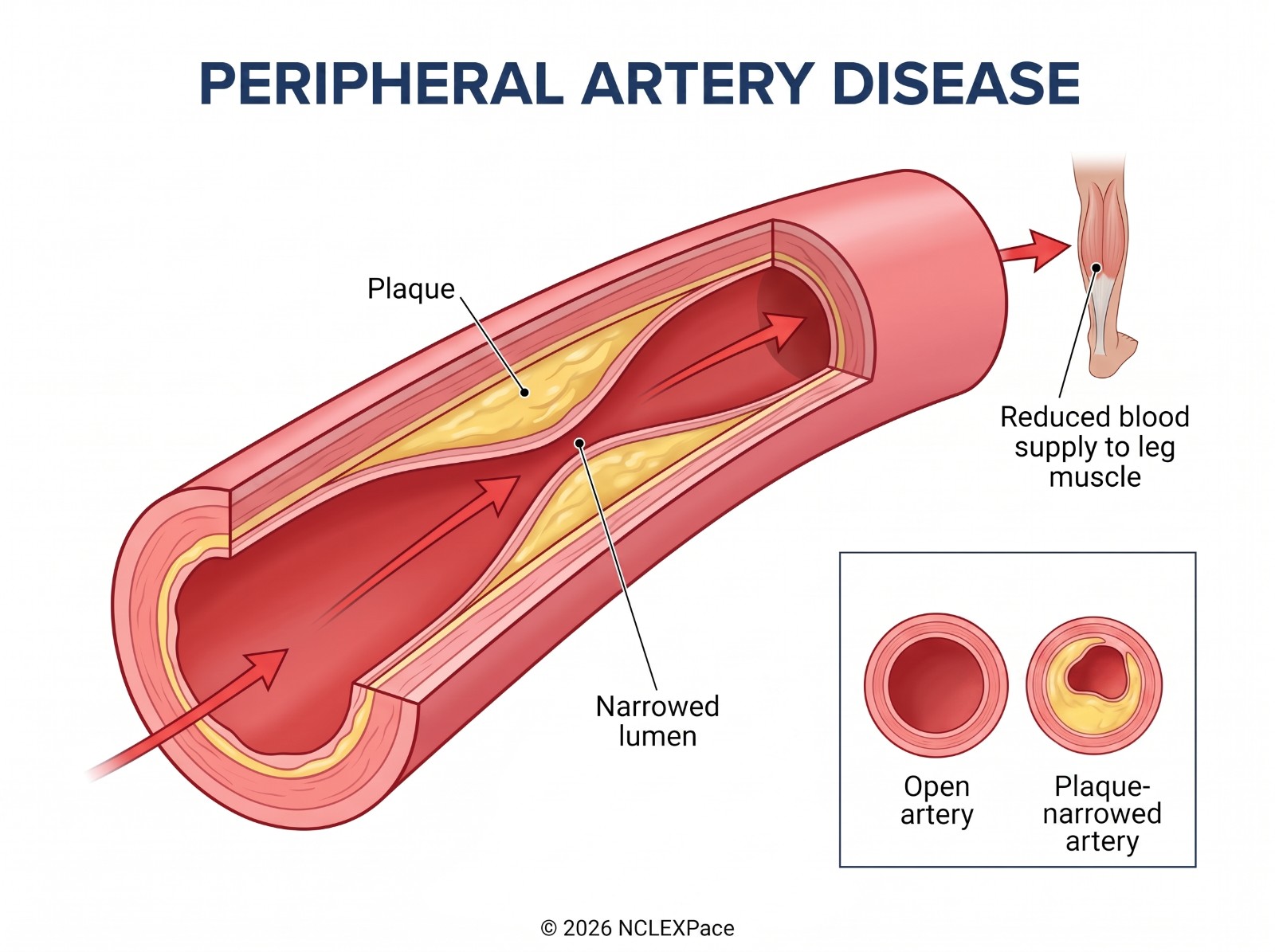
What they share, and what the exam does with it
| Shared feature | Nursing consequence |
|---|---|
| All three are asymptomatic | Adherence is the main intervention. Explore barriers — cost, side effects, forgetting, not believing it matters |
| All three damage the same vessels | They multiply cardiovascular risk together rather than adding to it |
| All three improve with the same lifestyle changes | One conversation about diet, activity and smoking serves all three |
| All three need regular follow-up | A missed appointment is a clinical problem, not an administrative one |
When a question asks for the priority teaching for a client with all three, look for the option addressing something shared — smoking cessation, or taking medication as prescribed — rather than one disease-specific detail.
NCLEX tip: These conditions are silent, so the correct answer is often about adherence and follow-up rather than a symptom. And remember the direction of each target: you want blood pressure, A1c, LDL and triglycerides down, and HDL up. HDL is the one that goes the other way, and it is the one students get wrong.
5 NCLEX practice questions on this topic
The same questions, player and partial-credit scoring students use inside NCLEXPace: answer, submit, read the full rationale, then Next. Your score is waiting at the end. No account needed for these.
A free account opens 20 more questions, a case study, a video and a cheat sheet. The full bank has 3,200+ questions with rationales, by topic.
Practice more, free →Ready for the full bank? See NCLEXPace plans and prices: one payment for 1, 2, 3 or 6 months.
Frequently asked questions
Common follow-up questions on Body Systems & Clinical Content.
Which cholesterol number do you want high?
HDL is the good one and you want it high, over 40 in men and over 50 in women, with under 40 a risk factor. The memory hook is H for Healthy, L for Lousy. LDL, by contrast, you want under 100 mg/dL, or under 70 if cardiac risk is high.
What is the rule of 15 for hypoglycaemia?
For a client below 70 mg/dL who can swallow, give 15 g of fast-acting carbohydrate such as 4 oz juice, 3 to 4 glucose tablets or 1 tbsp honey, wait 15 minutes, and recheck, repeating up to three times, then follow with a protein-containing snack once above 70. If the client cannot swallow, give glucagon IM or subcutaneous, or IV dextrose. Note that beta blockers mask the tachycardia and tremor, so a client on one may only sweat.
What are the diabetic sick-day rules?
Never stop insulin because of not eating, since illness increases the requirement. Check glucose every 2 to 4 hours, and ketones if type 1, and keep drinking, using sugar-free fluids if glucose is high and carbohydrate-containing fluids if low. Call the provider for glucose persistently over 240, ketones, vomiting, or an inability to keep fluids down.
Why is a statin started even when cholesterol is normal?
A statin is often started after a cardiac event regardless of the cholesterol number, because the benefit is not only lipid lowering. Clients frequently ask why they need it when their cholesterol is normal, and that is the answer. Statins are first-line, and clients should report muscle pain or weakness because of the risk of rhabdomyolysis.
How should a hypertensive crisis be managed?
A hypertensive crisis is over 180/120 with signs of organ damage such as headache, visual change, chest pain or confusion, and it is an emergency. Lower the pressure gradually, because dropping it too fast causes stroke by under-perfusing a brain accustomed to high pressure. This reflects the same adherence-and-follow-up focus these silent conditions demand.
Sources and references
- Harding MM, Kwong J, Hagler D, Reinisch C. Lewis's Medical-Surgical Nursing: Assessment and Management of Clinical Problems. 12th ed. Elsevier; 2023; Chapter: Hypertension.
- Whelton PK, et al. 2017 ACC/AHA Guideline for the Prevention, Detection, Evaluation, and Management of High Blood Pressure in Adults. Hypertension. 2018;71(6):e13-e115.
- American Diabetes Association Professional Practice Committee. Standards of Care in Diabetes-2026. Diabetes Care. 2026;49(Supplement 1).
Reviewed by the NCLEXPace team, October 2026.
Keep reading

3,200+ NCLEX questions with think-like-a-nurse rationales, unfolding case studies and adaptive readiness exams. Start with free practice questions, then choose a plan when you are ready.
Create Free Account →