
Why Passive Reading Fails on the NCLEX (and the Active Method That Replaces It)
Rereading notes is the most common study behavior among nursing students and one of the least effective, because it builds recognition (familiarity when material is placed in front of you) while the NCLEX requires retrieval, producing information from memory without cues. Replace passive rereading with active retrieval: blank-page recall, question-first reading, teaching aloud, building tables from memory, and practice questions with full review.

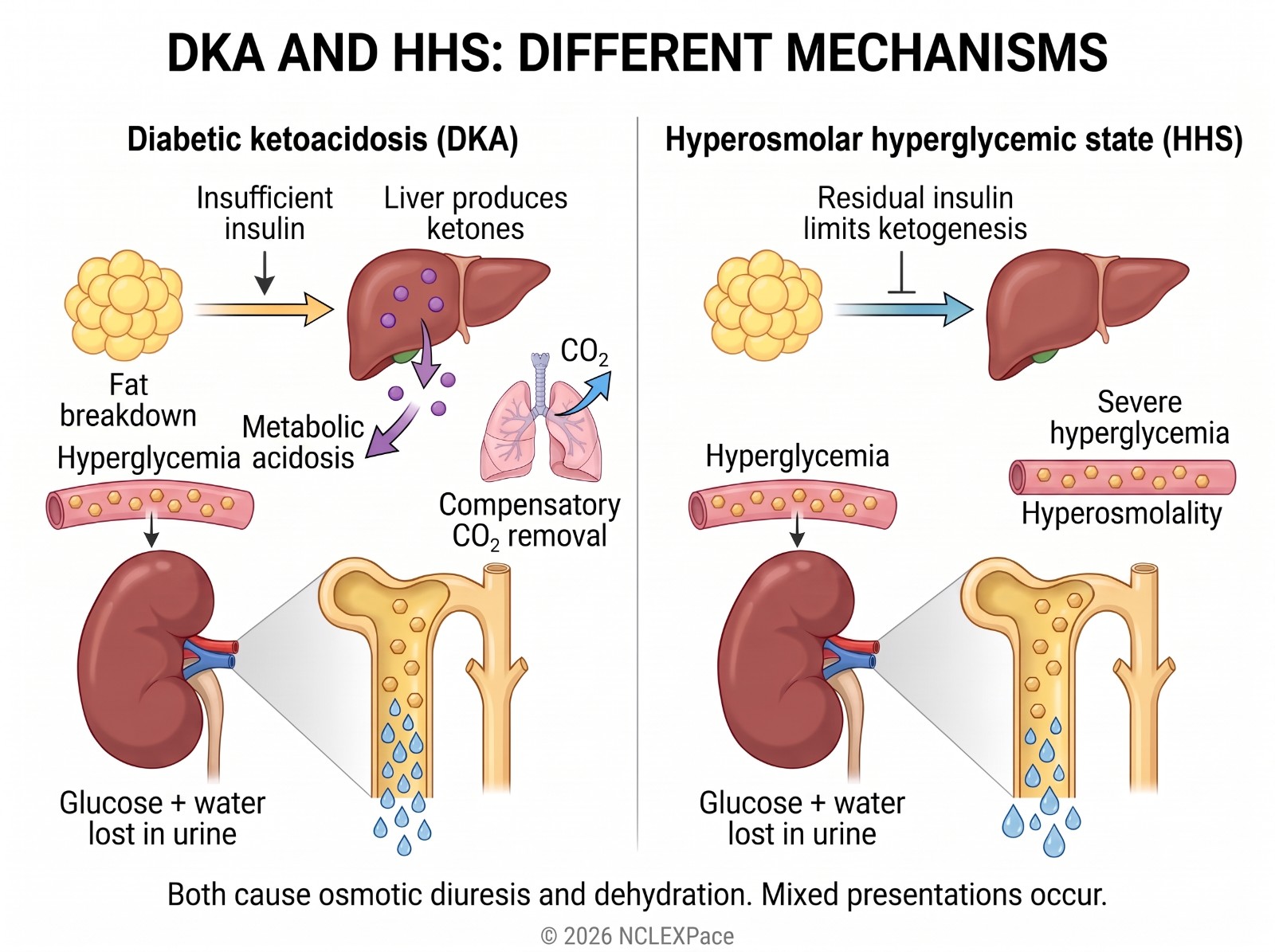
A free sample lesson built the way this article recommends you study: the DKA versus HHS comparison, which you can then redraw from memory.
From the Intensive NCLEX Course. This lesson is a free sample: watch it with a free account.
Rereading your notes is the most common study behavior among nursing students and one of the least effective techniques available.
That is not a provocative opinion. It is the finding of the largest systematic review of study techniques in educational psychology.
The evidence
Dunlosky and colleagues evaluated ten widely used learning techniques and rated each for utility across conditions, materials, and learner types.
Rated high utility: practice testing, distributed practice.
Rated low utility: rereading, highlighting and underlining, summarization, keyword mnemonics, imagery for text, and the “learning styles” approach to studying.
Rereading and highlighting — the two things students do most — landed in the low-utility group.
Why rereading feels like it works
This is the important part, because the illusion is powerful and it is what keeps people doing it.
Rereading increases fluency. The second pass through a chapter is easier than the first. The third is easier still. The text feels familiar, and processing it requires less effort.
Your brain reads that ease as knowing.
It is not knowing. It is recognition — the ability to identify material as familiar when it is placed in front of you.
The NCLEX never places your notes in front of you. It gives you an unfamiliar client, in an unfamiliar situation, and asks what you would do. That requires retrieval — producing information from memory without cues.
Recognition and retrieval are different capacities. Rereading builds the first and barely touches the second.
This is why candidates report “I knew the material, I just could not answer the questions.” They are describing exactly this gap, accurately.
What works instead: retrieval
Roediger and Karpicke tested this directly. Students who studied material and were then tested on it retained substantially more after a delay than students who spent the same time restudying it.
Karpicke and Blunt extended it: retrieval practice outperformed elaborative studying with concept mapping — a technique that feels far more sophisticated than simply testing yourself.
The consistent finding: the effort of pulling information out of memory strengthens it more than putting it back in again.
Retrieval feels worse. It is harder, slower, and you get things wrong. That difficulty is the mechanism, not a sign of failure — what learning researchers call a desirable difficulty.
The method
Five ways to convert passive study into retrieval. All of them share one feature: you produce something before you check the source.
1. Blank page recall. Read a section. Close it. Write everything you remember on a blank page. Then open the source and mark what you missed.
The gaps are the point. That is your actual knowledge state, and rereading would never have shown it to you.
2. Question-first reading. Before reading a section, write three questions you expect it to answer. Read. Then answer them from memory, closed-book.
3. Teach it aloud. Explain the concept to an empty room, a friend, or a recording — without notes. You will stall at exactly the points you do not actually understand. Those stalls are diagnostic.
4. Build the table from memory. For any comparison — Addison’s versus Cushing’s, DKA versus HHS, heparin versus warfarin — draw the empty table and fill it in from recall. Then check.
5. Practice questions with full review. The highest-value form of retrieval, because it also trains the reasoning format the exam uses. Article 28 covers the ratio.
The rule for any study session
Never finish a topic by reading it. Finish by producing it.
Read the section, then close it and write what you know. Watch the video, then explain it aloud. Review the drug class, then recall the suffix, mechanism, and adverse effects without looking.
The final act of every study block should be retrieval.
What to do with highlighters
Very little.
Highlighting was rated low utility in the same review. It feels active but is essentially passive — you are marking text, not processing it, and the marks create an illusion of progress.
If you must, highlight sparingly on a first pass, then never reread the highlights. Instead, cover the page and try to recall what you marked and why.
The uncomfortable adjustment
Retrieval practice is unpleasant compared to rereading.
You will get things wrong. You will sit with a blank page and produce four facts where you expected fifteen. You will feel like you are learning less.
You are learning more. The comfort of rereading is the comfort of not being tested, and the NCLEX is five hours of being tested.
Better to discover your gaps now, on a blank page in your kitchen, than at item 63 on exam day.
One caveat worth stating
None of this means content review is worthless. You cannot retrieve what you never encoded, and a first read of unfamiliar material is necessary.
The finding is about rereading — second, third, and fourth passes through material you have already read. That is where the returns collapse and where retrieval should take over.
Read it once. Then spend the rest of your time being asked about it.
Exam facts accessed August 2026.
5 NCLEX practice questions to try now
A mixed set from the NCLEXPace bank, in the same player with the same partial-credit scoring students use inside the platform: answer, submit, read the full rationale, then Next. Your score is waiting at the end. No account needed for these.
A free account opens 20 more questions, a case study, a video and a cheat sheet. The full bank has 3,200+ questions with rationales, by topic.
Practice more, free →Ready for the full bank? See NCLEXPace plans and prices: one payment for 1, 2, 3 or 6 months.
Frequently asked questions
Common follow-up questions on Study Plans & Timelines.
Why does rereading feel like it works but does not?
Rereading increases fluency (each pass through a chapter is easier) and your brain reads that ease as knowing. But it is only recognition, the ability to identify material as familiar when placed in front of you, whereas the NCLEX gives you an unfamiliar client in an unfamiliar situation and asks what you would do. That requires retrieval, which rereading barely touches.
What is retrieval practice?
Producing information from memory without cues, such as closing a section and writing what you remember. Roediger and Karpicke found students who were tested on material retained substantially more after a delay than students who spent the same time restudying it, and Karpicke and Blunt found retrieval even outperformed elaborative studying with concept mapping.
Why does retrieval feel worse if it works better?
Because it is harder and slower and you get things wrong, which learning researchers call a desirable difficulty: the effort of pulling information out of memory is the mechanism that strengthens it, not a sign of failure. Better to discover your gaps on a blank page in your kitchen than at item 63 on exam day.
What are some ways to convert passive study into retrieval?
Blank-page recall (read a section, close it, write everything you remember, then check), question-first reading, teaching the concept aloud without notes, building a comparison table from memory then checking it, and practice questions with full review. All of them share one feature: you produce something before you check the source.
Does this mean content review is worthless?
No. You cannot retrieve what you never encoded, and a first read of unfamiliar material is necessary. The finding is about rereading (the second, third, and fourth passes through material you have already read) where the returns collapse and retrieval should take over. Read it once, then spend the rest of your time being asked about it.
Sources and references
- Dunlosky J, Rawson KA, Marsh EJ, Nathan MJ, Willingham DT. Improving Students' Learning With Effective Learning Techniques: Promising Directions From Cognitive and Educational Psychology. Psychol Sci Public Interest. 2013;14(1):4-58.
- Karpicke JD, Blunt JR. Retrieval Practice Produces More Learning Than Elaborative Studying With Concept Mapping. Science. 2011;331(6018):772-775.
- Roediger HL, Karpicke JD. Test-Enhanced Learning: Taking Memory Tests Improves Long-Term Retention. Psychol Sci. 2006;17(3):249-255.
Reviewed by the NCLEXPace team, October 2026.
Keep reading



3,200+ NCLEX questions with think-like-a-nurse rationales, unfolding case studies and adaptive readiness exams. Start with free practice questions, then choose a plan when you are ready.
Create Free Account →