
Diabetes Emergencies: DKA vs HHS, Step by Step
DKA and HHS are both hyperglycaemic emergencies needing fluids and insulin, but DKA happens in type 1 with ketones and acidosis, while HHS happens in type 2 with much higher glucose, no ketones, and more profound dehydration. Treatment order is IV fluids first, then insulin, then potassium, and the single most tested point is that potassium may look normal or high at presentation yet fall dangerously once insulin starts.

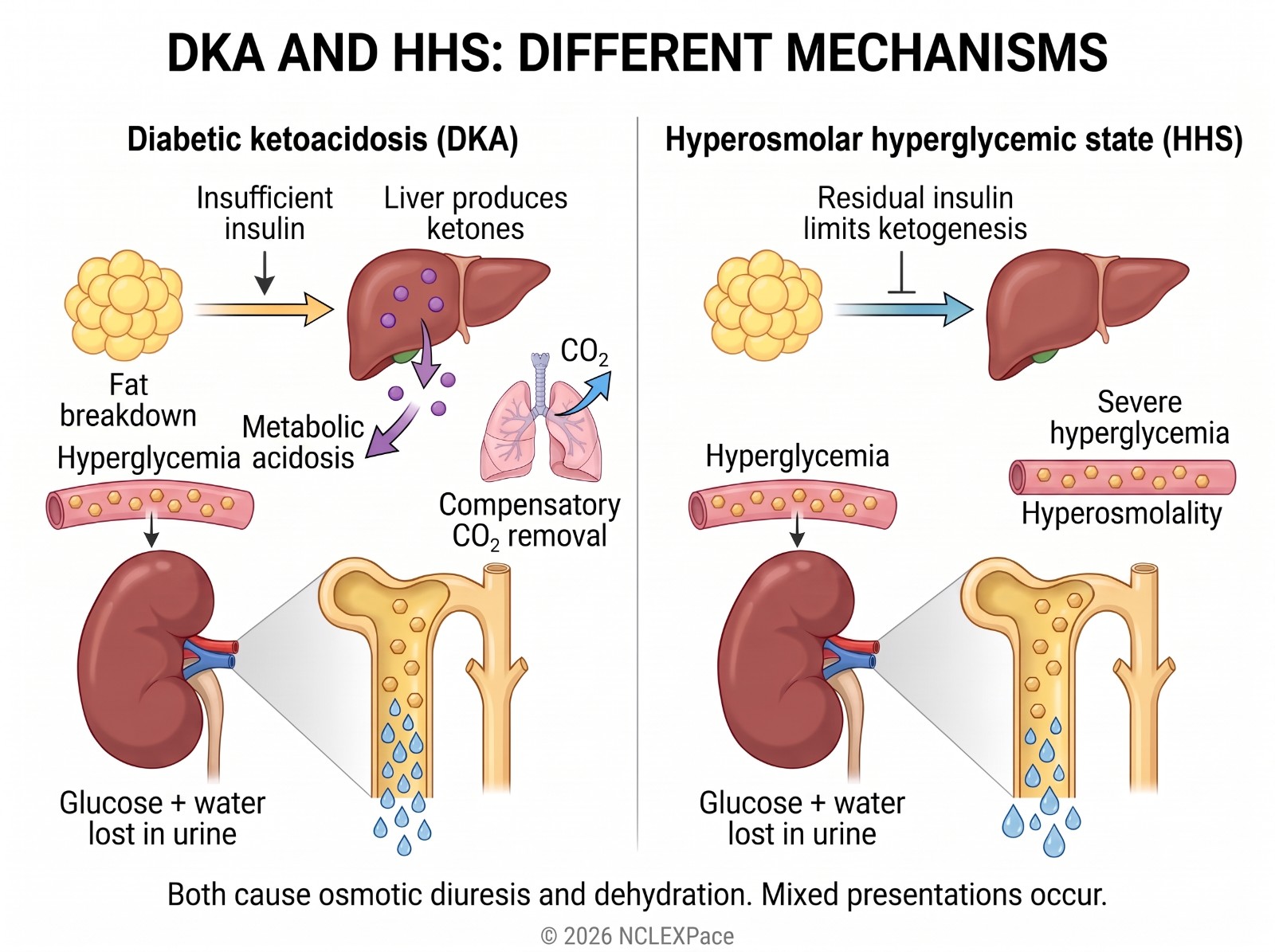
DKA versus HHS side by side: who gets each, the laboratory picture, the treatment order and the potassium rule.
From the Intensive NCLEX Course. This lesson is a free sample: watch it with a free account.
Both are hyperglycaemic emergencies. Both need fluids and insulin. But they happen to different clients, present differently, and the details of the treatment order are where NCLEX questions live.
Step 1 — Side by side
| Feature | DKA | HHS |
|---|---|---|
| Typical client | Type 1, often younger; first presentation of diabetes | Type 2, older, often with an infection |
| Onset | Hours to a day — fast | Days to weeks — slow |
| Glucose | Usually > 250 mg/dL | Often > 600 mg/dL — much higher |
| Ketones | Present — blood and urine | Absent or minimal |
| pH | Acidotic, under 7.30 | Normal or near normal |
| Bicarbonate | Low, under 18 | Normal |
| Breathing | Kussmaul — deep and rapid; fruity acetone breath | Normal rate |
| Mental state | Alert to drowsy | More profoundly altered — confusion, seizures, coma |
| Dehydration | Significant | Severe — much greater fluid deficit |
| Mortality | Lower | Higher |
Why the difference exists
In type 1 there is no insulin at all, so the body burns fat for fuel and produces ketones — hence the acidosis, the Kussmaul breathing blowing off CO₂, and the acetone breath. In type 2 there is some insulin, enough to prevent ketosis but not enough to control glucose. So HHS has no ketones, no acidosis, and much more time to become profoundly dehydrated — which is why the glucose climbs so much higher and the mental status is worse.
Step 2 — Treatment, in order
| Order | What | Detail |
|---|---|---|
| 1 | IV fluids | 0.9% sodium chloride first, and generously. Rehydration alone lowers glucose substantially |
| 2 | Insulin | Regular insulin by continuous IV infusion — never subcutaneous in an emergency |
| 3 | Potassium | Replaced as insulin runs — see below, this is the exam's favourite detail |
| 4 | Find the trigger | Usually infection or missed insulin. Treating the emergency without the cause invites a repeat |
Step 3 — The potassium rule
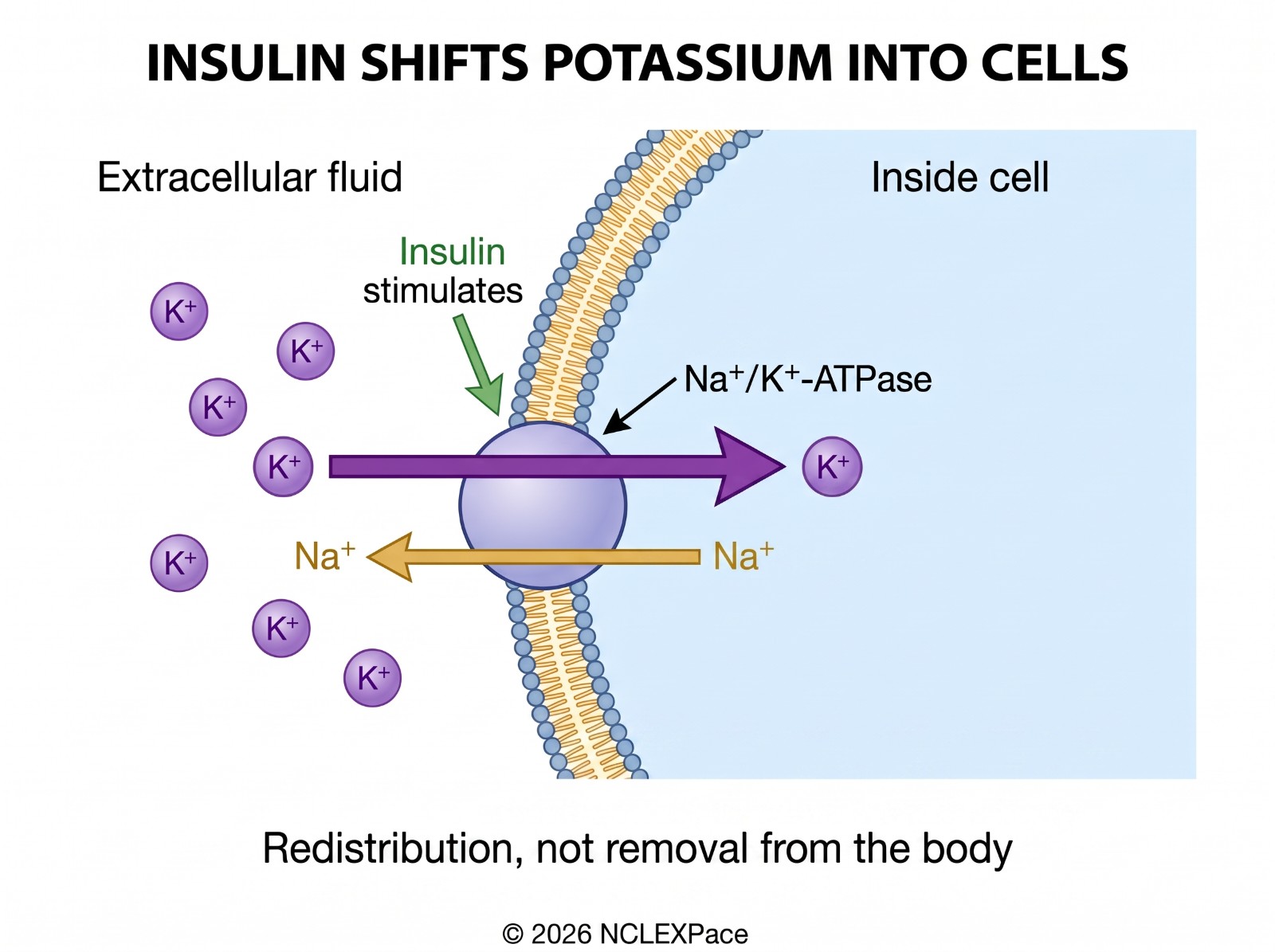
This is the single most tested point on the topic. At presentation the serum potassium may be normal or high, because acidosis drives potassium out of the cells into the blood. The body is nonetheless depleted.
The moment insulin starts, potassium moves back into the cells and the serum level falls — sometimes dangerously. So:
- Check potassium before starting insulin. If it is under 3.3 mEq/L, potassium is replaced first — insulin would drop it into a lethal range.
- Monitor it continuously during the infusion, with cardiac monitoring.
- A falling potassium during treatment is expected, not a surprise — it is why replacement runs alongside.
Step 4 — Two more rules the exam checks
| Rule | Why |
|---|---|
| When glucose reaches about 250 mg/dL, add dextrose to the fluids | Sounds backwards, but the insulin must keep running to clear the ketones. Dextrose prevents hypoglycaemia while it does |
| Lower glucose gradually | Dropping it too fast shifts water into brain cells — cerebral oedema, the most feared complication, especially in children |
| Bicarbonate is rarely given | Correcting the fluid and insulin deficit resolves the acidosis. Bicarbonate is reserved for severe acidosis |
Resolution is measured by ketones, not glucose
DKA is resolved when the anion gap closes and ketones clear — not when the glucose looks normal. A client with a glucose of 180 and persistent ketones is still in DKA, and the insulin infusion continues.
NCLEX tip: If a DKA question mentions potassium, the answer almost always involves it. Normal potassium at presentation means depletion hiding behind acidosis; under 3.3 means potassium before insulin; falling during treatment means keep replacing. Insulin is what moves it, so insulin is what you plan around.
5 NCLEX practice questions on this topic
The same questions, player and partial-credit scoring students use inside NCLEXPace: answer, submit, read the full rationale, then Next. Your score is waiting at the end. No account needed for these.
A free account opens 20 more questions, a case study, a video and a cheat sheet. The full bank has 3,200+ questions with rationales, by topic.
Practice more, free →Ready for the full bank? See NCLEXPace plans and prices: one payment for 1, 2, 3 or 6 months.
Frequently asked questions
Common follow-up questions on Body Systems & Clinical Content.
What separates DKA from HHS?
DKA typically occurs in type 1 diabetes with glucose usually over 250 mg/dL, ketones present, an acidotic pH under 7.30, Kussmaul breathing, and fruity acetone breath. HHS typically occurs in type 2 with glucose often over 600 mg/dL, absent or minimal ketones, a normal pH, and more profoundly altered mental status. HHS also carries a much greater fluid deficit and more severe dehydration.
Why does DKA have ketones and HHS does not?
In type 1 there is no insulin at all, so the body burns fat for fuel and produces ketones, which causes the acidosis, the Kussmaul breathing blowing off carbon dioxide, and the acetone breath. In type 2 there is some insulin, enough to prevent ketosis but not enough to control glucose. So HHS has no ketones, no acidosis, and much more time to become profoundly dehydrated, which is why the glucose climbs so much higher.
What is the order of treatment?
IV fluids first, using 0.9 percent sodium chloride generously, because rehydration alone lowers glucose substantially. Then insulin, given as a regular insulin continuous IV infusion, never subcutaneous in an emergency. Then potassium replaced as insulin runs, and finally finding the trigger, usually infection or missed insulin.
Why is the potassium rule so important?
At presentation the serum potassium may be normal or high, because acidosis drives potassium out of the cells into the blood, but the body is nonetheless depleted. The moment insulin starts, potassium moves back into the cells and the serum level falls, sometimes dangerously. Check potassium before starting insulin; if it is under 3.3 mEq/L, replace potassium first, because insulin would drop it into a lethal range.
When is DKA considered resolved?
DKA is resolved when the anion gap closes and ketones clear, not when the glucose looks normal. A client with a glucose of 180 and persistent ketones is still in DKA, and the insulin infusion continues. When glucose reaches about 250 mg/dL, dextrose is added to the fluids so the insulin can keep running to clear the ketones while preventing hypoglycaemia.
Sources and references
- Harding MM, Kwong J, Hagler D, Reinisch C. Lewis's Medical-Surgical Nursing: Assessment and Management of Clinical Problems. 12th ed. Elsevier; 2023; Chapter: Diabetes.
- Umpierrez GE, Davis GM, ElSayed NA, et al. Hyperglycemic Crises in Adults With Diabetes: A Consensus Report. Diabetes Care. 2024;47(8):1257-1275.
- American Diabetes Association Professional Practice Committee. Standards of Care in Diabetes-2026. Diabetes Care. 2026;49(Supplement 1).
Reviewed by the NCLEXPace team, October 2026.
Keep reading



3,200+ NCLEX questions with think-like-a-nurse rationales, unfolding case studies and adaptive readiness exams. Start with free practice questions, then choose a plan when you are ready.
Create Free Account →