
Newborn Assessment: APGAR, Reflexes, and Red Flags
APGAR scores five signs (heart rate, respiratory effort, muscle tone, reflex irritability and colour) from 0 to 2 at one and five minutes, where 7 to 10 is reassuring, 4 to 6 needs intervention and 0 to 3 needs resuscitation. The score guides immediate care but does not predict long-term outcome, and a low one-minute score that rises by five minutes is common and reassuring.

Newborn transition, assessment and Apgar: the normal values, the reflexes and the red flags.
From the Intensive NCLEX Course. See the course; the full video library is part of Pro and Ultimate.
APGAR score
Done at 1 minute and 5 minutes after birth. Five things, each scored 0, 1, or 2.
| 0 | 1 | 2 | |
|---|---|---|---|
| A — Appearance (color) | Blue or pale all over | Body pink, hands and feet blue | Pink all over |
| P — Pulse | Absent | Under 100 | Over 100 |
| G — Grimace (reflex) | No response | Grimace | Cry, cough, sneeze |
| A — Activity (tone) | Limp | Some flexion | Active movement |
| R — Respirations | Absent | Slow, weak, irregular | Strong cry |
Scoring:
- 7 to 10 — normal
- 4 to 6 — moderately depressed, needs support
- 0 to 3 — severely depressed, needs resuscitation
Blue hands and feet with a pink body is common and normal in the first hours. It scores 1 for appearance, and it is not a cause for alarm on its own.
Important: APGAR describes the baby’s condition; it does not by itself dictate resuscitation, which begins based on assessment rather than waiting for a score.
Normal newborn values
| Normal | |
|---|---|
| Heart rate | 110–160 |
| Respiratory rate | 30–60 |
| Temperature | About 36.5–37.5°C |
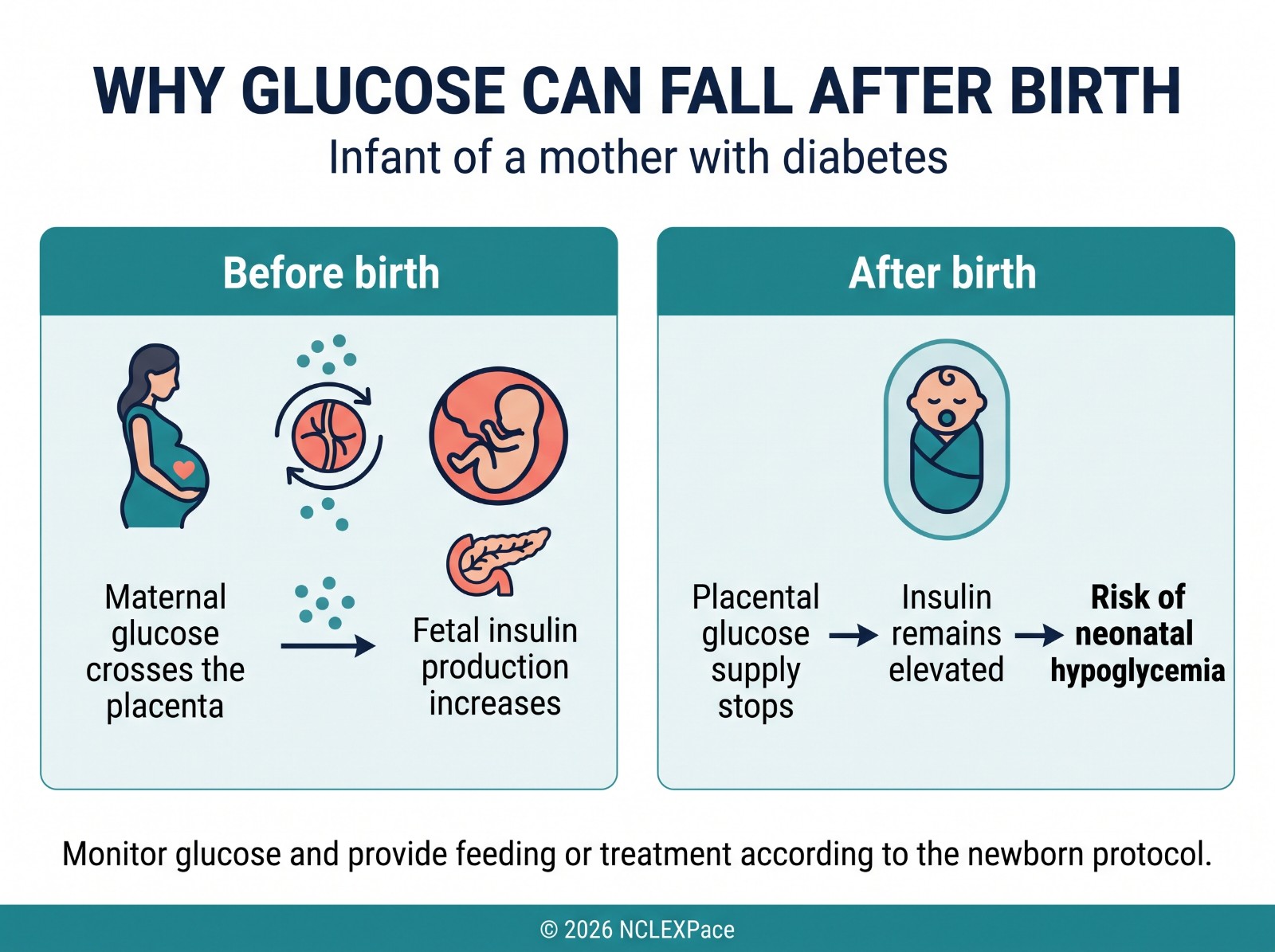
| Blood glucose | Varies by protocol; low glucose is common and monitored |
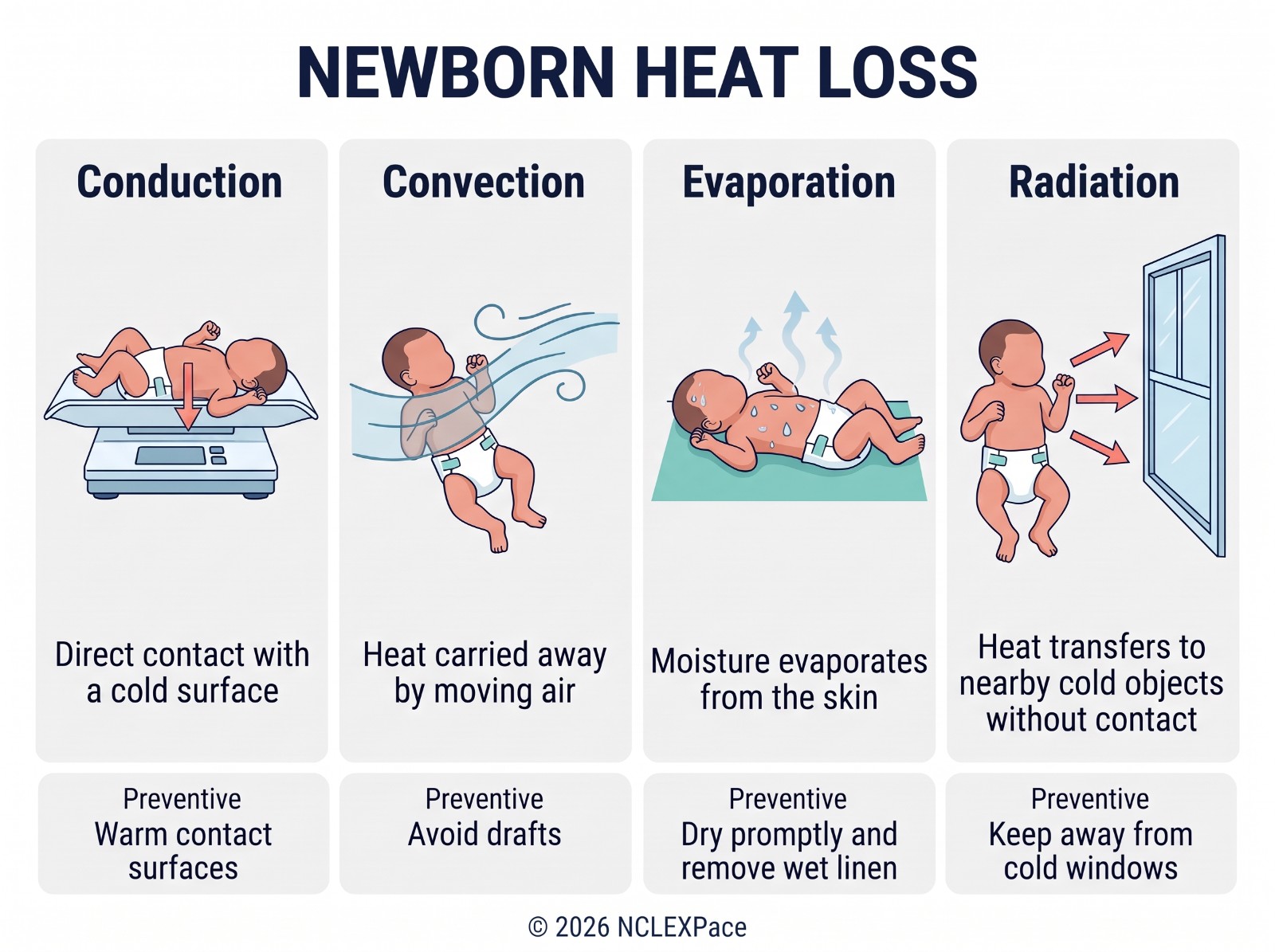
Newborns lose heat fast. Dry them immediately, put on a hat, use skin-to-skin contact or a warmer, and avoid drafts. Cold stress increases oxygen use and can cause low blood sugar.
Newborn reflexes
| Reflex | What it is | Usually gone by |
|---|---|---|
| Moro (startle) | Arms fling out then come together when startled | About 3–6 months |
| Rooting | Turns toward a touch on the cheek | About 3–4 months |
| Sucking | Sucks when the mouth is touched | Gradually becomes voluntary |
| Palmar grasp | Grips a finger placed in the palm | About 3–4 months |
| Plantar grasp | Toes curl when the sole is touched | About 12 months |
| Babinski | Toes fan out when the sole is stroked | About 12–24 months |
| Tonic neck (fencing) | Head turns, same-side arm extends | About 3–4 months |
| Stepping | Appears to walk when held upright | About 2 months |
Two points the exam tests:
A missing reflex in a newborn is abnormal.
A reflex that persists past the expected age may indicate a neurological problem. Babinski is the exception — it is normal in infants and abnormal only in older children and adults.
Red flags in the newborn
Breathing:
- Grunting — a serious sign of respiratory distress
- Nasal flaring
- Chest retractions — the skin pulling in between and below the ribs
- Respiratory rate over 60 at rest
- Central cyanosis — blue lips, tongue, and trunk (blue hands and feet alone is normal)
- Apnea — pauses in breathing over about 20 seconds
Any of these needs immediate attention.
Feeding and output:
- Poor feeding or refusing to feed
- No urine in the first 24 hours
- No meconium stool in the first 24 to 48 hours
- Persistent vomiting, especially if green (bile-stained) — this suggests an obstruction
Neurological:
- A high-pitched shrill cry — associated with neurological problems and with drug withdrawal
- Jitteriness — may indicate low blood sugar or withdrawal
- Lethargy or difficulty waking
- A bulging fontanel — increased pressure in the head
- A sunken fontanel — dehydration
- Seizure activity
Jaundice:
- Jaundice in the first 24 hours is always abnormal and needs evaluation
- Jaundice after 24 hours is common and is monitored
- Feed frequently — this helps clear bilirubin through the stool
The “first 24 hours” rule for jaundice is heavily tested.
Temperature:
- Low temperature is more common than fever in newborn illness
- A newborn with an infection may have a LOW temperature, not a high one
Umbilical cord care
- Keep it clean and dry
- Fold the diaper below it
- It usually falls off in 1 to 3 weeks
- Report redness spreading onto the abdomen, foul odor, or drainage — signs of infection
The short version
- APGAR at 1 and 5 minutes. 7 to 10 is normal. Blue hands and feet alone is normal.
- Heart rate 110–160, respirations 30–60
- Dry and warm immediately — cold stress causes problems
- Missing reflexes, or reflexes that persist too long, are abnormal
- Grunting, flaring, and retractions = respiratory distress
- Jaundice in the first 24 hours is always abnormal
- A newborn with infection may be COLD, not hot
Newborn reference values and reflex timelines vary somewhat by source. Follow current pediatric guidelines.
5 NCLEX practice questions on this topic
The same questions, player and partial-credit scoring students use inside NCLEXPace: answer, submit, read the full rationale, then Next. Your score is waiting at the end. No account needed for these.
A free account opens 20 more questions, a case study, a video and a cheat sheet. The full bank has 3,200+ questions with rationales, by topic.
Practice more, free →Ready for the full bank? See NCLEXPace plans and prices: one payment for 1, 2, 3 or 6 months.
Frequently asked questions
Common follow-up questions on Maternity, Newborn & Pediatrics.
What does APGAR measure?
Appearance (colour), Pulse (heart rate), Grimace (reflex irritability), Activity (muscle tone) and Respiration (respiratory effort), each scored 0, 1 or 2 at one and five minutes of life, for a maximum of 10.
What APGAR score is normal?
Seven to ten indicates a newborn adapting well. Four to six indicates moderate difficulty requiring stimulation and oxygen, and zero to three requires immediate resuscitation. Most healthy newborns do not score a perfect 10 because peripheral cyanosis of the hands and feet is normal in the first minutes.
Which newborn reflexes should be present at birth?
Moro (startle), rooting, sucking, palmar and plantar grasp, Babinski, tonic neck and stepping. Absence of an expected reflex, or persistence beyond the age it should disappear, suggests a neurological problem and warrants further assessment.
What are newborn red flags requiring immediate action?
Central cyanosis, grunting, nasal flaring or chest retractions, a respiratory rate outside 30–60 breaths per minute, a heart rate below 100, temperature instability, jitteriness suggesting hypoglycaemia, and jaundice appearing in the first 24 hours of life.
Sources and references
- Lowdermilk DL, Perry SE, Cashion K, Alden KR, Olshansky EF. Maternity & Women's Health Care. 12th ed. Elsevier; 2020; Chapter: Nursing Care of the Newborn and Family.
- American Academy of Pediatrics, American Heart Association. Textbook of Neonatal Resuscitation (NRP). 8th ed. AAP; 2021.
Reviewed by the NCLEXPace team, October 2026.
Keep reading



3,200+ NCLEX questions with think-like-a-nurse rationales, unfolding case studies and adaptive readiness exams. Start with free practice questions, then choose a plan when you are ready.
Create Free Account →