
Pediatric Vital Signs by Age: The Only Table You Need
Paediatric vital signs move in one direction as a child grows: heart rate and respiratory rate fall while blood pressure rises. A newborn breathes 30–60 times a minute with a heart rate of 100–160, while an adolescent approaches adult values: and in children, hypotension is a late and ominous sign of shock because they compensate with tachycardia first.

Vital signs and accurate measurement: the normal ranges by age and the technique behind a reading you can trust.
From the Intensive NCLEX Course. See the course; the full video library is part of Pro and Ultimate.
Pediatric vital sign questions are not memory tests disguised as clinical questions — they are memory tests, plainly. But there is a pattern underneath the numbers that makes them far easier to hold, and the exam rewards knowing which direction each value moves.
Step 1 — Learn the direction before the numbers
As a child grows: heart rate falls, respiratory rate falls, blood pressure rises. A newborn's heart races and their pressure is low; an adolescent looks like an adult. Every number below is a consequence of that.
Step 2 — The table
| Age | Heart rate | Respiratory rate | Systolic BP |
|---|---|---|---|
| Newborn (0–1 mo) | 100–160 | 30–60 | 65–85 |
| Infant (1–12 mo) | 100–150 | 25–40 | 70–100 |
| Toddler (1–3 y) | 90–140 | 20–30 | 80–110 |
| Preschool (3–6 y) | 80–110 | 20–25 | 90–110 |
| School age (6–12 y) | 70–110 | 18–25 | 95–120 |
| Adolescent (12–18 y) | 60–100 | 12–20 | 110–135 |
Reference ranges vary slightly between textbooks. The exam writes its questions well outside the borderline zone, so a value that is clearly outside these bands is meant to be caught, and a value near an edge is usually not the point of the question.
Step 3 — What the exam actually asks
Rarely "what is normal". Almost always "which finding requires follow-up" — which means you need to spot the value that does not belong for that age.
| Scenario | Reasoning |
|---|---|
| Infant, RR 55 | High even for an infant — report. An infant at 30 would be fine |
| Toddler, HR 100 | Normal. Would be concerning in an adolescent |
| Adolescent, HR 130 | Clearly abnormal — this is adult territory now |
| Newborn, brief pauses in breathing under 15 seconds | Periodic breathing, normal in newborns. Over 20 seconds is apnea — report |
Step 4 — The compensation rule that outranks the table
Children compensate extremely well and then crash suddenly. Two consequences the NCLEX tests hard:
- Tachycardia is the earliest sign of shock in a child — not low blood pressure. A child's pressure holds until they are close to collapse.
- Hypotension in a child is a late and ominous sign. By the time systolic pressure drops, compensation has already failed.
So the question "which child is most unstable" often does not point at the one with the lowest blood pressure. It points at the one whose heart rate has climbed, whose capillary refill has lengthened past 2 seconds, and who has become quiet.
The finding that outranks any number
A child's level of consciousness and interaction beats every vital sign on the flowsheet. An irritable child who cannot be consoled, or a normally active child who has gone limp and quiet, is a sick child regardless of what the monitor says. Parents saying "he is just not himself" is assessment data, not anxiety.
How to take them, in the right order
Least invasive first, while the child is calm: respirations, then heart rate, then temperature, then blood pressure. Counting respirations on a screaming toddler gives you a number that means nothing. Do the intrusive things last.
NCLEX tip: When a peds question gives you a vital sign, the first thing to establish is the child's age — the same number is reassuring at two and alarming at sixteen. Students lose these questions by evaluating the number against adult ranges out of habit.
5 NCLEX practice questions on this topic
The same questions, player and partial-credit scoring students use inside NCLEXPace: answer, submit, read the full rationale, then Next. Your score is waiting at the end. No account needed for these.
A free account opens 20 more questions, a case study, a video and a cheat sheet. The full bank has 3,200+ questions with rationales, by topic.
Practice more, free →Ready for the full bank? See NCLEXPace plans and prices: one payment for 1, 2, 3 or 6 months.
Frequently asked questions
Common follow-up questions on Maternity, Newborn & Pediatrics.
What is a normal heart rate for a child by age?
Newborn 100–160, infant 100–150, toddler 90–140, preschooler 80–110, school-age 75–100, and adolescent 60–100 beats per minute. Rates fall steadily as the child grows toward adult values.
What is a normal respiratory rate for a child by age?
Newborn 30–60, infant 30–50, toddler 24–40, preschooler 22–34, school-age 18–30, and adolescent 12–20 breaths per minute. As with heart rate, the trend is downward with age.
Why is hypotension a late sign in children?
Children compensate for volume loss with tachycardia and vasoconstriction far longer than adults, maintaining blood pressure until roughly 25% of blood volume is lost. Once a child becomes hypotensive, decompensation is imminent: which is why tachycardia and delayed capillary refill are the findings to act on.
What are the early signs of respiratory distress in a child?
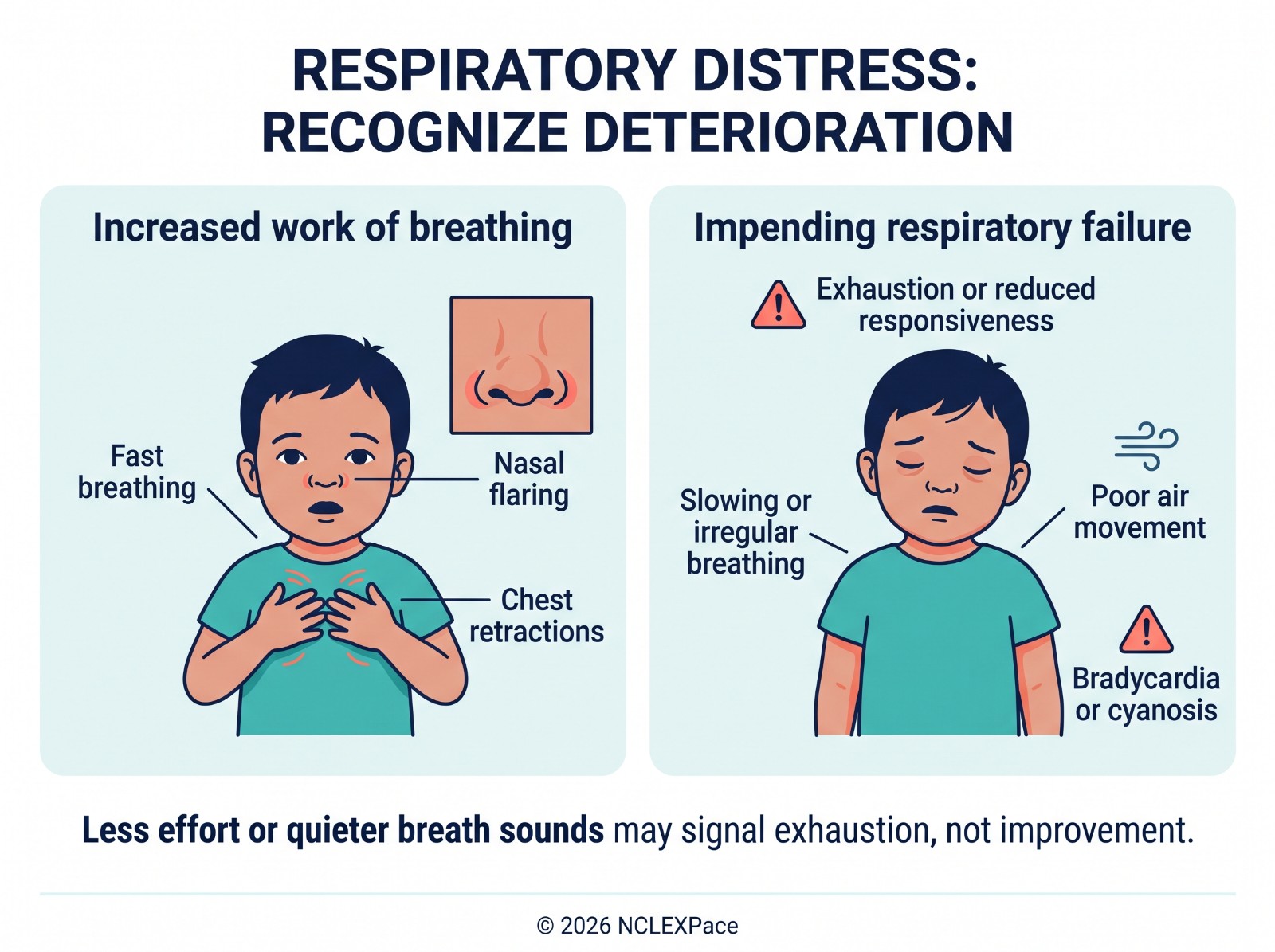
Tachypnoea, nasal flaring, grunting, retractions, head bobbing in infants, and the tripod position in older children. Restlessness and irritability from hypoxia appear before cyanosis, and a quiet child who was previously distressed may be tiring rather than improving.
Sources and references
- Potter PA, Perry AG, Stockert PA, Hall AM. Fundamentals of Nursing. 10th ed. Elsevier; 2021; Chapter: Vital Signs.
Reviewed by the NCLEXPace team, October 2026.
Keep reading



3,200+ NCLEX questions with think-like-a-nurse rationales, unfolding case studies and adaptive readiness exams. Start with free practice questions, then choose a plan when you are ready.
Create Free Account →