
Thyroid Storm and Myxedema Coma: Two Emergencies, Opposite Directions
Thyroid storm is hyperthyroidism gone critical (high fever, tachycardia or atrial fibrillation, agitation progressing to delirium) and it is treated by blocking hormone production and release, controlling the heart rate, and cooling the client without aspirin. Myxedema coma is the opposite (hypothermia, bradycardia, hypoventilation and a falling level of consciousness) and it is treated with intravenous thyroid hormone, airway support and slow, passive rewarming.

Hyperthyroidism and thyroid storm: the findings, the medications, and what the nurse does first when the storm breaks.
From the Intensive NCLEX Course. See the course; the full video library is part of Pro and Ultimate.
Both are rare, both are lethal, and because they sit at opposite ends of the same axis, the exam pairs them precisely so that mixing up the direction costs the question. Fix the direction first: hot, fast and agitated is storm; cold, slow and drowsy is myxedema.
Side by side
| Thyroid storm (thyrotoxic crisis) | Myxedema coma | |
|---|---|---|
| Underlying state | Severe hyperthyroidism — usually Graves disease | Severe untreated hypothyroidism |
| Temperature | High fever, often above 38.5 °C and climbing | Hypothermia — may be profound |
| Heart | Tachycardia, often over 130; atrial fibrillation; heart failure | Bradycardia, hypotension, low cardiac output |
| Breathing | Tachypnoea | Hypoventilation with CO₂ retention |
| Neurological | Agitation, restlessness, tremor, delirium, then coma | Lethargy, slowed everything, then stupor and coma |
| Gut | Vomiting, diarrhoea, abdominal pain | Constipation, ileus |
| Skin | Hot, flushed, drenched in sweat | Cool, dry, coarse; non-pitting periorbital puffiness |
| Sodium / glucose | Often normal; dehydration common | Hyponatraemia and hypoglycaemia are typical |
| Common triggers | Infection, surgery, trauma, childbirth, stopping antithyroid medication, iodine or contrast load, thyroid palpation | Infection, cold exposure, sedatives or opioids, stopping levothyroxine, surgery |
One trigger sits on both lists and is worth remembering on its own: stopping the medication. A client who ran out of tablets, or stopped because they felt better, is the classic stem for either crisis.
Thyroid storm — what the nurse does
- Airway, monitoring and IV access first; continuous cardiac monitoring — atrial fibrillation and heart failure are the usual killers.
- Beta blockade (commonly propranolol) to control heart rate and adrenergic symptoms.
- Antithyroid drugs to stop new hormone synthesis; iodine given afterwards, not before, to block release.
- Corticosteroids as ordered.
- Cool the client — cooling blanket, tepid sponging, cool environment. Do not use aspirin: salicylates displace thyroid hormone from its binding protein and raise the free level, making the crisis worse. Paracetamol is the antipyretic of choice.
- Fluids, glucose and electrolytes — losses through fever, sweating, vomiting and diarrhoea are large.
- Quiet, cool, low-stimulation environment; treat the precipitating cause, usually infection.
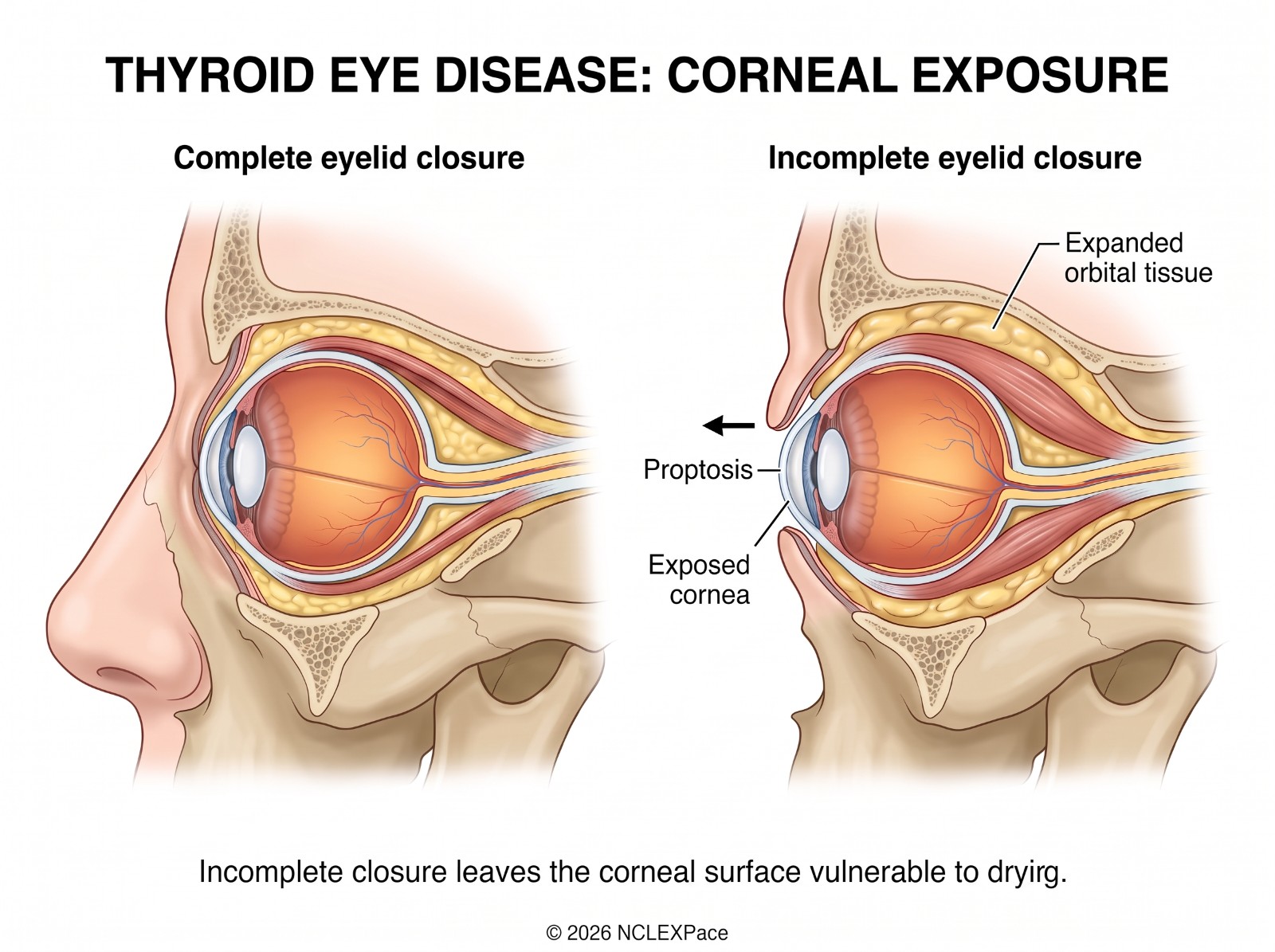
Before it becomes a storm: a high-calorie, high-protein diet because the client is burning through reserves, no caffeine, and eye protection for exophthalmos. After thyroidectomy, keep tracheostomy equipment and calcium gluconate at the bedside — the two feared complications are airway obstruction from bleeding or swelling, and hypocalcaemia from parathyroid injury (tingling around the mouth and fingers, then Chvostek and Trousseau signs).
Myxedema coma — what the nurse does
- Airway first. Hypoventilation with CO₂ retention is what kills; be ready for ventilatory support.
- Intravenous thyroid hormone as ordered — oral absorption cannot be relied on.
- Passive, gradual rewarming with blankets. Do not use active external warming: it dilates peripheral vessels and drops an already low blood pressure, and can precipitate collapse.
- Treat hypoglycaemia and hyponatraemia; correct sodium slowly.
- Corticosteroids as ordered, since adrenal insufficiency may coexist.
- Avoid sedatives and opioids — metabolism is profoundly slowed and normal doses accumulate.
- Turn regularly, prevent pressure injury, monitor for ileus and urinary retention, treat the cause.
Long-term teaching for hypothyroidism: levothyroxine is taken in the morning on an empty stomach, at least 30–60 minutes before food, separated from calcium, iron and antacids, and taken for life even once the client feels well. Report chest pain or palpitations — the dose may be too high — and expect improvement over weeks, not days.
NCLEX tip: Fix the direction before anything else. Hot, fast and agitated is storm; cold, slow and drowsy is myxedema. Then remember the two “nevers” that sit one on each side: no aspirin in thyroid storm, and no rapid active warming in myxedema coma.
Educational use only: this article supports nursing review and does not replace clinical judgment, facility protocols, or instructions from an authorised prescriber.
5 NCLEX practice questions on this topic
The same questions, player and partial-credit scoring students use inside NCLEXPace: answer, submit, read the full rationale, then Next. Your score is waiting at the end. No account needed for these.
A free account opens 20 more questions, a case study, a video and a cheat sheet. The full bank has 3,200+ questions with rationales, by topic.
Practice more, free →Ready for the full bank? See NCLEXPace plans and prices: one payment for 1, 2, 3 or 6 months.
Frequently asked questions
Common follow-up questions on Body Systems & Clinical Content.
What are the signs of thyroid storm?
High fever, marked tachycardia often with atrial fibrillation, hypertension followed by heart failure, agitation and delirium progressing to coma, vomiting and diarrhoea, and hot flushed skin with profuse sweating. It is usually precipitated by infection, surgery or stopping antithyroid medication.
Why is aspirin avoided in thyroid storm?
Salicylates displace thyroid hormone from thyroid-binding globulin, raising the free hormone level and intensifying the crisis. Paracetamol is used for fever instead, alongside cooling blankets and a cool environment.
What are the signs of myxedema coma?
Hypothermia, bradycardia, hypotension, hypoventilation with carbon dioxide retention, a declining level of consciousness, hyponatraemia and hypoglycaemia, with cool dry skin and non-pitting periorbital oedema. Sedatives, infection and cold exposure commonly precipitate it.
Why should a client with myxedema coma not be warmed quickly?
Active external rewarming dilates peripheral vessels, which drops an already low blood pressure and can cause cardiovascular collapse. Warming is passive and gradual, using blankets while the underlying hormone deficiency is corrected.
How is levothyroxine taken?
In the morning on an empty stomach, at least 30 to 60 minutes before food, separated from calcium, iron and antacids, and continued lifelong. Chest pain or palpitations suggest the dose is too high and are reported.
What must be kept at the bedside after a thyroidectomy?
Tracheostomy equipment and calcium gluconate. The two feared complications are airway obstruction from bleeding or swelling, and hypocalcaemia from parathyroid injury, which presents as perioral and digital tingling with positive Chvostek and Trousseau signs.
Sources and references
- Harding MM, Kwong J, Hagler D, Reinisch C. Lewis's Medical-Surgical Nursing: Assessment and Management of Clinical Problems. 12th ed. Elsevier; 2023; Chapter: Endocrine Problems.
- Ross DS, et al. 2016 American Thyroid Association Guidelines for Diagnosis and Management of Hyperthyroidism and Other Causes of Thyrotoxicosis. Thyroid. 2016;26(10):1343-1421.
- Jonklaas J, et al. Guidelines for the Treatment of Hypothyroidism: American Thyroid Association Task Force on Thyroid Hormone Replacement. Thyroid. 2014;24(12):1670-1751.
Reviewed by the NCLEXPace team, October 2026.
Keep reading



3,200+ NCLEX questions with think-like-a-nurse rationales, unfolding case studies and adaptive readiness exams. Start with free practice questions, then choose a plan when you are ready.
Create Free Account →