
Blood Transfusion: The Nursing Steps and the Five Reactions
At the first sign of any transfusion reaction: stop the transfusion, disconnect the blood tubing, keep the vein open with normal saline through new tubing, then assess and notify. Only normal saline goes with blood: dextrose haemolyses red cells and lactated Ringer's contains calcium that clots them. Stay with the client for the first 15 minutes, because that is when the fatal reaction declares itself.

Blood transfusion from the two-nurse check to the five reactions and the exact order of actions when one starts.
From the Intensive NCLEX Course. See the course; the full video library is part of Pro and Ultimate.
Transfusion questions look like clinical trivia and are really a single safety reflex: at the first sign of any reaction, stop the transfusion. Everything else — which reaction it is, what to give, who to call — happens afterwards.
Before it runs
| Step | Detail |
|---|---|
| Consent and access | Informed consent obtained; large-bore IV (commonly 18–20 gauge in an adult) |
| Baseline vital signs | Taken immediately before starting. Without a baseline you cannot recognise a change |
| Two-nurse verification at the bedside | Client identity using two identifiers, blood group and Rh, unit number, expiry and the crossmatch record — all checked by two qualified staff |
| Inspect the unit | Discolouration, clots, leaks or excess air means return it, do not hang it |
| Y-tubing with normal saline only | Filtered blood administration set |
| Start within 30 minutes of release | Beyond that the unit is returned to the blood bank |
Once running, stay with the client for the first 15 minutes at a slow rate, then recheck vital signs. Most severe reactions appear in that window. A unit is completed within 4 hours of hanging because of infection risk.
The five reactions
| Reaction | When | What you see | What is happening |
|---|---|---|---|
| Acute haemolytic | Minutes — earliest and deadliest | Fever with chills, flank or low back pain, dark or red urine, hypotension, tachycardia, a feeling of impending doom, oozing at IV sites | ABO incompatibility — the wrong unit. Red cells are being destroyed |
| Febrile non-haemolytic | Within 1–6 hours | Temperature rise of ~1 °C or more, chills, headache — without hypotension or back pain | The most common reaction. Recipient antibodies against donor white cells |
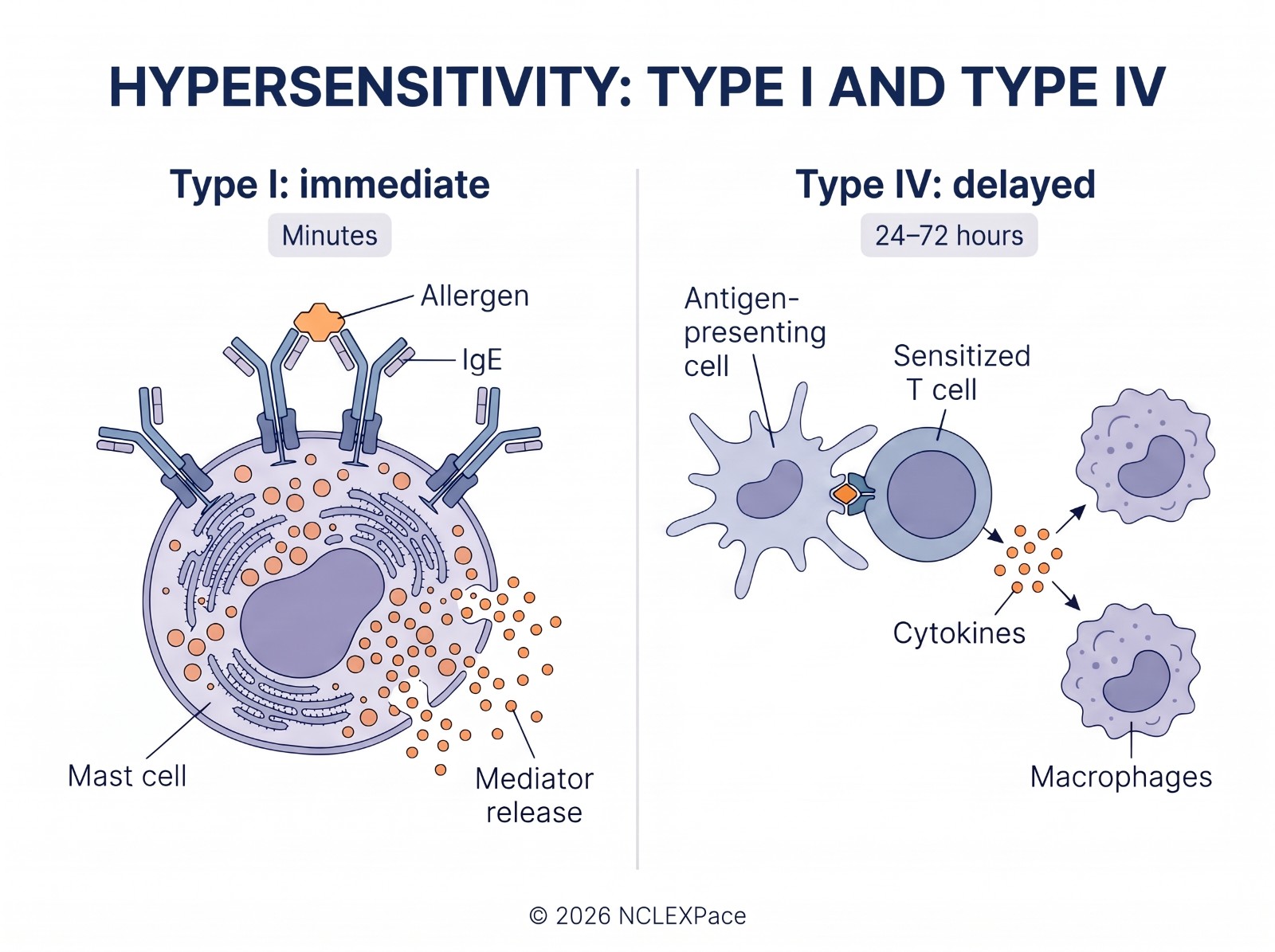
| Allergic / anaphylactic | Minutes to hours | Mild: hives, itching, flushing. Severe: wheeze, stridor, facial swelling, hypotension | Reaction to donor plasma proteins |
| TACO — circulatory overload | During or soon after | Dyspnoea, crackles, raised blood pressure, distended neck veins, cough with frothy sputum | Too much volume, too fast. Highest risk in the elderly, small adults, cardiac and renal clients |
| TRALI — acute lung injury | Within 6 hours | Sudden severe dyspnoea, hypoxia, fever, hypotension, bilateral infiltrates | Donor antibodies injuring the lung. Looks like TACO but the pressure is low, not high |
The two that get confused: TACO and TRALI both present as sudden respiratory distress during a transfusion. The blood pressure separates them — TACO raises it, TRALI drops it. TACO responds to slowing or stopping the infusion, upright positioning and diuretics; TRALI needs respiratory support and does not respond to diuresis.
Fever with back pain is haemolytic until proven otherwise. Fever alone, with stable pressure and no pain, is more likely febrile non-haemolytic — but the immediate action is identical either way, because you cannot tell them apart in the first minute.
What you do, in order
- Stop the transfusion immediately.
- Disconnect the blood tubing at the hub — do not simply switch the Y-line, because that flushes remaining blood into the client.
- Keep the vein open with normal saline through new tubing.
- Assess — vital signs, respiratory status, urine output and colour.
- Notify the provider and the blood bank.
- Return the unit and tubing to the blood bank; send blood and urine samples as ordered.
- Document the time, the findings, the actions and the client's response.
Step 1 is the answer to almost every transfusion-reaction question. Anything that assesses, medicates or calls before stopping the infusion is wrong.
Rates, volumes and the details that get tested
- Only normal saline with blood. Dextrose causes haemolysis; lactated Ringer's contains calcium, which promotes clotting.
- No medications are added to blood or run through the same line.
- One unit is infused within 4 hours; started within 30 minutes of release.
- A febrile client is usually pre-treated and cleared before transfusing, since a later fever then becomes uninterpretable.
- A client who declines blood on religious grounds — their refusal stands. The nurse ensures it is informed and documented and explores alternatives with the team, not persuasion.
NCLEX tip: When a stem gives you a client 10 minutes into a unit with a fever and low back pain, do not spend the question deciding which reaction it is. Stop the transfusion first — the classification happens afterwards, in the laboratory.
Educational use only: this article supports nursing review and does not replace clinical judgment, facility protocols, or instructions from an authorised prescriber.
5 NCLEX practice questions on this topic
The same questions, player and partial-credit scoring students use inside NCLEXPace: answer, submit, read the full rationale, then Next. Your score is waiting at the end. No account needed for these.
A free account opens 20 more questions, a case study, a video and a cheat sheet. The full bank has 3,200+ questions with rationales, by topic.
Practice more, free →Ready for the full bank? See NCLEXPace plans and prices: one payment for 1, 2, 3 or 6 months.
Frequently asked questions
Common follow-up questions on Body Systems & Clinical Content.
What is the first action if a transfusion reaction is suspected?
Stop the transfusion immediately, disconnect the blood tubing at the hub, and keep the vein open with normal saline through new tubing. Assessment, provider notification and sample collection all follow: none of them precede stopping the infusion.
Which IV fluid can be given with blood?
Normal saline only. Dextrose solutions cause red cells to haemolyse and lactated Ringer's contains calcium that can promote clotting in the line, so neither is ever hung with blood products.
How long should the nurse stay with a client after starting a transfusion?
At least the first 15 minutes, running at a slow rate, because acute haemolytic reactions declare themselves early. Vital signs are taken before starting, at 15 minutes, and per policy thereafter.
What are the signs of an acute haemolytic transfusion reaction?
Fever with chills, flank or low back pain, dark or red urine, hypotension, tachycardia, oozing from puncture sites and a sense of impending doom. It results from ABO incompatibility and is the most dangerous reaction.
How do you tell TACO from TRALI?
By the blood pressure. Circulatory overload raises it and produces distended neck veins and crackles, responding to slowing the infusion and diuresis. Transfusion-related acute lung injury lowers it, produces hypoxia with bilateral infiltrates, and requires respiratory support rather than diuretics.
How long can a unit of blood hang?
Up to 4 hours from the time it is started, and it must be started within 30 minutes of release from the blood bank. Beyond those limits the infection risk is unacceptable and the unit is returned.
Sources and references
- Harding MM, Kwong J, Hagler D, Reinisch C. Lewis's Medical-Surgical Nursing: Assessment and Management of Clinical Problems. 12th ed. Elsevier; 2023; Chapter: Hematologic Problems.
- AABB. Standards for Blood Banks and Transfusion Services. 33rd ed. Bethesda, MD: AABB; 2022.
Reviewed by the NCLEXPace team, October 2026.
Keep reading



3,200+ NCLEX questions with think-like-a-nurse rationales, unfolding case studies and adaptive readiness exams. Start with free practice questions, then choose a plan when you are ready.
Create Free Account →