Vital Signs NCLEX Questions With Rationales
What it is
Vital signs are measurements of essential body functions, including temperature, pulse, respiratory rate, blood pressure, and oxygen saturation. They provide information about cardiovascular, respiratory, and thermoregulatory function. Normal ranges vary with age, health status, activity, medications, and measurement technique. Nurses must interpret vital signs in relation to the client's baseline and overall clinical condition.
What the NCLEX focuses on
- Normal resting adult pulse is 60 to 100 beats per minute, and the adult respiratory rate is generally 12 to 20 breaths per minute.
- Normal adult temperature is approximately 97.8°F to 99.1°F, and a typical resting blood pressure is approximately 90/60 to 120/80 mm Hg.
- Newborn heart rate is generally 110 to 160 beats per minute, and newborn respiratory rate is 30 to 60 breaths per minute.
- Infant, toddler, and preschool heart rates are generally higher than adult heart rates, and respiratory rates decrease as children grow.
- Use an appropriately sized blood pressure cuff because a cuff that is too small produces a falsely high reading, while a cuff that is too large can produce a falsely low reading.
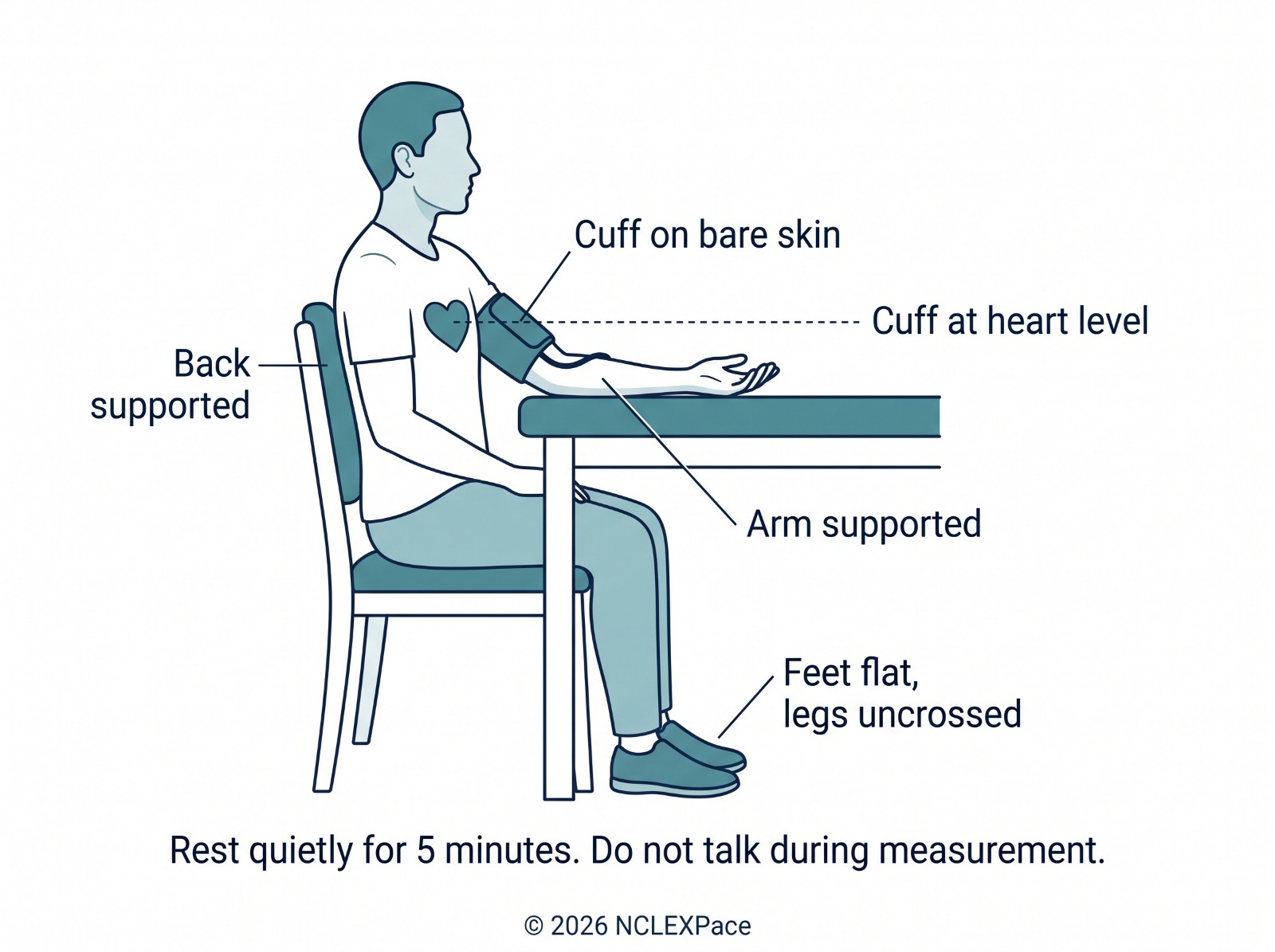
- Position the client's arm at heart level, support the arm, keep the feet flat, and avoid crossing the legs during blood pressure measurement. An arm that hangs unsupported or sits below heart level, or crossed legs, gives a falsely high reading. An arm held above heart level gives a falsely low reading.
- Deflate a manual blood pressure cuff at approximately 2 mm Hg per second to identify systolic and diastolic pressures accurately.
- An auscultatory gap is a temporary disappearance of Korotkoff sounds during cuff deflation that can cause an incorrectly low systolic reading if missed.
- When measuring an adult's apical pulse and radial pulse simultaneously, a pulse deficit is the difference between the two measurements and may indicate ineffective cardiac contractions.
- Orthostatic hypotension is a sustained decrease in systolic blood pressure of at least 20 mm Hg or diastolic blood pressure of at least 10 mm Hg within 3 minutes of standing.
- Pulse oximetry estimates oxygen saturation and can be affected by poor circulation, movement, cold extremities, nail polish, and skin pigmentation.
Priority nursing actions
- Assess the client's general appearance, respiratory effort, level of consciousness, and symptoms before interpreting numerical measurements.
- Verify abnormal findings obtained by assistive personnel by personally reassessing the client and repeating the measurement using correct technique. Do not delegate interpretation or clinical assessment.
- For blood pressure, use a bare upper arm, an appropriate cuff, and an arm supported at heart level. Avoid an arm with an active IV infusion or an arteriovenous fistula, and follow precautions for an arm affected by mastectomy or lymph node removal.
- Measure apical and radial pulses simultaneously for one full minute when assessing a suspected pulse deficit. Report irregular rhythms and significant differences.
- For orthostatic measurements, allow the client to rest supine for at least 5 minutes, measure blood pressure and pulse, assist the client to stand safely, and repeat measurements after standing. Stop if severe dizziness or syncope occurs.
- Verify an unexpected pulse oximetry reading by assessing the client, checking sensor placement and signal quality, and comparing the reading with the clinical presentation. Report concerning findings promptly.
Numbers to know
| Value | Number | Why it matters |
|---|---|---|
| Adult pulse | 60 to 100 beats/min | Expected resting range. |
| Adult respirations | 12 to 20 breaths/min | Expected resting range. |
| Newborn pulse | 110 to 160 beats/min | Expected newborn range. |
| Newborn respirations | 30 to 60 breaths/min | Expected newborn range. |
| Blood pressure cuff bladder | 75% to 100% of arm circumference | Supports accurate cuff sizing. |
| Manual cuff deflation | 2 mm Hg per second | Allows accurate identification of Korotkoff sounds. |
| Orthostatic hypotension | 20 mm Hg systolic or 10 mm Hg diastolic within 3 minutes | Identifies a clinically significant postural blood pressure decrease. |
Common exam traps
- Choosing a smaller blood pressure cuff: wrong because it produces a falsely elevated reading.
- Choosing an unsupported arm below heart level: wrong because the blood pressure reading may be falsely elevated.
- Choosing rapid cuff deflation: wrong because Korotkoff sounds may be missed, producing inaccurate readings.
- Choosing an immediate standing blood pressure without a baseline: wrong because orthostatic changes require comparison with a resting measurement.
- Choosing an abnormal assistive personnel measurement without verification: wrong because the RN must personally assess the client and validate the finding.
What to teach
- Explain that blood pressure should be measured after the client rests quietly, with the back supported, feet flat, and arm at heart level.
- Ask clients to avoid caffeine, exercise, and smoking for at least 30 minutes before a blood pressure measurement when possible.
- For oral temperature, wait 15 to 25 minutes after hot or cold food or beverages and 5 minutes after smoking or chewing gum.
- Explain that oral temperature is unsuitable for clients who are unconscious, confused, unable to follow instructions, or have an oral airway or endotracheal tube.
- Use tympanic measurements cautiously when ear infection or excessive cerumen may interfere with accuracy. Avoid rectal measurements when contraindicated, including significant neutropenia, thrombocytopenia, or rectal surgery.
- Explain that pulse oximetry is an estimate rather than a direct measurement of arterial oxygenation. Symptoms and clinical assessment remain important even when the displayed number appears normal.
2 NCLEX questions with rationales on this topic
From the NCLEXPace question bank. Choose your answer first, then open the correct answer and the full rationale under each question.
Two nurses simultaneously count an adult client's pulses for 1 minute. The apical rate is 112/min and the radial rate is 84/min. Which action should the nurse take?
Select the best answer.
- A. Document a pulse deficit of 28 and notify the provider
- B. Record the radial rate of 84/min and continue routine monitoring
- C. Count the opposite radial pulse for 1 minute and average the two
- D. Document 28 beats/min as the client's heart rate
Show the correct answer and rationale
Correct answer:
- A. Document a pulse deficit of 28 and notify the provider
Rationale
Overview
- Definition: A pulse deficit is the difference between simultaneously measured apical and radial pulse rates.
- How to measure: Two nurses count both sites during the same full minute; subtract radial from apical.
- What it means: Some ventricular contractions generate insufficient stroke volume to produce a palpable peripheral pulse, as occurs with atrial fibrillation or premature beats.
Nursing key points
- Calculate 112 - 84 = 28 beats/min.
- Document apical 112/min, radial 84/min, and deficit 28 beats/min separately.
- Assess dizziness, blood pressure, shortness of breath, and peripheral perfusion.
- Notify the provider and obtain an ECG as ordered.
- Use the apical rate, 112/min, as the measured heart rate.
Answer analysis
| Nursing action | Rationale |
|---|---|
| Document a pulse deficit of 28 and notify the provider | Correct. The simultaneous measurements establish a deficit of 28 beats/min requiring assessment and reporting. |
| Record the radial rate of 84/min and continue routine monitoring | Not correct. The radial pulse misses contractions counted at the apex. |
| Count the opposite radial pulse for 1 minute and average the two | Not correct. Averaging peripheral rates does not measure an apical-radial deficit. |
| Document 28 beats/min as the client's heart rate | Not correct. The heart rate is 112/min; 28 beats/min is the deficit. |
A nursing student is learning manual blood pressure measurement. For each technique error, indicate whether it produces a falsely high or a falsely low reading.
For each technique error, identify the effect on the reading.
| Falsely high reading | Falsely low reading | |
|---|---|---|
| Letting the arm hang unsupported at the client side | ||
| Using a cuff whose bladder is too wide for the arm | ||
| Using a cuff that is too narrow for the client arm | ||
| Measuring while the client sits with legs crossed at the knee | ||
| Supporting the arm above the level of the heart |
Show the correct answer and rationale
Correct answers:
- Letting the arm hang unsupported at the client side: Falsely high reading
- Using a cuff whose bladder is too wide for the arm: Falsely low reading
- Using a cuff that is too narrow for the client arm: Falsely high reading
- Measuring while the client sits with legs crossed at the knee: Falsely high reading
- Supporting the arm above the level of the heart: Falsely low reading
Rationale
Overview
- Definition: Blood pressure measurement errors occur when incorrect cuff size or client positioning changes the recorded pressure from the actual arterial pressure.
- Errors that read high: A narrow cuff, crossed legs, an unsupported or dependent arm, a full bladder, talking, and an unsupported back increase the recorded pressure.
- Errors that read low: An excessively wide cuff, an arm positioned above heart level, and excessively rapid cuff deflation produce falsely low readings.
Nursing key points
- Measure mid-upper arm circumference and select the manufacturer's recommended cuff size.
- Use a cuff bladder width approximately 40% and length approximately 80% of arm circumference.
- Seat the client quietly for 5 minutes with the back supported and feet flat and uncrossed.
- Support the bare arm at heart level without muscle tension.
- Ask the client to empty the bladder and avoid talking during measurement.
- Correct technique errors and repeat an unexpected reading before making treatment decisions.
Answer analysis
| Technique error | Effect on the reading | Why |
|---|---|---|
| Letting the arm hang unsupported at the client side | Falsely high reading. | Dependent positioning and muscle tension increase the recorded pressure. |
| Using a cuff whose bladder is too wide for the arm | Falsely low reading. | The oversized bladder compresses the artery at a lower recorded pressure. |
| Using a cuff that is too narrow for the client arm | Falsely high reading. | The undersized cuff requires greater pressure to occlude the artery. |
| Measuring while the client sits with legs crossed at the knee | Falsely high reading. | Crossing the legs increases the recorded pressure. |
| Supporting the arm above the level of the heart | Falsely low reading. | The elevated arm reduces hydrostatic pressure at the measurement site. |
The NCLEXPace bank has 3,200+ NCLEX questions with full rationales, sorted by topic, with your progress tracked as you practice. Create your account to start.
Create Account →More topics in Fundamentals
Postmortem Care NCLEX Questions With RationalesCovers respectful care of the body after death, legal pronouncement, organ donation referral, preservation of evidence, family support, and documentation.Carbon Monoxide Poisoning NCLEX Questions With RationalesCovers carbon monoxide exposure, clinical manifestations, diagnostic testing, emergency oxygen therapy, complications, and prevention.Scabies and Head Lice NCLEX Questions With RationalesReviews scabies and head lice transmission, clinical findings, treatment, infection control, prevention, and nursing interventions.Sources
- National Library of Medicine. Vital Signs. 2025.
- American Heart Association. Measurement of Blood Pressure in Humans: A Scientific Statement. 2019.
- Open RN, National Library of Medicine. Chapter 1: General Survey. 2021.
- Food and Drug Administration. Pulse Oximeters. Current edition.
3,200+ NCLEX questions with think-like-a-nurse rationales, unfolding case studies and adaptive readiness exams. Start with free practice questions, then choose a plan when you are ready.
Create Account →