Urinary Catheter Care NCLEX Questions With Rationales
What it is
Urinary catheter care involves inserting, maintaining, monitoring, and removing a urinary catheter to provide safe bladder drainage. An indwelling urinary catheter passes through the urethra into the bladder and remains in place through an inflated retention balloon. Catheter-associated urinary tract infection (CAUTI) occurs when microorganisms enter the urinary tract through the catheter and cause infection. Proper indications, aseptic insertion, closed drainage, daily assessment, and early removal reduce infection risk.
What the NCLEX focuses on
- Appropriate indications for an indwelling catheter include acute urinary retention, bladder outlet obstruction, accurate urine output measurement in critically ill clients, selected surgical procedures, and assistance with healing open sacral or perineal wounds in incontinent clients.
- Urinary catheters should not be used simply for convenience, routine incontinence management, or obtaining a urine specimen when the client can void voluntarily.
- In acute care settings, urinary catheter insertion requires hand hygiene, sterile equipment, sterile gloves, sterile drapes, appropriate periurethral cleansing, and single-use lubricant.
- The catheter should be secured after insertion to prevent movement, urethral trauma, and traction.
- A continuously closed drainage system must be maintained, and unnecessary disconnections should be avoided.
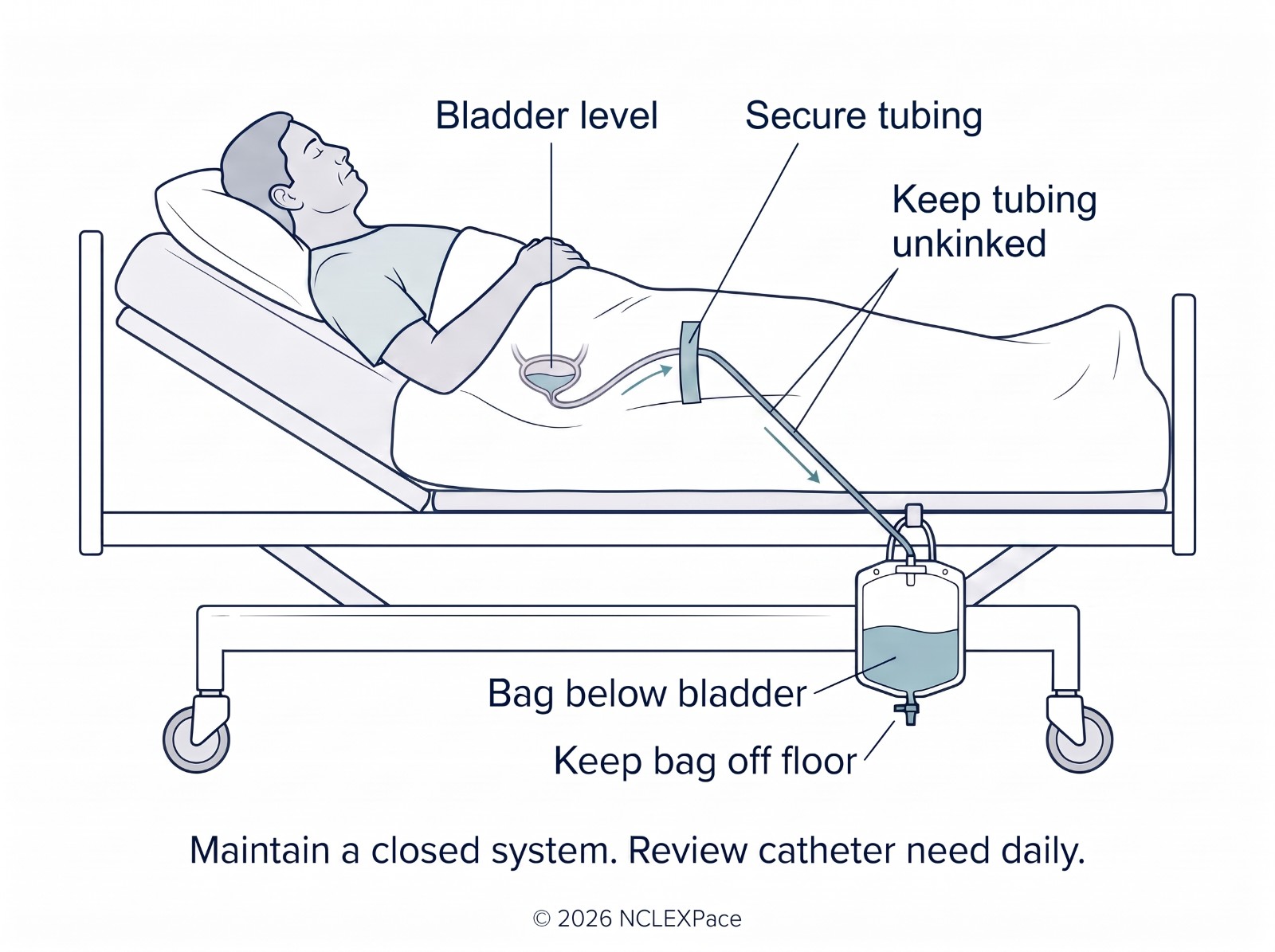
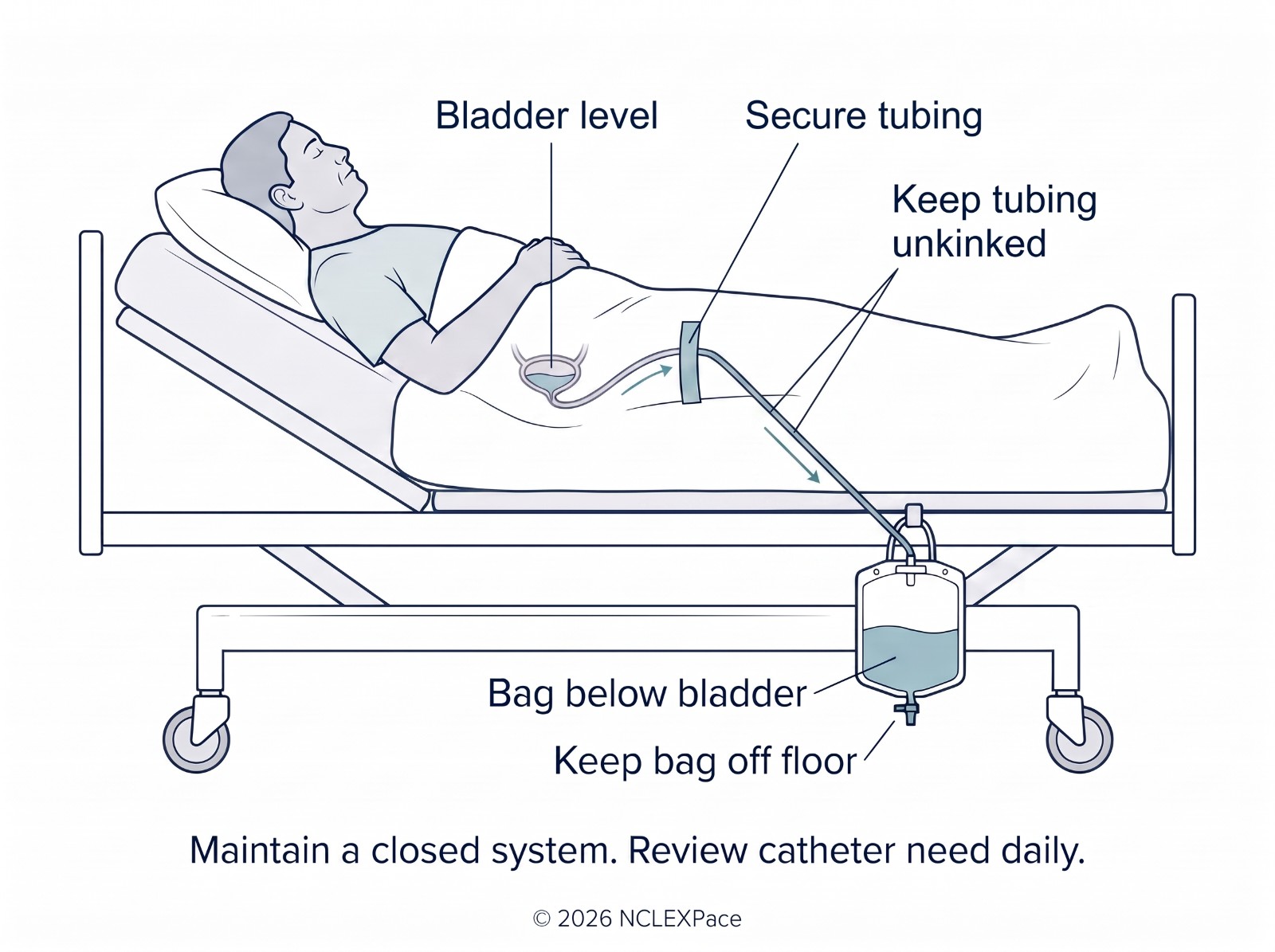
- The drainage bag must remain below bladder level and off the floor to prevent urine backflow and contamination.
- Catheter tubing must remain free of kinks, compression, dependent loops, and other obstructions that interfere with urine drainage.
- Routine perineal hygiene with soap and water is appropriate, but routine antiseptic cleaning of the meatus while the catheter remains in place is not recommended.
- Routine bladder irrigation is not recommended unless a specific clinical indication exists, such as anticipated obstruction from bleeding after selected urologic procedures.
Priority nursing actions
- Assess the indication for catheterization and consider alternatives, including scheduled toileting, external collection devices, and intermittent catheterization when appropriate.
- Perform hand hygiene and insert the catheter using sterile technique and equipment according to facility policy.
- Secure the catheter, maintain the closed drainage system, keep the bag below bladder level, and prevent tubing kinks.
- Review the continued need for the catheter every day and advocate for removal as soon as the indication resolves.
- If no urine drains, first assess the tubing for kinks, compression, dependent loops, and incorrect drainage bag positioning. Assess the client's bladder for distension or discomfort and evaluate for possible obstruction or displacement. Notify the provider when drainage does not resume or retention is suspected.
- For a fresh urine specimen, disinfect the needleless sampling port and obtain the specimen aseptically using a sterile syringe or approved collection device. Never collect a urine culture from the drainage bag.
Numbers to know
| Value | Number | Why it matters |
|---|---|---|
| Postoperative catheter removal | Preferably within 24 hours | Selected surgical clients should have catheters removed promptly unless continued use is indicated. |
| Assessment after catheter removal | 4 to 6 hours | Failure to void or complaints of bladder fullness warrant assessment for urinary retention according to the nursing protocol. |
| Small voided volume | Less than 180 mL | A void this small after removal suggests retention, so a bladder scan is used to check the post-void residual. |
| Elevated post-void residual | Greater than 300 mL | Requires provider notification and evaluation for possible intermittent catheterization according to clinical protocol. |
Common exam traps
- Choosing to place a catheter for routine urinary incontinence: wrong because incontinence alone is not an appropriate indication for an indwelling catheter.
- Choosing to collect a urine culture from the drainage bag: wrong because the specimen may be contaminated and should be collected from the disinfected sampling port.
- Choosing to place the drainage bag above bladder level: wrong because urine can flow backward and increase infection risk.
- Choosing to irrigate the catheter routinely when urine output decreases: wrong because routine irrigation is not recommended without a clinical indication.
- Choosing to immediately replace a catheter when urine stops draining without assessing the tubing: wrong because kinks, compression, or incorrect positioning may be correctable causes.
What to teach
- Teach clients and caregivers to keep the drainage bag below bladder level and never place it on the floor.
- Explain the importance of hand hygiene before and after handling catheter equipment.
- Teach clients to avoid pulling, twisting, or disconnecting the catheter tubing.
- Instruct clients to report fever, chills, suprapubic discomfort, flank pain, or other new symptoms of urinary infection.
- After catheter removal, encourage fluids unless restricted, measure and document the first void, and report inability to urinate, bladder fullness, or discomfort.
- Explain that a bladder scanner uses ultrasound to estimate bladder volume and post-void residual without inserting another catheter.
2 NCLEX questions with rationales on this topic
From the NCLEXPace question bank. Choose your answer first, then open the correct answer and the full rationale under each question.
A client with an indwelling urinary catheter has had no urine drain into the collection bag for the past 3 hours. The client is alert and reports lower abdominal fullness. Which action should the nurse take first?
Select the best answer.
- A. Trace the tubing by hand and correct any kinks or dependent loops
- B. Irrigate the catheter with 30 mL of sterile normal saline
- C. Remove the catheter and insert a new one of the same size
- D. Notify the provider that the client has acute anuria
Show the correct answer and rationale
Correct answer:
- A. Trace the tubing by hand and correct any kinks or dependent loops
Rationale
Overview
- Definition: Troubleshooting an indwelling urinary catheter involves identifying and correcting impaired drainage while preserving the closed urinary drainage system.
- Mechanical causes: Kinked tubing, compression beneath the client, dependent loops, and incorrect collection-bag positioning obstruct gravity drainage.
- Next steps: Inspect the external tubing first. Assess bladder distention and measure retained urine if drainage does not resume. Persistent obstruction requires further intervention.
Nursing key points
- Trace the catheter from the urinary meatus to the collection bag. Correct kinks, compression, and dependent loops.
- Keep the drainage bag below bladder level and off the floor.
- Assess suprapubic fullness and perform a bladder scan if urine flow does not resume.
- Preserve the closed drainage system. Irrigate only when indicated by an order or approved protocol.
- Notify the provider if obstruction persists or bladder distention increases.
Answer analysis
| Nursing action | Rationale |
|---|---|
| Trace the tubing by hand and correct any kinks or dependent loops | Correct. External obstruction is assessed before invasive catheter manipulation. |
| Irrigate the catheter with 30 mL of sterile normal saline | Not correct. Irrigation requires an appropriate indication and order or protocol after external obstruction is excluded. |
| Remove the catheter and insert a new one of the same size | Not correct. Catheter replacement is premature before checking the drainage tubing. |
| Notify the provider that the client has acute anuria | Not correct. Lower abdominal fullness indicates possible urinary retention rather than established anuria. |
A client has an indwelling urinary catheter in place following pelvic surgery. Which nursing actions reduce this client's risk of a catheter-associated urinary tract infection? Select all that apply.
- A. Disconnect the tubing each night to empty and rinse the bag
- B. Review the continued need for the catheter with the team daily
- C. Clean the perineum and meatus daily with soap and water
- D. Apply an antiseptic ointment to the meatus every 8 hours
- E. Keep the drainage bag below bladder level and off the floor
- F. Secure the catheter to the thigh to prevent traction on it
Show the correct answer and rationale
Correct answers:
- B. Review the continued need for the catheter with the team daily
- C. Clean the perineum and meatus daily with soap and water
- E. Keep the drainage bag below bladder level and off the floor
- F. Secure the catheter to the thigh to prevent traction on it
Rationale
Overview
- Definition: Catheter-associated urinary tract infection prevention reduces urinary pathogen exposure by limiting catheter duration and maintaining a closed urinary drainage system.
- Maintenance bundle: Routine meatal hygiene, catheter securement, unobstructed drainage, correct collection-bag positioning, and daily assessment of catheter necessity reduce infection risk.
- What increases risk: Unnecessary catheter duration, drainage-system disconnection, urine reflux, and contamination during handling increase infection risk.
Nursing key points
- Perform hand hygiene and wear gloves before manipulating the catheter or drainage system.
- Maintain a closed system. Empty urine through the drainage spout into a clean collection container.
- Clean the perineum and meatus daily with soap and water. Avoid routine antiseptic ointments.
- Secure the catheter to prevent traction and maintain tubing without kinks or dependent loops.
- Keep the collection bag below bladder level and off the floor.
- Review catheter necessity daily and use an approved nurse-driven removal protocol when indicated.
Answer analysis
| Nursing action | Rationale |
|---|---|
| Disconnect the tubing each night to empty and rinse the bag | Not correct. Disconnection breaks the closed drainage system and increases contamination risk. |
| Review the continued need for the catheter with the team daily | Correct. Daily review promotes early removal and decreases infection exposure. |
| Clean the perineum and meatus daily with soap and water | Correct. Routine hygiene removes secretions without unnecessary antiseptic exposure. |
| Apply an antiseptic ointment to the meatus every 8 hours | Not correct. Routine antiseptic ointment is not recommended for CAUTI prevention. |
| Keep the drainage bag below bladder level and off the floor | Correct. Proper positioning maintains gravity drainage and prevents reflux. |
| Secure the catheter to the thigh to prevent traction on it | Correct. Securement reduces catheter movement and urethral trauma. |
The NCLEXPace bank has 3,200+ NCLEX questions with full rationales, sorted by topic, with your progress tracked as you practice. Create your account to start.
Create Account →More topics in Fundamentals
Postmortem Care NCLEX Questions With RationalesCovers respectful care of the body after death, legal pronouncement, organ donation referral, preservation of evidence, family support, and documentation.Carbon Monoxide Poisoning NCLEX Questions With RationalesCovers carbon monoxide exposure, clinical manifestations, diagnostic testing, emergency oxygen therapy, complications, and prevention.Scabies and Head Lice NCLEX Questions With RationalesReviews scabies and head lice transmission, clinical findings, treatment, infection control, prevention, and nursing interventions.Sources
- Centers for Disease Control and Prevention. Summary of Recommendations. 2024.
- Centers for Disease Control and Prevention. Clinical Safety: Preventing Catheter-associated Urinary Tract Infections. 2025.
- Centers for Disease Control and Prevention. Strategize Initiatives You Can Incorporate into Your Program. 2024.
- National Library of Medicine. Elimination. 2024.
3,200+ NCLEX questions with think-like-a-nurse rationales, unfolding case studies and adaptive readiness exams. Start with free practice questions, then choose a plan when you are ready.
Create Account →