Traction NCLEX Questions With Rationales
What it is
Traction is the application of a controlled pulling force to align or stabilize an injured bone or joint and reduce muscle spasms. Skin traction applies force through materials attached to the skin, while skeletal traction applies force directly to bone through surgically inserted pins or wires. Buck traction is a form of straight skin traction commonly used for temporary lower-extremity immobilization. Traction requires correct alignment, the prescribed weight, and unobstructed pulling force to remain effective.
What the NCLEX focuses on
- Skin traction transfers pulling force through the skin and soft tissues rather than through pins inserted into bone.
- Skeletal traction uses metal pins or wires inserted into bone and requires careful monitoring for infection.
- Buck traction applies a straight pulling force to the lower extremity, often while awaiting definitive fracture treatment.
- Traction weights must hang freely without resting on the bed, floor, or other surfaces.
- Weights must not be removed, added, or changed without a provider prescription.
- Proper body alignment and freely moving ropes and pulleys maintain effective traction.
- Neurovascular assessment includes pain, skin color, temperature, sensation, movement, pulses, and capillary refill.
- Prolonged immobility increases the risk of pressure injuries, venous thromboembolism, constipation, and respiratory complications.
- Skeletal pin sites require infection assessment and care according to the prescribed protocol.
Priority nursing actions
- Assess distal circulation, sensation, and movement immediately, and urgently report new severe pain, numbness, weakness, or impaired perfusion.
- Verify prescribed weights, correct body alignment, free-hanging weights, and unobstructed ropes and pulleys.
- Inspect skin under accessible traction materials, assess pressure areas, and monitor for device-related injury.
- Assess skeletal pin sites for redness, warmth, swelling, drainage, increased pain, or loosening, and perform prescribed aseptic care.
- Provide ordered pain medication, assist with permitted repositioning and exercises, and implement prescribed prevention measures for immobility complications.
Common exam traps
- Choosing to remove weights during routine care: wrong because interrupting prescribed traction can compromise alignment.
- Choosing to place weights on the floor: wrong because the prescribed pulling force would be disrupted.
- Choosing to ignore increasing pain and numbness: wrong because these findings may indicate neurovascular compromise.
- Choosing to clean pin sites with an unapproved solution: wrong because pin care must follow the prescribed protocol.
What to teach
- Do not touch, lift, or adjust traction weights or equipment.
- Report increasing pain, tingling, numbness, weakness, or changes in the affected extremity immediately.
- Maintain the position recommended by the care team and request assistance before moving.
- Report redness, drainage, fever, or increasing discomfort around skeletal pin sites.
- Perform permitted exercises and follow the prescribed skin care, breathing, and mobility plan.
2 NCLEX questions with rationales on this topic
From the NCLEXPace question bank. Choose your answer first, then open the correct answer and the full rationale under each question.
An older adult with a hip fracture is in Buck’s skin traction while awaiting surgery. Which finding indicates a complication of the traction?
Select the best answer.
- A. The toes of the affected foot are dusky and cool
- B. The foot rests in the boot in a neutral position
- C. Redness and drainage develop around a pin site
- D. Muscle spasms have decreased since traction began
Show the correct answer and rationale
Correct answer:
- A. The toes of the affected foot are dusky and cool
Rationale
Overview
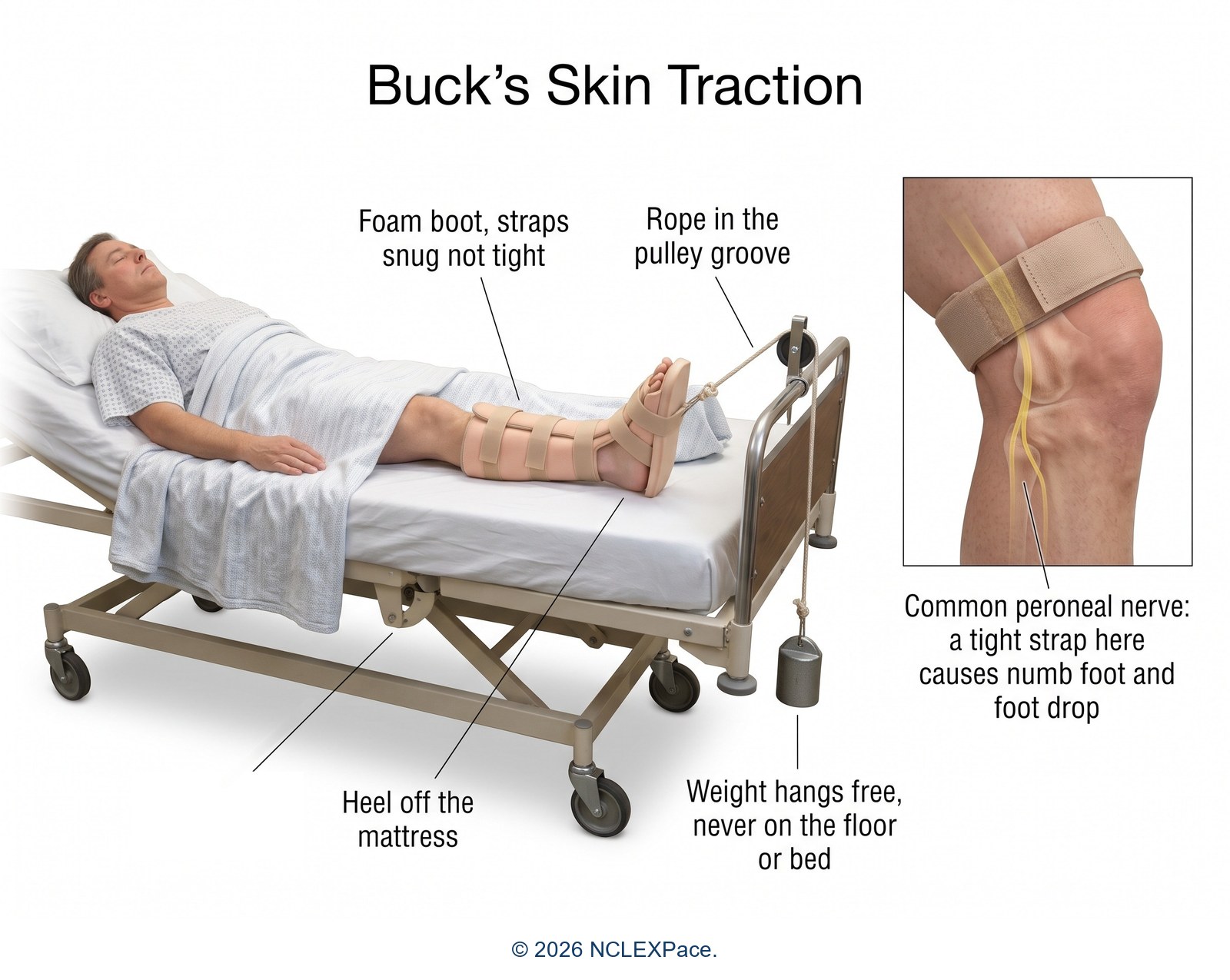
- Definition: Buck's skin traction applies a continuous pulling force through a boot or skin wrap to reduce muscle spasm and maintain fracture alignment before surgery.
- Complications: Excessive pressure from tight straps or wraps impairs distal circulation and compresses peripheral nerves, including the common peroneal nerve.
- Signs: Dusky or pale toes, cool skin, delayed capillary refill, paresthesia, weakness, and impaired foot dorsiflexion indicate neurovascular compromise.
Nursing key points
- Compare both feet for color, temperature, capillary refill under 3 seconds, and pedal pulses.
- Assess sensation, toe movement, ankle dorsiflexion, edema, and pain.
- Report new discoloration, coolness, delayed refill, paresthesia, or weakness immediately.
- Inspect traction straps and pressure areas without interrupting prescribed traction.
- Keep traction weights hanging freely and maintain prescribed limb alignment.
Answer analysis
| Finding | Rationale |
|---|---|
| The toes of the affected foot are dusky and cool | Correct. Discoloration and coolness indicate impaired distal perfusion. Immediate neurovascular reassessment and provider notification are required. |
| The foot rests in the boot in a neutral position | Not correct. This describes appropriate positioning without evidence of neurovascular compromise. |
| Redness and drainage develop around a pin site | Not correct. Buck's skin traction does not use skeletal pins. |
| Muscle spasms have decreased since traction began | Not correct. Reduced muscle spasm is an intended effect of traction. |
A client has been in skeletal traction for a fractured femur for 10 days. For which complications is the client at increased risk? Select all that apply.
- A. Pressure injury of the sacrum and heels
- B. Deep vein thrombosis
- C. Constipation
- D. Fluid volume overload
- E. Osteomyelitis at the pin sites
- F. Atelectasis and pneumonia
Show the correct answer and rationale
Correct answers:
- A. Pressure injury of the sacrum and heels
- B. Deep vein thrombosis
- C. Constipation
- E. Osteomyelitis at the pin sites
- F. Atelectasis and pneumonia
Rationale
Overview
- Definition: Prolonged skeletal traction restricts mobility while maintaining fracture alignment. Immobility increases pressure injury, pulmonary, thrombotic, and gastrointestinal complications. Skeletal pins introduce a route for infection into bone.
- Signs and symptoms: Complications include nonblanching skin changes, reduced lung expansion, dependent edema, calf swelling, decreased bowel movements, and infected pin sites.
- Prevention: Pressure redistribution, pulmonary hygiene, anticoagulant prophylaxis, bowel management, and pin-site care reduce these risks.
Nursing key points
- Inspect and offload the sacrum and heels while maintaining traction alignment.
- Encourage coughing, deep breathing, and incentive spirometry as prescribed.
- Administer prescribed anticoagulant prophylaxis and monitor for new unilateral calf swelling or pain.
- Record bowel movements and provide the prescribed bowel regimen.
- Perform prescribed pin-site care and report fever, purulent drainage, or increasing pin-site pain.
Answer analysis
| Potential complication | Rationale |
|---|---|
| Pressure injury of the sacrum and heels | Include. Sustained pressure and limited repositioning reduce tissue perfusion. |
| Deep vein thrombosis | Include. Immobilization produces venous stasis, and tissue injury increases thrombosis risk. |
| Constipation | Include. Reduced activity and opioid analgesics decrease bowel motility. |
| Fluid volume overload | Do not include. Skeletal traction does not independently cause fluid volume overload. |
| Osteomyelitis at the pin sites | Include. Infection can spread along the pin tract into bone. |
| Atelectasis and pneumonia | Include. Reduced lung expansion and secretion retention increase pulmonary complications. |
The NCLEXPace bank has 3,200+ NCLEX questions with full rationales, sorted by topic, with your progress tracked as you practice. Create your account to start.
Create Account →More topics in Medical-Surgical
Lyme Disease NCLEX Questions With RationalesCovers Lyme disease stages, clinical manifestations, doxycycline treatment, tick removal, nursing priorities, and prevention.Influenza NCLEX Questions With RationalesReviews seasonal influenza symptoms, high-risk groups, antiviral treatment, isolation, vaccination, complications, and nursing care.Atopic Dermatitis (Eczema) NCLEX Questions With RationalesReviews childhood eczema manifestations, age-related distribution, triggers, skin care, topical medications, infection prevention, and parent education.Sources
3,200+ NCLEX questions with think-like-a-nurse rationales, unfolding case studies and adaptive readiness exams. Start with free practice questions, then choose a plan when you are ready.
Create Account →