Tracheostomy Care NCLEX Questions With Rationales
What it is
A tracheostomy is a surgical opening through the neck into the trachea that holds a tube to create an artificial airway. It is done for upper airway obstruction, prolonged mechanical ventilation, and secretion clearance in clients with neuromuscular weakness. The tube has an outer cannula, often with an inflatable cuff, a removable inner cannula, and an obturator that guides insertion. When no air flows over the vocal cords, the client cannot speak.
What the NCLEX focuses on
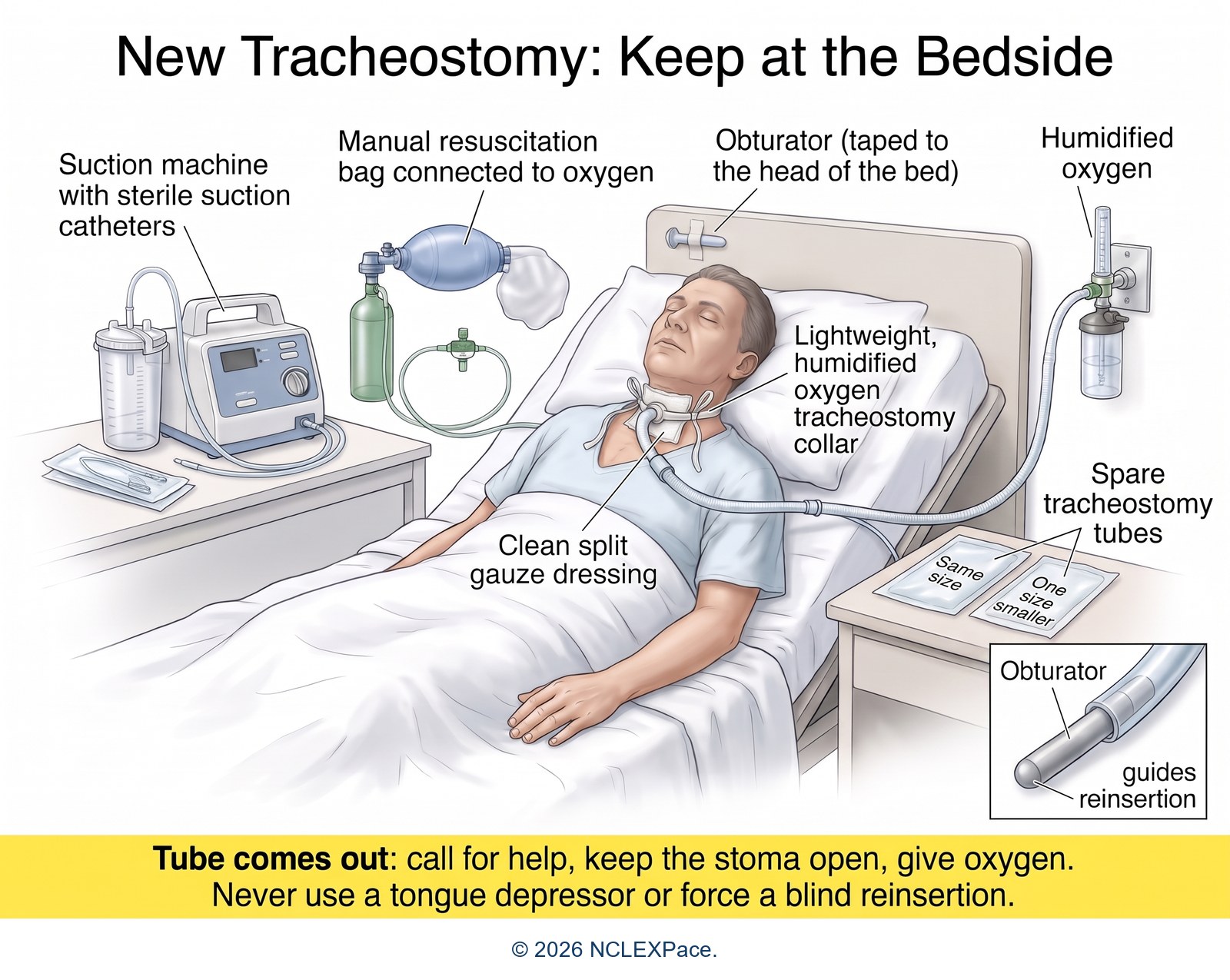
- Bedside safety equipment includes the obturator, spare tubes of the same size and one size smaller, suction equipment, a bag-valve mask and a syringe for the cuff.
- Suction only when clinically indicated, for example with visible or audible secretions, coarse or gurgling breath sounds, or respiratory distress.
- Preoxygenate before suctioning and apply suction only while withdrawing the catheter.
- Normal saline is not routinely instilled into the tube during suctioning.
- Prolonged high cuff pressure can cause tracheal ischemia, necrosis and stenosis, so cuff pressure is measured with a manometer.
- A fenestrated tube is never suctioned without first inserting a nonfenestrated inner cannula.
- Humidified gas reduces mucus plugging; tube obstruction is the leading cause of tracheostomy-related death.
Priority nursing actions
- Confirm that the bedside safety equipment is present.
- Assess breath sounds, oxygen saturation and the need for suctioning, and place the client in semi-Fowler position.
- Preoxygenate per agency policy, suction on withdrawal for no more than 15 seconds, and let the client recover between passes.
- Clean or replace the inner cannula before changing the dressing, then clean and dry the stoma and apply a manufactured split dressing.
- Change ties with a second person holding the tube, or secure the new ties before removing the old ones; one finger should fit under the tie.
- If the tube comes out, call for help, keep the client oxygenated with a mask over the stoma and over the nose and mouth, and have the obturator and spare tubes ready for reinsertion.
Numbers to know
| Value | Number | Why it matters |
|---|---|---|
| Suction time per pass | 10 to 15 seconds | Limits hypoxia and tissue trauma |
| Preoxygenation | 100% oxygen for 30 to 60 seconds | Helps prevent hypoxemia and dysrhythmias |
| Recovery between passes | 30 to 60 seconds | Allows reoxygenation |
| Adult suction pressure | 100 to 150 mm Hg | Higher pressure causes trauma, hypoxemia and atelectasis |
| Cuff pressure | 20 to 30 cm H2O | Seals the airway while limiting tracheal injury |
| Inner cannula cleaning | At least every 12 to 24 hours | Prevents tube obstruction |
| First tube change | Not sooner than 5 to 7 days | An immature tract raises the risk of a false passage |
Common exam traps
- Choosing to suction every 2 hours on a schedule: wrong because suctioning is done only when assessment shows a need.
- Choosing to instill normal saline to loosen secretions: wrong because saline use during suctioning should generally be avoided.
- Choosing to remove the old ties first when working alone: wrong because the tube can be dislodged.
- Choosing to continue suctioning when the heart rate drops: wrong because bradycardia or a dysrhythmia means the procedure is stopped.
What to teach
- Keep the obturator, a spare tube and suction equipment with the client at all times.
- Communicate with writing, a whiteboard or an electronic device.
- Report trouble breathing, or redness, drainage, odor or skin breakdown at the stoma.
2 NCLEX questions with rationales on this topic
From the NCLEXPace question bank. Choose your answer first, then open the correct answer and the full rationale under each question.
A client with a tracheostomy created 3 weeks ago accidentally coughs out the tube. The client is awake, breathing through the mature stoma, and has an SpO₂ of 90%. Which actions should a nurse trained in tracheostomy replacement take?
Select all that apply.
- A. Apply oxygen over the stoma while preparing the bedside replacement equipment
- B. Cover the stoma tightly and provide oxygen only through the nose and mouth
- C. Remove the obturator promptly, secure the tube, and reassess airflow, breath sounds, and SpO₂
- D. Stay with the client, call for assistance, and assess breathing and oxygenation
- E. Force the original tube through resistance to prevent the stoma from narrowing
- F. Insert the prescribed same-size replacement tube with the obturator; use one size smaller if the same size will not pass easily
Show the correct answer and rationale
Correct answers:
- A. Apply oxygen over the stoma while preparing the bedside replacement equipment
- C. Remove the obturator promptly, secure the tube, and reassess airflow, breath sounds, and SpO₂
- D. Stay with the client, call for assistance, and assess breathing and oxygenation
- F. Insert the prescribed same-size replacement tube with the obturator; use one size smaller if the same size will not pass easily
Rationale
Overview
- Definition: Accidental tracheostomy decannulation is unplanned displacement or removal of the tracheostomy tube. Loss of the airway requires immediate assessment and intervention.
- Mature vs new stoma: A tracheostomy created 3 weeks ago has an established tract. A newly created tract has greater risk of false passage during reinsertion and requires specialist airway management.
- Steps: Assess breathing, call for assistance, provide oxygen over the functioning stoma, and prepare the replacement tube. A trained nurse gently inserts the tube with an obturator according to protocol and removes the obturator immediately to restore airflow.
Nursing key points
- Stay with the client and activate emergency assistance.
- Deliver oxygen over the functioning stoma while preparing replacement equipment.
- A trained nurse gently replaces the tube according to policy; never force insertion.
- Remove the obturator immediately after insertion because it obstructs airflow.
- Reassess chest rise, breath sounds, SpO₂, and available capnography. Escalate failed replacement immediately.
Answer analysis
| Nursing action | Rationale |
|---|---|
| Apply oxygen over the stoma while preparing the bedside replacement equipment | Include. The stoma is the client's functioning airway and requires oxygen. |
| Cover the stoma tightly and provide oxygen only through the nose and mouth | Do not include. Tight stoma occlusion obstructs the client's functioning airway. |
| Remove the obturator promptly, secure the tube, and reassess airflow, breath sounds, and SpO₂ | Include. Obturator removal restores airflow, and reassessment verifies ventilation. |
| Stay with the client, call for assistance, and assess breathing and oxygenation | Include. Immediate assessment and assistance protect airway safety. |
| Force the original tube through resistance to prevent the stoma from narrowing | Do not include. Forced insertion risks tissue injury and false passage. |
| Insert the prescribed same-size replacement tube with the obturator; use one size smaller if the same size will not pass easily | Include. Gentle replacement through the established tract restores airway access. |
| Appropriate at bedside | Not appropriate | |
|---|---|---|
| Suction equipment | ||
| Tongue depressor for blind reinsertion of the tube | ||
| Replacement tracheostomy tubes of the same size and one size smaller | ||
| Manual resuscitation bag connected to oxygen | ||
| Chest-drainage system for routine use | ||
| Obturator |
Show the correct answer and rationale
Correct answers:
- Suction equipment: Appropriate at bedside
- Tongue depressor for blind reinsertion of the tube: Not appropriate
- Replacement tracheostomy tubes of the same size and one size smaller: Appropriate at bedside
- Manual resuscitation bag connected to oxygen: Appropriate at bedside
- Chest-drainage system for routine use: Not appropriate
- Obturator: Appropriate at bedside
Rationale
Overview
- Definition: A newly created tracheostomy provides an artificial airway through the anterior neck. Before the tract matures, obstruction and accidental decannulation create immediate airway emergencies.
- Emergency readiness: Keep suction equipment, two replacement tracheostomy tubes (the same size and one size smaller), the correct obturator, and a manual resuscitation bag connected to oxygen at the bedside.
Nursing key points
- Check suction equipment, oxygen connections, and manual resuscitation equipment for immediate readiness.
- Keep replacement tubes of the same size and one size smaller with the correct obturator.
- For accidental decannulation during the first 7 days, call for emergency airway assistance immediately.
- Follow the emergency tracheostomy protocol. Reinsertion with an obturator requires appropriate expertise; avoid blind reinsertion into an immature tract.
- Support oxygenation and ventilation during emergency airway management. Remove the obturator immediately after successful insertion to establish airflow.
Answer analysis
| Bedside item | Appropriate at bedside or not appropriate? | Why |
|---|---|---|
| Suction equipment | Appropriate at bedside. | Suction removes secretions that obstruct the tracheostomy tube. |
| Tongue depressor for blind reinsertion of the tube | Not appropriate. | Blind reinsertion risks creating a false passage in an immature tract. |
| Replacement tracheostomy tubes of the same size and one size smaller | Appropriate at bedside. | Replacement tubes support emergency airway restoration by trained personnel. |
| Manual resuscitation bag connected to oxygen | Appropriate at bedside. | This equipment supports emergency assisted ventilation. |
| Chest-drainage system for routine use | Not appropriate. | Chest drainage is not routine tracheostomy emergency equipment. |
| Obturator | Appropriate at bedside. | The obturator guides tube insertion and is removed immediately afterward. |
The NCLEXPace bank has 3,200+ NCLEX questions with full rationales, sorted by topic, with your progress tracked as you practice. Create your account to start.
Create Account →More topics in Medical-Surgical
Lyme Disease NCLEX Questions With RationalesCovers Lyme disease stages, clinical manifestations, doxycycline treatment, tick removal, nursing priorities, and prevention.Influenza NCLEX Questions With RationalesReviews seasonal influenza symptoms, high-risk groups, antiviral treatment, isolation, vaccination, complications, and nursing care.Atopic Dermatitis (Eczema) NCLEX Questions With RationalesReviews childhood eczema manifestations, age-related distribution, triggers, skin care, topical medications, infection prevention, and parent education.Sources
- Open RN (NCBI Bookshelf). Nursing Skills, Chapter 22: Tracheostomy Care and Suctioning.
- American Association for Respiratory Care. AARC Clinical Practice Guidelines: Artificial Airway Suctioning. Respiratory Care. 2022.
- StatPearls (NCBI Bookshelf). Tracheostomy, last update 2025; Tracheostomy Tube Change, last update 2024.
- Merck Manual Professional Edition. Tracheal Intubation. 2026.
3,200+ NCLEX questions with think-like-a-nurse rationales, unfolding case studies and adaptive readiness exams. Start with free practice questions, then choose a plan when you are ready.
Create Account →