Thyroidectomy NCLEX Questions With Rationales
What it is
Thyroidectomy is the surgical removal of part or all of the thyroid gland, commonly performed to treat thyroid cancer, large goiters, or hyperthyroidism. Total thyroidectomy requires lifelong thyroid hormone replacement, while postoperative priorities include maintaining airway patency, detecting hemorrhage, and identifying hypocalcemia caused by parathyroid injury.
What the NCLEX focuses on
- Preoperative preparation: Clients with hyperthyroidism should be rendered euthyroid before elective surgery using prescribed antithyroid medications and other appropriate treatment to reduce the risk of perioperative thyroid storm.
- Potassium iodide: Lugol solution or saturated solution of potassium iodide (SSKI) may be prescribed before surgery for Graves disease to reduce thyroid gland vascularity and intraoperative blood loss.
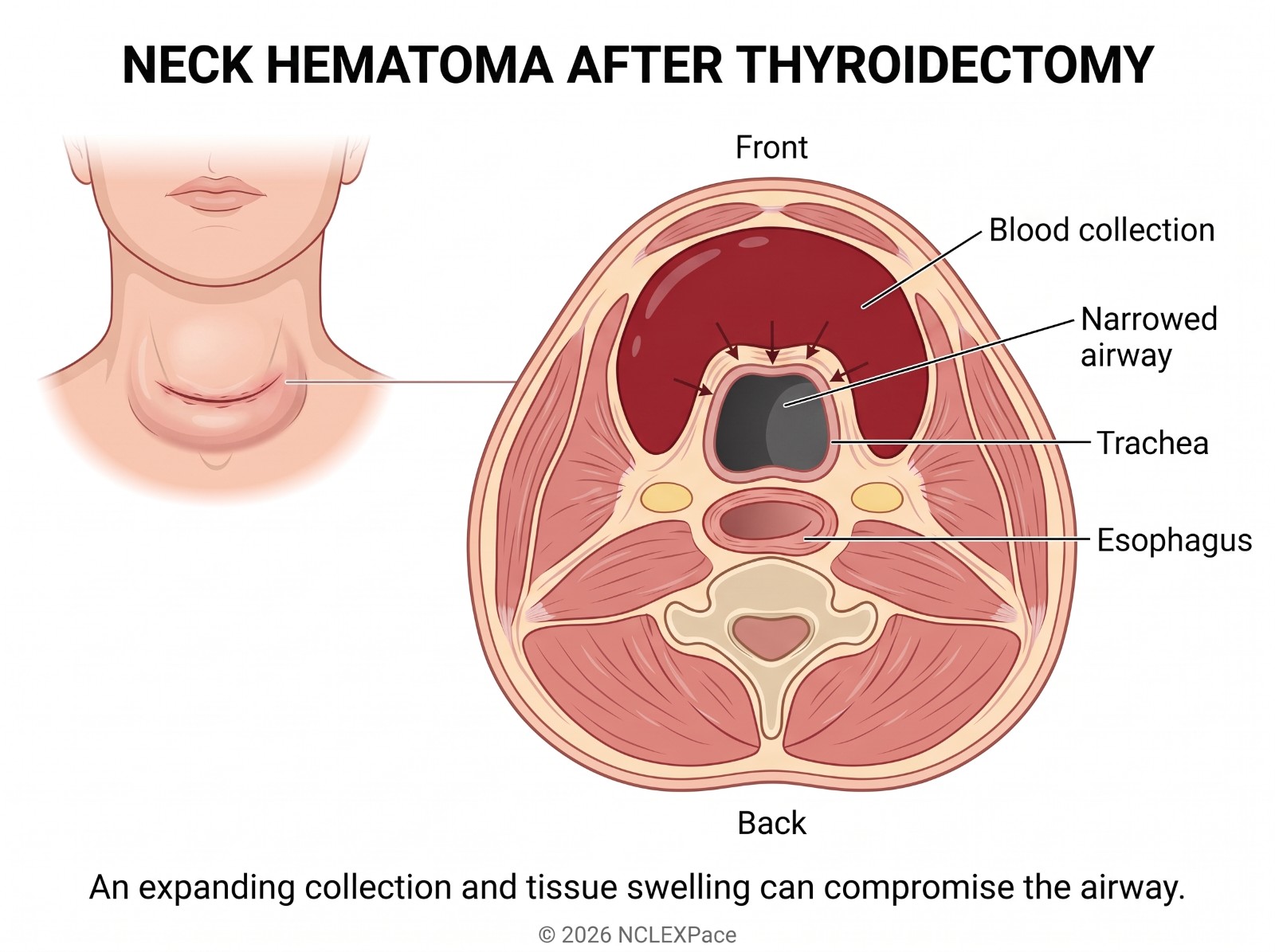
- Airway compromise: Neck swelling, expanding hematoma, stridor, respiratory distress, and severe hoarseness may indicate airway obstruction or recurrent laryngeal nerve injury. Airway assessment is the first postoperative priority.
- Hemorrhage: Bleeding may collect beneath the incision or extend posteriorly toward the back of the neck. Assess the anterior and posterior neck for swelling, bruising, drainage, and increasing tightness.
- Hypocalcemia: Accidental removal or injury to the parathyroid glands can reduce parathyroid hormone and serum calcium. Early symptoms include perioral tingling, finger numbness, muscle cramps, and increased neuromuscular excitability.
- Chvostek and Trousseau signs: Chvostek sign is facial muscle twitching after tapping the facial nerve. Trousseau sign is carpal spasm after inflation of a blood pressure cuff. Both may indicate hypocalcemia.
- Severe hypocalcemia: Tetany, laryngospasm, seizures, and cardiac dysrhythmias may occur. Prescribed IV calcium gluconate must be available for severe symptomatic hypocalcemia.
- Thyroid storm: This life-threatening complication involves excessive thyroid hormone effects, causing high fever, severe tachycardia, hypertension, agitation, vomiting, and possible cardiovascular collapse.
- Voice changes: Assess the client's voice after surgery. Persistent hoarseness, weak voice, difficulty speaking, or stridor requires prompt evaluation for possible laryngeal nerve injury.
Priority nursing actions
- Assess airway patency, respiratory effort, oxygen saturation, and neck swelling immediately after surgery. Keep oxygen, suction, and emergency airway equipment, including a tracheostomy tray, available at the bedside.
- Assess for hemorrhage by inspecting the incision, surrounding neck, and posterior neck. Report increasing swelling, tightness, drainage, or signs of circulatory instability immediately.
- Monitor for hypocalcemia through assessment of perioral tingling, numbness, muscle cramps, Chvostek sign, and Trousseau sign. Monitor calcium levels and administer prescribed calcium replacement.
- Position the client in semi-Fowler position with the head and neck supported. Avoid excessive neck extension or sudden movements that place tension on the incision.
- Assess voice quality, swallowing, temperature, heart rate, and other signs of thyroid storm or nerve injury.
- Administer prescribed levothyroxine after total thyroidectomy and provide discharge instructions concerning medication adherence, calcium monitoring, and emergency symptoms.
Common exam traps
- Choosing to assess pain before airway patency: wrong because airway obstruction from hematoma or swelling can rapidly become life-threatening.
- Choosing to ignore tingling around the mouth: wrong because it may be an early manifestation of postoperative hypocalcemia.
- Choosing to position the head with the neck extended: wrong because excessive extension places tension on the surgical incision.
- Choosing to assume hoarseness is always an expected effect of intubation: wrong because it may indicate laryngeal nerve injury or airway compromise.
- Choosing to discontinue thyroid replacement after total thyroidectomy: wrong because the body can no longer produce sufficient thyroid hormone.
What to teach
- Take prescribed levothyroxine consistently, preferably on an empty stomach, and separate calcium supplements and iron from levothyroxine according to medication instructions.
- Report difficulty breathing, rapidly increasing neck swelling, severe hoarseness, or difficulty swallowing immediately.
- Report perioral tingling, finger numbness, muscle cramps, and spasms because these may indicate low calcium.
- Support the neck when changing positions and avoid strenuous activities until cleared by the surgeon.
- Attend follow-up appointments for thyroid hormone and calcium monitoring, and understand that lifelong hormone replacement is necessary after total thyroidectomy.
2 NCLEX questions with rationales on this topic
From the NCLEXPace question bank. Choose your answer first, then open the correct answer and the full rationale under each question.
Eighteen hours after total thyroidectomy, a client reports numbness and tingling around the lips and cramping in both hands. The nurse notes a carpal spasm when the blood pressure cuff inflates. Which action should the nurse take first?
Select the best answer.
- A. Reassure the client that temporary nerve compression from operative positioning commonly causes bilateral hand cramping and facial tingling
- B. Notify the provider and prepare intravenous calcium gluconate per protocol
- C. Apply warm compresses to both hands, encourage relaxation, and reassess whether the carpal spasms resolve within 30 minutes
- D. Perform gentle passive range-of-motion exercises to reduce muscle spasm and restore circulation to the hands
Show the correct answer and rationale
Correct answer:
- B. Notify the provider and prepare intravenous calcium gluconate per protocol
Rationale
Overview
- Definition: Post-thyroidectomy hypocalcemia results from impaired parathyroid hormone secretion following parathyroid injury, devascularization, or removal. Reduced serum ionized calcium increases neuromuscular excitability.
- Signs: Perioral paresthesia, muscle cramps, carpopedal spasm, positive Trousseau sign, tetany, and prolonged QT interval indicate symptomatic hypocalcemia.
- Treatment: Prompt calcium assessment and prescribed intravenous calcium gluconate treat significant symptomatic hypocalcemia. Severe complications include laryngospasm, seizures, and dysrhythmias.
Nursing key points
- Assess respiratory effort, voice changes, stridor, and muscle spasms immediately.
- Notify the provider promptly and prepare prescribed intravenous calcium gluconate.
- Obtain ionized calcium, total calcium, and magnesium measurements as ordered.
- Administer intravenous calcium slowly through a patent line with cardiac monitoring.
- Monitor the electrocardiogram for QT prolongation and dysrhythmias.
- Maintain emergency airway and seizure precautions for severe symptomatic hypocalcemia.
Answer analysis
| Nursing action | Rationale |
|---|---|
| Reassure the client that temporary nerve compression from operative positioning commonly causes bilateral hand cramping and facial tingling | Not correct. Perioral paresthesia and Trousseau sign after thyroidectomy indicate symptomatic hypocalcemia requiring urgent assessment. |
| Notify the provider and prepare intravenous calcium gluconate per protocol | Correct. Symptomatic hypocalcemia requires prompt calcium replacement to prevent tetany, laryngospasm, and cardiac complications. |
| Apply warm compresses to both hands, encourage relaxation, and reassess whether the carpal spasms resolve within 30 minutes | Not correct. Comfort measures do not correct the calcium deficit. Delaying treatment increases complication risk. |
| Perform gentle passive range-of-motion exercises to reduce muscle spasm and restore circulation to the hands | Not correct. Hypocalcemic muscle spasms result from neuromuscular excitability rather than impaired peripheral circulation. |
The nurse receives a client from the recovery unit after total thyroidectomy. Which assessments and preparations should the nurse include during the first 24 hours? Select all that apply.
- A. Check behind the neck and shoulders for pooling blood
- B. Keep the client flat with a small pillow under the shoulders
- C. Ask the client to speak aloud at regular intervals
- D. Assess for tingling around the mouth or in the fingertips
- E. Encourage full range-of-motion neck exercises every 2 hours
- F. Confirm a tracheostomy tray and calcium gluconate are available
Show the correct answer and rationale
Correct answers:
- A. Check behind the neck and shoulders for pooling blood
- C. Ask the client to speak aloud at regular intervals
- D. Assess for tingling around the mouth or in the fingertips
- F. Confirm a tracheostomy tray and calcium gluconate are available
Rationale
Overview
- Definition: Total thyroidectomy is surgical removal of the entire thyroid gland.
- Complications: Postoperative hemorrhage and neck hematoma threaten airway patency. Recurrent laryngeal nerve injury affects voice and airway function. Parathyroid injury causes hypocalcemia, frequently presenting within 24 to 72 hours.
- Care: Maintain semi-Fowler's position with neck support and monitor breathing, bleeding, voice changes, and hypocalcemia.
| Complication | Sign | Action |
|---|---|---|
| Hemorrhage or neck hematoma | Neck swelling, tightness, stridor, or blood pooling | Activate emergency response and follow hematoma protocol |
| Laryngeal nerve dysfunction | New hoarseness or voice changes | Assess voice and report changes |
| Hypocalcemia | Perioral tingling, fingertip paresthesia, muscle cramps | Check prescribed calcium levels and prepare ordered IV calcium |
| Airway obstruction | Stridor, respiratory distress, reduced oxygenation | Activate airway emergency response and prepare equipment |
Nursing key points
- Monitor respiratory status, oxygen saturation, neck swelling, and stridor frequently during the first 24 hours.
- Inspect the anterior dressing and behind the neck and shoulders for bleeding.
- Assess voice quality and swallowing at regular intervals.
- Assess for perioral tingling, fingertip paresthesia, and muscle cramps during the first 24 to 72 hours.
- Maintain semi-Fowler's position with head and neck supported; avoid excessive neck extension.
- Confirm immediate access to emergency airway equipment, a tracheostomy tray, and prescribed IV calcium gluconate.
Answer analysis
| Postoperative nursing action | Rationale |
|---|---|
| Check behind the neck and shoulders for pooling blood | Include. Blood collects in dependent areas despite an apparently dry anterior dressing. |
| Keep the client flat with a small pillow under the shoulders | Do not include. Semi-Fowler's position with neck support reduces edema and incision tension. |
| Ask the client to speak aloud at regular intervals | Include. Serial voice assessment detects changes associated with laryngeal edema or recurrent laryngeal nerve dysfunction. |
| Assess for tingling around the mouth or in the fingertips | Include. Perioral and fingertip paresthesia indicate hypocalcemia associated with parathyroid dysfunction. |
| Encourage full range-of-motion neck exercises every 2 hours | Do not include. Unrestricted neck movement strains the fresh surgical incision. |
| Confirm a tracheostomy tray and calcium gluconate are available | Include. Emergency airway equipment and prescribed IV calcium support rapid treatment of serious complications. |
The NCLEXPace bank has 3,200+ NCLEX questions with full rationales, sorted by topic, with your progress tracked as you practice. Create your account to start.
Create Account →More topics in Medical-Surgical
Lyme Disease NCLEX Questions With RationalesCovers Lyme disease stages, clinical manifestations, doxycycline treatment, tick removal, nursing priorities, and prevention.Influenza NCLEX Questions With RationalesReviews seasonal influenza symptoms, high-risk groups, antiviral treatment, isolation, vaccination, complications, and nursing care.Atopic Dermatitis (Eczema) NCLEX Questions With RationalesReviews childhood eczema manifestations, age-related distribution, triggers, skin care, topical medications, infection prevention, and parent education.Sources
- National Institutes of Health, National Library of Medicine. Thyroidectomy. 2024.
- American Thyroid Association. Thyroid Surgery. 2024.
3,200+ NCLEX questions with think-like-a-nurse rationales, unfolding case studies and adaptive readiness exams. Start with free practice questions, then choose a plan when you are ready.
Create Account →