Suctioning NCLEX Questions With Rationales
What it is
Suctioning is a nursing procedure used to remove accumulated secretions, blood, vomitus, and other material from the airway when a client cannot clear them independently. The purpose is to maintain airway patency, improve ventilation, and support adequate oxygenation. Suctioning is performed only when clinical assessment indicates a need because unnecessary suctioning can cause hypoxemia, airway trauma, and cardiovascular complications.
What the NCLEX focuses on
- Indications: Assess for visible secretions, coarse or gurgling breath sounds, ineffective cough, increased work of breathing, decreased oxygen saturation, and suspected aspiration before suctioning.
- Oropharyngeal suctioning: A rigid Yankauer catheter removes secretions from the mouth and oropharynx when the client cannot clear them independently.
- Nasopharyngeal suctioning: A soft, flexible catheter passes through the nostril into the nasopharynx to remove secretions that cannot be cleared orally.
- Nasotracheal suctioning: A sterile flexible catheter is advanced through the nose into the trachea when the client cannot clear lower airway secretions and does not have an artificial airway.
- Endotracheal and tracheostomy suctioning: A catheter is introduced through the artificial airway to remove tracheal secretions while maintaining airway patency.
- Use sterile technique for open suctioning of artificial airways, and maintain aseptic technique during invasive suction procedures.
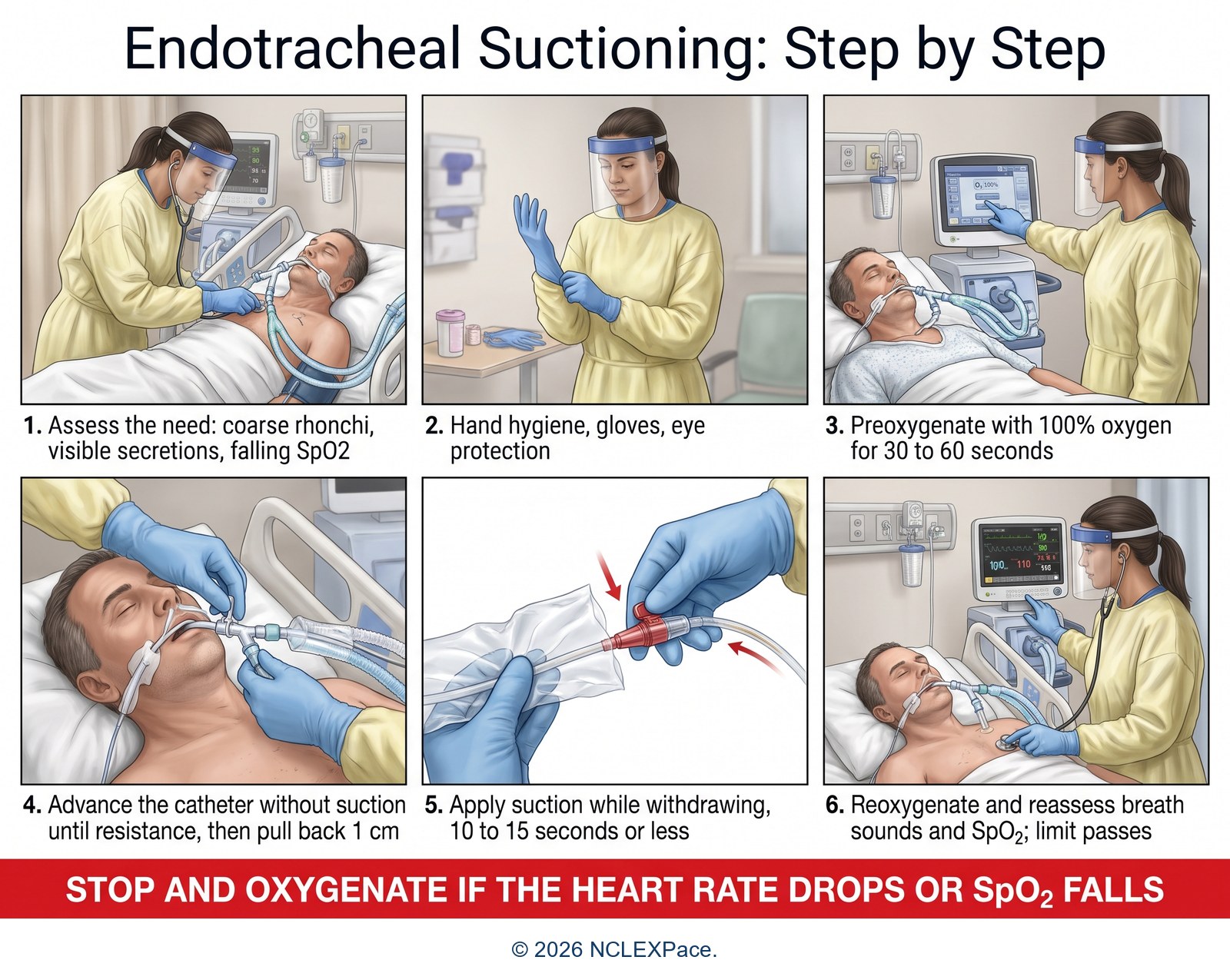
- Preoxygenate clients before artificial airway suctioning as appropriate, and allow oxygenation and recovery between passes and after the procedure.
- Apply suction only while withdrawing the catheter, using a gentle rotating motion when appropriate, to minimize mucosal trauma.
- Use a suction catheter that occupies less than 50% of the endotracheal tube lumen in pediatric and adult clients and less than 70% in neonates.
- Closed in-line suction allows removal of secretions through a catheter enclosed within the ventilator circuit, reducing the need to disconnect the ventilator.
- Routine normal saline instillation into an artificial airway is generally avoided because it can worsen oxygenation and does not provide established routine benefit.
Priority nursing actions
- Assess airway patency, respiratory rate, breath sounds, oxygen saturation, cough effectiveness, secretion characteristics, and the client's tolerance of the procedure.
- Explain the procedure, position the client appropriately, prepare suction equipment, and perform hand hygiene and required protective precautions.
- Preoxygenate when indicated, particularly before artificial airway suctioning, and monitor oxygen saturation and heart rate throughout the procedure.
- Insert the catheter without applying suction, following the appropriate anatomical route and avoiding unnecessary deep insertion.
- Apply suction intermittently while withdrawing the catheter, limiting each suctioning event to 15 seconds or less.
- Allow recovery and reoxygenation between passes, reassess respiratory status, and document the procedure, secretions, and client response.
Numbers to know
| Value | Number | Why it matters |
|---|---|---|
| Adult oropharyngeal and nasopharyngeal suction pressure | 100 to 150 mm Hg | Commonly cited nursing reference range; follow equipment and facility guidance. |
| Adult artificial airway catheter size | Less than 50% of tube lumen | Reduces airway obstruction and oxygen loss during suctioning. |
| Neonatal catheter size | Less than 70% of tube lumen | Recommended catheter-to-airway size limitation. |
| Maximum suctioning event duration | 15 seconds | Limits hypoxemia and other complications. |
| Adult artificial airway suction pressure | Below 200 mm Hg | AARC recommendation; use the lowest effective pressure. |
Common exam traps
- Choosing scheduled suctioning regardless of assessment: wrong because suctioning should be performed when clinically indicated.
- Choosing to apply suction while inserting the catheter: wrong because suction is applied during withdrawal to reduce mucosal trauma and oxygen loss.
- Choosing routine saline instillation before suctioning: wrong because routine saline instillation is generally not recommended.
- Choosing to continue suctioning when bradycardia develops: wrong because vagal stimulation can cause bradycardia, so the nurse stops suctioning at once, gives oxygen, and reassesses.
- Choosing to use clean technique for open endotracheal suctioning: wrong because sterile technique is recommended for open suctioning of artificial airways.
What to teach
- Explain that suctioning is performed when secretions interfere with breathing or cannot be cleared by coughing.
- Teach clients with artificial airways to communicate discomfort, difficulty breathing, or a sensation of retained secretions.
- Encourage effective coughing, deep breathing, hydration when permitted, and prescribed respiratory therapies to support secretion clearance.
- Teach caregivers to recognize increased work of breathing, cyanosis, noisy respirations, and ineffective coughing.
- Explain the importance of maintaining prescribed oxygen delivery and following instructions for home suction equipment.
2 NCLEX questions with rationales on this topic
From the NCLEXPace question bank. Choose your answer first, then open the correct answer and the full rationale under each question.
Which finding best indicates that an intubated client requires endotracheal suctioning now?
Select the best answer.
- A. Coarse rhonchi, visible secretions in the tube, and decreasing SpO₂
- B. Visible secretions are present in the tube, but SpO2 remains stable.
- C. Rhonchi are heard after repositioning, but SpO2 and ventilator pressures are stable.
- D. A ventilator high-pressure alarm without breath-sound changes or visible secretions
Show the correct answer and rationale
Correct answer:
- A. Coarse rhonchi, visible secretions in the tube, and decreasing SpO₂
Rationale
Overview
- Definition: Endotracheal suctioning removes retained secretions from an artificial airway to maintain airway patency and effective gas exchange.
- Indications: Coarse rhonchi, visible retained secretions, decreasing SpO2, and increased airway pressures indicate secretion accumulation requiring assessment-based suctioning.
- Safe suctioning: Preoxygenate before suctioning, limit each suction pass to less than 15 seconds, and use an appropriate adult suction pressure of 80 to 120 mm Hg according to protocol.
Nursing key points
- Assess breath sounds, respiratory effort, SpO2, visible secretions, and ventilator pressures.
- Recognize coarse rhonchi with visible retained secretions and falling SpO2 as an immediate suctioning indication.
- Preoxygenate according to protocol and maintain adult suction pressure at 80 to 120 mm Hg.
- Limit each suction pass to less than 15 seconds and monitor oxygen saturation and heart rhythm.
- Stop suctioning for significant deterioration and reassess breath sounds, oxygenation, and ventilator pressures afterward.
Answer analysis
| Assessment finding | Rationale |
|---|---|
| Coarse rhonchi, visible secretions in the tube, and decreasing SpO₂ | Correct. Combined evidence of retained secretions and worsening oxygenation indicates an immediate need for endotracheal suctioning. |
| Visible secretions are present in the tube, but SpO2 remains stable. | Not correct. Visible secretions require assessment, but stable oxygenation without additional obstruction findings does not establish the strongest immediate indication. |
| Rhonchi are heard after repositioning, but SpO2 and ventilator pressures are stable. | Not correct. Rhonchi require assessment, but stable oxygenation and ventilator pressures indicate less immediate concern than worsening oxygenation with retained secretions. |
| A ventilator high-pressure alarm without breath-sound changes or visible secretions | Not correct. An isolated high-pressure alarm requires assessment for airway obstruction, circuit problems, coughing, and other causes before selecting suctioning. |
During closed endotracheal suctioning, the client's heart rate decreases from 88/min to 48/min and SpO₂ falls from 94% to 82%. What should the nurse do first?
Select the best answer.
- A. Stop suctioning and provide oxygenation with the prescribed emergency method
- B. Withdraw the catheter, reduce suction pressure, and repeat if the heart rate improves.
- C. Stop the pass, wait for SpO2 to improve, then resume suctioning without added oxygen
- D. Call respiratory therapy and keep the catheter in place until the heart rate improves
Show the correct answer and rationale
Correct answer:
- A. Stop suctioning and provide oxygenation with the prescribed emergency method
Rationale
Overview
- Definition: Endotracheal suctioning removes secretions from an artificial airway. Suctioning interrupts ventilation and stimulates airway receptors.
- Complications of suctioning: Vagal stimulation produces bradycardia. Interruption of oxygen delivery and removal of airway gas contribute to hypoxemia. Severe changes in heart rate and oxygen saturation indicate acute physiological compromise.
- Prevention: Preoxygenate as indicated, use appropriate suction pressure, limit each suction pass to less than 15 seconds, and allow recovery between passes.
| Complication | Prevention |
|---|---|
| Hypoxemia | Preoxygenate and limit suction duration |
| Vagal bradycardia | Avoid prolonged airway stimulation |
| Airway mucosal injury | Use appropriate catheter size and suction pressure |
| Atelectasis | Avoid excessive suction pressure and prolonged passes |
| Respiratory deterioration | Monitor SpO₂ and cardiac rhythm throughout suctioning |
Nursing key points
- Stop suctioning immediately and withdraw the catheter when marked bradycardia and desaturation occur.
- Restore oxygenation with 100% oxygen using the prescribed ventilator or manual ventilation method.
- Assess cardiac rhythm, pulse, respiratory effort, breath sounds, and SpO₂.
- Activate emergency assistance for persistent bradycardia, hypoxemia, or ineffective ventilation.
- Resume suctioning only after stabilization and reassessment of need.
Answer analysis
| Nursing action | Rationale |
|---|---|
| Stop suctioning and provide oxygenation with the prescribed emergency method | Correct. Stopping suction removes the vagal stimulus, and immediate oxygenation addresses hypoxemia. |
| Withdraw the catheter, reduce suction pressure, and repeat if the heart rate improves. | Not correct. Another suction pass is unsafe before complete stabilization and respiratory reassessment. |
| Stop the pass, wait for SpO2 to improve, then resume suctioning without added oxygen | Not correct. Severe desaturation requires active oxygenation rather than observation. |
| Call respiratory therapy and keep the catheter in place until the heart rate improves | Not correct. The catheter must be withdrawn immediately to stop airway stimulation. |
The NCLEXPace bank has 3,200+ NCLEX questions with full rationales, sorted by topic, with your progress tracked as you practice. Create your account to start.
Create Account →More topics in Medical-Surgical
Lyme Disease NCLEX Questions With RationalesCovers Lyme disease stages, clinical manifestations, doxycycline treatment, tick removal, nursing priorities, and prevention.Influenza NCLEX Questions With RationalesReviews seasonal influenza symptoms, high-risk groups, antiviral treatment, isolation, vaccination, complications, and nursing care.Atopic Dermatitis (Eczema) NCLEX Questions With RationalesReviews childhood eczema manifestations, age-related distribution, triggers, skin care, topical medications, infection prevention, and parent education.Sources
3,200+ NCLEX questions with think-like-a-nurse rationales, unfolding case studies and adaptive readiness exams. Start with free practice questions, then choose a plan when you are ready.
Create Account →